
TMT

Search documents
资金涌入权益市场ETF部分品种出现短线获利了结
Zhong Guo Zheng Quan Bao· 2025-08-24 20:10
Market Performance - The stock market has become increasingly active, with the Shanghai Composite Index breaking through 3800 points, driven by a positive cycle of profit accumulation and capital inflow [1] - The STAR Market AI Index surged by 16.7%, while the CSI Chip Industry Index and CSI AI Theme Index rose by 14.2% and 13.7% respectively, indicating strong performance in semiconductor and AI-related sectors [1] ETF Activity - Significant trading activity was observed in ETFs, with the total trading volume of CSI A500-related ETFs reaching 143.28 billion yuan, ranking first among all index products [2] - The trading volume of Hong Kong stock ETFs was also robust, with the E Fund CSI Hong Kong Securities Investment Theme ETF surpassing 120 billion yuan in trading volume, maintaining its position as the market leader for seven consecutive weeks [2] Fund Flows - The overall market attracted a net inflow of 24.783 billion yuan into ETFs, with notable inflows into brokerage-related ETFs, including 3.956 billion yuan into the Guotai CSI All-Share Securities Company ETF [3] - Some high-performing ETFs, such as the Huaxia STAR Market 50 ETF, experienced significant net outflows, indicating profit-taking behavior among investors [3] Sector Insights - The technology sector, particularly the semiconductor industry, has shown strong growth, with the STAR Market Chip Index rising approximately 10% in a single day [4] - The release of DeepSeek-V3.1, aimed at next-generation domestic chip design, is expected to catalyze the development of a domestic AI ecosystem [4] Future Outlook - The market is anticipated to continue receiving support from positive capital flows, with structural opportunities expected to persist due to ongoing economic recovery and policy support [5] - Investors are encouraged to focus on core growth assets, as current valuations are at historical lows, providing potential for valuation recovery [5]
知名基金经理调仓路径浮现
Zhong Guo Zheng Quan Bao· 2025-08-24 20:10
Group 1 - Notable fund managers such as Zhu Shaoxing, Ge Lan, and Xie Zhiyu have made significant adjustments to their portfolios as revealed by the recent half-year reports of listed companies [1][2] - Zhu Shaoxing's fund, the Fu Guo Tian Hui Selected Growth, has become a new top ten circulating shareholder of Guangdong Hongda, holding 15 million shares as of the end of Q2 [1] - Ge Lan's fund, the Zhong Ou Medical Health, increased its holdings in several companies including Huadong Medicine and Xinlitai during Q2 [2] Group 2 - The Fu Guo Tian Hui Selected Growth also reduced its holdings in Guocera Materials from 31 million shares at the end of Q4 last year to 22 million shares at the end of Q2 [2] - Xie Zhiyu's fund, the Xing Quan He Run LOF, became a new top ten circulating shareholder of Jixiang Airlines, holding 18.79 million shares as of the end of Q2 [3] - The market is expected to maintain a trend of steady upward movement, with a focus on quality technology assets [4] Group 3 - The market style is anticipated to shift from small-cap themes to large-cap growth in the second half of the year, with a focus on sectors such as AI, non-bank financials, and independent industries with cyclical growth [4][5] - The semiconductor sector is highlighted as a key growth area driven by AI, with opportunities in analog chips and related fields [5] - The innovative pharmaceutical sector remains a significant focus for fund managers, with expectations of substantial market value growth driven by efficient R&D and clinical practices [5]
行业研究框架培训 - A股二十年复盘
2025-08-24 14:47
Summary of Key Points from Conference Call Records Industry Overview - The A-share market reflects expectations rather than current value, necessitating attention to the mismatch between investment duration and performance realization duration [1][4][11] - Different sectors have varying requirements; for example, cyclical sectors require supply-demand inflection point assessments, while technology sectors need to grasp industry trends [1][5] Core Insights and Arguments - The investment opportunity in the basic chemical sector should consider macroeconomic conditions, liquidity, fundamentals, and valuation [1][11] - Historical bull markets were driven by favorable macroeconomic conditions, significant industry trends (e.g., TMT, new energy), stable market sentiment, and rising risk appetite [1][13] - Key indicators for predicting inflection points in the basic chemical industry include liquidity (M1 minus PPI), valuation (PB percentile), stock-bond yield ratio, and market sentiment (turnover rate) [1][16][19] Investment Strategy - The "Three Good Companies" standard (good industry, good company, good price) should guide company selection, emphasizing the importance of management [1][9] - In the current macroeconomic environment, the basic chemical sector presents investment opportunities when macroeconomic conditions are improving, liquidity is loose, fundamentals are rising, and valuations are low [11][12] - Specific stocks with potential for significant growth include Wanhua Chemical, which operates in a favorable competitive landscape with high barriers to entry [12] Historical Analysis and Lessons - Historical reviews of bull markets reveal that they often occur during periods of sustained macroeconomic improvement and are influenced by major industry trends [13] - The basic chemical sector has seen notable bull stocks during specific periods, driven by rapid demand growth or supply-side contractions [14][15] Forward-Looking Indicators - Effective forward-looking indicators for the chemical sector include liquidity metrics, valuation benchmarks (especially PB percentiles), and market sentiment indicators [19][20] - The impact of rising oil prices on the chemical sector varies; initial price increases can benefit certain sub-sectors, while later stages may face cost transmission challenges [36][37] Policy and Planning - Policies significantly influence market expectations and industry trends, with five-year plans serving as strategic frameworks to guide market direction [21][34] - The five-year planning process involves three stages: basic research, outline development, and draft formulation, focusing on themes like expanding domestic demand and optimizing industrial structure [22][23][24] Conclusion - The current investment landscape in the basic chemical sector is shaped by macroeconomic trends, liquidity conditions, and strategic policy directions, with specific stocks and indicators providing actionable insights for investors [11][12][39]
中信建投:科创引领加速上涨 关注新赛道轮动
Zhi Tong Cai Jing· 2025-08-24 10:59
Core Viewpoint - Market sentiment is heating up, with some indicators reaching high levels, suggesting potential risks if the slow bull market accelerates towards a peak [1][2] Market Sentiment and Indicators - The investor sentiment index broke above 90, entering an exuberant zone, with the index nearing 95, indicating an accelerated upward trend [2] - Some indicators, such as the MA5 turnover rate exceeding 2% warning line and overbought/oversold indicators approaching 20%, suggest short-term overheating [2] - Financing buy-in ratio has reached the highest level since July 2020, indicating strong market momentum despite short-term overheating signals [2] Industry Performance and Trading Structure - The TMT sector's trading volume has increased to 37%, still below the 45% historical high, indicating room for growth [3] - The relative turnover rate in the TMT sector remains moderate, suggesting no significant deterioration in market trading structure [3] Fund Flow and Investor Behavior - Margin financing has been a significant source of market liquidity, with a net inflow of approximately 330 billion since late June, and 82.8 billion in the first four trading days of the week [3] - Stock ETFs are experiencing net redemptions, indicating that retail investors have not yet fully embraced the current market rally [3] Investment Strategy - The overall market conditions do not present significant bearish signals, suggesting a continuation of the mid-term slow bull market [4] - The strategy of sector rotation remains prominent, with a focus on finding low-position new directions in thriving sectors for better short-term value [4]

让子弹飞,还是已超涨?
Guotou Securities· 2025-08-23 12:01
- The report discusses the monitoring of market adjustments using two perspectives: whether the market is in a five-wave upward trend and whether the stock-bond yield gap has reached 2 standard deviations. Currently, most broad-based indices have not triggered warning conditions[1][7] - The report introduces a timing system that evaluates market trends and potential overbought conditions using trend indicators, low-frequency thermometers, and ultra-low-frequency thermometers. These indicators suggest that the market has not yet crossed the risk threshold, but sustained upward momentum next week may trigger short-term overbought signals[7] - The report highlights the TMT sector's rising crowding level, with transaction volume accounting for approximately 34%, still below the two-year high. This indicates that the sentiment in the TMT sector has not yet reached a bubble-like state. Meanwhile, cyclical and consumer sectors are at near two-year lows in transaction volume, suggesting potential sector rotation once the market enters an overbought state[8]
科创债新规落地,科技企业融资“游戏规则”全变了?未来应如何做?
Sou Hu Cai Jing· 2025-08-23 06:06
Core Viewpoint - The article discusses the development of technology innovation bonds (科创债) in China, highlighting their policy support, financing characteristics, and the challenges they face in risk pricing and structural alignment with the needs of technology enterprises [2][9]. Group 1: Policy Support and Market Development - In May 2025, the People's Bank of China and the China Securities Regulatory Commission jointly released an announcement to upgrade the policy framework for technology innovation bonds, expanding the range of issuers and optimizing bond structures [2]. - The issuance scale of technology innovation bonds reached 348.3 billion yuan in May 2025, marking the highest monthly record since 2022 [2]. - The technology innovation bond market is evolving into a "technology board" within the bond market, facilitating deep integration between finance and technology [2][4]. Group 2: Characteristics of Technology Innovation Bonds - Technology innovation bonds are issued by enterprises in the technology sector, with funds primarily allocated for technological innovation [3]. - The market for technology innovation bonds has become more precise in terms of fund usage and issuer types, with strict requirements for funds to be used in technology innovation [5][6]. - The issuance of technology innovation bonds has diversified, expanding from local government financing platforms to include various types of technology enterprises and investment institutions [6]. Group 3: Market Dynamics and Challenges - The technology innovation bond market has seen significant growth, with issuance volumes increasing from 277.8 billion yuan in 2022 to 1217.8 billion yuan in 2024 [8]. - Despite the rapid development, challenges remain in risk pricing, term structure, and investor composition, as technology enterprises often have long cycles and high risks that do not align with the short-term nature of traditional credit bonds [9][10]. - The need for improved information disclosure and transparency in the operations and innovation progress of technology enterprises is emphasized to enhance investor confidence [10]. Group 4: Future Directions and Recommendations - To achieve high-quality development of the technology innovation bond market, there is a need for innovative product structures and credit protection mechanisms to increase risk tolerance among investors [11]. - Encouraging institutional investors to enhance their research and risk assessment capabilities is crucial for attracting long-term capital into the market [11][12]. - Continuous collaboration among regulatory bodies and market participants is essential to foster a healthy and orderly development of the technology innovation bond market [12].
牛市ETF如何布局?历次牛市最强行业盘点
Xin Lang Cai Jing· 2025-08-22 07:33
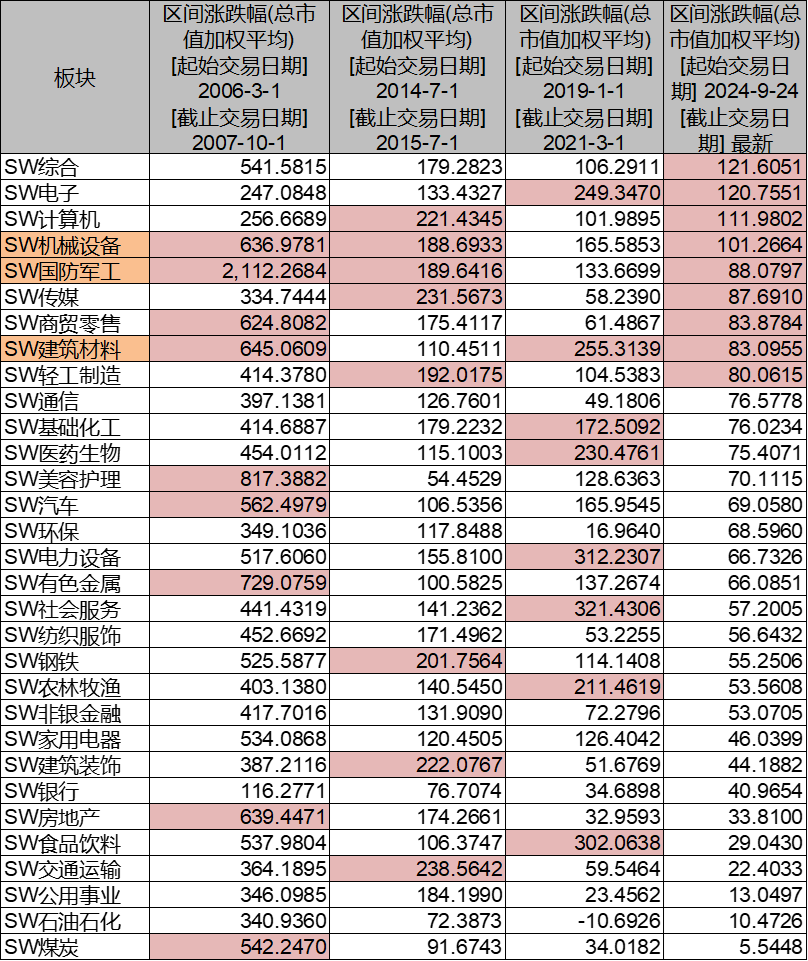
Core Viewpoint - The A-share market's bull market does not guarantee profits for all industries, as there is significant divergence in performance among sectors, with some industries outperforming the market while others lag behind [1] Historical Bull Market Analysis - Historical data from the last decade indicates that each bull market's leading sectors are closely aligned with the prevailing development trends of the era [1] - In the 2005-2006 bull market, industries such as non-ferrous metals, non-bank financials, and real estate benefited from urbanization and economic reforms [1] - The 2014-2015 bull market saw a rise in TMT sectors due to the emergence of smart manufacturing and new consumption trends, alongside a stimulus-driven infrastructure boom [1] - Post-2019, sectors like liquor and pharmaceuticals thrived due to consumption upgrades, while the "dual carbon" policy led to a surge in carbon-neutral industries [1][2] Industry Performance in Bull Markets - The analysis of the top 10 performing industries in each bull market reveals that machinery, building materials, and defense industries consistently ranked high, with significant gains even in years they did not make the top 10 [3] ETF Investment Strategies - **Machinery Sector**: The machinery sector, particularly in engineering and robotics, has maintained high performance. The Tianhong CSI Robotics ETF (159770) has a significant scale of over 7 billion, indicating strong market interest [4] - **Defense Industry**: The defense sector has shown consistent high performance across all four major bull markets from 2000 to 2021, with ETFs like Guotai CSI Defense ETF (512660) and Fuguo CSI Defense Leaders ETF (512710) exceeding 10 billion in scale [6] - **Building Materials**: The building materials sector is expected to benefit from increased demand and supply adjustments, with ETFs like Guotai CSI All-Index Building Materials ETF (159745) showing scale advantages [7]

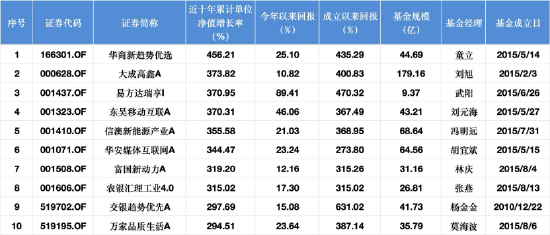
深度布局算力板块,易方达瑞享I十年回报371%!基金经理武阳:不担心“算力通缩” 二季度加仓新易盛
Xin Lang Ji Jin· 2025-08-21 10:07
在A股市场沪指创出十年新高的时刻,权益类基金再次成为投资者关注的焦点。Wind数据显示,过去十 年间(2015年8月20日至2025年8月20日),全市场1053只权益类基金(仅统计主代码)中,正收益产品 数量占据绝对主流,共有958只收益为正,占比超过90%,仅有95只收益为负,体现了主动权益基金在 长期维度上创造超额收益的能力。 | 序号 | 证券代码 | 证券简称 | 近十年累计单位 净值增长率 | 今年以来回报 | 成立以来回报 | 基金规模 | 基金经理 | 基金成立日 | | --- | --- | --- | --- | --- | --- | --- | --- | --- | | | | | (%) | (%) | (%) | ((2) | | | | 1 | 166301.OF | 华商新趋势优选 | 456.21 | 25.10 | 435.29 | 44.69 | 章文 | 2015/5/14 | | 2 | 000628.OF | 大成高鑫A | 373.82 | 10.82 | 400.83 | 179.16 | 刘旭 | 2015/2/3 | | 3 | 001437.OF | ...

董忠云:当前流动性与预期好转驱动的牛市仍较为健康
Sou Hu Cai Jing· 2025-08-19 07:04
Core Viewpoint - The consensus that the Federal Reserve may resume interest rate cuts in September and inject significant liquidity into the global market has become a central focus of the current global capital markets [2][8]. Group 1: Market Performance - Global risk appetite has been rising, with major stock markets showing an upward trend [2][9]. - The Shanghai Composite Index reached a new high, briefly surpassing 3700 points, driven by gains in the TMT sector and non-bank financials [9][27]. - A-shares are experiencing a liquidity boost, with average daily trading volume rising to the 74.80th percentile since 2015 [13][15]. Group 2: Economic Data and Trends - Recent economic data in China showed mixed results, indicating that the domestic economic fundamentals need to be solidified despite a generally improving trend [9][10]. - The "anti-involution" policy is expected to facilitate the orderly exit of outdated production capacity, addressing the current supply surplus and enhancing industrial capacity utilization [9][10]. - Short-term economic slowdown does not alter the long-term improvement trend, with A-share profitability expected to reach an inflection point [10][27]. Group 3: Leverage and Market Dynamics - Margin financing has accelerated, with the balance surpassing 2 trillion yuan, approaching levels seen during the liquidity-driven bull market of 2015 [15][18]. - The current leverage ratio is around 51% of the A-share market capitalization, indicating room for growth compared to historical peaks [15][18]. - Historical analysis shows that previous bull markets were driven by liquidity improvements before earnings began to recover, suggesting a similar pattern may emerge [18][20]. Group 4: Sector-Specific Insights - The military industry is experiencing a notable uptrend, with significant trading volumes and expectations for performance improvements as key events approach [25][26]. - The military sector's recent performance is driven by factors such as geopolitical stimuli and upcoming policy clarifications related to the 14th and 15th Five-Year Plans [25][26]. Group 5: Investment Recommendations - The anticipated interest rate cuts by the Federal Reserve are expected to release substantial liquidity globally, with sectors like artificial intelligence, brokerage firms, and innovative pharmaceuticals likely to become short-term focal points in the A-share market [27].

关注港股科技ETF(513020)投资机会,流动性改善与AI驱动下的估值修复
Mei Ri Jing Ji Xin Wen· 2025-08-19 02:32
Group 1 - The core viewpoint is that during the US interest rate cut cycle, Hong Kong stocks may exhibit better resilience than US stocks, benefiting from improved liquidity and risk appetite, with a focus on TMT, energy, and telecommunications sectors [1] - The current market is primarily characterized by stagflation trading, with a shift towards easing trading scenarios and recession trading scenarios, leading to significant gains in Hong Kong stocks, which are close to the gains seen in easing trading [1] - Before inflation concerns ease, sectors like TMT and energy in Hong Kong stocks are expected to outperform, mainly due to incremental investments from fiscal and tariff negotiations [1] Group 2 - The Hong Kong Technology ETF (513020) tracks the Hong Kong Stock Connect Technology Index (931573), focusing on technology-related Hong Kong listed companies traded through Stock Connect, covering sectors such as information technology, electronic components, and interactive media and services [1] - The index selects 30 stocks that meet the Stock Connect criteria and have high market capitalization, emphasizing the hardware and application aspects of the artificial intelligence industry chain to reflect the overall performance of AI infrastructure-related listed companies [1] - Investors without stock accounts can consider the Cathay CSI Hong Kong Stock Connect Technology ETF Initiated Link C (015740) and Initiated Link A (015739) [1]