
贵金属

Search documents
土耳其1月白银进口量创单月最高纪录
Xin Hua Cai Jing· 2026-02-13 02:24
Core Viewpoint - Turkey's physical silver demand has surged significantly due to global market fluctuations and the country's gold import restrictions, leading to record-high silver imports in January 2026 [1] Group 1: Silver Import Data - In January 2026, Turkey's silver imports reached 273,357 kilograms, marking the highest monthly import volume since records began in March 1999 [1] - This January import volume is nearly one-third of the total silver imports for the entire year of 2025, which was 860,443 kilograms [1] - The previous annual import record was set in 2023, with a total of 1,160,000 kilograms [1] Group 2: Local Factors Influencing Demand - The surge in silver imports is attributed to local factors, particularly Turkey's strict import quota system for gold, which has redirected some precious metal investment demand towards silver [1] - With international gold prices rising, silver has become a more affordable alternative for investors with limited purchasing power [1] Group 3: Global Market Dynamics - Globally, there is a significant supply-demand imbalance for silver, with physical delivery demand on the New York Commodity Exchange rising sharply, at times reaching several times the available inventory [1] - Meanwhile, global silver production is declining, while industrial demand from sectors such as photovoltaics and power electronics continues to grow, further widening the supply gap [1]
淡水泉陶冬-股-债-商品齐涨盛况-2026年能否延续
2026-02-13 02:17
Summary of Key Points from the Conference Call Industry or Company Involved - The discussion primarily revolves around the macroeconomic environment, focusing on the trends in global asset classes, particularly equities, bonds, and commodities, as well as the implications of AI technology and monetary policy. Core Insights and Arguments 1. **Asset Class Performance in 2025** - In 2025, nearly all major asset classes, except oil, experienced growth, driven by liquidity and inflation concerns. Investors shifted wealth from bank deposits to risk assets, particularly precious metals, to preserve purchasing power in a high-inflation environment [3][2][4]. 2. **Federal Reserve's Monetary Policy Outlook** - The Federal Reserve is expected to maintain a loose monetary policy in the long term to support the government's fiscal needs. In the short term, interest rates may remain unchanged due to persistent inflation and political pressures, with potential aggressive rate cuts anticipated under the new chairperson [4][5]. 3. **Challenges in the U.S. Treasury Market** - The U.S. Treasury market faces significant risks, including the normalization of quantitative easing, rising foreign bond yields, and geopolitical uncertainties. These factors have led to a reduction in allocations to U.S. dollar assets by sovereign funds, although U.S. Treasuries still hold appeal due to a lack of safer alternatives [5][4]. 4. **Precious Metals Price Trends** - Precious metals prices surged in 2025 but are currently in an overbought state, indicating potential short-term volatility. Factors such as a sudden dollar rebound or changes in Federal Reserve leadership could impact prices. Silver is particularly favored due to its industrial applications and strategic reserve demand [6][7]. 5. **Industrial Demand for Precious and Base Metals** - The industrial properties of precious and base metals are becoming increasingly important, with copper and aluminum also affected by technological advancements. The demand for these metals is expected to grow, driven by their roles in AI and energy sectors [8]. 6. **AI Technology and Investment Risks** - While the AI technology revolution is significant, investment in AI carries risks due to discrepancies between market expectations and actual developments. Financial instability among some AI companies could trigger industry-wide adjustments in 2026-2027 [9]. 7. **K-Shaped Economic Recovery** - The K-shaped recovery trend is expected to deepen, leading to political polarization. A significant portion of U.S. households is facing economic hardship, which could influence future elections and global monetary policies [10][11]. 8. **Investment Recommendations** - There is a preference for A-shares over U.S. equities, with a particular bullish outlook on silver due to its industrial demand. The bond market is viewed as problematic, and oil prices are expected to rise despite uncertainties [14]. Other Important but Potentially Overlooked Content 1. **Market Risks and Consensus** - The market faces risks from potential trading crowding, where a small trigger could lead to significant adjustments. High fiscal deficits in countries like the U.S., France, and the U.K. pose serious concerns, with the possibility of a debt crisis in France or the U.K. leading to global financial turmoil [15]. 2. **Long-term Asset Strategy** - In the current inflationary environment, holding cash in banks is deemed unwise. The focus should be on assets that can withstand economic cycles, with a shift towards technology-driven investments and away from central bank-controlled assets [12].
A股开盘:三大指数集体低开,沪指跌0.44%
Jin Rong Jie· 2026-02-13 02:12
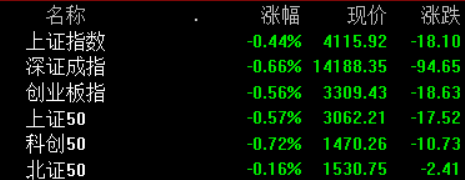
Market Overview - The Shanghai Composite Index opened down 0.44% at 4115.92 points, the Shenzhen Component Index fell 0.66% to 14188.35 points, the ChiNext Index decreased by 0.56% to 3309.43 points, and the STAR 50 Index dropped 0.72% to 1470.26 points [1] - The total trading volume in the Shanghai and Shenzhen markets was 19.977 billion yuan, with nearly 3000 stocks declining across the market [1] Sector Performance - The sectors that experienced the largest declines included energy metals, precious metals (core stocks), oil and gas, small metals, industrial metals, film (core stocks) and cinema, and communication equipment [2] - Conversely, sectors that saw gains included airport and shipping (core stocks), beverages, tourism and hotels (core stocks), liquor (core stocks), retail, and diversified finance [3] Notable Stocks - Key stocks such as Yabo Co., Ltd. opened up 2.29%, while AI application company Zhangyue Technology opened up 5.94%. However, Decai Co., Ltd. opened down 2.76% [3] - In the computing power (core stocks) leasing sector, Dwei Technology reached a bidding limit up, while YN Holdings also hit a bidding limit up [3] - Fiber optic concept stock Teifa Information opened down 2.56%, while Jinshi Technology opened up 5.31%. In the non-ferrous metals (core stocks) sector, Xianglu Tungsten Industry opened down 2.39%, and Zhangyuan Tungsten Industry opened up 3.52% [3] - Electronic cloth concept stock Honghe Technology opened up 0.08%, and Zhongcai Technology opened flat [3]
A股开盘:三大指数集体低开,沪指跌0.44%,能源金属、贵金属、油气等跌幅居前
Jin Rong Jie· 2026-02-13 01:39
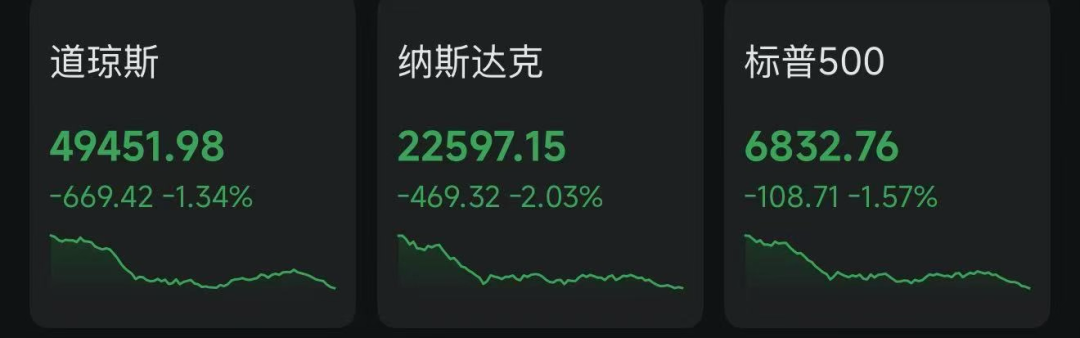
Market Overview - The Shanghai Composite Index opened down 0.44% at 4115.92 points, the Shenzhen Component Index fell 0.66% to 14188.35 points, the ChiNext Index decreased by 0.56% to 3309.43 points, and the STAR 50 Index dropped 0.72% to 1470.26 points. The total trading volume in the Shanghai and Shenzhen markets was 19.977 billion yuan, with nearly 3000 stocks declining across the market [1][2]. Sector Performance - The sectors with the largest declines included energy metals (-2.11%), precious metals (-1.85%), oil and gas extraction (-1.57%), small metals (-1.54%), industrial metals (-1.33%), film and cinema (-1.11%), and communication equipment (-0.76%) [3][4]. - Conversely, sectors that saw gains included airport and shipping (+0.50%), beverage manufacturing (+0.46%), tourism and hotels (+0.39%), liquor (+0.37%), retail (+0.32%), and diversified finance (+0.31%) [4]. Notable Stocks - Key stocks included Yabo Co., which opened up 2.29%, and AI application company Zhangyue Technology, which opened up 5.94%. Other notable movements included De Cai Co., which opened down 2.76%, and major technology rental company Dwei Technology, which hit the daily limit up [4][5]. Overnight Market Trends - The U.S. stock market saw all three major indices decline, with the Dow Jones down 1.34% to 49451.98 points, the S&P 500 down 1.57% to 6832.76 points, and the Nasdaq down 2.03% to 22597.15 points. Major tech stocks also fell, with Apple down approximately 5% and Facebook down nearly 3% [6]. Economic and Policy Updates - The People's Bank of China announced a reverse repurchase operation of 1 trillion yuan to maintain liquidity in the banking system, with a term of 182 days [7]. - The launch of the "2026 Film Economy Promotion Year" was announced by the National Film Administration, aiming to boost the film industry [8]. Analyst Insights - Huatai Securities highlighted that the demand for CPUs will surge due to the rapid development of Agentic AI, which is expected to drive a significant increase in cloud computing needs [9][10]. - Zhongtai Securities noted that the electronic fabric market is experiencing unexpected price increases due to supply tightness, suggesting a focus on leading companies with production capacity and cost advantages [11]. - CITIC Construction pointed out that the oil transportation industry is facing supply constraints, which is driving up the value of shipping stocks [12].

重估有色:产业趋势与金融属性双击
Bank of China Securities· 2026-02-13 01:37
Core Insights - The report highlights that the non-ferrous metal industry is expected to experience a revaluation opportunity in 2026, driven by the resonance of financial attributes and industrial trends, with industrial metals and strategic minor metals as the focus and precious metals as a hedge [1][2] - The overall performance of the non-ferrous metal sector in 2025 showed a structural upward trend due to supply-demand mismatches and macroeconomic easing, with a significant annual increase of 94.73%, outperforming the broader market by 67% [2][8] - The investment theme for 2026 centers on the dual drivers of financial attributes and industrial trends within the non-ferrous sector, with minor metals showing the most growth potential, precious metals in a performance realization phase, and industrial metals as a balanced foundational choice [2][40] Industry Performance Review - In 2025, the non-ferrous metal sector was a market focus due to its significant excess returns, with industrial and energy metals leading the gains, followed by minor and precious metals [8] - The rotation pattern observed in 2025 featured precious metals leading, followed by minor metals, and industrial metals making a strong finish [8] 2026 Macroeconomic and Market Outlook - The macroeconomic environment for 2026 is characterized by a transition into a bull market's second phase, driven by profit growth, with a focus on domestic demand stabilization and price recovery [15][20] - A weak dollar cycle is anticipated to support commodity prices, with historical patterns indicating that a weaker dollar correlates with higher commodity prices [16][18] - Geopolitical risks are expected to reinforce the rigidity of resource supply, leading to structural constraints in key resource commodities [17] Investment Themes for 2026 - Industrial metals are expected to benefit from a tightening supply due to long-term investment cycles and geopolitical factors, with copper prices likely to find solid support amid a balanced supply-demand landscape [41][42] - Strategic minor metals, such as rare earths, are entering a phase of systematic revaluation driven by supply constraints and policy support, with significant growth potential linked to emerging industries [44][52] - Precious metals maintain a strong long-term investment logic, with performance realization expected to aid in valuation recovery [40][61] Specific Insights on Industrial Metals - Copper, as a representative of industrial metals, is expected to see a tightening supply due to long-term investment cycles, with demand growth driven by emerging green industries [41][42] - The financial attributes of copper are enhanced in a weak dollar environment, which is expected to support its price in the long term [42] Specific Insights on Strategic Minor Metals - The rare earth sector is highlighted for its strategic importance, with China's dominance in supply and recent export control measures reinforcing its pricing power [52][53] - Demand for rare earths is expected to grow steadily due to their critical role in emerging industries such as electric vehicles and renewable energy [57][59] Conclusion - The non-ferrous metal industry is poised for a revaluation in 2026, driven by a combination of financial and industrial factors, with specific focus areas including industrial metals, strategic minor metals, and precious metals [1][2][40]
黄金巨震、原油冲高、大豆破关,节后市场逻辑将如何演绎?
Sou Hu Cai Jing· 2026-02-13 01:35
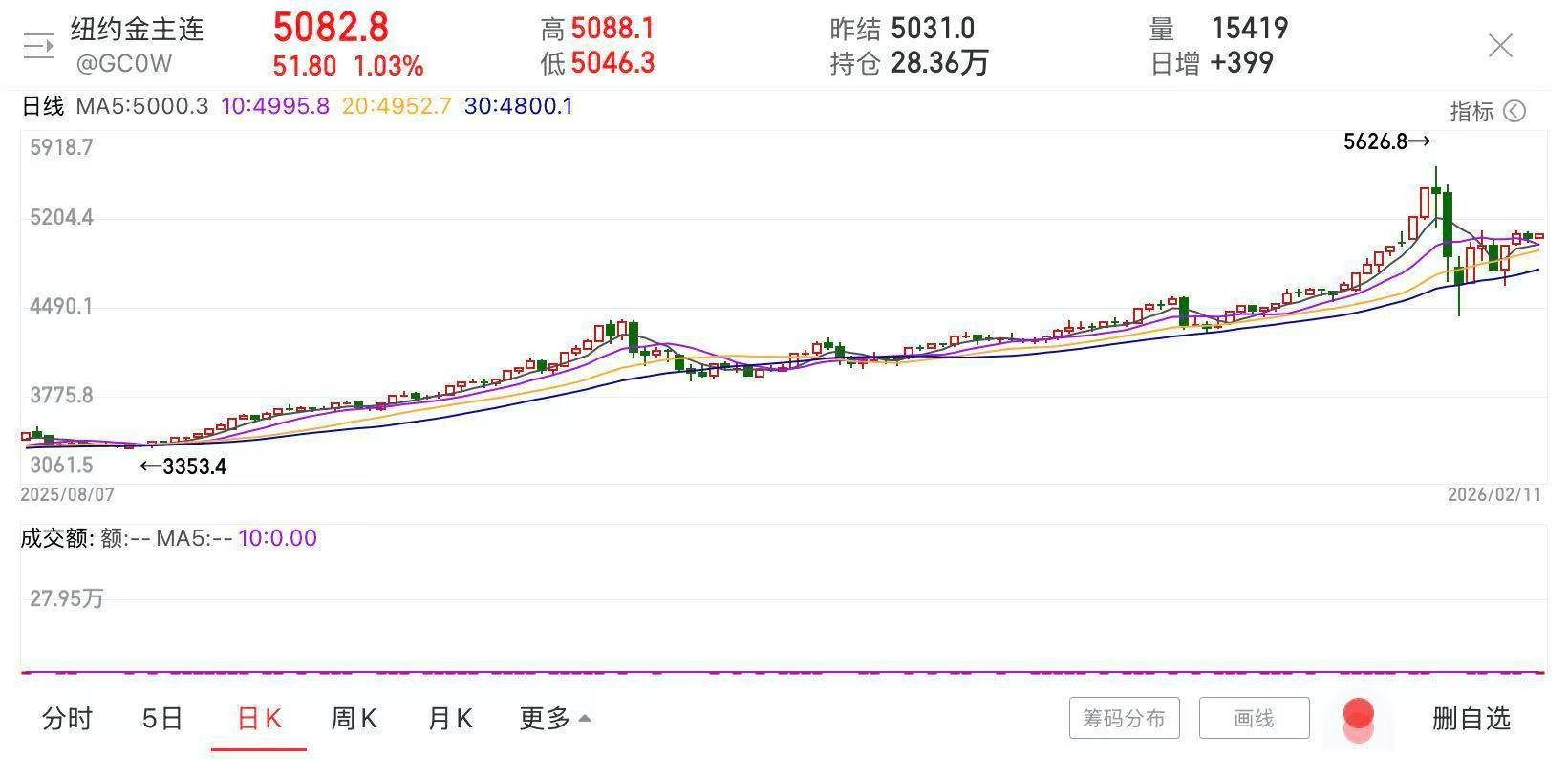
Group 1: Precious Metals - The recent volatility in precious metals, particularly gold and silver, has raised questions about whether the current price adjustments signify a market correction or the end of a bull market [1][2] - Gold prices surged to over $5600 per ounce at the end of January but have since dropped back to around $5000, while silver experienced a significant one-day drop exceeding 25% [1][2] - Factors contributing to the recent decline include increased geopolitical uncertainty, potential shifts in Federal Reserve monetary policy, and profit-taking from previous highs [2] Group 2: Oil Market - Oil prices have recently increased, with West Texas Intermediate crude rising from a low of $55 per barrel to a high of $66 per barrel, reflecting a more than $10 increase [3][6] - Tensions between the U.S. and Iran are a primary driver of oil price fluctuations, as Iran controls a significant portion of global oil reserves and key shipping routes [6] - The outlook for oil prices post-Chinese New Year will depend on geopolitical developments and the resumption of global economic activities, with predictions of a potential supply surplus in 2026 varying among major energy agencies [6][7] Group 3: Agricultural Products - The market reacted positively to President Trump's announcement regarding China's potential purchase of 20 million tons of soybeans, leading to a rise in soybean futures prices above $11 per bushel [8][12] - The increase in soybean prices is supported by improved trade expectations, supply changes in major producing regions, and favorable policy adjustments regarding biodiesel [12] - The soybean market's dynamics will shift post-holiday, focusing on seasonal supply and demand factors, with the consumption pace and recovery in end-user markets being critical for price movements [13]
沪银跌超7%,沪金跌超2%丨金银价格
Mei Ri Jing Ji Xin Wen· 2026-02-13 01:11
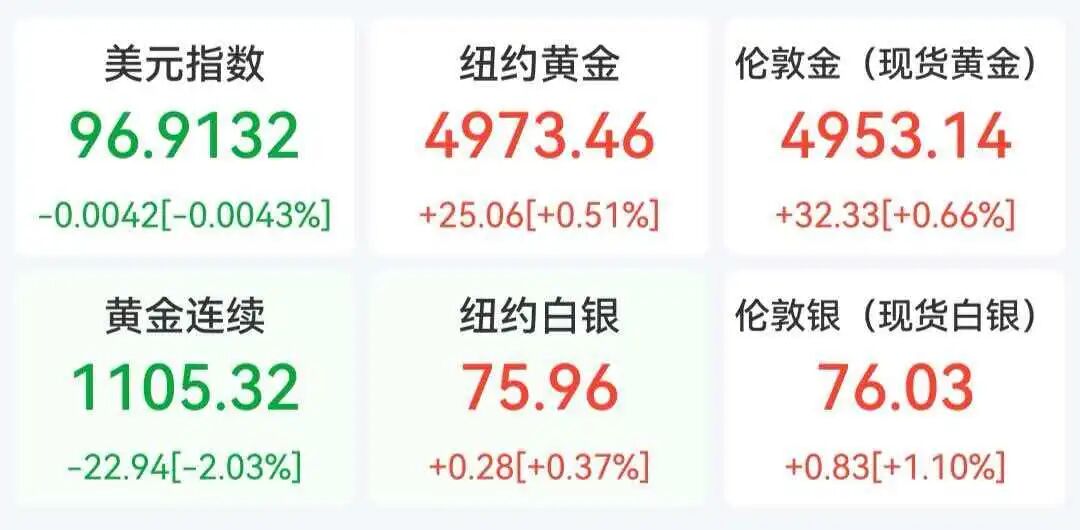
Group 1 - The core viewpoint of the articles indicates a significant decline in domestic commodity futures, with most commodities experiencing a drop, particularly silver and crude oil [1] - As of the latest report, silver has fallen over 7%, while crude oil and tin have decreased by more than 4%, and gold and copper have dropped over 2% [1] - In contrast, some commodities like caustic soda and soybean have seen increases, with caustic soda rising over 3% and soybean up over 2% [1] Group 2 - International precious metal prices have sharply declined, with spot gold falling below the $4900 mark, representing a 3.27% decrease, while spot silver has dropped by 10.84% [3]
金银巨震,美股重挫
Shang Hai Zheng Quan Bao· 2026-02-13 01:03
Market Overview - Significant sell-off in precious metals, with London spot silver dropping over 10% and gold falling more than 3% [8][9] - Recovery observed in precious metals prices, with silver rebounding to around $75 per ounce and gold to approximately $4940 per ounce [9] - U.S. stock market also faced heavy selling pressure, with the Dow Jones Industrial Average down 669.42 points, a decline of 1.34%, closing at 49451.98 points [3][5] U.S. Stock Market Performance - Major U.S. indices closed lower, with the Nasdaq down 469.32 points (2.03%) and the S&P 500 down 108.71 points (1.57%) [3][5] - Increased investor panic reflected in the S&P 500 volatility index, which surged over 20% during trading [5] - Large tech stocks experienced declines, with Apple down 5%, Broadcom over 3%, and other major companies like Amazon and Tesla down more than 2% [7] Geopolitical Developments - U.S. President Trump expressed hope for a U.S.-Iran agreement within "about a month," while Israeli Prime Minister Netanyahu expressed skepticism about the feasibility of such an agreement [12][17] - Tensions remain high, with the U.S. deploying military assets in the region and emphasizing the need for a strong agreement that addresses Israel's security concerns [17][18]
帮主快评:黄金白银一天跌没一周涨幅,避险资产为何不避险?
Sou Hu Cai Jing· 2026-02-13 00:37
Core Viewpoint - The global market experienced a peculiar "indiscriminate sell-off," with significant declines in various asset classes, including gold and silver, despite the absence of clear negative catalysts [1][4]. Group 1: Market Dynamics - The sell-off was characterized by algorithmic trading, where CTA strategy models triggered stop-loss orders, leading to a rapid sell-off without consideration for fundamental factors [3]. - The phenomenon is described as a liquidity squeeze, where even traditionally safe-haven assets like gold were sold off to raise cash and cover losses elsewhere [4]. Group 2: Investment Outlook - The short-term view suggests that the decline is driven by emotional panic, while the long-term fundamentals supporting gold prices remain intact, including ongoing central bank purchases and low real interest rates [4]. - Three operational guidelines are proposed: avoid catching falling knives, distinguish between trading and long-term positioning, and monitor specific signals indicating a return to safe-haven characteristics for gold and silver [5].

苹果一夜蒸发近1.4万亿元人民币 美股集体下挫静待CPI数据
Sou Hu Cai Jing· 2026-02-13 00:12
Group 1 - The U.S. stock market experienced a collective decline due to concerns over the disruptive impact of artificial intelligence (AI) and cautious sentiment ahead of significant CPI inflation data, with all three major indices falling over 1% [1] - The technology sector was the primary driver of the decline, with Apple shares dropping 5%, resulting in a market value loss of approximately $202.2 billion, marking the second-largest single-day market value loss in the company's history [1] - Concerns regarding AI are spreading from the software industry to logistics and real estate, with investors worried that AI tools may replicate business models and erode profit margins [1] Group 2 - Investors are closely monitoring the upcoming U.S. CPI inflation data, following stronger-than-expected January non-farm payroll data, which has reduced expectations for an urgent rate cut by the Federal Reserve [2] - The probability of a 25 basis point rate cut in March is currently estimated at 5.9%, while the probability for a cumulative 25 basis point cut by June stands at 48.1% [2] - The storage sector saw gains, with companies like SanDisk and Seagate Technology rising over 5%, while precious metals faced significant declines, with COMEX gold futures down 3.08% and COMEX silver futures down 10.62% [2]
