
通信

Search documents
调仓换基增配价值品种 基金投顾开年布局求稳
Zhong Guo Zheng Quan Bao· 2026-02-12 22:18
Core Viewpoint - In January 2026, fund advisors accelerated their portfolio adjustments, with a consensus on increasing allocations to undervalued value funds and enhancing positions in A-shares and bonds while reducing cash, U.S. stocks, and Hong Kong stocks [1][2]. Asset Allocation - A total of 178 out of nearly 650 fund advisor portfolios adjusted their allocations in January 2026, with significant increases in low-valuation value funds such as Yongying Rong'an and Huatai-PB Hongli Low Volatility ETF [2]. - Fund advisors increased their allocations to A-shares and bonds while reducing cash, U.S. stocks, and Hong Kong stocks [2]. Industry Focus - In the A-share market, fund advisors increased allocations to sectors such as non-ferrous metals, electronics, communications, and non-bank financials, while reducing exposure to biomedicine, automobiles, transportation, banks, and food and beverages [3]. - The technology sector saw adjustments, with a focus on increasing communication industry weight while reducing the computer industry weight, reflecting a strategic shift towards AI applications and related sectors [5]. Market Outlook - Looking ahead, fund advisors suggest focusing on the "overseas expansion + technology" dual strategy, emphasizing cyclical industries supported by global demand and AI-related sectors [6][7]. - The Hong Kong stock market is viewed as having a favorable investment window due to its low valuation and improving liquidity, with historical trends indicating potential for a "red envelope market" post-Chinese New Year [7].
调仓换基增配价值品种基金投顾开年布局求稳
Zhong Guo Zheng Quan Bao· 2026-02-12 20:26
Group 1 - In January 2026, fund advisors accelerated their portfolio adjustments, with 178 out of nearly 650 fund advisor combinations making changes, primarily increasing allocations to undervalued value-type funds [1] - Major funds that saw the highest increase in allocation include Yongying Rong'an, HFT Investment's Hongli Low Volatility ETF, and others [1] - Fund advisors generally increased their positions in A-shares and bonds while reducing cash assets, U.S. stocks, and Hong Kong stocks [1][2] Group 2 - Specific sector adjustments included increasing allocations to non-ferrous metals, electronics, and communications, while reducing exposure to biomedicine, automotive, and banking sectors [2] - Jia Shi Wealth's portfolio adjustments included increasing holdings in funds related to economic recovery and reducing exposure to high-performing products like the CSI 500 [2] - Silver Hua Fund's portfolio rebalancing involved increasing bond fund allocations from 39% to 44% and reducing mixed and equity fund allocations [3] Group 3 - The focus on the technology sector included increasing the weight of the communications industry while reducing the weight of the computer industry, reflecting a strategic shift in response to market conditions [4] - The investment strategy emphasizes a dual focus on "overseas expansion + technology," suggesting a balanced approach to mitigate risks and smooth volatility [4][5] - The Hong Kong stock market is viewed as having a favorable investment window due to its low valuation and improving liquidity, with historical data indicating better performance post-Chinese New Year [5][6]
县区动态|淮阴区商务局开展促消费政策进企业活动
Sou Hu Cai Jing· 2026-02-12 16:34
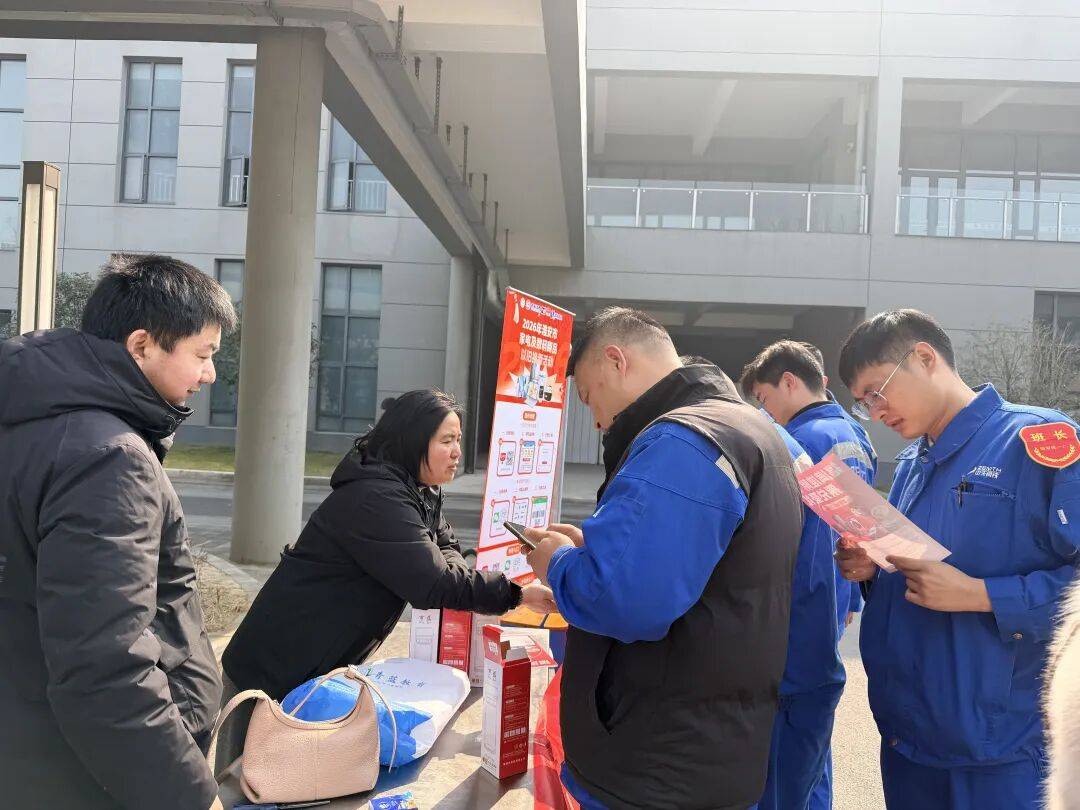
Group 1 - The core objective of the event is to promote consumer policies directly to enterprises, facilitating precise connections between supply and demand [1] - The Huaiyin District Commerce Bureau conducted an on-site activity to explain and guide employees on the standards, application processes, and timelines for subsidies related to the replacement of old automobiles, home appliances, and digital products [3] - The event featured local home appliance company Nian Nian Wang and China Mobile, providing immersive experiences with electronic products such as smartphones, smartwatches, and tablets [5] Group 2 - The Huaiyin District Commerce Bureau plans to continue deepening the "Five Advances" consumer replacement initiative, aiming to expand the coverage and influence of the policy [5] - The bureau aims to stimulate market potential by ensuring that policy strength resonates with market enthusiasm [5]

美国猛然惊醒:中国太精,嘴上说我不行,手里却攒了不少“好牌”
Sou Hu Cai Jing· 2026-02-12 14:55
Group 1 - The U.S. has imposed tariffs on Chinese goods in multiple phases since 2018, aiming to stifle China's economic growth [2][4] - In response, China has retaliated with tariffs ranging from 10% to 25% on U.S. exports, particularly targeting key U.S. industries like agriculture [4][6] - The U.S. agricultural sector, especially soybean farmers, has faced significant challenges due to reduced sales and falling prices, leading to increased bankruptcies and government subsidies [6][9] Group 2 - American brands such as Harley-Davidson and Caterpillar have seen a noticeable decline in sales in the Chinese market due to tariffs [8] - Consumers in the U.S. are experiencing higher prices for everyday goods, as many products previously sourced from China have become more expensive [9][11] - The trade war has resulted in losses for both sides, with the U.S. farmers and consumers bearing the brunt of the impact while China has shown flexibility in sourcing alternatives [11][29] Group 3 - China's military capabilities are advancing steadily, with a focus on developing a complete industrial system that supports its defense needs [20][26] - The comparison of military expenditures reveals that while the U.S. spends more, China's investments are yielding effective results in terms of operational capabilities [24][26] - China's achievements in various sectors, such as high-speed rail, 5G technology, and electric vehicles, demonstrate its commitment to maintaining a robust industrial base [27][29]

节前最后交易日,A股如何操作?
Guo Ji Jin Rong Bao· 2026-02-12 14:40
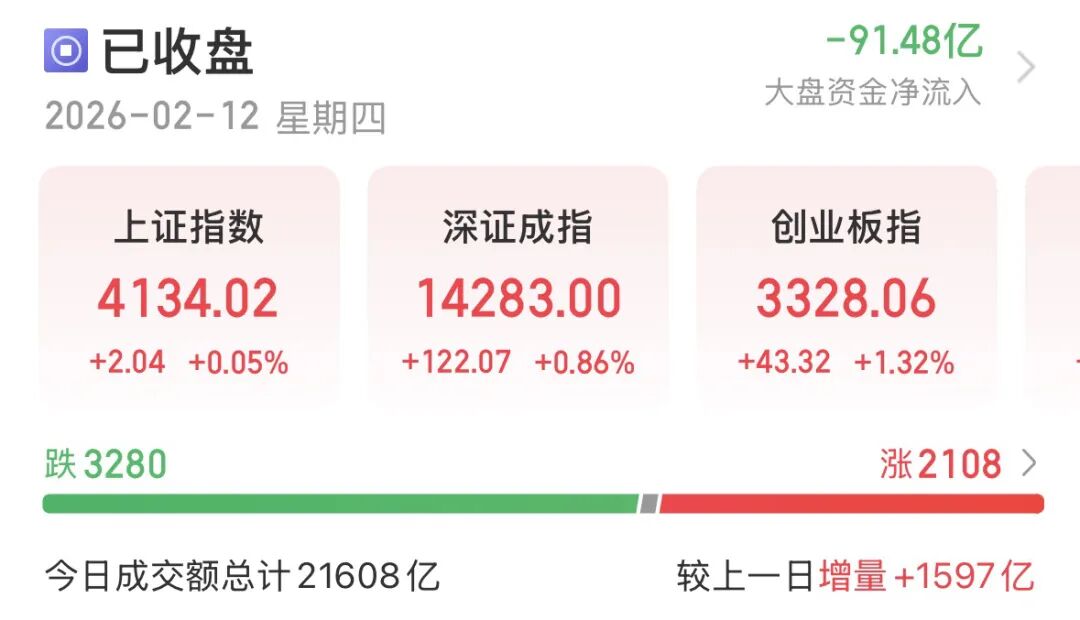
Market Overview - A-shares continued to show a fluctuating and differentiated trend, with major indices mostly closing slightly higher and trading volume increasing to 2.16 trillion yuan [1][4] - The market saw 2,108 stocks rise, with notable performances from technology stocks in communications, electronics, and military industries, as well as resource stocks like non-ferrous metals and steel [1][4] Trading Dynamics - The balance of margin financing decreased to 2.64 trillion yuan, indicating a continued decline in leveraged funds [4] - The trading activity was characterized by 3,280 stocks declining, with 22 hitting the daily limit down, while 69 stocks reached the daily limit up [5] Sector Performance - The technology sector, particularly in areas like AI applications and commercial aerospace, showed strong performance, while consumer sectors such as beauty care and retail experienced declines of over 1% [8][10] - Specific stocks like Tianfu Communication and Kunlun Wanwei saw significant gains, with Tianfu Communication rising over 14% [5][6] Investor Sentiment - Analysts suggest that the current market is undergoing structural adjustments rather than a broad influx of new capital, with funds shifting from defensive sectors to aggressive technology growth sectors [14] - The upcoming trading day before the Spring Festival is expected to see a narrow fluctuation and stabilization of indices, with a generally optimistic outlook for post-holiday market performance [3][15] Future Outlook - Post-holiday, the market is anticipated to experience a "opening red" scenario, driven by policy expectations and fundamental factors, despite potential volatility [17][19] - Investment strategies are recommended to focus on sectors with solid fundamentals and reasonable valuations, particularly in technology and cyclical resources, while maintaining a balanced portfolio to mitigate risks [20]
通信行业点评报告:维谛指引乐观,液冷趋势再强化
KAIYUAN SECURITIES· 2026-02-12 13:10
Investment Rating - The industry investment rating is "Overweight" (maintained) [1] Core Insights - The report highlights the optimistic outlook for the liquid cooling industry, driven by strong performance and order growth from key players like维谛, AWS, and Google Cloud [4][5][6][7] - The report emphasizes the significant growth in organic orders and backlog for维谛, indicating a robust demand for liquid cooling solutions [4] - Major cloud service providers, including AWS and Google Cloud, have reported revenue growth exceeding expectations, with substantial increases in capital expenditures, suggesting a positive trend for the AI computing power supply chain [5][6] Summary by Sections 维谛 Performance - In Q4 2025, 维谛's sales reached $2.88 billion, a 23% year-over-year increase, with an adjusted operating profit margin of 23.2%, exceeding expectations [4] - The company experienced a 252% year-over-year growth in organic orders and a backlog increase to $15 billion, up 109% [4] - For 2026, 维谛 projects sales between $13.25 billion and $13.75 billion, with an organic growth rate of 28% and an EPS range of $5.97 to $6.07, reflecting a 43% year-over-year increase [4] AWS and Google Cloud Insights - AWS reported Q4 2025 net sales of $35.58 billion, a 24% year-over-year increase, with capital expenditures of $38.5 billion, up 48% [5] - Google Cloud's Q4 2025 revenue reached $17.7 billion, a 48% increase, with capital expenditures of $27.9 billion, up 95% [5] - Both companies are expected to continue significant capital investments in 2026, indicating strong growth prospects in the cloud computing sector [5] Meta and Microsoft Performance - Meta's Q4 2025 revenue was $59.893 billion, a 24% increase, with capital expenditures of $22.14 billion [6] - Microsoft's FY2026 Q2 revenue was $81.273 billion, a 17% increase, with the intelligent cloud segment growing by 26% [6] - Both companies are also increasing their capital expenditures significantly, reflecting confidence in future growth [6]





【12日资金路线图】两市主力资金净流出近12亿元,电子等行业实现净流入
证券时报· 2026-02-12 12:55
Market Overview - The A-share market experienced a narrow range of consolidation on February 12, with the Shanghai Composite Index rising by 0.05%, the Shenzhen Component Index increasing by 0.86%, and the ChiNext Index up by 1.32%. The total trading volume for the day was 2.16 trillion yuan, compared to 2 trillion yuan the previous day [1]. Capital Flow - The main funds in the Shanghai and Shenzhen markets saw a net outflow of approximately 12 billion yuan, with an opening net outflow of 31.42 billion yuan and a closing net outflow of 8 billion yuan, resulting in a total net outflow of 11.81 billion yuan for the day [2]. - Over the last five trading days, the main funds have shown a consistent trend of outflow, particularly in the ChiNext, which saw a net outflow of 39.79 billion yuan on February 12, while the CSI 300 index recorded a net inflow of 10.85 billion yuan [3][4]. Sector Performance - The electronics sector achieved a net inflow of 167.93 billion yuan, with a growth of 1.36%. Other sectors with positive net inflows included electric power equipment (143.16 billion yuan, up 1.10%) and computers (81.72 billion yuan, up 0.89%) [5]. - Conversely, the banking sector experienced a significant net outflow of 76.90 billion yuan, declining by 1.51%. Other sectors with notable outflows included non-bank financials (-64.83 billion yuan), pharmaceuticals (-57.24 billion yuan), and retail (-40.91 billion yuan) [5]. Institutional Activity - The top stocks with net buying from institutions included Yingweike (32.02 million yuan, up 10.00%), Zhichuan Co. (22.56 million yuan, down 4.92%), and Jingchen Co. (18.68 million yuan, up 15.75%) [7]. - The stocks with the highest net selling included Jihua Group (-12.02 million yuan, down 14.19%) and Jianxin Culture (-10.16 million yuan, down 14.19%) [9]. Institutional Focus - Recent institutional ratings highlighted stocks such as Guangdong Hongtu (target price 13.00 yuan, current price 12.25 yuan, potential upside 6.12%) and China Duty Free Group (target price 116.00 yuan, current price 94.17 yuan, potential upside 23.18%) [10].

基金经理及产品研究系列:东吴基金刘瑞:成长风格占优趋势延续,关注AI与创新药投资机会
Guohai Securities· 2026-02-12 09:35
- The report utilizes the Fama Five-Factor Model for analysis, which includes market, size, value, investment, and profitability factors[29][37][41] - The construction process involves analyzing factor sensitivities and decomposing returns and risks based on the five factors. Market factor sensitivity is consistently positive, while value factor sensitivity is notably negative. The formula for factor exposure is $ R_i = \alpha + \beta_1 \cdot MKT + \beta_2 \cdot SMB + \beta_3 \cdot HML + \beta_4 \cdot RMW + \beta_5 \cdot CMA + \epsilon $, where $ \beta $ represents factor sensitivities[37][41][42] - Evaluation of the model indicates strong individual stock selection capabilities, as excess returns are primarily derived from specific stock alpha rather than systematic factor exposure[41][42] - Testing results show that market factor contributes significantly to returns, while value, size, and investment factors exhibit weaker performance. Specific alpha remains a key driver of excess returns[37][41][42]
股价近期连续大涨!软银Q3扭亏为盈,但净利大幅不及预期,前三财季重仓OpenAI实现2.8万亿日元投资收益
美股IPO· 2026-02-12 08:04
Core Viewpoint - SoftBank has turned a profit in Q3 of FY2025, reporting a net profit of 248.59 billion yen (approximately $1.6 billion), primarily driven by significant investments in AI, particularly in OpenAI, although the results fell short of market expectations, achieving only about 30% of the anticipated profit [1][3][6]. Financial Performance - The net profit for Q3 reached 248.59 billion yen, marking a turnaround from previous losses, but only meeting 29% of market expectations [6][7]. - Revenue showed resilience with net sales of 1.98 trillion yen, reflecting an 8.2% year-on-year growth, slightly exceeding market expectations of 1.96 trillion yen [8]. - For the first nine months of the fiscal year, the company reported a cumulative net profit of 3.17 trillion yen and net sales of 5.72 trillion yen, indicating strong overall fiscal performance [9]. Vision Fund Performance - The Vision Fund was a major contributor to the quarterly performance, achieving a profit of 735.49 billion yen, a significant recovery from a loss of 309.93 billion yen in the same period last year [5][11]. - Investment returns for the Vision Fund turned from a loss of 352.75 billion yen to a profit of 374.99 billion yen, marking a reversal of over 720 billion yen [12]. Investment in OpenAI - SoftBank's investment in OpenAI is a strategic highlight, with total investments reaching $34.6 billion, making it a key institutional investor with an 11% stake [14][16]. - The company is negotiating a new investment round of up to $30 billion in OpenAI, which could elevate the company's valuation to between $750 billion and $830 billion, further solidifying SoftBank's position as a major investor [16]. Asset Management and Liquidity - To support its aggressive AI investments, SoftBank has been optimizing its asset portfolio, including the sale of T-Mobile stock, which generated $12.73 billion (approximately 1.9 trillion yen) [18][19]. - The cash flow from these asset sales provides a solid foundation for SoftBank's AI investment strategy and alleviates market concerns regarding its financial leverage [20].


深圳民企总量超283万家 2025年全市新设民营企业超34万户
Nan Fang Ri Bao Wang Luo Ban· 2026-02-12 07:55
Group 1 - In 2025, Shenzhen is expected to establish over 340,000 new private enterprises, bringing the total number of private enterprises to over 2.83 million [1] - Shenzhen has created a thriving ecosystem for private enterprises, with leading companies like Huawei, Tencent, BYD, and SF Express entering the Fortune Global 500 [1] - The city has implemented 24 special measures to relax market access and is actively promoting quality projects to private capital, with a total investment of approximately 240 billion yuan in major projects [1] Group 2 - Shenzhen has introduced innovative financial support models, such as the "Park Loan," with a credit amount exceeding 22 billion yuan, and aims for inclusive small and micro loans to surpass 2 trillion yuan by 2025 [2] - The city has established a comprehensive office system and built over 4 million square meters of high-standard factory space to support business operations [2] - Shenzhen is focused on protecting the legal rights of private enterprises and has implemented measures to reduce the burden on businesses, including the promotion of an "enforcement supervision code" [2] Group 3 - Shenzhen has created the first comprehensive service platform for private enterprises going global, establishing cooperation with 46 parks in 32 countries and regions [3] - The international logistics network has expanded with the launch of 15 new international passenger and cargo routes, and 30 cross-border e-commerce shipping lines are in regular operation [3] - The construction of overseas warehouses is progressing, with over 377 warehouses operating in 36 major countries and regions, covering an area of more than 4.2 million square meters [3]