
新能源车

Search documents
桥水猛砍英伟达,嗅到了什么风险?
Sou Hu Cai Jing· 2025-11-15 11:09
Core Insights - Bridgewater, the world's largest hedge fund, has significantly reduced its holdings in major tech companies while increasing its investment in the S&P 500 ETF by 883% and initiating a position in Tesla, signaling a strategic shift in investment focus [1][5] Group 1: Reduction in Tech Holdings - Bridgewater has cut its stake in Nvidia by 1.25 million shares, Google by 750,000 shares, and Apple by 40%, with other tech giants like Meta, Microsoft, and Amazon also facing reductions [3][4] Group 2: Key Signals from the Moves - The reduction in tech stocks suggests a warning against valuation bubbles, as Nvidia's stock rose over 200% last year, leading to a dynamic P/E ratio exceeding 80 times, making profit-taking a normal strategy [5] - The shift to index ETFs indicates a strategy to diversify risk, moving away from high concentration in tech stocks [5] - The initiation of a position in Tesla, with 150,000 shares, reflects a long-term outlook on the electric vehicle market rather than short-term fluctuations [5] Group 3: Broader Economic Context - Bridgewater's founder, Ray Dalio, has cautioned about the potential end of the "big debt cycle" in the U.S., suggesting that a shift in Federal Reserve policy could lead to a burst in tech stock bubbles [5] - The strategy of moving funds from high-valuation stocks to index ETFs represents a preference for overall economic resilience over individual stock performance [5] Group 4: Investment Lessons - Investors should learn to take profits on high-flying stocks like Nvidia, rather than holding onto them indefinitely [6] - Emphasizing a balanced investment approach is crucial, combining index funds, leading industry stocks, and cash to withstand market volatility [6] - Monitoring macroeconomic factors such as interest rates, debt, and inflation is essential, as these variables often have a greater impact on market trends than individual company earnings reports [6]







巴菲特退休了 股神投资科技公司最大遗憾是什么
Xin Lang Ke Ji· 2025-11-14 11:41
Group 1 - Warren Buffett officially announced his retirement in the annual shareholder letter of Berkshire Hathaway, marking the end of an era for the legendary investor [2][4] - Buffett will pass the CEO position to Greg Abel by the end of the year while remaining as chairman, indicating a strategic transition for the company [2][4] - Berkshire Hathaway's cash and equivalents reached a record high of $358 billion at the end of the third quarter, providing ample resources for future acquisitions under Abel's leadership [4] Group 2 - Buffett's investment philosophy, heavily influenced by Benjamin Graham, emphasizes investing in companies with a strong "moat" and predictable cash flows, particularly in consumer goods, finance, and insurance sectors [5][7] - Despite his initial reluctance, Buffett gradually embraced technology investments, viewing successful tech companies through the lens of consumer brands with strong customer loyalty [15][20] - Buffett's significant investments in Apple and Amazon reflect a shift in his strategy, recognizing their strong market positions and brand loyalty, leading to substantial returns [20][23] Group 3 - Buffett's cautious approach to technology stocks, including missed opportunities with companies like IBM and Microsoft, highlights his preference for understanding the business model before investing [10][19] - The investment in BYD, a leading electric vehicle manufacturer, showcases Buffett's willingness to invest in innovative technologies when backed by strong fundamentals [25][27] - Despite the current AI boom, Buffett remains skeptical and cautious, emphasizing the importance of value investing principles and the need for regulatory oversight in the AI sector [30]


平替时代:一家车企、一个行业如何被自己的成功困住
创业邦· 2025-11-14 10:24
Core Insights - Li Auto has maintained its position as the leading new energy vehicle manufacturer since the success of its large SUV L9 in 2022, being one of the few profitable companies in the sector alongside Seres [5][7] - Recently, competitors like Xpeng have surpassed Li Auto in market capitalization, while NIO's stock has risen significantly despite substantial losses, indicating a shift in market dynamics [5][7] - In October, Li Auto's sales ranked seventh among new energy vehicle manufacturers, trailing behind several competitors [5][7] Pricing Strategy and Market Position - Following the underperformance of high-priced models MEGA and i8, Li Auto has shifted its strategy to lower pricing, exemplified by the i6, which has a price reduction of nearly 100,000 yuan compared to the i8 [8] - The i6 has quickly secured 80,000 orders, but its gross margin is around 10%, indicating minimal profit [8] - Li Auto's previous pricing strategy aimed for a 20% gross margin to fund R&D, but the competitive landscape has forced a reevaluation of this approach [8][9] Competitive Landscape - The success of new energy vehicles often hinges on their ability to serve as "value alternatives" to traditional models, a strategy that has been effectively employed by brands like BYD and Tesla [9][11] - The market has seen a trend where new energy vehicles are priced competitively against traditional fuel vehicles, leading to increased sales and market share for brands that adopt this strategy [11][12] - As competition intensifies, brands are increasingly focusing on price as the primary differentiator, with many models now offering similar features at lower costs [8][9][22] Technological Advancements and Consumer Expectations - The rapid advancement of battery technology and electric vehicle performance has led to a convergence in product offerings, making it challenging for brands to maintain distinct competitive advantages [25][26] - The focus has shifted towards enhancing user experience through technology, with features like advanced driver assistance systems becoming critical selling points [28][29] - As the market matures, the emphasis on high-quality materials and luxury features has become standard across many brands, further blurring the lines between competitors [26][28] Market Dynamics and Future Outlook - The automotive industry is characterized by a relentless cycle of competition, where companies continuously seek to outdo each other in terms of pricing and features [38][42] - The shift towards electric vehicles has altered the competitive landscape, with traditional automakers adapting to the new market realities and re-entering the fray with more competitive offerings [48] - The ongoing price wars and the need for efficiency and scale will likely continue to shape the strategies of automotive companies in the coming years [38][42]




雷军“神话”遭难,左手4.99万京东卖车,右手杀入保险业,刘强东又要卷谁?
Sou Hu Cai Jing· 2025-11-14 08:12
Core Insights - The automotive industry is experiencing intense competition during the Double Eleven shopping festival, with companies employing aggressive marketing strategies to boost sales figures [1][2] - The entry of JD.com into the automotive market signifies a shift in marketing dynamics, leveraging its platform to create a new model of car sales [11][12] - The use of "small deposits" and "large deposits" by car manufacturers to inflate order numbers raises questions about the authenticity of reported sales figures [3][2] Group 1: Automotive Sales Dynamics - Monthly sales rankings in the automotive sector are highly competitive, with fewer than 40,000 units sold failing to make the top ten [1] - The trend of using "big order" and "small order" data to create hype around new car launches has become commonplace, with some companies reporting over 10,000 orders within 24 hours of a vehicle's release [2][3] - The distinction between small deposits (flexible, refundable) and large deposits (binding, non-refundable) is crucial for understanding consumer commitment and production planning [2] Group 2: JD.com's Market Entry - JD.com has launched its own vehicle, priced at 49,900 yuan for a battery rental version, aiming to compete directly with established brands like BYD [1][11] - The marketing strategy for JD.com's vehicle includes a unique collaboration model with GAC and CATL, focusing on a "platform + manufacturing + technology" approach [12] - JD.com's extensive service network, comprising over 3,000 self-operated car stores and 40,000 partner stores, enhances the customer experience from test drives to after-sales service [13] Group 3: Industry Challenges and Opportunities - The insurance market for new energy vehicles faces significant challenges, including high claim rates and difficulties in obtaining coverage, leading to losses for insurers [15][16] - Regulatory efforts are underway to improve the insurance landscape for new energy vehicles, including the introduction of a platform to prevent insurers from refusing coverage [15] - The need for a more accurate risk pricing system is emphasized as essential for making insurance affordable for new energy vehicle owners while ensuring profitability for insurers [15]



留心欧洲印度化!安世事件启示:退一步可能丢科技话语权!
Sou Hu Cai Jing· 2025-11-13 21:43
Core Viewpoint - The forced takeover of ASML by the Netherlands is framed as a response to "technology transfer risks," but it is essentially a political maneuver aligned with the Atlantic alliance's strategy to contain China technologically [1][3]. Group 1: Impact on Semiconductor Industry - The ASML incident has caused significant disruptions in the global automotive chip supply chain, prompting companies like Infineon and STMicroelectronics to accelerate production, while Japan invests heavily in domestic chip support [5]. - China's self-sufficiency in mature process chips has reached a 70% rate, with a 35% year-on-year increase in domestic automotive-grade chip shipments, indicating a growing capability to provide alternatives to European automakers [5][9]. Group 2: European Market Dynamics - Despite a 52% increase in Chinese electric vehicle exports to Europe, European automakers have seen a 42% decline in sales in China, highlighting a complex interdependence that complicates Europe's stance against China [3][11]. - The European Union's recent legislation, such as the Critical Raw Materials Act, has set the stage for more aggressive actions against companies like ASML, reflecting a broader strategy to align with U.S. policies [1][3]. Group 3: China's Strategic Response - China's response to the Netherlands' actions includes targeted measures like suspending certain high-tech export licenses, which directly impact the Netherlands without disrupting the entire market [5][9]. - Chinese companies are shifting their approach in Europe from mere market penetration to technology collaboration, as seen with CATL's commitment to share technology in Hungary, aiming to alleviate local concerns about Chinese influence [7]. Group 4: Broader Geopolitical Implications - The ASML incident serves as a litmus test for Europe's willingness to follow the U.S. in its containment strategy against China, with potential repercussions for its own industrial base [11]. - The ongoing geopolitical chess game between China and Europe is characterized by a delicate balance of interests, where Europe seeks to limit China while simultaneously relying on it, creating a precarious situation that cannot be sustained long-term [9][11].
平替时代:一家车企、一个行业如何被自己的成功困住
晚点LatePost· 2025-11-13 16:16
Core Viewpoint - The article discusses the challenges faced by Li Auto in the competitive landscape of the Chinese electric vehicle market, highlighting the shift towards price competition and the concept of "value-for-money" or "平替" (ping ti), which translates to "alternative" or "substitute" products that offer similar features at lower prices [4][8][39]. Group 1: Market Position and Competition - Li Auto has maintained its position as a leading new energy vehicle manufacturer since the success of its L9 model in 2022, but recently faced increased competition from rivals like XPeng and NIO, with XPeng surpassing Li Auto in market capitalization [4][6]. - In October, Li Auto's sales ranked seventh among new energy vehicle manufacturers, trailing behind brands such as Leap Motor, XPeng, Xiaomi, and NIO [4][6]. - The competitive landscape has intensified, with NIO entering the mid-range market and offering lower-priced models, further squeezing Li Auto's market share [8][21]. Group 2: Product Strategy and Pricing - Li Auto's i8 model was launched at a price exceeding 320,000 yuan, competing directly with Tesla's Model Y and NIO's models, but failed to gain traction due to its high price point [6][8]. - Following the underperformance of high-priced models, Li Auto shifted its strategy, launching the i6 at a significantly lower price, which quickly garnered 80,000 orders despite a low gross margin of around 10% [8][9]. - The company previously aimed for a 20% gross margin to fund R&D, but the current market dynamics have forced it to compromise on pricing to remain competitive [8][9]. Group 3: Industry Trends and Consumer Behavior - The article emphasizes that successful electric vehicles often serve as "平替" for more expensive models, with brands like BYD and Tesla leading the way by offering high-performance vehicles at competitive prices [9][11]. - The trend of "平替" has become prevalent in the industry, with various brands launching models that provide similar features to luxury vehicles at significantly lower prices, thus intensifying price competition [21][39]. - As the market matures, the differentiation between electric vehicles has diminished, leading to a focus on price and features rather than brand prestige [22][39]. Group 4: Future Outlook and Challenges - The article suggests that the ongoing price wars and the shift towards "平替" models may lead to a scenario where only the most efficient and scalable manufacturers survive, similar to trends observed in mature markets [39][46]. - The rapid technological advancements and the emergence of new players in the market have created a challenging environment for established brands, as they must continuously innovate to maintain their competitive edge [46][50]. - The article concludes that the electric vehicle market in China is characterized by an ongoing cycle of competition, where brands must adapt to consumer preferences for value and performance [39][50].

万亿巨头,大涨!百亿级产品爆发
Zhong Guo Zheng Quan Bao· 2025-11-13 15:09
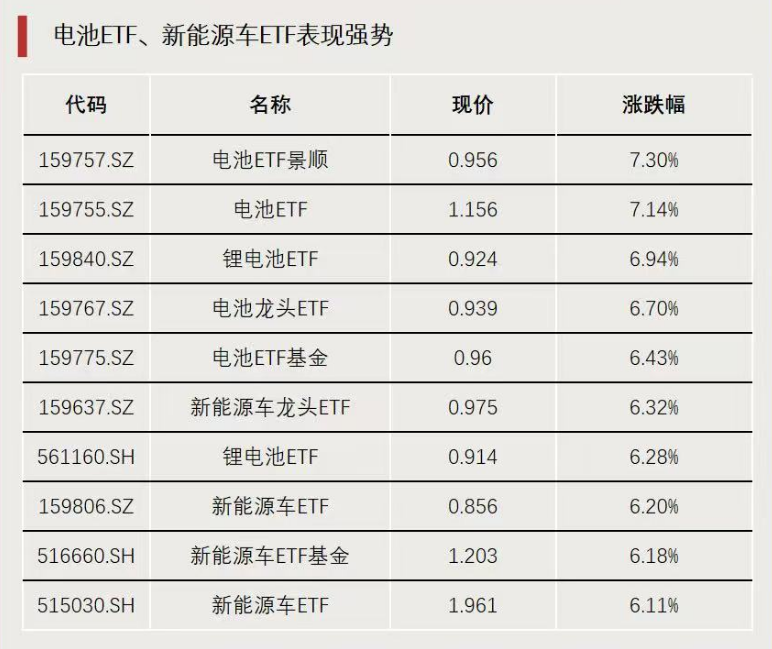
Group 1: Market Performance - A-shares and Hong Kong stocks saw strong gains in battery and automotive sectors, with CATL's stock price rising over 7%, approaching historical highs, and its market capitalization exceeding 1.9 trillion yuan [1] - Multiple battery ETFs and new energy vehicle ETFs experienced significant increases, with several battery ETFs rising by 70% year-to-date [1][3] - The lithium battery industry chain saw a broad increase, with battery ETFs (159755) rising by 7.14% and achieving a year-to-date increase of over 77% [3] Group 2: ETF Performance - Several battery-themed ETFs showed strong performance, with the largest battery ETF (159755) having a net inflow of 8.4 billion yuan this year, reaching a total size of over 15 billion yuan [3] - Metal-themed ETFs also performed well, driven by rising prices of lithium carbonate, silver, gold, and copper, with rare metal ETFs increasing by over 5% [5] - Bond ETFs, particularly those focused on innovative technology, saw high trading volumes, with several achieving transaction amounts exceeding 10 billion yuan [7] Group 3: Investment Trends - Gold, innovative technology boards, and non-bank financial sectors have become significant targets for capital inflow, with multiple related ETFs seeing net inflows exceeding 1 billion yuan this week [9][10] - The recent World Power Battery Conference resulted in 180 signed projects worth 86.13 billion yuan, indicating strong industrial development momentum in the new energy sector [11] - The demand for rare metals is expected to grow due to the needs of new energy vehicles and high-end manufacturing, highlighting the cyclical growth attributes and investment value of the rare metals sector [11]

新能源车销量持续走高,动力电池产能吃紧?
Mei Ri Jing Ji Xin Wen· 2025-11-13 13:30
Core Insights - The current supply of power batteries in China is tight, with high capacity utilization rates among manufacturers, leading to competition among automakers to secure battery supplies [1][2] - The increase in demand for new energy vehicles (NEVs) has resulted in a "battery hoarding" battle among car manufacturers, driven by optimistic market expectations and the upcoming traditional sales peak in Q4 [2][3] - The adjustment of the new energy vehicle purchase tax is influencing manufacturers to accelerate delivery schedules to improve financial performance [3][4] Industry Dynamics - The production and sales of NEVs in China from January to October reached 13.015 million and 12.943 million units, respectively, marking a year-on-year increase of over 30% [2] - In October, NEV sales exceeded 50% of total new car sales for the first time, indicating a significant market shift [2] - The demand for high-nickel batteries, primarily used in high-end electric and hybrid vehicles, is currently constrained due to supply chain issues and raw material price fluctuations [4][5] Supply Chain Challenges - The storage market's explosive growth is a key factor contributing to the tight supply of power batteries, with the demand for lithium batteries in storage applications surging [5][6] - The production capacity for lithium iron phosphate batteries is sufficient overall, but many production lines are being diverted to meet storage project demands, leading to resource competition [5][6] - The third quarter of this year saw a 65% year-on-year increase in China's storage lithium battery shipments, with total shipments expected to reach 580 GWh for the year, a 67% increase [5][6] Future Outlook - The demand for storage is expected to remain strong, with global installation growth projected at 40% to 50% next year [7] - The ongoing high demand for storage is likely to continue affecting the availability of power batteries for electric vehicles, particularly those using lithium iron phosphate technology [7] - The current battery shortage is viewed as a short-term issue, with expectations of improved supply in the future [7]
10月新能源车销量“成绩单”:比亚迪销售44万,零跑超7万,蔚来/小鹏/小米破4万
高工锂电· 2025-11-13 11:39
Core Viewpoint - The article highlights the performance of various electric vehicle brands in October 2025, showcasing the sales growth and market dynamics in the Chinese electric vehicle sector, particularly during the traditional peak sales season. Group 1: Overall Market Performance - October 2025 marked a traditional peak sales season for the automotive market, driven by the National Day holiday's customer attraction effect and year-end policy adjustments [5] - Among the 12 tracked automotive brands, most reported positive growth in new energy vehicle sales for October, with only Li Auto and GAC Aion showing negative month-on-month growth [5] Group 2: Brand-Specific Sales Data - BYD sold approximately 441,706 vehicles in October, a month-on-month increase of 11.5% but a year-on-year decrease of 12.1%. Cumulatively, BYD's sales from January to October reached about 3.7 million, reflecting a year-on-year growth of 13.9% [6] - Leap Motor achieved a record high of 70,289 vehicle deliveries in October, marking a year-on-year increase of over 84% and a cumulative total of 465,805 vehicles for the year, up 120.7% [8] - Xpeng Motors delivered 42,013 vehicles in October, a year-on-year increase of 76% and a month-on-month growth of 1%. The cumulative total for the year reached 355,209 vehicles, up 190% [10] - NIO delivered 40,397 vehicles in October, with a year-on-year growth of 92.6%. The cumulative total for the year stands at 913,182 vehicles [13] - Xiaomi's vehicle deliveries exceeded 40,000 in October, maintaining the same level as the previous month but doubling compared to the same period last year. The cumulative total for the year surpassed 290,000, reflecting a growth of 283.2% [17] - Deep Blue Automotive sold 36,792 vehicles in October, with a year-on-year increase of 32.1% and a cumulative total of 269,058 vehicles for the year, up 57.1% [19] - Li Auto delivered 31,767 vehicles in October, showing a year-on-year decline of 38.2% and a cumulative total of 328,916 vehicles for the year, down 16.4% [22] - GAC Aion's sales reached 27,014 vehicles in October, with a year-on-year decrease of 32.6% and a cumulative total of 261,992 vehicles for the year, down 25.9% [24] - Zeekr delivered 21,423 vehicles in October, with a year-on-year decline of 14.5% but a month-on-month increase of 17.3%. The cumulative total for the year is 165,023 vehicles, down 1.7% [27] - Lantu delivered 17,218 vehicles in October, reflecting a year-on-year increase of 70% and a cumulative total of 114,210 vehicles for the year, up 82% [31] - Avita's sales reached 13,506 vehicles in October, with a year-on-year growth of 34.3% and a cumulative total of 104,245 vehicles for the year, up 104.6% [33] - Zhiji Automotive delivered 13,159 vehicles in October, marking a year-on-year increase of 31.6% and a cumulative total of 63,452 vehicles for the year, up 27.1% [36]

幸亏奇瑞没爬上去
3 6 Ke· 2025-11-13 10:33
Core Viewpoint - The incident involving Chery has paradoxically elevated its visibility in the competitive landscape of the Chinese electric vehicle (EV) market, despite being a failure in execution [1][2][9]. Group 1: Chery's Position in the Market - Chery has historically positioned itself as a "technical" and "practical" brand, avoiding conflicts with other automakers and focusing on engineering excellence [2][3][6]. - The recent incident reflects a shift in Chery's marketing strategy, contrasting with its previous image of a reliable and conservative brand [6][8]. Group 2: Industry Dynamics - The current EV market is characterized by intense competition and negative publicity among various brands, leading to a culture of public ridicule rather than serious technical discourse [4][5][10]. - The incident highlights the industry's trend towards sensational marketing tactics as automakers struggle to differentiate themselves in a market with high product homogeneity [5][11]. Group 3: Consumer Perception and Brand Image - The public's reaction to Chery's incident has been mixed, with some defending the brand's willingness to take risks, while others criticize it for poor execution [2][3][4]. - The incident has generated significant online engagement, transforming a negative event into a source of entertainment and discussion, which may not necessarily harm Chery's brand in the short term [2][4][8]. Group 4: Future Implications for the Industry - The incident serves as a cautionary tale for the entire EV sector, emphasizing the need for brands to focus on long-term value and consumer trust rather than short-lived marketing stunts [12][13]. - The industry must recognize that sustainable success relies on delivering consistent and reliable products rather than engaging in a race for attention through extreme marketing [12][13].