
公用事业

Search documents
《枪炮、病菌与钢铁》的2025年金融版:枪炮与贵金属封神! 其他“传统避风港”集体失灵
智通财经网· 2025-12-23 14:08
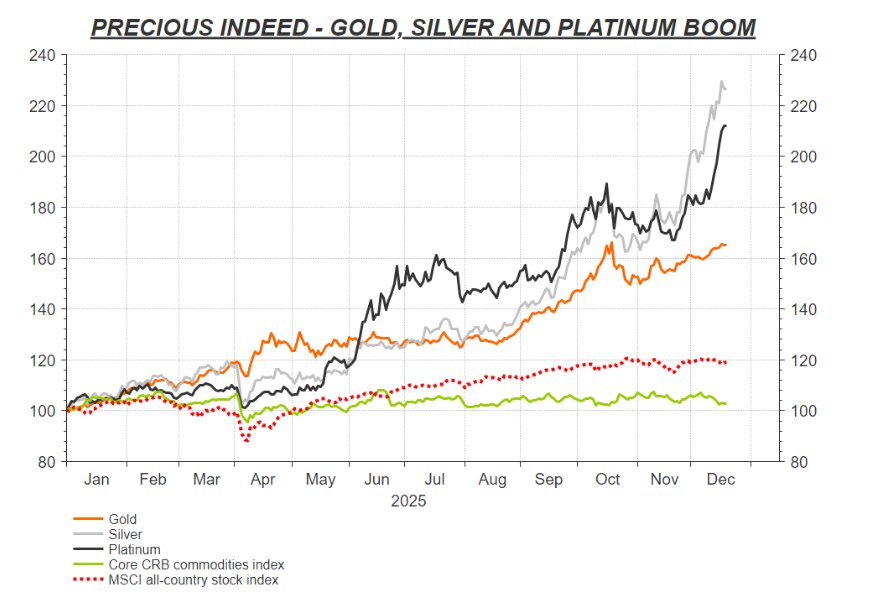
Core Viewpoint - Gold is projected to be the biggest winner among commodities and safe-haven assets in 2025, with a significant increase in its price, while traditional safe-haven assets have underperformed compared to the S&P 500 index [1][4]. Group 1: Precious Metals Performance - Precious metals, including gold, silver, and platinum, have collectively surged in 2025, outperforming the MSCI global stock index, with gold prices rising over 70%, marking the largest increase since the 1979 oil crisis [1][4]. - Silver and platinum have also seen their prices more than double, indicating a strong performance across the precious metals sector [1][4]. Group 2: Market Dynamics - The unexpected resilience of the global economy, coupled with rising geopolitical tensions and concerns over an "AI bubble," has contributed to the extreme pricing dynamics where traditional safe-haven assets have failed [1][7]. - The defense and military sector has emerged as an alternative safe haven, with U.S. aerospace and defense stocks rising by 36% and European counterparts increasing by 55% due to rearmament efforts in Europe [4][8]. Group 3: Traditional Safe-Haven Assets - Traditional safe-haven assets, such as government bonds and defensive stocks, have underperformed significantly, with global government bond prices unexpectedly declining by about 1% [15][17]. - The performance of traditional defensive sectors, including utilities and consumer staples, has lagged behind the S&P 500 index, with consumer staples being the worst-performing sector, rising only about 2% [17][18]. Group 4: Currency Performance - The Japanese yen and Swiss franc, typically viewed as safe-haven currencies, have also disappointed in 2025, with the yen declining approximately 4% against major trading partners [20][21]. - The U.S. dollar index (DXY) experienced a significant drop of 12% during periods of geopolitical turmoil, indicating a lack of safe-haven characteristics for both the dollar and yen in 2025 [23][21]. Group 5: Volatility Strategies - Volatility strategies, often used as hedging tools, have failed to deliver returns in 2025, with the VIX index reflecting lower volatility levels by year-end compared to the beginning of the year [24][26].

年内险资举牌39次:偏爱红利资产,科技板块迎布局机遇
2 1 Shi Ji Jing Ji Bao Dao· 2025-12-23 13:16
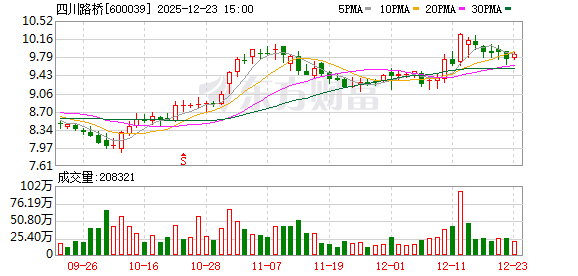
Core Insights - The article highlights the increasing trend of insurance capital (险资) in China, particularly focusing on the surge in shareholding activities, with a total of 39 instances of shareholding increases recorded in 2025, marking the second-highest level in history after 2015 [2][4]. Group 1: Shareholding Activities - Zhongyou Insurance has increased its stake in Sichuan Road and Bridge, reaching a total of 435 million shares, which constitutes 5.00% of the company's total equity, marking its fourth shareholding increase this year [3]. - Other insurance companies, such as Ruizhong Life and Taikang Life, have also engaged in similar shareholding activities, with Taikang Life triggering multiple shareholding increases in companies like Fuhong Hanlin and participating as a cornerstone investor in the IPO of Fengcai Technology [3][4]. - The trend of multiple shareholding increases by the same insurance company in a single target has been observed, with companies like Hongkang Life and Ping An Life making several increases in their holdings in banks [4]. Group 2: Investment Trends and Characteristics - The insurance capital's shareholding activities are characterized by a preference for high Return on Equity (ROE) and high dividend stocks, indicating a strategic focus on long-term investments that enhance the ROE of the insurance companies themselves [6]. - The asset allocation of insurance funds has seen an increase, with the proportion of stocks and funds rising to 15.5% by the third quarter of 2025, creating more room for shareholding activities [6]. - The insurance capital's preference for H-shares reflects a broader trend of favoring dividend-paying assets, which is expected to continue into 2026, with a potential shift towards growth sectors [7][8]. Group 3: Regulatory Support and Future Outlook - Recent regulatory changes, including the adjustment of risk factors for long-term holdings of certain equity assets, are expected to support the ongoing trend of shareholding increases by insurance companies [7]. - Analysts predict that the high frequency of shareholding activities will persist into 2026, with a gradual shift in focus towards more dynamic sectors, particularly technology stocks [8].



12月22日基金调研瞄准这些公司
Zheng Quan Shi Bao Wang· 2025-12-23 11:57
Group 1 - On December 22, a total of 13 companies were investigated by institutions, with 7 companies being focused on by funds, including Lingyi iTech and Junda Co., Ltd. [1] - Lingyi iTech received the most attention, with 33 funds participating in its investigation, while Junda Co., Ltd. and Wanxiang Qianchao had 4 and 3 funds respectively involved in their investigations [1][2] Group 2 - Among the companies investigated by funds, 4 are from the Shenzhen main board and 3 from the ChiNext board [2] - Only one company has a total market capitalization exceeding 500 billion yuan, with Lingyi iTech being among those exceeding 100 billion yuan, while 4 companies, including Meirui New Materials and Boying Special Welding, have market capitalizations below 10 billion yuan [2] - All investigated stocks have risen in the past 5 days, with Junda Co., Ltd. leading with a 13.16% increase, followed by Wanxiang Qianchao at 5.57% and Zhongtai Co., Ltd. at 4.69% [2] - In terms of net capital inflow over the past 5 days, Junda Co., Ltd. saw a net inflow of 132 million yuan, the highest among the stocks, followed by Lingyi iTech and Wanxiang Qianchao with net inflows of 118 million yuan and 113 million yuan respectively [2]


滨海投资(02886.HK)12月23日以4.4万港元回购4万股
Ge Long Hui· 2025-12-23 10:08
格隆汇12月23日丨滨海投资(02886.HK)发布公告,2025年12月23日以4.4万港元回购4万股,回购价格每 股1.1-1.12港元。 ...
滨海投资(02886)12月23日斥资4.42万港元回购4万股
智通财经网· 2025-12-23 10:04
智通财经APP讯,滨海投资(02886)发布公告,于2025年12月23日,该公司斥资4.42万港元回购4万股股 份,每股回购价1.1-1.12港元。 ...
太平洋煤气电力公司(PG&E CORP):正在对停电情况进行全面审查。
Xin Lang Cai Jing· 2025-12-23 01:50
Group 1 - The core focus of the article is on Pacific Gas and Electric Company (PG&E Corp) conducting a comprehensive review of its power outage situations [1] Group 2 - The company is assessing the causes and impacts of recent power outages [1] - This review aims to improve operational efficiency and customer service [1] - PG&E Corp is likely to implement changes based on the findings of this review to prevent future outages [1]


【光大研究每日速递】20251223
光大证券研究· 2025-12-22 23:05
Group 1: Fund Market Overview - Financial and real estate themed funds performed well, while TMT themed funds saw a net value decline [5] - A total of 40 new funds were established in the domestic market, with a combined issuance of 18.321 billion units [5] - Stock ETFs experienced significant inflows, particularly in large-cap broad-based ETFs, Hong Kong stock ETFs, and TMT themed ETFs [5] Group 2: Real Estate Market Insights - From January to November 2025, the transaction area of residential land in 100 cities decreased by 15.1% year-on-year, totaling 221 million square meters [5] - The average transaction floor price increased by 9.4% year-on-year to 6,295 yuan per square meter, with first-tier cities seeing a 29.5% increase [5] Group 3: Steel Industry Analysis - The price gap between hot-rolled and rebar steel is at its lowest level in six years [6] - High furnace capacity utilization rates have been below last year's levels for three consecutive weeks [6] - The price of tungsten concentrate reached a new high since 2012, while the capacity utilization rate for electrolytic aluminum hit a historical high [6] Group 4: Oil and Gas Sector Performance - China National Offshore Oil Corporation (CNOOC) received an "AA" rating in ESG, ranking 10th among 527 companies in the petrochemical sector [7] - The company has improved its board independence and risk management, actively addressing climate change and implementing carbon reduction measures [7] Group 5: Public Utilities Sector Update - In November, electricity generation increased by 2.7% year-on-year, with marginal improvements in the growth rates of nuclear, photovoltaic, and wind power [8] - The SW public utilities sector index fell by 0.59%, ranking 25th among 31 SW primary sectors [8] Group 6: Pharmaceutical and AI Integration - Ant Group rebranded its AI health application to "Ant Ai Fu," which saw a surge in downloads shortly after launch [8] - The product iteration transforms low-frequency medical visits into high-frequency health management, creating a digital closed loop from consultation to insurance claims [8] Group 7: Automotive Industry Developments - Botai Carlink, established in 2009, went public in September 2025, ranking third in China's passenger car intelligent cockpit domain control suppliers with a market share of 7.3% [8] - In the first five months of 2025, the company ranked second in the new energy passenger car cockpit domain control market with a market share of 13.11% [8]
旧金山突发大规模停电!波及约13万用户,无人驾驶车当街“瘫痪”
Mei Ri Jing Ji Xin Wen· 2025-12-22 13:25
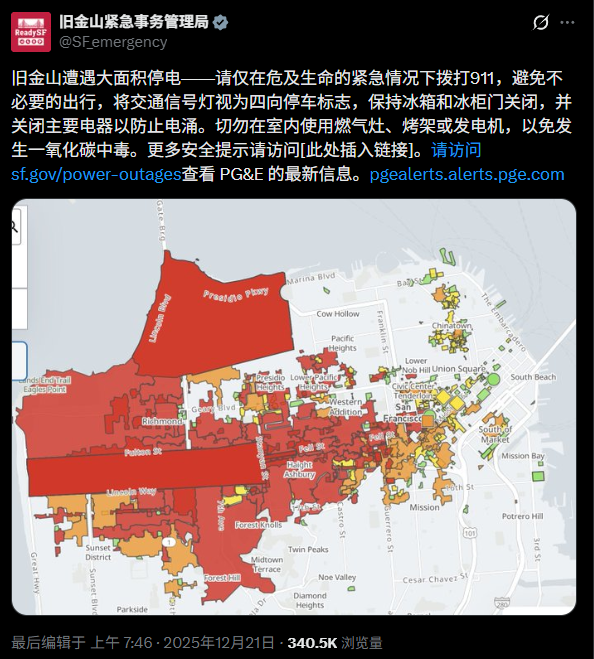
Core Viewpoint - A significant power outage occurred in San Francisco on December 20, affecting approximately 130,000 users, with over 20,000 still without power by the morning of December 21 [1]. Group 1: Power Outage Details - The first outage began at around 9:40 AM, impacting about 15,000 households and businesses, followed by a second outage at 10:10 AM affecting around 25,000 users [3]. - By 5:30 PM on the same day, Pacific Gas and Electric Company (PG&E) could not provide an estimated time for power restoration, coinciding with the peak shopping and social period before Christmas, leading to many businesses closing [3]. Group 2: Emergency Response and Impact - The city activated an emergency operations center to coordinate the response, while the cause of the outage remained unclear initially [5]. - A fire at a PG&E substation was reported to have caused part of the outage, which also led to traffic signal failures and disruptions in public transportation services [5]. Group 3: Impact on Autonomous Vehicle Services - Waymo, a subsidiary of Alphabet, reported that its autonomous ride-hailing service was suspended due to the power outage, causing significant traffic congestion in the city [5]. - Waymo is working closely with city officials to learn from this incident and restore services in the San Francisco Bay Area [5]. Group 4: Industry Context - Waymo has been operating its autonomous taxi service in San Francisco for over two years, with plans to expand to Las Vegas, San Diego, and Detroit in 2024 [6]. - Unlike Waymo, Tesla's autonomous taxi service was not affected by the outage, as it has not yet received permission for fully autonomous operations in California [6]. - A transportation researcher noted that the incident highlights overlooked issues in the design and development of autonomous vehicle technology, emphasizing the need for human oversight in highly automated systems [9].
看涨加仓?
第一财经· 2025-12-22 10:51
2025.12. 22 A肢二天指致圭圳局并局走、震荡上行念劣, 最终集体收冻。上此指数王要受队重股与周期权 块支撑,深证成指主要受科技板块与消费板块拉动,创业板指领涨,主要受新能源、医药等高 成长板块的驱动。 2983家上涨 2261 涨跌停比 105+8 市场呈现"情绪回暖+结构分化"格局。上涨板 块主要集中在政策驱动(海南自贸、商业航 天)、科技成长(算力硬件、半导体)、贵金属等 领域;调整板块则集中在金融(银行、保险)、影 视院线、医药商业等传统行业。 两市成交额 .80万亿元 ▲ 7.5% 两市成交额放量,是宏观政策、区域战略与产 业趋势三者共振的结果。指数方面深市量能的 放大超沪市,说明成长股的资金关注度更高,市 场的结构性行情仍在延续。板块方面,半导体、 人工智能及商业航天表现亮眼,成为量能放大 的重要支撑。 资金情绪 主力资金净流入 散户情绪 75.85% TITL 上 让 指 数 2月22日 0月10日 7月7日 3月 21 日 9月5日 12月9日 月23日 2月7日 2月22日 3月9日 3月24日 4月8日 4月23日 5月8日 5月23日 6月7日 6月22日 7月22日 8月6日 ...

滨海投资(02886.HK)12月22日以12.3万港元回购11万股
Ge Long Hui· 2025-12-22 10:05
格隆汇12月22日丨滨海投资(02886.HK)发布公告,2025年12月22日以12.3万港元回购11万股,回购价格 每股1.11-1.12港元。 ...