机械设备

Search documents
本周哪些行业有追涨和抄底机会?
HUAXI Securities· 2026-01-18 12:27
Quantitative Models and Construction Methods Moving Average Trend Model - **Model Name**: Moving Average Trend Model - **Model Construction Idea**: The model evaluates industry trends using four moving averages and combines three moving average indicators to derive a trend score[2][24] - **Model Construction Process**: 1. **Moving Average Arrangement**: When a shorter-term moving average is above a longer-term moving average, it is considered a bullish arrangement and scores 1 point; conversely, a bearish arrangement scores -1 point[2][24] 2. **Moving Average Spread**: Calculate the price difference between adjacent moving averages and take the average of all differences[2][24] 3. **Moving Average Temporal Change**: When the price of a moving average increases compared to the previous day, it scores 1 point; when it decreases, it scores -1 point[2][24] 4. Combine the three indicators and take the absolute value to get the moving average score. Rank the scores from high to low to identify industries with clear upward or downward trends[2][24] - **Model Evaluation**: This model effectively identifies industries with clear trends by combining multiple moving average indicators[2][24] Capital Flow Model - **Model Name**: Capital Flow Model - **Model Construction Idea**: The model measures changes in industry capital flow using the capital inflow rate[3][26] - **Model Construction Process**: 1. Calculate the capital inflow rate as the ratio of active net capital inflow to transaction amount[3][26] 2. For each industry, calculate the change in recent capital inflow rate relative to historical capital inflow rates[3][26] 3. Rank the changes in capital inflow rates from high to low to identify industries with the most significant capital inflow increases[3][26] - **Model Evaluation**: This model effectively identifies industries with significant capital inflow changes by comparing recent and historical inflow rates[3][26] Combined Moving Average Trend and Capital Flow Model - **Model Name**: Combined Moving Average Trend and Capital Flow Model - **Model Construction Idea**: The model combines moving average trend scores and capital flow scores to select industries with clear trends and high capital inflow rankings[4][27] - **Model Construction Process**: 1. Calculate the moving average trend score for each industry[2][24] 2. Calculate the capital flow score for each industry[3][26] 3. Combine the moving average trend scores and capital flow scores to rank industries[4][27] - **Model Evaluation**: This model effectively identifies industries with clear trends and significant capital inflows by combining two different indicators[4][27] Model Backtest Results - **Moving Average Trend Model**: - Top-ranked industries: Non-ferrous metals, communication, electronics[9] - **Capital Flow Model**: - Top-ranked industries: Media, computer, electronics[9] - **Combined Moving Average Trend and Capital Flow Model**: - Top-ranked industries: Electronics, media, non-ferrous metals, machinery equipment, computer[10]
A股投资策略周报:近期资本市场资金面异动分析-20260118
CMS· 2026-01-18 11:33
Core Insights - The report indicates that the recent acceleration in net financing inflow has provided incremental capital to the market, driving individual stock performance while significantly increasing overall market leverage and potential volatility risks [5][30]. - To mitigate the rapid rise in leverage, regulatory measures have been intensified, including raising the margin requirement for financing from 80% to 100%, which aims to control new leverage without impacting existing contracts [7][17]. - The report anticipates that the A-share market is likely to shift to a volatile trend after reaching previous highs, with a focus on performance disclosures expected to intensify as the earnings forecast disclosure peak approaches on January 15 [2][30]. Market Analysis - The report highlights that the A-share market experienced a high trading volume, with total market turnover exceeding 3.9 trillion yuan in the first half of the week, followed by a drop below 3 trillion yuan after the margin policy announcement [32]. - The technology sector, particularly AI computing and semiconductor equipment, is identified as a key battleground for January, alongside resource products represented by industrial metals [5][30]. - The report notes that the net outflow from ETFs, amounting to 129.6 billion yuan, has contributed to cooling market enthusiasm, with significant withdrawals from major ETFs such as the CSI 300 ETF [12][15]. Sector Performance - The report indicates that sectors such as computing, electronics, and non-ferrous metals have seen positive valuation trends, while sectors like defense, real estate, and steel have experienced declines [30][33]. - The report emphasizes the importance of cyclical and technology sectors for investment strategies, recommending a focus on industries such as electric equipment, machinery, non-bank financials, electronics, and basic chemicals [6][31]. - The report also highlights the improvement in the semiconductor industry, with December exports of integrated circuits showing a year-on-year increase of 47.72%, indicating a positive trend in the tech sector [38][41]. Investment Strategy - The report suggests a preference for large-cap growth stocks in the current market environment, recommending index combinations including CSI 300, STAR Market 50, and quality indices [6][31]. - It advises that industry allocation should focus on spring market dynamics and forward-looking clues from annual reports, particularly in cyclical and technology sectors [6][31]. - The report underscores the significance of monitoring performance disclosures, especially for small-cap and thematic stocks, as they may face pressure from earnings forecasts [5][30].
机构论后市丨A股慢牛趋势不变;业绩线索权重上升
Di Yi Cai Jing· 2026-01-18 10:03
Core Viewpoint - The A-share market is experiencing mixed performance, with the Shanghai Composite Index down 0.45% and the Shenzhen Component Index and ChiNext Index up 1.14% and 1% respectively, indicating a divergence in market trends as institutions provide insights on future movements [2] Group 1: Institutional Insights - CITIC Securities highlights that the adjustment of financing margins does not affect the overall upward trend of the market but impacts its structure, emphasizing the importance of performance indicators as the annual report preview period approaches [2] - Huaxi Securities maintains that the slow bull trend of A-shares remains intact, with a focus on sectors showing high growth or improving conditions as macro policies support economic recovery [3] - Galaxy Securities notes that investor sentiment is highly active, with a continuous increase in margin trading balances, indicating a stable long-term bullish foundation for the market despite short-term fluctuations [4] Group 2: Investment Opportunities - Investment opportunities are identified along two main lines: the acceleration of global changes favoring technology innovation and growth sectors, and the recovery of manufacturing and resource sectors due to improved supply-demand dynamics [5] - The first main line focuses on technology sectors such as AI and robotics, while the second emphasizes the recovery paths for industries like non-ferrous metals and basic chemicals [5] - Auxiliary opportunities include the continuation of consumption policies aimed at boosting demand and the trend of companies expanding their profitability through international markets [5]
北交所策略专题报告:开源证券融资杠杆适度收敛,聚焦北交所的“水位”提升空间
KAIYUAN SECURITIES· 2026-01-18 08:12
Group 1 - The financing balance of the North Exchange is approximately one-third of that of the ChiNext, indicating lower investor sentiment and market activity [1][11] - The North Exchange's financing balance reached a historical high of 92.85 billion yuan as of January 14, 2026, with a financing balance of 92.84 billion yuan [11][12] - The North Exchange's financing balance as a percentage of market capitalization was 1.25% in 2025, significantly lower than the ChiNext (3.57%) and the Sci-Tech Innovation Board (2.97%) [15][18] Group 2 - The North Exchange 50 Index reported 1,548.33 points, with a P/E ratio of 64.92X, while the North Exchange specialized and new index reached 2,666.88 points with a P/E ratio of 83.81X [2][32] - The average P/E ratios for key sectors in the North Exchange are as follows: high-end equipment (42.38X), information technology (96.48X), new chemical materials (47.82X), consumer services (49.03X), and biomedicine (37.32X) [39][44] - The North Exchange has seen a significant increase in daily trading volume, with an average of 409.81 billion yuan, up 55.52% from the previous week [31][33] Group 3 - The report recommends focusing on high-performing stocks within the North Exchange 50 and technology growth companies, particularly those with strong new production capabilities and scarcity attributes [46] - Recent IPOs have shown strong performance, with the first new stock of 2026, Kema Materials, experiencing a first-day increase of 371.27% [2][24] - The report highlights the active trading of North Exchange 50 constituent stocks, which generally show higher activity levels in financing and margin trading compared to non-constituent stocks [19][20]
A股市场运行周报第76期:市场修斜率,慢牛更可期,两法可应对-20260117
ZHESHANG SECURITIES· 2026-01-17 11:40
Core Insights - The market experienced a surge followed by a pullback, with a general trend of "small strength and large weakness" observed. The major indices began to correct their upward slope, indicating a potential short-term consolidation after the spring rally initiated in mid-December last year. However, this correction does not alter the overall "systematic slow bull" nature of the market [1][4][55] - The report suggests that the technology growth sector is expected to outperform, and recommends two strategies for market participation: one is to balance mid-term positions in sectors with high prosperity and reasonable price levels, specifically in the "two electric and non-mechanical" sectors (electronics, new energy, chemicals, non-bank financials, machinery) to adopt an "offensive instead of defensive" approach; the second is to consider the relatively lower positions in the market, such as the CSI 1000 and National CSI 2000, to capture relative returns [1][5][56] Weekly Market Overview - The market saw a significant increase in trading volume followed by a decline, with the major indices showing a "small strength and large weakness" pattern. The Shanghai Composite, SSE 50, and CSI 300 indices fell by 0.45%, 1.74%, and 0.57% respectively, while growth indices like CSI 500, CSI 1000, and National CSI 2000 rose by 2.18%, 1.27%, and 1.31% respectively [2][12][54] - The technology sector is gaining momentum, with TMT sectors (Technology, Media, Telecommunications) showing strong performance, while other styles are generally weakening. The computer, electronics, media, and communication sectors rose by 3.82%, 3.77%, 2.04%, and 1.42% respectively [2][14][54] Market Sentiment and Fund Flows - The average daily trading volume in the Shanghai and Shenzhen markets increased to 3.43 trillion yuan, indicating heightened market activity. However, the financing buy-in ratio decreased to 10.85% [20][26] - The total margin financing balance rose significantly to 2.71 trillion yuan, with a notable inflow of funds into the margin financing sector, while stock ETFs experienced a net outflow of 675 million yuan [26][31] Market Attribution - Key events influencing the market included the increase in financing margin ratios by the Shanghai and Shenzhen stock exchanges, announcements from multiple listed companies urging rational decision-making, and a meeting by the China Securities Regulatory Commission emphasizing market stability [3][50][54]
梳理2025年中国出口结构:20+图看2025年出口结构-20260116
Huachuang Securities· 2026-01-16 12:41
Export Structure Overview - In 2025, China's export structure shows a significant contribution from emerging markets, with a 49.1% share, up 2.5 percentage points from 2024[21] - Exports to the US decreased to 11.1%, down 3.5 percentage points from 2024, while non-US developed markets increased to 39.8%, up 1 percentage point[21] Commodity Contribution - Intermediate goods' export share rose from 41.9% in 2017 to 47.4% in 2025, with an annual increase of 0.7 percentage points[28] - Consumer goods' share fell from 36.6% to 28.7%, with an average annual decline of about 1 percentage point[28] - Capital goods' share slightly decreased from 21.5% to 20.1%, maintaining relative stability[28] Growth Contribution - From 2018 to 2025, the contribution of intermediate goods to export growth increased from 55.8% to 85%, while consumer goods' contribution dropped from 24.7% to -34%[28] - Capital goods' contribution rose from 19.4% to 22.4% during the same period[28] Regional Analysis - In the US, intermediate goods' share increased by 2.7 percentage points to 33.2%, while consumer goods decreased by 1 percentage point to 43.3%[41] - In the EU, intermediate goods remained stable at 39.3%, with consumer goods dropping by 3.1 percentage points to 31.7%[46] - In ASEAN, intermediate goods rose by 3.1 percentage points to 61.6%, while consumer goods fell by 5 percentage points to 19.1%[52] Market Dynamics - Emerging markets are driving growth, with significant contributions from regions like Africa, ASEAN, and Latin America, which collectively boosted exports by 5.6%[22] - The overall export growth for China in 2025 is projected at 5.5%, a slight decline of 0.3 percentage points from the previous year[21]
基于公开调研的超额收益挖掘
Huachuang Securities· 2026-01-16 12:11
- The report constructs an equal-weighted index based on the stocks investigated by fund managers over the past six months, with the "Research Stock-All Sample Index" achieving a cumulative return of 21.0%, outperforming the Shanghai Composite Index's 15.2% during the same period[5][13][14] - The "Research Stock-Growth Index" achieved a cumulative return of 20.5% over the past six months, surpassing the Shanghai Composite Index's 15.2% during the same period. Additionally, the representative fund's equal-weighted net value growth rate reached 29.2%, outperforming both the Growth Index and the Shanghai Composite Index[25][26][27] - The "Research Stock-Balanced Index" recorded a cumulative return of 25.7% over the past six months, exceeding the Shanghai Composite Index's 15.2%. The representative fund's equal-weighted net value growth rate was 19.8%, which is lower than the Balanced Index but higher than the Shanghai Composite Index[32][33][34] - The "Research Stock-Value Index" achieved a cumulative return of 18.3% over the past six months, outperforming the Shanghai Composite Index's 15.2%. The representative fund's equal-weighted net value growth rate was 8.8%, which is lower than both the Value Index and the Shanghai Composite Index[39][40][42] - The "Research Stock-Large Cap Index" achieved a cumulative return of 23.8% over the past six months, surpassing the Shanghai Composite Index's 15.2%. The representative fund's equal-weighted net value growth rate reached 28.4%, outperforming both the Large Cap Index and the Shanghai Composite Index[51][52][54] - The "Research Stock-Mid Cap Index" recorded a cumulative return of 23.9% over the past six months, exceeding the Shanghai Composite Index's 15.2%. The representative fund's equal-weighted net value growth rate was 23.0%, which is close to the Mid Cap Index and higher than the Shanghai Composite Index[61][62][61] - The "Research Stock-Small Cap Index" achieved a cumulative return of 19.2% over the past six months, outperforming the Shanghai Composite Index's 15.2%. The representative fund's equal-weighted net value growth rate was 17.5%, which is lower than the Small Cap Index but higher than the Shanghai Composite Index[68][69][71] - The "Research Stock-TMT Index" achieved a cumulative return of 23.9% over the past six months, surpassing the Shanghai Composite Index's 15.2%. The representative fund's equal-weighted net value growth rate reached 38.8%, outperforming both the TMT Index and the Shanghai Composite Index[79][80][79] - The "Research Stock-Manufacturing Index" recorded a cumulative return of 23.4% over the past six months, exceeding the Shanghai Composite Index's 15.2%. The representative fund's equal-weighted net value growth rate was 29.4%, outperforming both the Manufacturing Index and the Shanghai Composite Index[87][88][87] - The "Research Stock-Consumer Index" achieved a cumulative return of 7.5% over the past six months, slightly outperforming the Shanghai Composite Index's 15.2%. The representative fund's equal-weighted net value growth rate was 1.9%, which is lower than both the Consumer Index and the Shanghai Composite Index[94][95][94] - The "Research Stock-Cycle Index" recorded a cumulative return of 21.3% over the past six months, exceeding the Shanghai Composite Index's 15.2%. The representative fund's equal-weighted net value growth rate was 29.2%, outperforming both the Cycle Index and the Shanghai Composite Index[100][101][100] - The "Research Stock-Financial Real Estate Index" achieved a cumulative return of 33.2% over the past six months, significantly outperforming the Shanghai Composite Index's 15.2%. The representative fund's equal-weighted net value growth rate was 7.7%, which is lower than both the Financial Real Estate Index and the Shanghai Composite Index[107][108][107]


1月16日科创板高换手率股票(附股)
Xin Lang Cai Jing· 2026-01-16 12:10
Market Performance - The Sci-Tech Innovation Board (STAR Market) index rose by 1.35%, closing at 1514.07 points, with a total trading volume of 6.346 billion shares and a turnover of 345.756 billion yuan, resulting in a weighted average turnover rate of 3.23% [1][4]. - Among the tradable stocks on the STAR Market, 379 stocks closed higher, with 16 stocks increasing by over 10%, including Meier Technology, Tianyue Advanced, and Yongxi Electronics, which hit the daily limit [5][6]. - The distribution of turnover rates shows that 2 stocks had turnover rates exceeding 20%, 37 stocks had rates between 10% and 20%, and 130 stocks had rates between 5% and 10% [6]. Stock Highlights - The stock with the highest turnover rate was Hengkang New Materials, which closed up by 4.36% with a turnover rate of 34.78% and a transaction amount of 1.174 billion yuan [6][8]. - Other notable stocks included Haohan Depth, which rose by 3.22% with a turnover rate of 23.79%, and Xigao Institute, which increased by 19.50% with a turnover rate of 19.99% [6][8]. Sector Analysis - In terms of sector performance, the electronics sector had the most stocks with a turnover rate exceeding 5%, totaling 62 stocks, followed by the computer and machinery equipment sectors with 30 and 20 stocks, respectively [2][6]. Fund Flow - Among high turnover stocks, 92 stocks experienced net inflows of main funds, with the highest net inflows seen in Lanke Technology, Huahong Company, and Bawei Storage, amounting to 552 million yuan, 544 million yuan, and 386 million yuan, respectively [7]. - Conversely, the stocks with the largest net outflows included Chengdu Xiandao, Zhongke Xingtai, and Zhuoyi Information, with net outflows of 260 million yuan, 190 million yuan, and 179 million yuan, respectively [7]. Leverage Fund Movements - A total of 108 high turnover stocks received net purchases of leveraged funds, with significant increases in financing balances for Bawei Storage, Western Superconducting, and Shijia Photon, which increased by 500 million yuan, 391 million yuan, and 357 million yuan, respectively [7].

机构调研策略周报(2026.01.12-2026.01.16):机械设备、计算机等行业调研热度持续-20260116
Yuan Da Xin Xi· 2026-01-16 11:42
Group 1: Popular Industry Research - The most researched industries from January 12 to January 16, 2026, are mechanical equipment, computers, electronics, and power equipment, with mechanical equipment and computers receiving the highest attention in the past five days [9][11]. - Over the past 30 days (December 17, 2025, to January 16, 2026), the most researched industries are mechanical equipment, electronics, automobiles, power equipment, basic chemicals, and computers, with mechanical equipment and computers again leading in the number of research institutions [11]. Group 2: Popular Company Research - In the past five days, the companies with the most research occurrences and more than 10 institutional ratings include Ice Wheel Environment, Ningbo Bank, and Zhou Dasheng [14]. - Companies with the highest number of research institutions in the past five days, each with more than 10 institutional ratings, include SF Holding, Aobi Zhongguang-UW, and Qianwei Central Kitchen [15]. - Over the past 30 days, the companies with the most research occurrences and more than 10 institutional ratings include Ice Wheel Environment, Kebo Da, and Jiangbolong [18]. Group 3: Key Company Research Insights 1. **Ice Wheel Environment**: The focus of research is on its three high-growth sectors: data center liquid cooling, nuclear power and heating, and thermal management. The company is the only supplier of cooling systems for the entire nuclear island area in China and has successfully implemented liquid cooling solutions in several benchmark projects domestically and internationally [21][22]. 2. **SF Holding**: The research highlights its strategic shareholding agreement with Jitu Express, where both companies will invest approximately HKD 8.299 billion in each other. This partnership aims to integrate SF's advantages in cross-border logistics with Jitu's local delivery capabilities in Southeast Asia, the Middle East, and Latin America [23][24]. 3. **Aobi Zhongguang-UW**: The research focuses on the rapid growth of its performance, attributed to the penetration of 3D vision technology in various applications. The company reported a revenue of CNY 714 million for the first three quarters of 2025, a year-on-year increase of 103.50%, and a net profit of CNY 108 million, up 279.12% [25][26].


【16日资金路线图】两市主力资金净流出近240亿元 电子等行业实现净流入
Zheng Quan Shi Bao· 2026-01-16 10:38
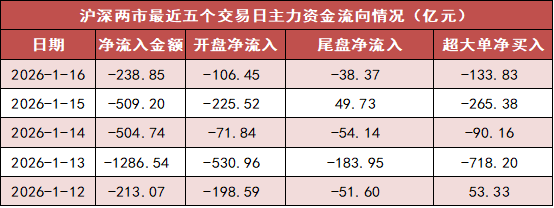
1月16日,A股市场整体下跌。截至收盘,上证指数收报4101.91点,下跌0.26%;深证成指收报14281.08点,下跌 0.18%;创业板指收报3361.02点,下跌0.2%。两市合计成交30262.32亿元,较上一交易日增加1207.36亿元。 1.两市主力资金净流出近240亿元 今日沪深两市主力资金开盘净流出106.45亿元,尾盘净流出38.37亿元,全天净流出238.85亿元。 | | | 沪深两市最近五个交易日主力资金流向情况(亿元) | | | | --- | --- | --- | --- | --- | | 日期 | | 净流入金额 开盘净流入 | 尾盘净流入 | 超大单净买入 | | 2026-1-16 | -238.85 | -106. 45 | -38. 37 | -133. 83 | | 2026-1-15 | -509.20 | -225.52 | 49.73 | -265. 38 | | 2026-1-14 | -504.74 | -71.84 | -54. 14 | -90. 16 | | 2026-1-13 | -1286.54 | -530. 96 | -183. 95 | ...