
饮料

Search documents
据港交所文件:东鹏饮料(集团)股份有限公司通过港交所上市聆讯。
Xin Lang Cai Jing· 2026-01-14 09:57
Group 1 - The core point of the article is that Dongpeng Beverage Group Co., Ltd. has passed the listing hearing on the Hong Kong Stock Exchange [1] Group 2 - The company is preparing for its initial public offering (IPO) in Hong Kong [1]

东鹏饮料,借钱+理财+减持+融资,一个不落
Sou Hu Cai Jing· 2026-01-14 09:56
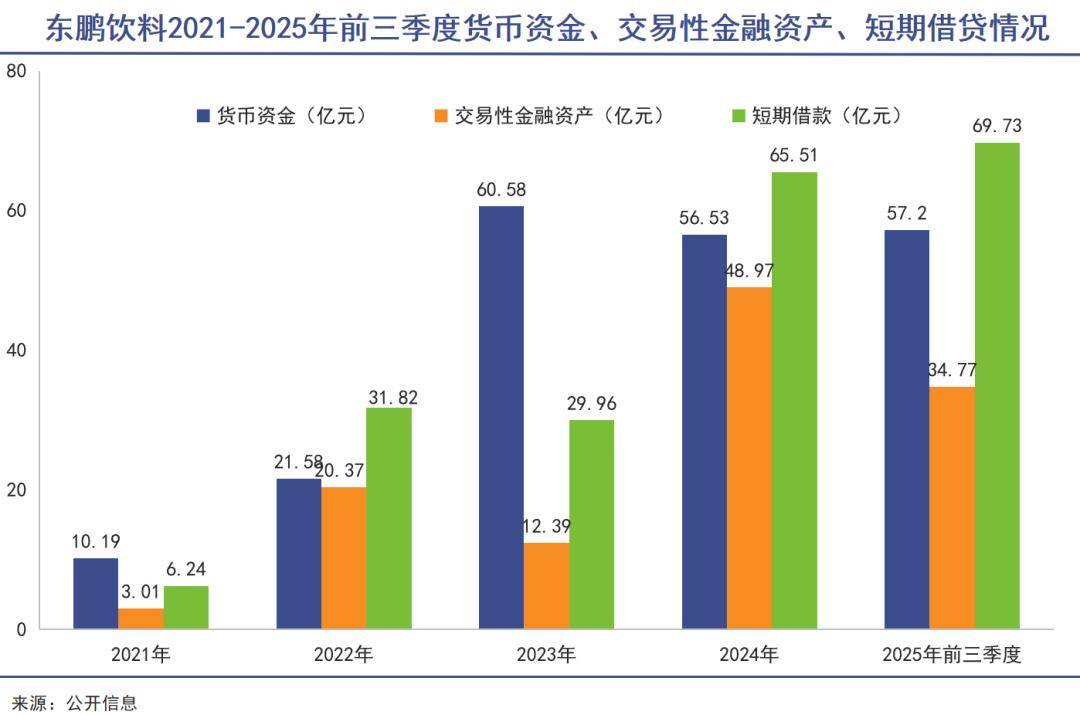
Core Viewpoint - Dongpeng Beverage, as the "first stock of functional drinks" in the A-share market, has shown strong operational momentum, but its financial strategy raises questions about its cash flow and reliance on borrowing [1][4]. Financial Performance - Dongpeng Beverage expects a net profit attributable to shareholders of between 4.34 billion and 4.59 billion yuan for 2025, representing a year-on-year growth of 30.46% to 37.97% [2]. - For the first three quarters of 2025, the company reported revenue of 16.844 billion yuan, a year-on-year increase of 34.13%, and a net profit of 3.761 billion yuan, up 38.91% [5]. Cash Flow and Debt - Despite strong profit growth, the company's cash reserves have been shrinking, with monetary funds decreasing from 6.058 billion yuan at the end of 2023 to 5.653 billion yuan by the end of 2024, and further down to 5.262 billion yuan in Q2 2025 [6]. - The short-term borrowing balance surged by 118.69% to 6.551 billion yuan by the end of 2024, with further increases to 6.973 billion yuan by Q3 2025, raising the debt-to-asset ratio from 57.01% to 66.08% [7]. Investment Strategy - Since 2022, Dongpeng Beverage has significantly increased its investment in financial products, with trading financial assets rising from 301 million yuan in 2021 to 4.897 billion yuan in 2024 [8][9]. - The company plans to invest up to 11 billion yuan of idle funds into various investment products, indicating a strong inclination towards financial investments [12]. Dividend Policy - From 2021 to 2024, Dongpeng Beverage distributed cash dividends totaling 5.3 billion yuan, with a cash dividend payout ratio of 69.1% in 2024, significantly higher than many A-share companies [16]. - The majority of dividends benefited the founding family, which holds over 65% of the company's shares, leading to over 3.4 billion yuan flowing into their pockets during the dividend period [17]. Shareholder Actions - Early investor Junzheng Investment has completely exited its position, having reduced its holdings by over 4 billion yuan within three years [20]. - The founding family's associated shareholders have also engaged in significant share reductions, with one plan resulting in the sale of shares worth 1.908 billion yuan [20]. Market Strategy - Dongpeng Beverage's rise is attributed to its strategy of emulating market leader Red Bull, including adopting similar marketing tactics and product offerings [21]. - The company has introduced a "1+6 multi-category strategy" to diversify its product line, but the energy drink still accounts for 74.63% of total revenue as of Q3 2025 [24]. International Expansion - The company plans to use funds from its Hong Kong listing to establish supply chain infrastructure in Southeast Asia, aiming for localized operations [24]. - However, entering the Southeast Asian market poses challenges due to established competitors like Red Bull and other international brands [24].

里昂:上调农夫山泉目标价至57.6港元 料下半年增长加速
Zhi Tong Cai Jing· 2026-01-14 08:40
Group 1 - The core viewpoint of the report is that the company Nongfu Spring (09633) has had its profit forecast slightly raised, maintaining a "highly confident outperform" rating, with the target price increased from HKD 55 to HKD 57.6 [1] - The sales growth rate for Nongfu Spring is projected to accelerate from 16% year-on-year in the first half of 2025 to 26% in the second half [1] - Tea products are expected to perform particularly well, with a projected year-on-year growth of 35%, while the market share for bottled water is anticipated to continue recovering [1] Group 2 - The report estimates that improved product mix, lower raw material costs, and savings in selling, general, and administrative expenses (SG&A) will lead to an expansion in gross and net profit margins [1] - It is expected that the net profit margin in the second half of 2025 will be slightly higher than in the first half [1] - The forecasted net profit for 2025 is approximately 5% higher than the market consensus, with strong performance in the second half likely to drive short-term stock price increases [1]

东鹏饮料股价连续4天下跌累计跌幅5.09%,国寿安保基金旗下1只基金持1300股,浮亏损失1.84万元
Xin Lang Cai Jing· 2026-01-14 07:25
Group 1 - Dongpeng Beverage's stock price fell by 2.91% on January 14, closing at 264.68 yuan per share, with a trading volume of 943 million yuan and a turnover rate of 0.68%, resulting in a total market capitalization of 137.637 billion yuan [1] - The stock has experienced a continuous decline for four consecutive days, with a cumulative drop of 5.09% during this period [1] - Dongpeng Beverage's main business includes the research, production, and sales of beverages, with revenue composition as follows: energy drinks 77.87%, electrolyte drinks 13.90%, other beverages 8.17%, and others 0.06% [1] Group 2 - The Guoshou Anbao Fund has a significant holding in Dongpeng Beverage, specifically in the Guoshou Anbao Quality Consumption Stock Initiation A Fund (020140), which increased its holdings by 200 shares to a total of 1,300 shares, representing 4.08% of the fund's net value [2] - The fund has incurred a floating loss of approximately 10,300 yuan today, with a total floating loss of 18,400 yuan during the four-day decline [2] - The Guoshou Anbao Quality Consumption Stock Initiation A Fund was established on December 7, 2023, with a latest scale of 9.3226 million yuan, and has achieved a year-to-date return of 6.31%, ranking 2017 out of 5520 in its category [2]
国盛证券:维持东鹏饮料“买入”评级,25年圆满收官,26年继续突破
Xin Lang Cai Jing· 2026-01-14 06:18
Core Viewpoint - Dongpeng Beverage is expected to achieve a net profit attributable to shareholders of 4.34 to 4.59 billion yuan for the year, representing a year-on-year growth of 30.46% to 37.97% [1] Financial Performance - For Q4, the estimated net profit attributable to shareholders is projected to be between 579 to 829 million yuan, with a year-on-year change of -6.5% to +33.9%, and a median of 704 million yuan, indicating a year-on-year increase of 13.7% [1] - The company is expected to maintain steady growth during the off-season in Q4 [1] Market Expansion and Product Strategy - Dongpeng Beverage is actively expanding into overseas markets, which is anticipated to provide new growth opportunities [1] - The functional beverage segment is identified as the fastest-growing sub-sector within the beverage industry, with significant potential for expansion due to increasing consumer demographics and usage scenarios [1] - The company is enhancing its leading position by leveraging product cost-effectiveness and digital advantages [1] Product Line Development - In addition to its flagship product Dongpeng Special Drink, the company is also developing new products such as Dongpeng Water and Guozhi Tea, which are showing strong momentum [1] Future Projections - For the years 2025 to 2027, the net profit attributable to shareholders is projected to grow by 32.7%, 23.4%, and 20.1% respectively, reaching 4.42 billion, 5.45 billion, and 6.55 billion yuan [1] - The company maintains a "Buy" rating based on its growth prospects [1]
东鹏饮料,借钱+理财+减持+融资一个不落
Xin Lang Cai Jing· 2026-01-14 06:06
文 | 老鱼儿 编辑 | 杨旭然 作为A股市场"功能饮料第一股",东鹏饮料的经营势头一直很好。 1月13日,东鹏饮料公告,其预计2025年度实现归属于母公司所有者的净利润在43.4亿元到45.9亿元之间,同比增幅为30.46%到37.97%。 根据这个数据粗略计算,从2017年到2025年这9年里,东鹏饮料累计净利润超140亿元,用"赚得盆满钵溢"来形容并不为过。 虽然"数钱到手软",东鹏饮料想要的还有更多。2025年4月和10月,东鹏饮料两次向香港联交所递交了发行境外上市外资股(H股)的申请。 根据招股书,东鹏饮料明确将把募集资金用于七大方向:完善产能布局与供应链升级、加强品牌建设与消费者互动、推进全国化战略与渠道精细化运营、 拓展海外市场与探索并购、深化各环节数字化建设、增强产品开发与品类拓展能力,以及补充营运资金与一般企业用途。 整体上看,除了拓展海外市场之外,其他六大方向都有些语焉不详。 一边是充沛的盈利能力,一边是急着赴港融资"补血",监管层和投资者显然对此会产生疑问:东鹏饮料真的缺钱吗?二次上市所融得的资金,究竟要被拿 去做什么? 借钱+理财 若单看业绩数据,东鹏饮料的增长势头足以让同行羡慕。 2 ...

美国通胀表现不温不火:环球市场动态2026年1月14日
citic securities· 2026-01-14 04:33
Market Overview - US inflation remains moderate, with the overall CPI year-on-year growth steady at 2.7% and core CPI at 2.6%, slightly below expectations[5] - A-shares ended a 17-day rally, with the Shanghai Composite Index down 0.64% to 4,138.76 points, and over 3,700 stocks declining[14] - The Hang Seng Index rose 0.90% to 26,848.47 points, driven by gains in innovative drugs and AI healthcare sectors[10] Commodity and Currency Insights - International oil prices surged over 2% due to concerns over Iranian supply, with NY crude oil up 2.77% to $61.15 per barrel[26] - Gold prices retreated after reaching a historical high, while silver set a new record high[26] - The US dollar index increased by 0.3%, closing at 99.13, reflecting a year-to-date rise of 0.8%[25] Fixed Income Market - US Treasury yields showed mixed movements, with the 10-year yield rising 0.4 basis points to 4.18%[28] - The auction of $220 billion in 30-year bonds saw a bid-to-cover ratio of 2.42, indicating solid demand[28] - Asian bond markets remained resilient, with spreads generally narrowing by 1-4 basis points[28] Sector Performance - In the US, the energy sector led gains with a 1.53% increase, while financial stocks lagged, dropping 1.84%[8] - In Europe, the energy and resource sectors performed strongly, benefiting from stable oil prices, while healthcare and consumer sectors showed weakness[8] - In the A-share market, healthcare and energy sectors saw positive performance, while information technology and industrial sectors faced declines[15]

泉阳泉迎来拐点了吗?归母净利润大增背后扣非仍亏损 矿泉水收入增速明显落后销量增速
Xin Lang Cai Jing· 2026-01-14 03:40
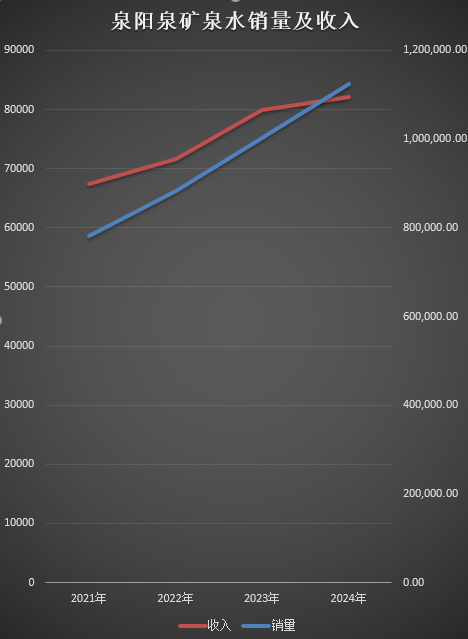
Core Viewpoint - The company, Quan Yang Quan, expects to achieve a net profit attributable to shareholders of 15.22 million yuan in 2025, representing a year-on-year increase of 147.89%, following significant losses in 2023 and achieving positive net profits for two consecutive years [1][11]. Financial Performance - In the first three quarters of 2025, Quan Yang Quan reported a net profit of 24.67 million yuan, but estimates suggest a fourth-quarter loss of 9.45 million yuan, leading to an annual net profit forecast of -1.58 million yuan when excluding non-recurring items [3][12]. - The company has experienced four consecutive years of losses when excluding non-recurring items, although the loss amount has significantly decreased compared to previous years [3][12]. - Non-recurring gains, primarily from government subsidies, contributed significantly to the positive net profit, with 51.26 million yuan in 2024 and 16.34 million yuan in the first three quarters of 2025, accounting for nearly 60% of non-recurring gains [3][13]. Business Segments - Quan Yang Quan's main business segments are mineral water and landscaping, with mineral water contributing 69% of revenue in 2024, while landscaping and door products contributed 15% and 13.69%, respectively [4][13]. - The landscaping business has been a consistent drag on performance, with revenue declining from 562 million yuan in 2019 to 181 million yuan in 2024, leading to significant asset impairment provisions totaling 452 million yuan in 2023 [4][13]. - The door business is also struggling due to a downturn in the real estate market, with losses reported in both the landscaping and door segments in the first half of 2025 [14]. Management and Strategy - A new management team was elected in September 2025, with a renewed focus on strengthening the mineral water business and exploring new product lines, such as forest-themed beverages [6][15]. - The company aims to enhance its mineral water segment, which has seen a sales volume increase to 1.5034 million tons in 2024, a 33.84% rise from the previous year [7][15]. Market Position and Challenges - Despite the growth in sales volume, revenue growth has lagged behind, raising questions about the company's pricing strategy and whether it is sacrificing margins for volume [7][16]. - The company's gross margin for mineral water is around 40%, significantly lower than competitors like Nongfu Spring and Yi Bao, which have margins of approximately 60% and 50%, respectively [8][17]. - High overall expense ratios, with sales and management expenses reaching 24.67% in 2024, further compress profit margins [8][17].

农夫山泉涨超6% 里昂预计其去年下半年增长加速
Zhi Tong Cai Jing· 2026-01-14 03:23
Core Viewpoint - Nongfu Spring (09633) shares rose over 6%, currently up 5.92% at HKD 50.65, with a trading volume of HKD 323 million [1] Group 1: Sales Growth Forecast - According to a report by Citi, Nongfu Spring's sales growth rate is expected to accelerate from 16% year-on-year in the first half of 2025 to 26% in the second half [1] - Tea products are projected to perform exceptionally well, with an anticipated year-on-year growth of 35% [1] - The bottled water market share is expected to continue its recovery [1] Group 2: Profitability and Cost Structure - The company is estimated to benefit from an improved product mix, lower raw material costs, and savings in selling, general, and administrative expenses (SG&A), leading to an expansion in gross and net profit margins [1] - The net profit margin for the second half of 2025 is expected to be slightly higher than that of the first half [1] - The net profit forecast for 2025 is approximately 5% higher than the market consensus [1] Group 3: Stock Price Impact - Strong performance in the second half of 2025 is anticipated to drive the stock price upward in the short term [1]
港股异动 | 农夫山泉(09633)涨超6% 里昂预计其去年下半年增长加速
智通财经网· 2026-01-14 03:15
Group 1 - The core viewpoint of the article highlights that Nongfu Spring (09633) has seen a stock price increase of over 6%, currently trading at 50.65 HKD with a transaction volume of 323 million HKD [1] - According to a report from Citi, Nongfu Spring's sales growth rate is expected to accelerate from 16% in the first half of 2025 to 26% in the second half [1] - The tea product segment is projected to perform exceptionally well, with an anticipated year-on-year growth of 35%, while the bottled water market share is expected to continue its recovery [1] Group 2 - The report estimates that improved product structure, lower raw material costs, and savings in selling, general, and administrative expenses (SG&A) will lead to an expansion in gross and net profit margins [1] - It is expected that the net profit margin in the second half of 2025 will be slightly higher than in the first half [1] - The forecasted net profit for 2025 is approximately 5% higher than the market consensus, with strong performance in the second half likely to drive short-term stock price increases [1]