
地产

Search documents
午评:沪指创阶段新高,创业板大涨近3%,券商、医药等板块拉升
Zheng Quan Shi Bao Wang· 2025-08-13 05:13
盘面上看,券商板块走高,有色、医药、保险、汽车、半导体、地产等板块均走强,液冷服务器、CPO 概念、创新药、光刻机概念等活跃。 截至午间收盘,沪指涨0.56%报3686.34点,深证成指涨1.47%,创业板指涨2.81%,沪深北三市合计成交 13285亿元。 东莞证券表示,当前市场情绪仍维持强势,两融余额持续攀升至2万亿元大关并创十年新高,印证了本 轮行情主要由增量流动性驱动的核心特征。短期看,市场技术面强势背景下,仍有惯性反弹挑战前期高 点机会,需要注意的是高位的震荡反复。中期视角下,随着中美贸易形势再度缓和,而8月既处于国内 政策相对真空期,又叠加上市公司半年报集中披露的时间窗口,预计结构性板块轮动的特征将进一步凸 显。展望后市,在境内无风险利率系统性下行的牵引下,叠加海外美元流动性外溢效应的助推,增量资 金流入的动能有望延续,为市场提供关键性支撑。 13日早盘,A股三大股指强势拉升,沪指盘中创2021年12月以来新高;深证成指涨超1%,创业板指大 涨近3%,均创阶段新高。 (文章来源:证券时报网) ...

衢州发展收购先导电子95.46%股份 加码硬科技生态链
Zheng Quan Shi Bao Wang· 2025-08-12 15:18
Group 1 - The core point of the news is that Quzhou Development plans to acquire 95.4559% of Xian Dao Electronic Technology Co., Ltd. through a share issuance and raise up to 3 billion yuan in supporting funds [1][2] - The acquisition price is set at 3.46 yuan per share, with the total estimated value of the target company not exceeding 12 billion yuan [1][2] - The transaction does not constitute a restructuring listing, and the controlling shareholder remains Quzhou Zhibao Enterprise Management Partnership [1] Group 2 - Xian Dao Electronic is a leading domestic enterprise in high-end sputtering targets and evaporation materials, focusing on R&D, production, and sales [2] - The target company's products serve downstream markets including display panels, advanced photovoltaics, semiconductors, and new solid fuel cells, with applications in various sectors such as renewable energy and consumer electronics [2] - In 2024, Xian Dao Electronic is projected to achieve revenue of 3.431 billion yuan and a net profit of 444 million yuan [2] Group 3 - Quzhou Development has been focusing on strategic transformation in the real estate sector, optimizing resource allocation through a light asset operation model [3] - The company has made significant investments in high-tech sectors such as semiconductor materials, blockchain, and artificial intelligence, establishing a hard technology ecosystem [3] - Recent investments in high-tech projects have started to yield returns, with the company planning to support and cultivate the development of invested enterprises further [3]

突然涨停!千亿巨头,新高!
证券时报· 2025-08-12 09:32
Market Overview - A-shares showed strong performance on August 12, with all three major indices reaching new highs for the year, and the Shanghai Composite Index achieving a seven-day winning streak [1] - The Shanghai Composite Index peaked at 3669.04 points during the day, closing at 3665.92 points, up 0.5% [1] Semiconductor Sector - The semiconductor sector experienced a significant rally, with stocks like Cambricon (寒武纪) and Shanghai Hualing (上海合晶) hitting the 20% daily limit, marking new historical highs [2][4] - The global semiconductor industry entered an upward cycle in Q2 2023, driven by AI infrastructure, particularly in North America, with growth rates around 20% [6] - Domestic semiconductor growth is primarily benefiting from the recovery in consumer electronics, with expectations of a sales growth slowdown in late 2024 [6] Photolithography Equipment Concept - The photolithography equipment concept stocks surged, with companies like Feikai Materials and SdiTech seeing gains of over 10% [8] - The price of core materials for photolithography, such as photoinitiators, has been rising, with a recent increase of 5.56% to 95 yuan/kg, marking a nearly 15% rise in August alone [10] Real Estate Sector - The real estate sector showed renewed strength, with stocks like Shenzhen Properties A and Shahe Shares hitting the daily limit [12] - Recent policy adjustments in Beijing aimed at optimizing housing purchase regulations are expected to stimulate the real estate market, with other first-tier cities likely to follow suit [14] - Analysts suggest that the current low valuations and reduced holdings in the real estate sector present a buying opportunity [14]



中国华星(00485.HK)8月12日收盘上涨9.33%,成交8400港元
Jin Rong Jie· 2025-08-12 08:38
机构评级方面,目前暂无机构对该股做出投资评级建议。 8月12日,截至港股收盘,恒生指数上涨0.25%,报24969.68点。中国华星(00485.HK)收报0.41港元/ 股,上涨9.33%,成交量2万股,成交额8400港元,振幅2.67%。 最近一个月来,中国华星累计涨幅150%,今年来累计涨幅140.38%,跑赢恒生指数24.16%的涨幅。 财务数据显示,截至2025年3月31日,中国华星实现营业总收入1832.28万元,同比减少37.79%;归母净 利润-2245.89万元,同比减少30.92%;毛利率25.47%,资产负债率27%。 行业估值方面,地产行业市盈率(TTM)平均值为9.29倍,行业中值-0.16倍。中国华星市盈率-3.28 倍,行业排名第139位;其他百仕达控股(01168.HK)为0.93倍、瑞森生活服务(01922.HK)为2.82 倍、鑫苑服务(01895.HK)为3.03倍、兴业物联(09916.HK)为3.25倍、中国新城市(01321.HK)为 3.32倍。 资料显示,中国华星集团有限公司肩负'创造美好生活'之使命,将公司新管理团队在企业文化方面取得的 成就融入到当前经营的业 ...
稳增长信号强劲释放 机构把脉投资主线
Xin Hua Wang· 2025-08-12 06:30
多个高景气行业受关注 "展望后市,不必对市场的短期调整过度悲观。"国泰君安表示,一方面,两会释放积极信号,预示着稳 增长将加速发力;另一方面,2月PMI已小幅回暖,使得市场下行有底。基于当前市场环境与政策主 线,机构预计后续政策力度还将持续加大。对A股而言,建议坚守稳增长主线,并结合一季报优选景气 较高且有望超预期的细分领域。 5日提请十三届全国人大五次会议审议的政府工作报告对2022年经济社会发展作出部署,明确释放 出坚持"稳字当头、稳中求进"的信号。机构普遍预计后续相关政策力度将持续加大,建议坚守稳增长主 线。 稳增长信号再强化 多家机构表示,政府工作报告再度释放稳增长信号,相关措施值得期待。中信证券认为,从国内经济和 政策来看,预计前两个月经济数据整体平稳,稳增长效果初步显现。全年经济增长目标清晰明确,预计 后续政策力度还将持续加大。农银汇理基金也表示,政府工作报告释放诸多积极信号,反映政策稳增长 的诉求和决心持续提升。 华安证券认为,在稳增长抓手方面,基建有资金有项目,将扮演主角;微观政策持续激发市场主体活 力,减税降费和给实体企业降成本力度扩大,低碳升级、高端制造将带动制造业投资增长;此外,保障 房 ...
万和财富早班车-20250812
Vanho Securities· 2025-08-12 02:19
Core Insights - The report emphasizes the ongoing improvement of the capital market's "1+N" policy system, aiming to enhance attractiveness and inclusivity [4] - The core CPI in July increased by 0.8% year-on-year, marking a continuous expansion in growth for three months [4] - The latest data from the China Small and Medium Enterprises Association indicates a stable outlook for the operation and development of small and medium enterprises [4] Industry Dynamics - The new real estate policy in Beijing has led to a significant increase in viewing volume, suggesting that the real estate sector may enter a phase of policy-driven market stimulation, with related stocks such as I Love My Home (000560) and Long Dragon Real Estate (600159) being highlighted [5] - The acceleration of low-orbit satellite launches in China indicates that the commercial aerospace sector is likely entering a high prosperity cycle, with relevant stocks including Aerospace Hanyu (688523) and Jinggong Technology (002006) [5] - Huawei is set to release groundbreaking achievements in AI inference, which is expected to catalyze the industry chain, with related stocks such as Tianyuan Dike (300047) and Hongda Electronics (300726) [5] Company Focus - Gaoxin Xing (300098) has developed a comprehensive C-V2X product matrix covering vehicle, road, and cloud endpoints [6] - Dao's Technology (300409) has achieved a certain production scale for single-walled carbon nanotubes and has begun sales to multiple battery cell customers [6] - Dezhan Health (000813) has a subsidiary, Deyi Pharmaceutical, which is currently in the preclinical research phase for an innovative small molecule cannabinoid drug [6] - Lianchuang Electronics (002036) has developed 3D vision-related lenses, imaging modules, and systems that are utilized in mobile phones, automobiles, drones, and robots [6] Market Review and Outlook - On August 11, the market experienced a steady rise, with the ChiNext Index leading gains, and both the Shanghai and Shenzhen indices reaching new highs for the year [7] - The total trading volume in the Shanghai and Shenzhen markets was 1.83 trillion, an increase of 116.7 billion compared to the previous trading day [7] - The report notes a healthy rotation of market hotspots, with over 4,100 stocks rising, and more than a hundred stocks increasing by over 9% [7] - Looking ahead, investors generally expect a bull market, although there is increasing divergence regarding short-term market conditions, with potential resistance due to economic downturn expectations and structural adjustments in policy [7] - The report suggests that sectors such as pharmaceuticals and overseas computing are high-prosperity directions, while new consumption may see a rotation and rebound in the near future [7]
A股放量反弹逼近前高,多板块联动,指数突破契机何在?
Sou Hu Cai Jing· 2025-08-11 23:00
Market Performance - The A-share market experienced a strong rebound on Monday after a volatile Friday, with trading volume significantly increasing and the index reaching 3656 points, close to the historical high of 3674 points set during last year's National Day holiday [1] - The securities sector showed active performance, with Tonghuashun's stock price soaring over 7%, indicating that some funds may be positioning for a breakout above the historical high [1] Sector Analysis - The real estate and liquor sectors, which have been underperforming for a long time, are showing signs of strength, potentially driven by the relaxation of purchase restrictions in Beijing for the real estate sector [1] - The liquor sector's rise is notable as it reflects a gradual recovery in market confidence, attracting funds even from previously pessimistic areas [1] - If the liquor, real estate, and securities sectors can work in tandem, a breakthrough of previous highs is possible, although it would require a trading volume of over 2 trillion to support such a move [1] Bond Market - The bond market experienced a significant drop, with the 30-year government bond futures falling by 0.55%, suggesting that the previously concentrated funds in the bond market are loosening, indicating a reduction in the most pessimistic market sentiment [1] Upcoming Events - The A-share market will closely monitor two major events: tariff negotiations and expectations for a Federal Reserve interest rate cut, with recent comments from Trump providing positive signals regarding tariffs [3] - Following disappointing U.S. non-farm data, expectations for interest rate cuts have begun to take shape, leading to a decline in the U.S. dollar index to around 98 [3] Commodity Market - The international financial market has been unsettled due to news of U.S. tariffs on imported gold bars, although the White House later denied this plan, resulting in a significant impact on gold prices, which fell by 1% [3] - The lithium mining sector gained attention over the weekend due to news of production halts in the Ningde Times' mining area, leading to a rebound in lithium price expectations and a surge in A-share lithium mining stocks [3] Stock Performance - The A-share market saw a notable increase in trading volume, reaching 1.84 trillion, with over 4100 stocks rising [5] - The power equipment, communication, computer, electronics, and food and beverage sectors led the gains, while banking, oil and petrochemicals, coal, public utilities, and transportation sectors lagged [5]
鱼尾行情,如何博弈?
格隆汇APP· 2025-08-11 10:29
Market Trends - The market trends from late July to early August closely resemble those from late February to early March, indicating a cyclical pattern in market behavior [3][4] - Both periods experienced a month-long rally followed by significant adjustments and rebounds, with similar volume patterns of "decrease-increase" [4] Risk Signals - The current market exhibits typical "tail behavior," with three major risk signals to watch for: accelerated sector rotation, rising external pressures, and irrational leverage [6][7][9] - Rapid sector rotation is evident, with strong sectors unable to maintain momentum, reflecting a "one-day tour" pattern where funds quickly shift from high-performing sectors to lower-positioned ones [6] - External pressures, particularly from U.S.-China relations, are increasing uncertainty, impacting market momentum [7][8] Leverage and Market Behavior - Leverage funds are increasing their positions despite market pressures, with margin financing balances exceeding 2 trillion yuan, the highest since July 2015, indicating potential overheating [9] - The behavior of leverage funds during market adjustments suggests a tendency to amplify volatility, raising concerns about future market corrections [9] Investment Strategy - In the context of a "tail market," the recommended strategy is to reduce positions at highs while preparing for potential rebounds, emphasizing the importance of locking in profits rather than chasing returns [11][13] - The current market dynamics suggest that maintaining a cautious approach may be more valuable than aggressive strategies, especially as market conditions evolve [14][15]
A股,全线爆发!近4200股飘红
证券时报· 2025-08-11 10:13
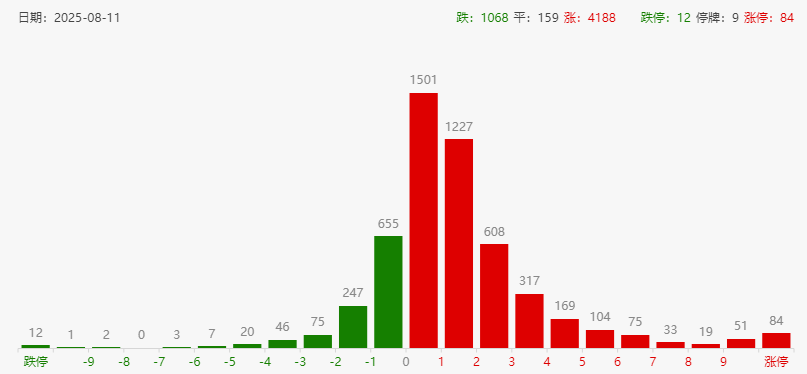
Market Overview - A-shares experienced a broad increase on August 11, with the Shanghai Composite Index reaching a new high for the year, marking six consecutive days of gains [1] - The Shanghai Composite Index rose by 0.34% to 3647.55 points, while the Shenzhen Component Index increased by 1.46% to 11291.43 points, and the ChiNext Index surged by 1.96% to 2379.82 points [1][2] - Total trading volume in the Shanghai and Shenzhen markets reached 18501 billion, an increase of 1135 billion from the previous day [1][2] Sector Performance PEEK Materials - The PEEK materials sector saw significant gains, with companies like Huami New Materials and Shuangyi Technology hitting the 20% daily limit up, and others like Zhongyan New Materials rising approximately 15% [6][8] - PEEK materials are recognized for their low density, high strength, and chemical stability, making them essential for lightweight humanoid robots, enhancing their performance and reliability [8] AI Industry Chain - Stocks in the AI industry chain were notably active, with companies like Weirgao and Dazhu Laser reaching the 20% limit up, and others like Tiancheng Technology and Luyiguangdian also showing strong performance [10][12] - The recent release of OpenAI's GPT-5 is expected to accelerate AI applications and commercialization, benefiting internet companies and enhancing the AI investment landscape [10][12] Lithium Mining - The lithium mining sector saw a collective rise, with companies like Ganfeng Lithium and Tianqi Lithium reaching their daily limit up, indicating strong market interest [14][16] - The expiration of mining permits for certain lithium projects is expected to impact domestic lithium carbonate production by nearly 12%, potentially leading to a tightening supply and higher lithium prices [16]


“红利资产+科技成长”折射A股市场投资新趋势,业内人士解读→
Sou Hu Cai Jing· 2025-08-11 10:09
Group 1 - The A-share market is experiencing a rebound with increased trading activity, driven by expectations of synchronized interest rate cuts in China and the US in the fourth quarter, highlighting the importance of "dividend assets" and "technology growth" sectors as key drivers of structural opportunities in the market [1] - "Dividend assets" refer to stocks of listed companies with stable cash flows, consistent dividend-paying capabilities, and high dividend yields. As of August 8, 2023, the total scale of dividend funds reached 528.836 billion yuan, and the ETF shares linked to dividend indices increased from 72.180 billion shares at the end of 2024 to 92.549 billion shares currently, marking a growth of approximately 28.2% [1] - In the current low-interest-rate environment, the advantages of dividend assets are more pronounced, attracting long-term institutional investors who naturally prefer high-yield assets, while the stability and high dividend yield of the dividend sector provide a good defensive choice amid market fluctuations [1] Group 2 - Dividend assets provide a certain "safety cushion," while technology assets offer "higher elasticity," with the two asset types complementing each other and exhibiting rotation characteristics. Recently, several technology-themed funds have seen enthusiastic subscriptions from investors, completing their fundraising ahead of schedule [2] - Leading technology stocks are showing strong growth momentum in their 2025 semi-annual reports or forecasts, particularly in sectors such as AI, optical modules, servers, and semiconductors, with core indicators like net profit, revenue, gross margin, and ROE showing varying degrees of growth or improvement [2] - The rapid iteration of AI large models and the acceleration of semiconductor localization trends have made technology funds a hot spot for market capital allocation, with policy support for the technology sector and market enthusiasm for tech stocks creating positive feedback that drives the expansion of technology fund issuance [2]