
高端制造

Search documents
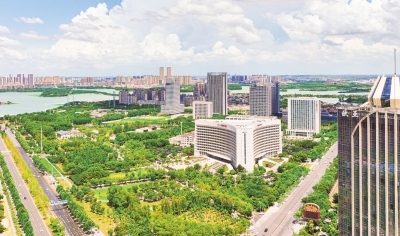
郊野湖泽变身环湖经济圈 40余家总部企业环抱金银湖
Chang Jiang Ri Bao· 2025-09-08 00:29
Core Insights - The transformation of the Jin Yin Lake area from a rural wetland to a thriving economic hub is highlighted, with over 40 headquarters enterprises established and an annual output value exceeding 100 billion yuan [1][8][12] - The area's ecological advantages and strategic location have attracted significant investments from various enterprises, including state-owned enterprises [4][6][10] - The integration of ecology, production, and living has created a desirable environment for residents and businesses alike, contributing to a population of approximately 230,000 [12][13] Group 1: Economic Development - The Jin Yin Lake headquarters economy has developed rapidly, with a focus on industries such as finance, health, high-end manufacturing, and modern services [7][8] - The establishment of the Jianghan Water Network Construction Development Co., Ltd. marked a significant milestone in attracting major enterprises to the area [3][4] - The Jin Yin Lake area has seen a continuous influx of headquarters enterprises since the early 2000s, with notable companies like China Unicom and Good Products entering the market [7][10] Group 2: Investment Attraction - The successful investment decisions by companies like Jiangsu Zhihui Port Technology Industry Group were influenced by the area's ecological environment and mature urban infrastructure [6][10] - The local government has played a crucial role in facilitating investments by providing comprehensive support throughout the project lifecycle [9][10] - The Jin Yin Lake Technology Park has attracted over 200 enterprises, primarily technology-driven, indicating a strong interest in the region's economic potential [11][12] Group 3: Community and Lifestyle - The integration of living spaces with business and ecological environments has enhanced the quality of life for residents, making it an attractive place for talent and executives [12][13] - The development of community infrastructure has expanded significantly, with the number of communities increasing from 9 to 18 and residential areas growing to accommodate the rising population [12][13] - The vision for the future includes creating a dual center of headquarters economy and modern services, further enhancing the area's appeal [14]


中金:“9·24”至今已近一年 成长、中小盘股表现占优
Zheng Quan Shi Bao Wang· 2025-09-08 00:29
Core Viewpoint - The A-share market has shown strong performance over the past year, with the Shanghai Composite Index reaching a nearly ten-year high, reflecting a significant shift in investor risk appetite [1] Market Performance - Since the "9.24" period last year, the Shanghai Composite Index has experienced a recovery from the bottom, followed by fluctuations and a subsequent rise [1] - The average daily trading volume in the A-share market has increased to around 3 trillion yuan, indicating a notable change in investor sentiment over the past year [1] Sector Performance - The technology growth style, driven by industrial trends, has performed well overall, with the STAR 50 and ChiNext Index both showing cumulative gains of over 90% [1] - Leading sectors in the past year include TMT (Technology, Media, and Telecommunications), non-ferrous metals, and high-end manufacturing, while the real estate chain, broad consumption, and some traditional cyclical industries have shown relatively flat performance [1]

中金 | “9.24”至今行情回顾:何为上涨主线?
中金点睛· 2025-09-07 23:51
Core Viewpoint - The A-share market has shown a strong performance over the past year, with the Shanghai Composite Index rising by 44.6% since the low point in September 2024, outperforming other markets and asset classes [3][4][7]. Market Performance Overview - The A-share market has experienced a significant increase in daily trading volume, rising from less than 500 billion yuan in September 2024 to around 3 trillion yuan recently, indicating a shift in investor risk appetite [3]. - The technology growth style has performed particularly well, with the STAR 50 and ChiNext Index showing cumulative gains of 95.9% and 92.9%, respectively [3][4]. Phases of Market Movement 1. **Initial Phase of Market Rally (Late September to Early October 2024)**: - The market began to rally following a series of pro-growth policies announced in late September, including interest rate cuts and support for the stock market [3]. - The Shanghai Composite Index rose by 27% in just six trading days, with the ChiNext Index and STAR 50 gaining 66.6% and 59.2%, respectively [3][4]. 2. **Consolidation Phase (October 2024 to March 2025)**: - After reaching a peak in October, the market entered a consolidation phase with the Shanghai Composite Index fluctuating within a 200-point range [4]. - The focus shifted from macroeconomic policies to industry trends, with technology and AI sectors gaining attention [5]. 3. **Adjustment Phase Due to External Risks (March to Early April 2025)**: - External uncertainties led to a market pullback, particularly in the technology sector, but intervention from state-owned funds and monetary policy support helped stabilize the market [6]. 4. **Recovery Phase (Mid-April 2025 to Present)**: - The market has entered a steady upward phase, supported by improved macroeconomic conditions and increased liquidity, with the margin trading balance exceeding 2 trillion yuan [6]. - Key sectors such as pharmaceuticals, AI, and non-bank financials have shown strong performance during this phase [6]. Driving Factors - The primary driver of the A-share market's performance has been a decline in risk premiums, with capital inflows and the resulting profit effects being secondary outcomes [7][8]. - The restructuring of the global monetary order and the strengthening of China's innovation capabilities are seen as significant underlying factors for the current bull market [8]. Future Outlook - While short-term volatility risks remain, the medium-term upward trend of the index is expected to continue, supported by ongoing structural policies and the potential for further asset revaluation in China [9]. - Key sectors to watch include technology, manufacturing, and financial services, with a focus on companies with solid industry fundamentals [10].

新质生产力投资全景图(附100+页报告)
材料汇· 2025-09-07 13:14
Core Viewpoint - New quality productivity is an inevitable path for switching economic growth momentum, characterized by high technology, high efficiency, and high quality, driven by technological breakthroughs and innovative allocation of production factors [4][10]. Group 1: Overview of New Quality Productivity - New quality productivity is defined as advanced productivity that achieves significant leaps in labor, materials, and objects through technological revolutions and deep industrial transformations [4]. - The development of new quality productivity is supported by various government policies aimed at enhancing emerging industries and future industries [5][24]. Group 2: Key Industry Core Sorting - The overall development of new quality productivity in Chinese provinces shows a trend of improvement and uneven development, with 20 provinces reaching a medium to high level since 2021 [9][10]. - High-level provinces such as Beijing, Shanghai, Zhejiang, Guangdong, and Jiangsu are expected to benefit first due to their advantages in higher education resources, innovation talent distribution, and infrastructure [9][10]. Group 3: Development Potential in Related Fields - The new quality productivity industry chain can be broken down into six core segments: digital economy, high-end equipment, biotechnology, smart electric vehicles, energy transition, and future industries [11][25]. - Each segment is expected to experience long-term favorable conditions driven by policies, with high-end equipment and energy transition showing significant growth potential [12][11]. Group 4: Investment Outlook - The focus on optimizing supply chains and actively cultivating emerging and future industries is crucial for enhancing new quality productivity [11][25]. - The government is expected to implement policies to address overcapacity in certain industries, promoting industrial restructuring and enhancing domestic demand [24][25].

中小盘周报:关注导热散热材料-20250907
KAIYUAN SECURITIES· 2025-09-07 09:46
Investment Rating - The report indicates a positive outlook for the thermal management materials industry, driven by strong downstream market demand and technological advancements [3][21]. Core Insights - The thermal management materials industry is experiencing sustained growth due to increasing demand from downstream sectors such as consumer electronics, automotive electronics, and data centers. The global thermal management market is projected to grow at a compound annual growth rate (CAGR) of 8.5%, increasing from $17.3 billion in 2023 to $26.1 billion by 2028 [3][21]. - The penetration rates of heat pipes and vapor chambers are continuously rising, with local procurement becoming a significant trend as domestic companies mature technologically [3][21]. Summary by Sections 1. Industry Demand and Growth - The global demand for thermal management materials is on the rise, with a forecasted market size growth from $17.3 billion in 2023 to $26.1 billion by 2028, reflecting a CAGR of 8.5% [3][21]. - The shift towards high-performance, miniaturized, and integrated electronic products is intensifying the need for effective thermal management solutions [3][21]. 2. Market Segmentation - Heat pipes and vapor chambers are becoming mainstream solutions in high-end smartphones, with market sizes expected to reach $3.776 billion and $1.197 billion respectively by 2025, with CAGRs of 6.17% and 14.20% [15][18]. - The thermal interface materials market is projected to grow from $5.2 billion in 2019 to $7.6 billion by 2026, with a CAGR of 5.57% [16][19]. 3. Local Procurement Trends - Local procurement is becoming a dominant trend in the thermal management materials industry, driven by supply chain security concerns among domestic electronic brands [35][36]. - Domestic companies like Suzhou Tianmai and Zhongshi Technology are expected to benefit from this trend as they enhance their technological capabilities [35][36]. 4. Key Beneficiaries - Suzhou Tianmai is highlighted as a key player in the industry, having established itself early in the ultra-thin heat pipe and vapor chamber market, achieving significant production scale and client certifications [4][35].


美国关税重大调整! 特朗普宣布豁免黄金、钨以及铀全球关税
智通财经网· 2025-09-06 04:41
Core Points - The article discusses significant tariff adjustments made by President Trump, exempting graphite, tungsten, uranium, gold bars, and other metals from the U.S. government's global tariff policy while including silicone products in the taxable category [1][2] - The adjustments are aimed at facilitating trade agreements with other countries and streamlining the process for implementing tariff changes without requiring new executive orders for each agreement [2][3] - The exemptions for gold, tungsten, and uranium are strategically important for financial stability, manufacturing, defense, and energy security, as they are critical materials that could impact key U.S. industries if subjected to tariffs [4][5] Group 1 - The U.S. Trade Representative (USTR) and the Department of Commerce are now authorized to implement framework trade agreements with countries like the EU, Japan, and South Korea, reducing the need for Trump to issue new executive orders for each tariff change [2][3] - The exemptions include key materials used in aerospace, consumer electronics, and medical devices, which are vital for various technological sectors [3][4] - The decision to exempt these materials aligns with the goal of maintaining the resilience of critical domestic industries and ensuring national security [4][5] Group 2 - Tungsten is crucial for the U.S. military industry, particularly in high-performance weaponry, and is heavily reliant on imports due to its unique physical properties [5] - Uranium is essential for nuclear energy production, which is a focus of Trump's administration, as it aims to revitalize the U.S. nuclear power sector [5] - The adjustments reflect a broader strategy to address trade imbalances and enhance the competitiveness of U.S. industries while ensuring access to critical materials [2][4]
物产中大关于2025年半年度业绩说明会召开情况的公告
Shang Hai Zheng Quan Bao· 2025-09-05 21:11
Core Viewpoint - The company reported a significant net profit increase of 29.65% for the first half of 2025, reaching 2.04 billion yuan, attributed to the combined efforts of multiple business segments and effective operational strategies [2][3]. Performance Summary - The company held a performance briefing on September 4, 2025, to discuss its half-year results and future development with investors [1]. - The supply chain integration service segment contributed significantly to profit stability through digital transformation and operational efficiency [2]. - The high-end manufacturing segment is being cultivated as a strategic growth engine, with increased R&D investment and a focus on high-value products [2]. Revenue and Profit Analysis - The supply chain integration service accounted for 92.06% of total revenue, generating 265.61 billion yuan, with steel sales up by 6.46% and coal by 14.13% despite a 12.91% drop in average rebar prices [3]. - The low gross margin of 1% in the bulk supply chain was primarily due to declining commodity prices and weak domestic demand [4]. Strategic Responses - The company employs various strategies to mitigate price volatility risks, including using financial derivatives for hedging, enhancing compliance in supply chain operations, and expanding international market presence [3]. - The company is focused on maintaining its growth targets despite slight revenue pressure, relying on cost reduction, structural optimization, and innovation [6][7]. Future Outlook - The company plans to deepen its focus on high-end manufacturing and overseas markets as key growth drivers [7]. - The company is actively pursuing acquisitions in the magnesium alloy sector to enhance its capabilities and market position [6]. Technological Innovations - The company is exploring AI applications in logistics and elder care, with initiatives aimed at improving efficiency and reducing costs [9][10]. - The company has invested in hard technology sectors, including semiconductors and robotics, through its investment platforms [12]. Manufacturing Segment Performance - The high-end manufacturing segment saw a revenue increase of 24.97%, with significant contributions from the wire and cable, tire manufacturing, and new materials sectors [12][13]. - R&D expenses rose by 27.96% to 655 million yuan, focusing on key technologies in the high-end manufacturing sector [12][13].

汇通达网络(09878)拟9.94亿元参与重整 收购金通灵科技25%股权
Zhi Tong Cai Jing· 2025-09-05 12:14
Group 1 - The company, HuTongDa Network, announced a restructuring investment agreement to acquire 25% equity of JinTongLing Technology Group for RMB 994 million, aiming to enhance shareholder returns by acquiring high-quality, scarce assets at a lower cost [1] - The acquisition is seen as a strategic move to leverage the company's strong industry position and competitive edge in high-end manufacturing, with expectations of turning profitable post-restructuring [1] - The completion of the acquisition will facilitate the establishment of an H+A capital operation platform, enabling easier access to quality capital resources both domestically and internationally [1] Group 2 - The group plans to utilize its management experience, supply chain, and channel advantages to empower the retained business segments of the target company, focusing on consumer and smart manufacturing sectors [2] - The acquisition will extend the group's industrial layout from industrial internet to high-end manufacturing, creating a dual-industry layout of "big consumption + smart manufacturing" to enhance profitability [2]

构建“大消费+智能制造”双产业布局,汇通达网络(9878.HK)收购金通灵25%股权
Ge Long Hui· 2025-09-05 11:53
Core Viewpoint - Huitongda Network (9878.HK) has signed a restructuring investment agreement with Jintongling (300091.SZ) to acquire a 25% stake for approximately 994 million RMB, indicating a strategic move to enhance shareholder returns and promote company development through asset acquisition and capital operation [1][2]. Group 1 - The acquisition price of 1.3996 RMB per share is significantly lower than Jintongling's closing price of 3.2 RMB, highlighting the opportunity to acquire high-quality assets at a fair cost [1]. - Jintongling is positioned in the high-end manufacturing sector, with a strong competitive edge and industry standing, expected to achieve profitability post-restructuring [1]. - The restructuring process is seen as a pathway for companies to enter the A-share capital market, with limited opportunities available each year for such cases [1]. Group 2 - The acquisition will enable Huitongda to establish a platform for H+A capital operations, facilitating access to quality capital resources both domestically and internationally [2]. - Huitongda plans to leverage its management experience and supply chain advantages to empower Jintongling's retained business segments, focusing on consumer and smart manufacturing sectors [2]. - The recent mid-term performance report from Huitongda emphasized the commitment to actively pursue quality enterprise acquisitions, reinforcing its dual strategy of industrial development and capital operation [2].
全球资本瞩目:中国科创引来QFLP基金新“活水”
2 1 Shi Ji Jing Ji Bao Dao· 2025-09-05 11:16
Group 1 - The establishment of QFLP funds is enhancing the integration of international capital with local industries, providing financial support to companies in Kunshan and promoting a new development pattern of dual circulation in the economy [1][4] - As of mid-2023, Wuxi has established 51 QFLP funds with a total scale exceeding $5 billion, focusing on strategic emerging industries such as IoT and biomedicine [1][2] - Local governments are actively revising QFLP pilot policies to facilitate fund establishment and attract foreign investment, indicating a strong commitment to the QFLP initiative [2][3] Group 2 - QFLP funds are becoming a crucial tool for supporting technology innovation by providing new equity financing channels for startups in fields like biomedicine and advanced manufacturing [3][6] - The collaboration between local governments and QFLP fund managers is aimed at aligning investment strategies with local industrial development, enhancing the regional innovation ecosystem [3][6] - The QFLP fund established in Chongqing is expected to fill funding gaps for long-cycle projects in innovative drug development and high-end medical equipment [6][7] Group 3 - QFLP funds are evolving from a mere financing tool to a vital link that promotes the deep integration of industry, technology, and capital [5][7] - The flexibility and efficiency of QFLP funds make them an attractive option for private equity and venture capital managers, facilitating the entry of long-term capital into China [7] - Continuous improvements in QFLP regulations and the establishment of more funds are expected to enhance capital structure optimization and regional innovation ecosystem development [7]