
智能网联汽车

Search documents
“车路云一体化”引领道路交通新纪元
2025-09-23 02:34
Summary of the Conference Call on "Vehicle-Road-Cloud Integration" Industry Overview - The conference discusses the "Vehicle-Road-Cloud Integration" system, which consists of vehicles, roadside facilities, cloud control platforms, supporting platforms, and communication networks. This system aims to overcome the limitations of single-vehicle intelligence in perception, computation, and path planning, thereby optimizing driving decisions and traffic efficiency [1][3][4]. Key Insights and Arguments - **Market Potential**: The "Vehicle-Road-Cloud Integration" industry is projected to generate approximately 729.5 billion RMB in value by 2025, increasing to about 2.5825 trillion RMB by 2030, according to the China Society of Automotive Engineers [1][4]. - **Traffic Safety Improvement**: The integration can significantly reduce accident rates by providing real-time obstacle maps and enabling vehicle-to-vehicle communication for collaborative decision-making [1][7]. - **Technological Advancements**: The system enhances the perception, computation, and path planning capabilities of vehicles, addressing inherent limitations of single-vehicle systems [4][5]. - **Economic, Social, and Environmental Impact**: - Economic: Opens up a trillion-level market, fostering innovation and efficiency [5]. - Social: Enhances traffic safety, with estimates suggesting that widespread adoption could prevent 80% of non-disabling loss-of-control traffic accidents [5]. - Environmental: Alleviates traffic congestion and promotes energy conservation, with predictions of reducing travel time by 27% on signal-controlled roads and 42% on non-signal roads, leading to a 22% reduction in fuel consumption and 11% in emissions [6]. Additional Important Points - **Investment Requirements**: Achieving nationwide coverage of major highway intersections and key expressways by 2030 will require over 400 billion RMB in investment, necessitating exploration of sustainable investment methods [2][17]. - **Current Development Stage**: China has made significant progress in smart connected vehicles and infrastructure since 2018, transitioning from closed-area testing to full-scale testing and city-wide pilot projects, with over 600 new "Vehicle-Road-Cloud Integration" projects expected by mid-2025 [10][19]. - **Global Comparison**: The U.S. leads in single-vehicle intelligence technology but is still in the testing phase for "Vehicle-Road-Cloud" collaboration. Europe is more conservative, while South Korea is actively developing computer-assisted driving applications [11]. - **Industry Structure**: The "Vehicle-Road-Cloud Integration" industry comprises five main components: vehicles, roads, cloud, image processing, and network connectivity, forming a vast economic ecosystem [12][13]. - **Growth Areas**: The road testing equipment and scenario application sectors are expected to see significant growth, with compound annual growth rates (CAGR) of 79.7% and 70%, respectively [14][15]. - **Key Players**: Various types of companies are involved in the integration, including vehicle system providers, cloud service extensions, and communication network firms, each with distinct characteristics [16]. This summary encapsulates the essential points discussed in the conference call regarding the "Vehicle-Road-Cloud Integration" industry, highlighting its potential, challenges, and the current state of development.
赛场频现中原新实力
He Nan Ri Bao· 2025-09-22 23:25
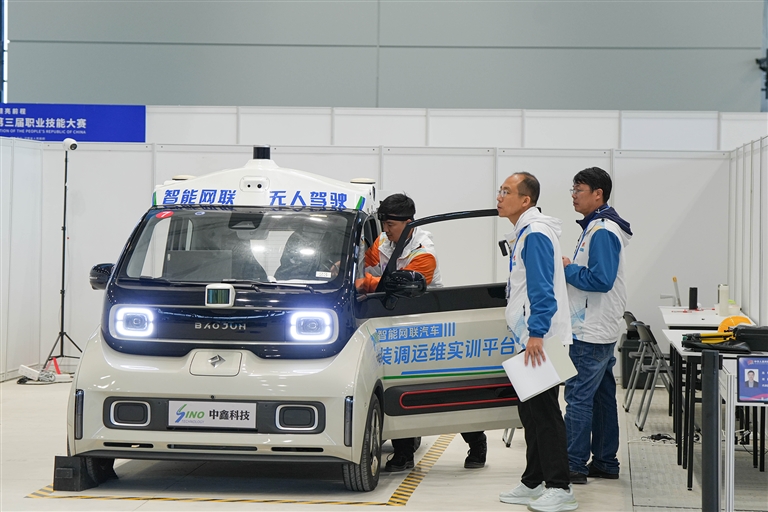
与传统汽车维修不同,这里没有油污和扳手,取而代之的是精密的电路模块和智能传感器。选手们需要快速 定位问题电路模块,排除各种技术障碍,展现对新兴技术的理解力和解决问题的能力。 第三届全国技能大赛智能网联汽车装调运维赛场上,河南选手李晓强(左一)正在专心进行比赛。河南日报 社全媒体记者 徐聪 摄 千百年来,技能推动下的创新创造,始终是推动发展的重要力量。第三届全国技能大赛设置的106个竞赛项目 中,智能制造、高端装备、数字技术等赛项占比超过50%。河南代表团参加了全部106个赛项的比赛。 "我参加的项目叫无人机系统,是前两届全国技能大赛所没有的,同时又是世赛选拔项目,将首次出现在明年 举办的第48届世界技能大赛中。"9月22日晚,来自河南技师学院的21岁选手王钰航说,"无人机系统项目融合 了机械、电子和计算机工程知识技能,考核选手对无人机的安装、调试、维护、编程及飞行任务完成能力, 是无人机行业的未来发展方向。" 赛项难度大,更激发了王钰航的好胜心。"我全身心投入比赛,个人的技能有了质的飞跃。同时,通过观察其 他选手,也发现了更适合自己的学习方法。"他说。 王钰航的成长足迹里,藏着个人精进技能的密码;我省所有选手 ...

2025/9/15-2025/9/19汽车周报:科技外溢,智驾与华为有望承接热情-20250922
Shenwan Hongyuan Securities· 2025-09-22 11:05
Investment Rating - The report suggests a bullish outlook for the automotive sector, particularly driven by technology and central state-owned enterprise reforms [3][10]. Core Insights - The automotive sector is expected to benefit from a market rally, with technology-driven segments like robotics and low-altitude economy likely to follow the TMT lead [3]. - The report highlights a rebound in the performance of the robotics sector in the second half of the year, with specific companies recommended for investment [3]. - The establishment of a national standard for intelligent driving assistance systems is anticipated to enhance safety and quality in the automotive industry [4][5]. Market Update - In the 37th week of 2025, retail sales of passenger cars reached 450,000 units, showing a month-on-month increase of 24.65% but a year-on-year decrease of 7.79% [3]. - The total transaction value in the automotive industry for the week was 922.739 billion, reflecting a 31.03% increase from the previous week [3]. - The automotive industry index rose by 2.95%, outperforming the Shanghai and Shenzhen 300 index, which fell by 0.44% [10]. Company Recommendations - The report recommends focusing on domestic leading manufacturers such as NIO, Xiaomi, Xiaopeng, and Li Auto, as well as companies involved in intelligent driving technology [3]. - It also suggests monitoring state-owned enterprises like SAIC and Dongfeng for potential investment opportunities [3]. - Companies with strong performance growth and capabilities in robotics or overseas expansion, such as Fuyao Glass and New Spring, are highlighted as potential investment targets [3]. Key Events - The report notes the launch of NIO's new ES8 and ET9 special edition, showcasing significant investments in charging and battery technology [6][7]. - Elon Musk's substantial investment in Tesla, amounting to approximately $1 billion, has positively impacted Tesla's stock performance [8][25]. - The report mentions the introduction of various new models and strategic partnerships in the automotive sector, indicating a dynamic market environment [26][29][34].

组合驾驶辅助:标尺已定,安全有道
Zhong Guo Qi Che Bao Wang· 2025-09-22 08:09
Core Viewpoint - The Ministry of Industry and Information Technology has released a draft for public consultation on mandatory national standards for intelligent connected vehicles' combined driving assistance systems, aiming to enhance safety and standardization in the industry [1][2]. Group 1: Industry Challenges and Developments - The combined driving assistance technology has faced a trust crisis due to a widely publicized traffic accident, marking the industry's biggest challenge since its inception [1]. - The penetration rate of combined driving assistance technology in China's new energy vehicles has exceeded 50% and continues to grow [2]. - There are significant discrepancies in the technical solutions, functions, and performance of products from different companies, complicating the evaluation of system safety [2]. Group 2: Draft Standard Characteristics - The draft standard applies to M and N category vehicles equipped with various types of combined driving assistance systems, ensuring uniform safety benchmarks across different vehicle types [3]. - The draft emphasizes the need for driver monitoring capabilities and outlines safety assurance requirements throughout the product development and usage processes [3][5]. - It aims to elevate the priority of safety and quality in product development, encouraging companies to focus on system reliability rather than rapid iteration [3][5]. Group 3: Development and Testing Regulations - The draft establishes a comprehensive testing framework that includes various testing scenarios to ensure safety and functionality [6]. - It mandates that companies maintain consistency in core components and software versions to avoid discrepancies in functionality during mass production [6]. - The draft requires the implementation of a data recording system to track vehicle status and driver actions, aiding in post-incident analysis [6]. Group 4: Consumer Impact and Behavior Changes - The draft clarifies that combined driving assistance systems are not autonomous driving systems, emphasizing the need for continuous driver engagement [9]. - It introduces measures to ensure that drivers are well-informed about the system's capabilities and limitations, promoting safe usage practices [9][10]. - The draft encourages the development of proper driving habits among consumers, such as maintaining hands on the wheel and eyes on the road, to enhance safety [10].

工信部公开征求组合驾驶辅助标准意见,小米大批量召回SU7标准版
Zhong Guo Qi Che Bao Wang· 2025-09-22 01:44
Group 1: Industry Developments - Jingu Co. established a wholly-owned subsidiary, "Hangzhou Jingu Embodied Intelligence Technology Co., Ltd.," to enter the embodied intelligence sector, focusing on humanoid, quadruped, service, and specialized application robots, leveraging its material technology for cost-effective solutions [2] - The U.S. Department of Transportation plans to propose three new federal motor vehicle safety standards in Spring 2026, aimed at updating regulations for autonomous vehicles without manual controls, reflecting a commitment to reshape the regulatory framework for autonomous driving [2] - Tesla's Robotaxi service is now open to the public in the U.S., following a pilot program in Texas, which could accelerate the adoption of autonomous driving technology and reshape the global transportation landscape [3] Group 2: Strategic Partnerships and Collaborations - Pony.ai announced a partnership with Qatar's national transport company Mowasalat to advance autonomous driving technology in Qatar, adapting its technology to local conditions [4] - Changan Automobile launched the "Tianshu Intelligent" brand, planning to explore applications for industrial robots and family service robots by 2030, marking a shift from vehicle manufacturing to smart living services [5][6] - Uber and Momenta are set to test a joint Robotaxi project in Munich, Germany, with plans for a full launch in 2026, indicating a significant step for Chinese autonomous driving technology in international markets [9][10] Group 3: Regulatory and Safety Initiatives - The China Automotive Engineering Research Institute introduced a "smart driving pyramid grading evaluation system," providing a structured assessment of autonomous driving capabilities to guide industry development and consumer choices [7][8] - The Ministry of Industry and Information Technology is soliciting public opinions on mandatory national standards for intelligent connected vehicles, aiming to strengthen safety measures in the industry [19] - Xiaomi announced a recall of over 116,000 SU7 electric vehicles due to safety concerns with the L2 highway navigation assistance feature, demonstrating a commitment to consumer safety and industry standards [22] Group 4: Market Movements and Financial Activities - Hesai Technology completed a dual listing on the Hong Kong Stock Exchange, raising over 4.16 billion HKD, marking the largest IPO in the global lidar industry [17] - Alibaba Group made a strategic investment in Hello's Robotaxi business, enhancing collaboration in autonomous driving and accelerating the commercialization of Robotaxi services [20][21] - Horizon Robotics established its European headquarters in Munich, enhancing its operational capabilities for the global market and supporting Chinese automotive companies in Europe [11]

2025世界智能安全大会解析智能网联汽车测试难点与解题思路
Zhong Guo Qi Che Bao Wang· 2025-09-22 01:15
Core Insights - The 2025 FISITA Intelligent Safety Conference aims to promote global collaboration in autonomous driving safety technology, focusing on key themes such as functional safety, testing evaluation, connected cooperative driving, information security, and artificial intelligence [1] Group 1: Functional Safety and Risk Assessment - The introduction of the SOTIF (Safety of the Intended Functionality) Index 1.0 aims to address the rising number of autonomous driving accidents by establishing a comprehensive risk and capability evaluation system [3] - The SOTIF Index is designed to create a multidimensional, quantifiable measurement system to assess the maturity and confidence level of autonomous driving systems in handling expected functional safety [3] - The need for a scientific and quantifiable evaluation paradigm is emphasized to ultimately reduce the accident rate to zero [3] Group 2: Challenges in Autonomous Driving - Various factors such as different road and weather conditions increase the accident rate of autonomous vehicles, posing higher reliability challenges for Advanced Driver Assistance Systems (ADAS) [4] - The necessity to establish mechanisms for identifying unknown risks and quantifying uncertainties in AI systems is highlighted [4] - Strict adherence to traffic regulations is essential, as violations contribute significantly to accident rates [4] Group 3: Industry Development and Collaboration - The penetration rate of L2-level assisted driving in passenger vehicles reached 62.1% in the first half of the year, with steady progress in L3/L4 autonomous driving testing [5] - The importance of top-level design and policy development is stressed to address new safety challenges and enhance global and industrial collaboration [5] - The establishment of a safety assurance system is crucial for promoting healthy industry development [5] Group 4: Integrated Safety Mechanisms - The need for an integrated safety approach that combines functional safety and cybersecurity is emphasized, moving beyond traditional protective mechanisms [8] - The concept of a "traffic immune system" is proposed, inspired by the human immune system, to achieve a vision of "zero deaths" in traffic [10] - Principles derived from urban immunology can guide the deep collaboration between people, vehicles, and cities to enhance the resilience and sustainability of transportation systems [10] Group 5: Testing and Standardization Challenges - The lack of unified safety standards, liability frameworks, and testing protocols for autonomous vehicles hinders cross-regional deployment and investment [9] - Existing infrastructure, such as road and communication networks, is insufficient to support large-scale autonomous vehicle operations, particularly in rural areas [9] - The need for real-time interaction between autonomous vehicles and urban traffic management systems is highlighted, along with the current immaturity of V2X communication protocols [9]

帮主郑重:下周A股能不能破局?六大信号看透震荡中的机会
Sou Hu Cai Jing· 2025-09-21 16:45
Core Viewpoint - The A-share market is experiencing fluctuations around the 3900-point mark, with expectations for potential opportunities and risks in the upcoming week [1] Policy Outlook - Key highlights for the upcoming week include a press conference from the State Council Information Office, with three potential positive developments: 1. Financial policy adjustments, including the central bank's recent change to "multiple price bidding" for reverse repos, signaling targeted liquidity support 2. Enhanced industrial policies, with significant documents expected for sectors like energy storage, smart connected vehicles, and semiconductors 3. New consumer stimulus policies potentially being introduced before the National Day holiday, focusing on tourism and retail subsidies [3] - Recent regulatory reforms, such as the registration system reform, are expected to facilitate the entry of quality companies while allowing weaker firms to exit more easily [3] Market Sentiment and Technical Analysis - The market sentiment has cooled, with the fear and greed index dropping from 75 to 62, indicating reduced enthusiasm among investors [5] - The Shanghai Composite Index has been consolidating around the 3900-point level for over half a month, with the 3850-point mark being crucial for market stability [4] - The ChiNext Index has reached new highs, but caution is advised as the MACD indicator shows signs of weakening momentum [4] Capital Flow - Northbound capital has shown significant inflows, with a net purchase of nearly 40 billion in September, primarily targeting technology growth stocks such as communication equipment and semiconductors [4] - Traditional consumer sectors like home appliances and textiles are experiencing reduced interest from these investors [4] Investment Strategy - Recommended positioning includes maintaining a 60% base position with 30% in flexible capital, focusing on technology growth sectors like semiconductors and robotics, which benefit from both capital inflows and policy support [5] - Defensive strategies should consider undervalued blue-chip stocks, banks, insurance, and gold sectors, which tend to perform well during interest rate cuts [5] - Caution is advised regarding high-valuation technology stocks and industries sensitive to tariff impacts, as these may pose risks [5] Key Signals to Monitor - Important signals to watch include whether northbound capital can exceed a net inflow of 8 billion in a single day, if the Shanghai Composite Index can maintain above 3850 points, and whether trading volume in technology stocks can increase [6]
雷军的小米汽车成功了,任正非为啥不造车?事实证明,“华为不造车”的决策很正确:任总真是太有战略远见了
Sou Hu Cai Jing· 2025-09-21 02:16
Core Viewpoint - The article discusses the strategic decisions of companies like Xiaomi and Huawei regarding car manufacturing, emphasizing the importance of focusing on core competencies and collaboration in the automotive industry. Group 1: Xiaomi's Strategy - Xiaomi's decision to enter the automotive market is driven by the desire for control over the supply chain and profit margins, similar to its approach with private label products [1] - Xiaomi's brand strength and the personal branding of its founder, Lei Jun, enhance its marketing effectiveness in the automotive sector [1] - The company is committed to a holistic ecosystem involving vehicles, homes, and technology, positioning itself firmly in the automotive market [1] Group 2: Huawei's Strategic Choice - Huawei has chosen not to manufacture cars but to assist existing car manufacturers, focusing on its strengths in ICT infrastructure and smart terminal technology [2][3] - The decision was made after internal debates, leading to a clear strategy of not entering the car manufacturing space, which Huawei's management believes is essential for maintaining focus on its core mission [3] - Huawei's strategy has proven effective, as evidenced by the growing number of partnerships with various automotive companies [5] Group 3: Collaboration and Ecosystem - The shift in perception among automotive companies from skepticism to eagerness to collaborate with Huawei is attributed to its clear strategic direction and the success of its products like the AITO series [7] - Huawei's three collaboration models with car manufacturers include component supply, the Huawei Inside (HI) model, and the innovative HarmonyOS-based smart vehicle model, which has gained traction among several automakers [8] - The company's approach of not competing directly with car manufacturers but rather supporting them has fostered a cooperative environment, allowing for mutual growth [10] Group 4: Industry Impact - Huawei's focus on becoming a supplier of incremental components for smart connected vehicles has created significant value in the automotive industry, igniting advancements in intelligent driving technology [10] - The article suggests that the scale of smart connected vehicles in the AI era could surpass that of smartphones, indicating a transformative shift in the automotive landscape [10]
招商证券:三行业整治内卷进展突出 中美元首会谈聚焦TikTok
智通财经网· 2025-09-21 00:51
Domestic Policy Insights - The Chinese government is making progress in addressing "involution" in the automotive, pig farming, and photovoltaic sectors, with a focus on pig farming and silicon materials [2] - The automotive industry is seeing the release of a payment standard initiative aimed at ensuring supplier payments do not exceed 60 days [2] - In pig farming, a meeting has been held to discuss reducing the number of breeding sows, with accompanying financial measures suggested [2] - The photovoltaic sector is tightening energy consumption standards, which may accelerate the exit of outdated production capacity, particularly in silicon material pricing [2] Autonomous Driving Developments - The Ministry of Industry and Information Technology has released a draft for mandatory national standards on intelligent connected vehicle driving assistance systems, aiming to fill safety gaps in large-scale applications [3] - The new standards emphasize safety boundaries and monitoring of driver status, suggesting a focus on three types of companies: leading autonomous driving suppliers, companies enhancing driving safety, and automotive testing institutions [3] Service Consumption Policies - The Ministry of Commerce and other departments have announced measures to boost service consumption, with 19 initiatives aimed at stimulating demand and supporting high-quality economic development [4] - Key areas of focus for future investment include cultural tourism, intellectual property consumption, and sports consumption [4] International Relations and Business Implications - Recent talks between Chinese and U.S. leaders have been described as pragmatic and constructive, with discussions on the TikTok transaction being a central issue [5] - The TikTok deal involves core algorithms and shareholding ratios, with Oracle and other companies potentially becoming buyers [5] Industry Policy Updates - The State Council is actively discussing policies related to ecological protection and domestic product standards in government procurement [6] - Recent industry policies include a growth plan for light industry and various regional initiatives to integrate artificial intelligence into industrial processes [7]

宝坻 “类中关村”产业生态持续构建
Bei Jing Ri Bao Ke Hu Duan· 2025-09-19 20:47
Core Viewpoint - The Tianjin government is actively promoting the high-quality development of the Baodi District, emphasizing its growing importance in the Beijing-Tianjin-Hebei collaborative development strategy, with significant economic indicators showing double-digit growth [1][2]. Group 1: Economic Development - Baodi District has integrated 1,883 market entities into the Beijing Zhongguancun Science Park, maintaining double-digit growth in fixed investment and tax revenue [1]. - The district has signed an 800 million yuan agreement with the Zhongguancun Development Group to enhance cooperation and establish a "flyover park" mechanism for cross-regional resource allocation [1]. - The establishment of a comprehensive service package from Zhongguancun, including 22 policy measures to support high-quality development, has created a "class Zhongguancun" industrial ecosystem [2]. Group 2: Innovation and Technology - The Science Park has developed a full-chain incubation system, recognized as an innovative base for entrepreneurship, and has collaborated with Tsinghua University to create a demonstration application line for intelligent connected vehicles [2]. - The park has successfully completed 370 innovation achievements, with technologies such as the boron nitride crucible and industrial robot controllers receiving international and domestic certifications [2]. Group 3: Transportation Infrastructure - The opening of the Jing-Tang and Jing-Bin intercity railways has marked Baodi's entry into the "high-speed rail era," enhancing its integration into the modern transportation network of the Beijing-Tianjin-Hebei region [3]. - The development of transportation infrastructure has activated regional economic vitality and strengthened the foundation for rural revitalization, serving as a bridge connecting development and livelihood [3].
