可再生能源

Search documents
中俄总理联合公报:加强氢能、储能等新兴领域的合作
Xin Hua She· 2025-11-06 03:00
Core Viewpoint - The joint statement from the 30th regular meeting of Chinese and Russian Prime Ministers highlights the significant achievements in energy cooperation and the commitment to further explore energy collaboration potential, ensuring energy security and promoting a fair global energy transition [1][2]. Energy Cooperation - Both countries will support enterprises in deepening cooperation in oil, natural gas, coal, and electricity sectors, while enhancing energy infrastructure connectivity and ensuring the safe and stable operation of cross-border energy channels [1]. - There will be a focus on emerging fields such as renewable energy, low-carbon energy, hydrogen, and energy storage, along with collaboration on carbon capture, utilization, and storage systems [1]. Nuclear Energy Projects - The construction of the Tianwan and Xudabao nuclear power plants will continue, with an emphasis on timely completion and operation, alongside deepening cooperation in peaceful nuclear energy applications [1]. - There is a plan to gradually advance cooperation in areas such as thermonuclear fusion, fast reactors, and closed nuclear fuel cycle, exploring collaborative opportunities for nuclear fuel cycle front-end and new nuclear power projects based on mutual benefits [1]. Market Stability and Dialogue - The commitment to maintaining global energy market stability will be reinforced, with an expansion of dialogue between energy-producing and consuming countries, supporting an open, fair, non-discriminatory, and free energy market [1][2].
(数据版)安徽省可再生能源市场发展现状、趋势与前景预测分析报告(2025版)
Sou Hu Cai Jing· 2025-11-06 02:45
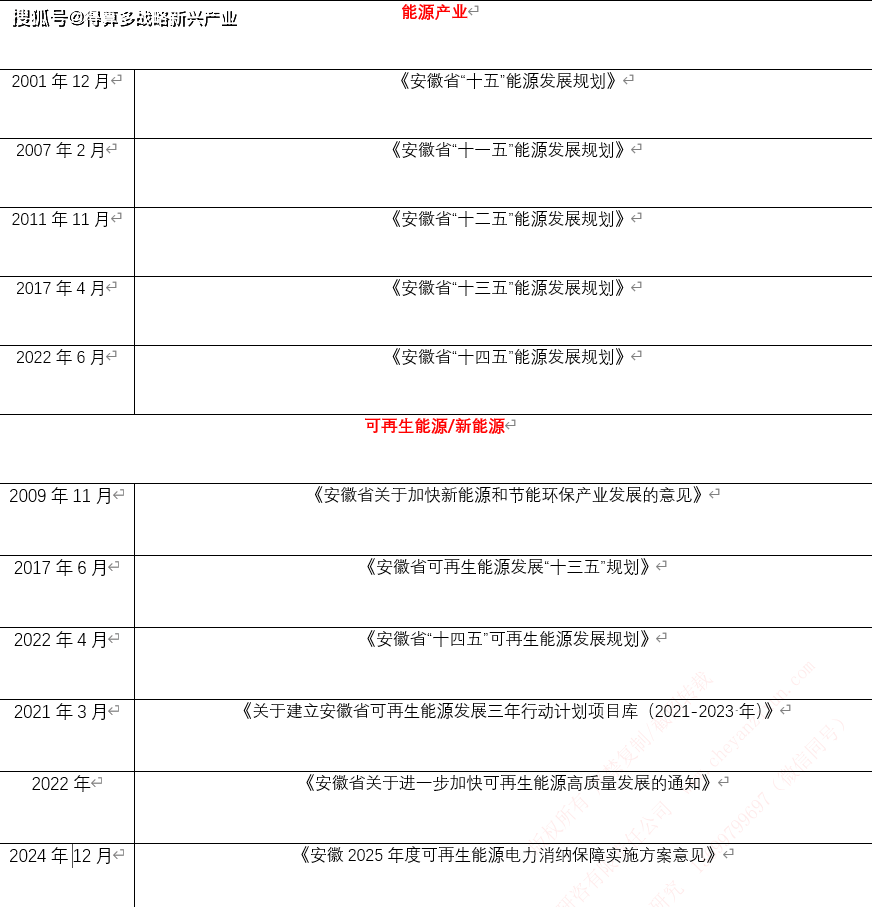
Group 1: Policy Planning - Anhui Province has established multiple energy development plans from 2001 to 2022, including the "14th Five-Year Plan" for renewable energy development [2][4]. - The province has issued opinions to accelerate the development of new energy and energy-saving environmental protection industries [4]. Group 2: Market Development Goals - By 2025, the proportion of non-fossil energy consumption in Anhui Province is expected to increase to approximately 15.5% [5]. - Renewable energy installed capacity is projected to reach around 45 million kilowatts by 2025, accounting for about 40% of the total installed capacity, with specific targets for hydropower, wind power, solar power, and biomass [5]. Group 3: Resource Analysis - In 2024, the national annual precipitation is expected to be 717.7 mm, which is 11.4% higher than the multi-year average, ranking third since 1956 [6]. - The total surface water resources in Anhui Province are part of the national total of 29,895.6 billion m³, which is 12.6% above the multi-year average [10]. - The average solar radiation in Anhui Province is part of the national average of 1,511.8 kWh/m², which is slightly below the recent 30-year average [12]. Group 4: Wind Energy Resource Analysis - The average wind speed at 70 meters in Anhui Province is around 5.0 to 6.0 m/s, which is considered moderate compared to other regions [34]. - The average wind power density at 70 meters is approximately 193.5 W/m², with some areas exceeding 200 W/m² [39]. Group 5: Renewable Energy Capacity and Ranking - Historical data indicates the growth of renewable energy installed capacity in Anhui Province, with specific rankings and national comparisons to be detailed [50][52]. - The structure of renewable energy installed capacity and its market share will be analyzed to understand its contribution to the overall energy landscape [54][61].

中俄平等互利务实合作典范,为什么是能源?
中国能源报· 2025-11-06 01:41
Core Viewpoint - The article emphasizes the importance of Sino-Russian energy cooperation as a cornerstone for practical collaboration between the two countries, particularly in the context of global energy security and the evolving international landscape [1][10]. Group 1: Energy Cooperation and Market Dynamics - Sino-Russian energy cooperation is built on natural complementary advantages, with Russia possessing abundant energy resources and China being one of the largest energy consumption markets globally [3]. - In 2024, China is expected to import 108.47 million tons of crude oil from Russia, accounting for 19.6% of China's total crude oil imports, making Russia the largest supplier [3]. - Russia has supplied 31 billion cubic meters of natural gas to China via pipelines and exported 8.6 million tons of liquefied natural gas (LNG) [3]. - Key cross-border energy infrastructure projects, such as the China-Russia oil pipeline and the East Route Gas Pipeline, are being developed to enhance energy connectivity [3]. Group 2: Transition to Comprehensive Cooperation - The focus of Sino-Russian cooperation is shifting from merely expanding trade volume to building a comprehensive industrial chain collaboration, emphasizing quality over quantity [4]. - Future areas of interest include stabilizing Russian oil supply to China, ensuring full operation of the Siberian Power Gas Pipeline, and enhancing financial cooperation to increase the proportion of local currency settlements in oil and gas trade [4]. - The cooperation is evolving to include infrastructure interconnectivity, emerging fields, and financial standards, indicating a more resilient and in-depth partnership [4]. Group 3: Clean Energy and Technological Collaboration - Both countries are accelerating cooperation in clean energy, with a focus on renewable energy, hydrogen, and energy storage [6]. - Russia is seeking to diversify its energy exports and modernize its economic structure, while China excels in renewable energy equipment manufacturing [6]. - There is a push for bilateral investments and cooperative development in green energy sectors such as wind, solar, and biomass [6][7]. - The two nations are also collaborating on new-generation small nuclear reactors and planning hydrogen energy industrial chains [7]. Group 4: Global Energy Governance Impact - Sino-Russian energy cooperation has implications beyond bilateral relations, significantly influencing global energy governance and transition processes [8]. - The partnership aims to ensure energy security at national, regional, and global levels, promoting affordable, reliable, and sustainable modern energy [9]. - The cooperation is seen as a stabilizing factor for regional and global energy security, contributing to the low-carbon transition of energy supply chains and the upgrading of industrial chains [9][10].

“一条既有连续性又具革新精神的规划”
人民网-国际频道 原创稿· 2025-11-06 01:40
Core Insights - The article emphasizes China's remarkable achievements during the "14th Five-Year Plan" period, highlighting its advancements in innovation, digitalization, and clean energy, positioning China as a global leader in various high-tech sectors [1][2] - The eradication of extreme poverty, lifting approximately 800 million people out of poverty, is presented as a historic achievement reflecting deep-rooted Confucian philosophy that prioritizes people's well-being as a measure of good governance [2] - The concept of "Chinese-style modernization" is introduced, which integrates tradition with innovation, stability with reform, and emphasizes the importance of long-term planning and international cooperation [2][3] Summary by Sections Achievements during the "14th Five-Year Plan" - China has become the country with the highest number of invention patent applications, showcasing its creativity and innovation capabilities [1] - The country leads in sectors such as new energy vehicles, renewable energy, telecommunications, and quantum technology [1] Poverty Alleviation - The elimination of extreme poverty is highlighted as an unprecedented achievement in human history, with a focus on social harmony and balance rather than mere economic growth [2] Governance and International Relations - The article argues for a new governance framework in Europe, particularly in Spain, that focuses on stability, mutual dependence, and dialogue with China, rather than mimicking its system [2] - The predictability offered by China's Five-Year Plans is deemed strategically valuable for countries seeking lasting relationships with the world's second-largest economy [2] Future Planning - The upcoming "15th Five-Year Plan" is expected to maintain continuity while emphasizing innovation, technological self-reliance, and deeper global engagement [3] - Understanding China's Five-Year Plans is essential for those wishing to collaborate with China, as they reflect the country's developmental ethos [3]
重要指数,刚刚宣布:新纳入17只A股
Shang Hai Zheng Quan Bao· 2025-11-06 00:42
Core Insights - MSCI announced the results of its November index review, which includes the addition of 17 new stocks to the MSCI China A-share index and the removal of 16 stocks, effective after the market close on November 24, 2025 [1] - The review also included changes to the MSCI China Index, adding 9 Hong Kong stocks and removing 4 [4] A-Share Index Adjustments - New additions to the MSCI China A-share index include stocks such as Qianli Technology (601777.SH), Dongyangguang (600673.SH), and Changchuan Technology (300604.SZ) [4] - Stocks removed from the index include Zhongzhi Co., Ltd. (600038.SH), Berteli (603596.SH), and Dong'e Ejiao (000423.SZ) [4] Hong Kong Stock Adjustments - New Hong Kong stocks added to the MSCI China Index include Zijin Mining International, GF Securities, and Ganfeng Lithium [4] - Stocks removed from the Hong Kong index include Beikong Water Group, China Everbright Bank, and China Resources Pharmaceutical [4] Global Index Adjustments - The MSCI Global Standard Index (ACWI) added 69 stocks and removed 64, with notable new additions including CoreWeave, Nebius Group, and Insmed [5] - The largest new additions to the MSCI Emerging Markets Index include Barito Renewables Energy, Zijin Mining International, and GF Securities [5] Adjustment Frequency and Impact - MSCI conducts four routine adjustments annually, with the May and November reviews typically having a larger impact compared to the February and August reviews [6] - Adjustments are based on objective quantitative indicators such as market capitalization and liquidity, with historical analysis indicating that the overall market impact of these adjustments is manageable [6]

全球瞭望丨阿根廷媒体:中国可持续产业为阿根廷带来重大机遇
Xin Hua She· 2025-11-05 09:31
Core Insights - The article highlights the significant opportunities that China's sustainable industries, particularly in electric vehicles and renewable energy, present for Argentina [1] - It emphasizes China's leading role in the global market for hybrid and electric vehicles, which has established a strong market presence in Latin America, creating local job opportunities [1] - The partnership between Argentina and China in developing sustainable industries is seen as strategic, leveraging Argentina's rich wind energy resources in Patagonia and China's expertise in wind turbine technology [1] Summary by Categories Electric Vehicles - China is a global leader in the manufacturing of hybrid and electric vehicles, offering competitive quality and pricing [1] - The presence of Chinese electric vehicles in Latin America has contributed to job creation in the region [1] Renewable Energy - Chinese companies are providing solar panel installation services at competitive prices, addressing energy needs in remote areas where traditional power lines are unavailable [1] - Argentina's ideal conditions for clean energy development align well with China's advancements in green technology [1] Strategic Partnership - The collaboration between Argentina and China in sustainable industries is viewed as a promising opportunity for both parties [1] - The article suggests that Argentina can effectively harness its wind energy resources in Patagonia by partnering with China, which is internationally recognized for its wind turbine technology [1]
【环球财经】新加坡吉宝收购Cleantech剩余股权 加速可再生能源市场布局
Xin Lang Cai Jing· 2025-11-05 06:39
Core Viewpoint - Keppel Corporation has acquired the remaining 49% stake in Cleantech Renewable Assets from Shell Singapore, achieving 100% ownership, which aligns with its strategy to enhance energy transition and decarbonization efforts [1][2]. Group 1: Acquisition Details - The acquisition was made in partnership with Keppel Asia Infrastructure Fund and another investor, although the specific purchase amount was not disclosed [1]. - This acquisition follows Keppel's initial purchase of a 51% stake in Cleantech in October 2022, indicating a continuation of its strategic focus [1]. Group 2: Company and Market Position - Cleantech, headquartered in Singapore, is a leading provider of solar solutions in the commercial and industrial sector, with assets across Southeast Asia and India [1]. - Since Keppel's initial investment, Cleantech's solar asset portfolio has grown to approximately 1.1 gigawatts (GW), with plans to add another 1 GW by the end of 2026 and expand into wind energy projects [1]. Group 3: Market Trends and Growth Potential - The acquisition comes at a pivotal moment for the clean energy sector in Southeast Asia and India, where the solar industry is recognized as one of the most cost-competitive renewable energy options [2]. - India aims to achieve 500 GW of renewable energy capacity by 2030, with the commercial and industrial renewable sector expected to grow at a compound annual growth rate (CAGR) of approximately 23% by 2027 [2].

《中国应对气候变化的政策与行动2025年度报告》发布——中国对全球气候治理的贡献日益凸显
Ren Min Ri Bao Hai Wai Ban· 2025-11-05 04:08
Core Insights - The 30th United Nations Climate Change Conference (COP30) will be held in Brazil, showcasing China's efforts in addressing climate change through the release of the "China's Policy and Action on Climate Change 2025 Annual Report" [1] Group 1: Climate Change Mitigation Efforts - China has made significant progress in reducing carbon emissions, with non-fossil energy accounting for 19.8% of total energy consumption by 2024, and coal consumption decreasing from 67.4% in 2013 to 53.2% [1] - The report highlights the growth of the lithium battery and photovoltaic industries, with multiple indicators expected to achieve double-digit growth in 2024, and China maintaining its position as the world's largest producer of new energy vehicles for ten consecutive years [1][2] Group 2: Carbon Market Development - The national carbon market has entered a new phase, with a total trading volume of 728 million tons and a transaction value of 49.83 billion yuan as of September 2025, marking a historical high in trading volume for 2024 at 18.04 billion yuan [2][3] - The completion rate for carbon quota compliance reached a historical high, with 2,096 key emission units required to submit a total of 5.244 billion tons of quotas, and actual compliance at 5.243 billion tons [3] Group 3: Global Climate Cooperation - China has contributed to global energy and industrial green transformation, reducing wind and solar power costs by over 60% and 80% respectively, and creating 46% of global renewable energy jobs [3] - By the end of 2024, China has signed 54 climate change cooperation documents with 42 developing countries, implementing over 300 capacity-building projects and providing training for more than 10,000 individuals [3] Group 4: Commitment to International Climate Goals - China announced its 2035 national contribution targets at the recent UN climate summit, reflecting its commitment to the Paris Agreement and the need for a conducive international environment to achieve these goals [4] - The report outlines China's basic positions for COP30, emphasizing the importance of multilateral cooperation, adherence to the UN Framework Convention on Climate Change, and promoting global green and just transitions [4]

Clearway Energy(CWEN) - 2025 Q3 - Earnings Call Transcript
2025-11-04 23:00
Financial Data and Key Metrics Changes - Clearway Energy reported Adjusted EBITDA of $385 million for Q3 2025 and $980 million year-to-date, with cash available for distribution (CAFD) of $166 million for the quarter and $395 million year-to-date [23][24] - The company narrowed its 2025 CAFD guidance range to $420-$440 million and established a 2026 CAFD guidance range of $470-$510 million, reflecting strong performance and growth strategy execution [24][25] Business Line Data and Key Metrics Changes - The renewables and storage segment showed wind resources tracking close to median expectations, while solar benefited from growth investments [24] - The company has executed 1.8 gigawatts of power purchase agreements (PPAs) to support data center loads in the past year, indicating strong demand in this segment [11] Market Data and Key Metrics Changes - Clearway Group's late-stage pipeline has grown four times since 2017, positioning the company favorably in the market for future growth opportunities [7][8] - The company is developing multi-technology generation complexes to serve gigawatt-class co-located data centers across five states, with commercial operations expected to begin as early as 2028 [11][12] Company Strategy and Development Direction - Clearway aims for a CAFD per share target of $2.90-$3.10 by 2030, reflecting a 7%-8% compound annual growth rate (CAGR) from the 2025 guidance midpoint [5][29] - The company plans to fund growth through retained cash flow, prudent debt use, and modest equity issuances, targeting a long-term payout ratio of less than 70% [5][28] Management's Comments on Operating Environment and Future Outlook - Management expressed confidence in meeting growth targets through 2030, citing strong traction in supporting energy needs for digital infrastructure and reindustrialization [4][5] - The company anticipates low single-digit annual growth in cash flow from its existing portfolio, with additional growth from new project investments [14][15] Other Important Information - Clearway has made significant progress in its growth pathways, including the construction of new projects and the advancement of long-term PPAs [17][18] - The company has executed three M&A transactions this year at cap yields above 12%, enhancing its portfolio and positioning for future growth [19][20] Q&A Session Summary Question: Development of flexible gas paired with renewables - Management noted that projects are being developed to complement existing renewable assets, targeting risk-adjusted returns comparable to traditional renewables [32][34] Question: Timing and contribution of repowering projects - Most repowering contributions will be reflected in 2028, with attractive PPA terms enhancing cash flow longevity [36][37] Question: Potential for PPA renewals - Management indicated that opportunities for PPA extensions could enhance cash flow and reduce variability, particularly for wind assets [39][40] Question: M&A opportunities and funding strategies - The company is seeing a favorable M&A environment and plans to ensure that any incremental investments are accretive and manageable within its capital allocation framework [45][46] Question: Asset disposition strategy - While not a core strategy, management remains open to selectively disposing of assets that may be more valuable to other buyers [49][50] Question: Update on flexible generation portfolio - Management is optimistic about the value of flexible generation assets, which are expected to contribute positively to the CAFD per share target [60][61]

COP30倒计时:中国已提交NDC 欧盟等缔约方仍未交卷
2 1 Shi Ji Jing Ji Bao Dao· 2025-11-04 14:30
Group 1: Climate Commitments and NDC Submissions - The COP30 conference is approaching with only six days left, and the submission rate of Nationally Determined Contributions (NDCs) is low, with only 64 out of 178 parties submitting new NDC reports, covering about 30% of global emissions in 2019 [1][3] - The United States' withdrawal from the Paris Agreement and its embrace of fossil fuels have raised doubts among developing countries regarding the reliability of commitments made by developed nations, complicating collective action [1][3] - The European Union is facing challenges in submitting its NDC, with its NDC3.0 currently in a difficult position, revealing cracks in its previously high-profile commitment to submit before COP30 [1][3][4] Group 2: China's NDC Submission - China officially submitted its 2035 NDC report on November 3, showcasing its commitment to addressing climate change and aligning with its modernization and ecological goals [2] Group 3: Funding and Investment Challenges - A significant funding gap for climate action in developing countries has been highlighted, with a need for nearly $7 trillion by 2030 to meet NDC targets, while developed countries mobilized less than $600 billion from 2016 to 2022 [12][13] - The COP30 conference aims to address the implementation of climate financing, emphasizing the need for public-private collaboration to meet the urgent demands of climate crises [13][14] - The lack of clear standards and investment pathways for climate adaptation and transition projects is a major barrier to attracting private capital [15][16] Group 4: Role of Public-Private Partnerships - The Asian Development Bank has committed to providing $100 billion in climate financing from 2019 to 2030, but this is insufficient compared to the overall demand for climate funding [17] - Effective public-private partnerships (PPP) are essential for leveraging private capital in climate projects, with governments providing policy support and infrastructure while private sectors handle operational aspects [18]