
电力

Search documents
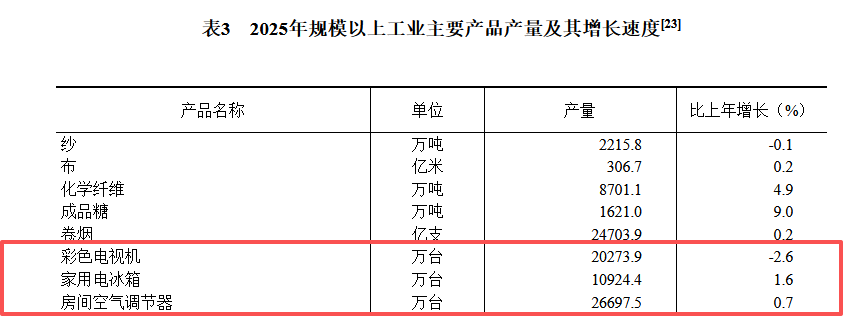
国家统计局:2025年中国空调产量26697.5万台
Guo Jia Tong Ji Ju· 2026-02-28 02:02
Group 1 - The core viewpoint of the news is the release of the "Statistical Bulletin on National Economic and Social Development of the People's Republic of China for 2025" by the National Bureau of Statistics, highlighting various industrial growth rates and production statistics [1] Group 2 - In 2025, the value added of the agricultural and sideline food processing industry increased by 5.6% compared to the previous year [1] - The textile industry saw a growth of 3.0%, while the chemical raw materials and chemical products manufacturing industry grew by 7.8% [1] - The non-metallic mineral products industry experienced a decline of 0.6%, whereas the black metal smelting and rolling processing industry grew by 4.5% [1] - General equipment manufacturing increased by 8.0%, and specialized equipment manufacturing grew by 4.3% [1] - The automotive manufacturing industry reported a significant growth of 11.5%, and the electrical machinery and equipment manufacturing industry grew by 9.2% [1] - The computer, communication, and other electronic equipment manufacturing industry saw a growth of 10.6%, while the electricity and heat production and supply industry grew by 2.2% [1] Group 3 - In terms of specific product outputs, the production of color TVs was 20,273.9 million units, a decrease of 2.6% year-on-year [2] - The refrigerator production reached 10,924.4 million units, marking a year-on-year increase of 1.6% [2] - The air conditioner production was 26,697.5 million units, with a slight increase of 0.7% compared to the previous year [2]

初步核算,全年能源消费总量61.7亿吨标准煤
Guo Jia Tong Ji Ju· 2026-02-28 02:02
Group 1 - The total supply of state-owned construction land in 2025 is projected to be 471,000 hectares, a decrease of 22.2% compared to the previous year [1] - Among the land supply, industrial and storage land is 138,000 hectares, down 10.8%; real estate land is 62,000 hectares, down 14.4%; and infrastructure land is 272,000 hectares, down 28.4% [1] - The area completed for afforestation in the year is 3.56 million hectares, with artificial afforestation accounting for 830,000 hectares, or 23.2% of the total afforestation area [1] Group 2 - The total energy consumption for the year is 6.17 billion tons of standard coal, an increase of 3.5% from the previous year [1] - Coal consumption increased by 0.1%, oil consumption increased by 3.6%, natural gas consumption increased by 2.0%, and electricity consumption increased by 5.0% [1] - The proportion of coal consumption in total energy consumption is 51.4%, a decrease of 1.8 percentage points from the previous year; the share of clean energy consumption is 30.4%, an increase of 1.8 percentage points [1] Group 3 - The energy consumption per unit of GDP, excluding raw material energy and non-fossil energy consumption, decreased by 5.1% compared to the previous year [2] - The carbon emissions trading market saw a transaction volume of 235 million tons of carbon emission allowances, with a transaction value of 14.63 billion yuan [2]
中华人民共和国2025年国民经济和社会发展统计公报
Guo Jia Tong Ji Ju· 2026-02-28 01:33
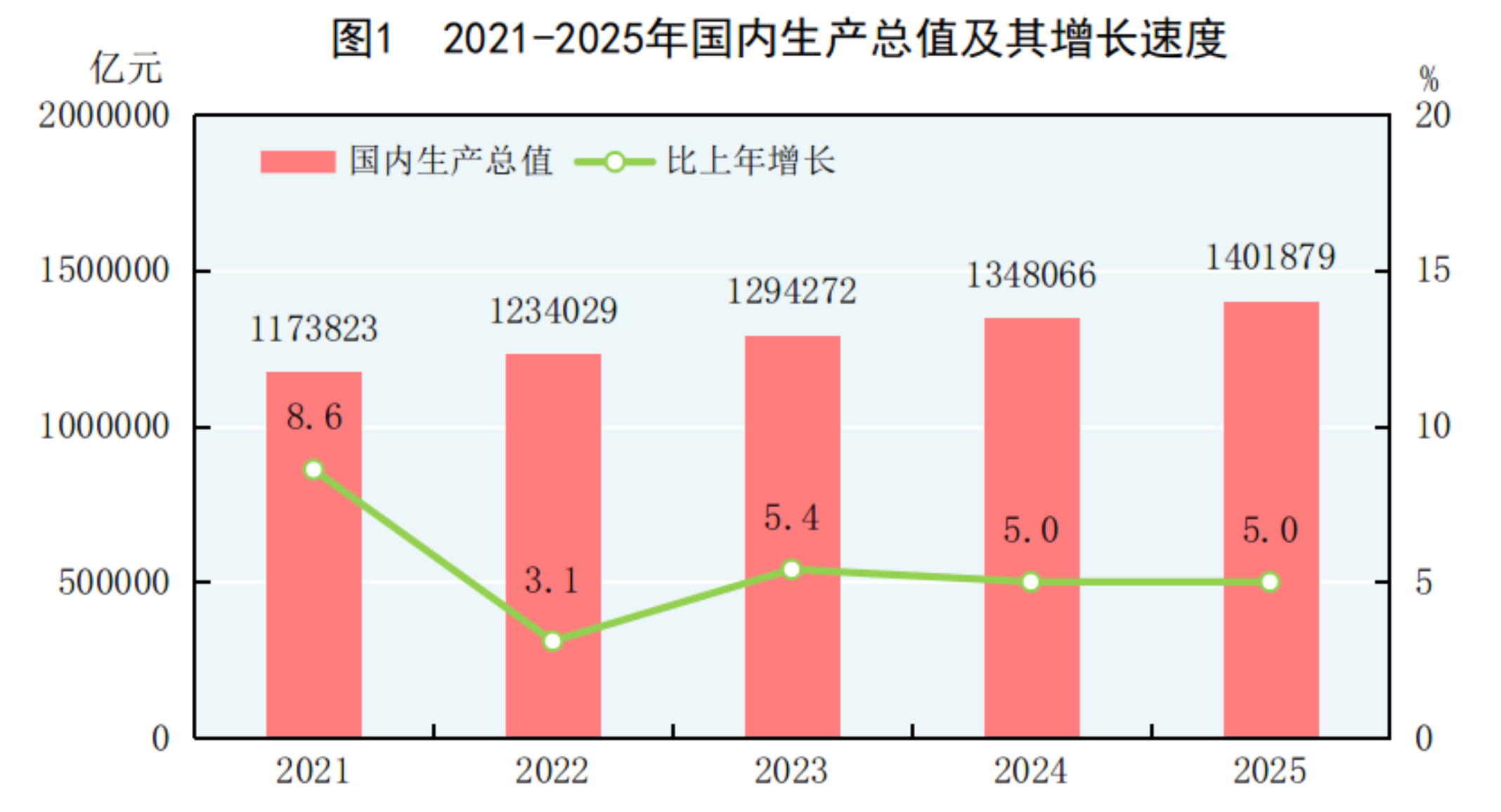
Economic Overview - The GDP for the year reached 140,187.9 billion yuan, growing by 5.0% compared to the previous year [3] - The primary industry added value was 93,347 billion yuan (3.9% growth), the secondary industry was 499,653 billion yuan (4.5% growth), and the tertiary industry was 808,879 billion yuan (5.4% growth) [3] - The per capita GDP was 99,665 yuan, reflecting a 5.1% increase year-on-year [3] Population and Employment - The total population at the end of the year was 1,404.89 million, a decrease of 3.39 million from the previous year [9] - The urban population was 953.80 million, accounting for 67.9% of the total population [7] - The total employment reached 72.50 million, with an urban employment rate of 65.6% [8] Industrial Performance - The total industrial added value was 416,826 billion yuan, marking a 5.8% increase [24] - The manufacturing sector saw a growth of 6.4%, with significant increases in automotive manufacturing (11.5%) and high-tech manufacturing (9.4%) [26][31] - The profits of industrial enterprises reached 73,982 billion yuan, a 0.6% increase year-on-year [31] Agricultural Output - The total grain output was 714.88 million tons, an increase of 1.2% from the previous year [21] - The production of pork was 59.38 million tons, reflecting a growth of 4.1% [23] Service Sector Growth - The value added by the wholesale and retail sector was 145,808 billion yuan, growing by 5.0% [36] - The information transmission, software, and IT services sector grew by 11.1% [36] Trade and Investment - The total import and export value reached 454,685 billion yuan, with exports growing by 6.1% and imports by 0.5% [60] - Foreign direct investment amounted to 747.7 billion yuan, a decrease of 9.5% [69] Financial Sector - The broad money supply (M2) increased by 8.5% to 340.3 trillion yuan [76] - The total social financing scale increased by 35.6 trillion yuan, with a year-end balance of 442.1 trillion yuan [77]
电力重磅文件发布!首批新型电力系统建设能力提升试点名单出炉,43个项目、10个城市入选
Hua Xia Shi Bao· 2026-02-28 01:03
Core Insights - The National Energy Administration has announced the first batch of pilot projects for the construction of a new power system, signaling a significant acceleration in the development of a new energy system and new energy power system during the 14th Five-Year Plan period [2][3] - The pilot projects include 43 initiatives across various technologies, such as system-friendly renewable energy stations, virtual power plants, and new energy storage projects, providing clear guidance for industry technology selection and investment layout [3][4] - The pilot projects aim to enhance core capabilities in high-proportion renewable energy integration, grid flexibility, and collaborative development of energy sources, networks, loads, and storage [3][4] Pilot Project Details - The pilot projects encompass a wide range of initiatives, including wind-solar-thermal storage integration, large-scale offshore wind power, and flexible direct current transmission projects [3][4] - The selected pilot cities are distributed across multiple provinces, ensuring a balanced representation of different regions and resource endowments [5][6] - The pilot projects are expected to provide case studies and data accumulation for future large-scale promotion of new energy systems [4][5] Investment and Economic Impact - The State Grid's fixed asset investment during the 14th Five-Year Plan is projected to reach 4 trillion yuan, a 40% increase compared to the previous plan, with an expected annual addition of 200 million kilowatts of renewable energy capacity [6][7] - The overall investment in the new power system is anticipated to reach a scale of 10 trillion yuan, indicating significant growth potential for the industry [6][7] - The dual drive of national policy and substantial funding is expected to create a favorable cycle for the entire power equipment industry chain, establishing a long-term high prosperity development trend [7][8] Industry Opportunities - The advancement of the new power system is expected to support energy security and stability while facilitating the transition to low-carbon energy sources, aligning with national carbon neutrality goals [8] - The related industries, particularly in energy storage, high-voltage transmission, and smart grid technologies, are projected to experience substantial growth opportunities as a result of increased investment and demand [8][9] - The focus on grid-side energy storage is anticipated to see explosive growth, as it is crucial for ensuring grid safety and addressing system stability challenges [8][9]

电改深化叠加盈利改善,马年首周电力板块走强
Zhong Guo Zheng Quan Bao· 2026-02-28 00:41
Core Viewpoint - The electricity sector has shown strong performance since the beginning of the year, driven by policy reforms and improving fundamentals, indicating significant long-term growth potential and investment opportunities in the sector [1][2]. Policy Drivers - The recent rally in the electricity sector is primarily attributed to policy-driven reforms, including the deepening of the electricity system reform and the establishment of a nationwide unified electricity market [2][3]. - The State Grid Corporation has announced a fixed asset investment plan of 4 trillion yuan for the 14th Five-Year Plan period, marking a 40% increase compared to the previous plan [2]. Financial Performance - The electricity industry's fundamentals are improving, transitioning from a phase of "dual pressure on volume and price" to "stable prices and increased revenue" [4]. - For 2025, Jin控电力 expects a net profit of 155 million to 195 million yuan, representing a year-on-year increase of 383.21% to 507.90%, driven by lower coal prices [4]. - Qian源电力 anticipates a net profit of 567 million to 633 million yuan for 2025, a growth of 160% to 190%, attributed to increased water flow and significant growth in power generation [5]. Investment Opportunities - The electricity demand is shifting from traditional industries to residential and emerging sectors, with a continuous optimization of the electricity supply structure [6]. - The investment logic in the electricity sector is transitioning towards growth driven by AI and energy transformation, moving away from traditional cyclical fluctuations [6]. - Short-term investment opportunities include coal power and energy storage, while mid-term focuses on cross-regional trading and long-term on low-cost hydropower and nuclear power [7].
江苏国信股份有限公司 估值提升计划
Zheng Quan Ri Bao· 2026-02-27 23:44
Core Viewpoint - The company has developed a valuation enhancement plan due to its stock price being below the audited net asset value per share for the past 12 months, as mandated by regulatory guidelines [2]. Group 1: Valuation Enhancement Plan - The company will focus on its core businesses in energy and finance, aiming to improve operational efficiency and project management, including the management of new power generation units and ongoing construction projects [3]. - The company plans to increase cash dividends, targeting a distribution that exceeds 30% of the average net profit over the last three years, to enhance shareholder returns and investor confidence [4]. - The company aims to leverage capital operations to support high-quality development in energy and finance, seeking strategic investors and enhancing its core competitive advantages [5]. - The company will optimize its governance structure, clarifying the roles of the shareholders' meeting, board of directors, and management to ensure effective decision-making and compliance [6]. - The company will enhance its information disclosure quality, aiming for a systematic and transparent approach to build market credibility and trust [8]. - The company will strengthen investor relations management, increasing engagement through various communication channels to ensure market understanding of its value proposition [9]. Group 2: Follow-up Assessment - The company will evaluate the implementation of the valuation enhancement plan annually, as required by regulatory guidelines, to ensure its effectiveness and make necessary adjustments [10].

多部门陆续出台系列增量政策 提振民间投资信心
Zhong Guo Zheng Quan Bao· 2026-02-27 23:35
Core Viewpoint - Recent policies aimed at stimulating private investment and supporting private enterprises are being implemented effectively, with various local governments facilitating private capital participation in major projects and infrastructure REITs [1][2]. Group 1: Policy Implementation - Multiple departments have introduced a series of incremental policies to support private enterprises and stimulate private investment, focusing on reducing costs for production expansion and technological upgrades [2]. - The People's Bank of China has established a private enterprise re-loan program with a quota of 1 trillion yuan, with initial loans already disbursed in regions like Beijing, Anhui, and Zhejiang [2]. - A special guarantee plan for private investment has been launched with a total quota of 500 billion yuan over two years, aimed at reducing financing costs for enterprises [2]. Group 2: Project Participation - Major projects are being opened to private capital, with recent announcements for private investment in high-voltage direct current projects in Sichuan and Gansu, with total investments of approximately 311 billion yuan and 246 billion yuan, respectively [4]. - The government has set clear guidelines to encourage private capital participation in various sectors, including railways and nuclear power, with some projects allowing up to 20% private ownership [4]. Group 3: Financial Support Measures - Additional policies have been introduced to address the investment challenges faced by private enterprises, including interest subsidies for loans to small and micro enterprises and mechanisms for risk sharing on private enterprise bonds [3]. - Local governments are implementing substantial measures to enhance market access, financial support, and resource guarantees for private enterprises, including promoting participation in airport construction and advanced manufacturing sectors [7]. Group 4: Future Development Environment - Experts suggest creating a more open and transparent mechanism for private capital participation in projects, ensuring that private investors have clear opportunities from the planning stages [5]. - There is a call for a stable and predictable institutional environment to encourage private investment, particularly in strategic emerging sectors and innovative industries [8].
算力爆发催生电力缺口 美国AI巨头要自备电厂
2 1 Shi Ji Jing Ji Bao Dao· 2026-02-27 23:11
Core Viewpoint - The article discusses the contrasting energy strategies between China and the United States, highlighting China's transition away from self-sufficient power plants while the U.S. tech giants are increasingly investing in self-supplied power sources to meet the growing energy demands of AI data centers [2][12][18]. Group 1: U.S. Energy Crisis and AI Demand - The U.S. government is pushing tech giants to self-supply or purchase power for AI data centers, amid rising electricity costs and dissatisfaction among residents [3][14]. - The International Energy Agency (IEA) projects that U.S. data center electricity consumption will reach 183 TWh in 2024, accounting for about 4% of total electricity use, and is expected to double to 426 TWh by 2030, potentially exceeding 12% [14][15]. - The PJM Interconnection, responsible for a significant portion of the U.S. electricity market, has seen capacity auction prices soar to $333.44 per megawatt, indicating a severe mismatch between demand and supply [16][17]. Group 2: Energy Infrastructure and Policy Changes - The U.S. government aims to establish 10 new nuclear reactors by 2030, viewing nuclear energy as a stable power source for AI operations, supported by an $80 billion strategic agreement with Westinghouse [18]. - Tech companies like Microsoft and Google are actively engaging in energy infrastructure projects, including nuclear partnerships and long-term agreements for clean energy, to secure their energy needs [18][19]. - The article notes that the energy crisis in the U.S. is creating opportunities for high-end manufacturing companies, particularly in the gas turbine and energy storage sectors, with significant contracts being signed [19]. Group 3: China's Energy Market Adaptation - China's "East Data West Computing" initiative aims to optimize energy distribution, but there is still room for improvement in market mechanisms to meet the rising energy demands driven by AI [20]. - The Chinese government has established a multi-layered market and pricing system to ensure energy security and adapt to new load demands, with a goal to complete a unified national electricity market by 2030 [20]. - The ongoing development of China's electricity spot market is progressing, focusing on capacity pricing, optimizing trading mechanisms, and enhancing collaboration between renewable energy and storage [20].



电改深化叠加盈利改善 马年首周电力板块走强
Zhong Guo Zheng Quan Bao· 2026-02-27 21:58
Core Viewpoint - The electricity sector has shown strong performance since the beginning of the Year of the Rabbit, driven by policy reforms and improving fundamentals, indicating significant long-term growth potential and investment opportunities in the sector [1][2]. Policy Drivers - The electricity sector's recent strength is attributed to ongoing policy reforms, including the deepening of the electricity system reform and the establishment of a nationwide unified electricity market [2][3]. - The State Grid Corporation has announced a fixed asset investment plan of 4 trillion yuan for the 14th Five-Year Plan period, marking a 40% increase compared to the previous plan [2]. Financial Performance - The industry is experiencing a turning point, moving from a phase of "dual pressure on volume and price" to a new stage of "stable prices and increased revenue" [4]. - For 2025, Jin控电力 expects a net profit of 155 million to 195 million yuan, representing a year-on-year increase of 383.21% to 507.90%, driven by lower coal prices [4]. - 建投能源 anticipates a net profit of approximately 1.877 billion yuan for 2025, a year-on-year growth of about 253.38%, attributed to optimized coal resource allocation [4]. - 黔源电力 forecasts a net profit of 567 million to 633 million yuan for 2025, a growth of 160% to 190%, due to increased water flow and significant growth in power generation [5]. Investment Opportunities - The core drivers of electricity demand are shifting from traditional industries to residential electricity and emerging industries, with a continuous optimization of the electricity supply structure [6]. - The investment logic in the electricity sector is transitioning from traditional cyclical fluctuations to a growth trajectory driven by AI and energy transition [6]. - Short-term investment opportunities include coal power and energy storage resources, while mid-term focuses on cross-regional trading and long-term on low-cost hydropower and nuclear power [7].
杭州热电集团股份有限公司关于使用部分暂时闲置募集资金进行现金管理的进展公告
Shang Hai Zheng Quan Bao· 2026-02-27 21:18
Core Viewpoint - The company is utilizing part of its temporarily idle raised funds for cash management to enhance fund efficiency and increase returns [2][3]. Group 1: Cash Management Overview - The initial amount for cash management is set at 52.0227 million yuan [2][3]. - The cash management product chosen is a time deposit, which is considered to have high safety and liquidity [2][3]. - The board approved the use of up to 100 million yuan of temporarily idle raised funds for cash management, with a one-year validity for rolling use [2][4]. Group 2: Fund Source and Usage - The funds for cash management come from temporarily idle raised funds, primarily allocated for the "Hubei Binhai Hubei Xiaochi Binhai New Area Combined Heat and Power Project (Phase I)" [4]. - The total raised funds amounted to 247.417 million yuan, with a net amount of 204.0609 million yuan after deducting issuance costs [4]. Group 3: Cash Management Period and Procedures - The cash management period is from February 28, 2026, to April 16, 2026 [6]. - The board and supervisory committee approved the cash management proposal in meetings held on April 17, 2025 [6]. Group 4: Risk Management - The company emphasizes risk control by selecting high-safety, low-risk cash management products and maintaining close contact with the product issuer [8]. - Measures include strict adherence to prudent investment principles, risk assessment by the finance department, and regular audits by the legal compliance department [8]. Group 5: Impact on the Company - The cash management will not affect the normal operation of the company's main business or the construction of the fundraising projects, while also improving fund returns [10]. - The initial cash management amount represents 7.01% of the company's latest audited cash and 2.23% of the net assets attributable to the parent company [10].
