
文体娱乐

Search documents
国家统计局人口和就业统计司司长:前三季度就业形势总体稳定
Guo Jia Tong Ji Ju· 2025-10-20 02:44
Core Viewpoint - The national economy is operating smoothly with overall stable employment conditions, supported by enhanced macro policies and employment stabilization measures [1] Group 1: Employment Statistics - The national urban surveyed unemployment rate averaged 5.2% from January to September, with quarterly averages of 5.3%, 5.0%, and 5.2%, showing a slight increase of 0.1 percentage points in the first quarter compared to the previous year, while the second and third quarters remained stable [2] - In September, the unemployment rate decreased to 5.2%, down 0.1 percentage points from August, following seasonal adjustments [2] - The unemployment rate in 31 major cities averaged 5.1%, which is 0.1 percentage points lower than the national average, with similar quarterly trends observed [2] Group 2: Employment in Key Sectors - Employment in key service sectors such as transportation, accommodation, and cultural industries improved due to active summer tourism and enhanced employment support policies [3] - The unemployment rate for migrant agricultural workers averaged 4.8%, which is 0.4 percentage points lower than the national urban average, with a slight increase in July due to seasonal factors, followed by a decrease in August and September [3] - The unemployment rate for the 16-24 age group, excluding students, saw a seasonal rise in July and August but significantly decreased in September as graduates secured jobs [3] Group 3: Economic Outlook and Policy Recommendations - The overall economic operation is stable, with steady progress in transformation and upgrading, although structural employment challenges remain in certain regions and industries [3] - There is a need for continued macro policy adjustments to stabilize employment, businesses, markets, and expectations, with an emphasis on enhancing employment support measures [3]
王萍萍:前三季度就业形势总体稳定
Guo Jia Tong Ji Ju· 2025-10-20 02:17
Group 1 - The overall urban surveyed unemployment rate in China remained stable at an average of 5.2% from January to September, with slight fluctuations in the third quarter due to seasonal factors [2][3] - The unemployment rate in 31 major cities averaged 5.1%, slightly lower than the national level, indicating a relatively stable employment situation in urban areas [2] - The unemployment rate for migrant workers was 4.8%, which is 0.4 percentage points lower than the national urban average, showing resilience in this demographic [3] Group 2 - Employment in key service sectors such as transportation, accommodation, and cultural industries improved due to increased support for employment policies and active summer tourism [3] - The unemployment rate for the 16-24 age group saw a seasonal increase during July and August but showed a significant recovery in September as graduates secured jobs [3] - The overall economic operation is stable, with steady progress in transformation and upgrading, although structural employment challenges remain in certain regions and industries [3]
研究推进美丽北京建设持续深入打好污染防治攻坚战等事项
Bei Jing Ri Bao Ke Hu Duan· 2025-10-15 23:49
Group 1 - The meeting emphasized the importance of pollution prevention and control, aiming to achieve annual and "14th Five-Year Plan" goals, and to continuously improve the ecological environment quality in the capital [2][3] - Key tasks include winning the blue sky defense battle, enhancing air pollution control, and promoting the use of new energy vehicles, especially for old vehicles and non-road mobile machinery [2] - The meeting highlighted the need for strict supervision and enforcement in construction sites and road transport to prevent pollution, as well as the protection of water sources and soil environment [2] Group 2 - The fourth quarter is identified as a critical period for achieving annual goals and the "14th Five-Year Plan" completion, with a focus on economic stability and growth [3] - The meeting called for optimizing the business environment, enhancing talent services, and providing policy support to help enterprises overcome difficulties and improve competitiveness [3] - Emphasis was placed on expanding effective investment and planning major projects to play a key role in stabilizing growth [3]
北京市政府召开常务会议,研究推进美丽北京建设持续深入打好污染防治攻坚战等事项
Bei Jing Ri Bao Ke Hu Duan· 2025-10-15 14:29
Core Points - The Beijing municipal government held an executive meeting to discuss the progress of the "Beautiful Beijing" initiative and pollution prevention efforts, emphasizing the importance of achieving annual and "14th Five-Year Plan" goals [1][2] Group 1: Pollution Prevention and Environmental Protection - The meeting stressed the need to accelerate the implementation of key tasks to improve the ecological environment quality in the capital, with a focus on winning the "Blue Sky Defense War" and enhancing air pollution control [2] - Specific measures include deepening autumn and winter air pollution prevention, promoting the electrification of small vehicles, old trucks, and non-road mobile machinery, and advancing the creation of green enterprises [2] - The government will enhance supervision of construction sites and road transport, increase nighttime enforcement inspections, and strictly investigate road spillage [2] - Water pollution prevention will be prioritized, with measures to protect water sources and ensure safe drinking water for urban and rural areas [2] - The meeting highlighted the importance of managing soil environmental risks and preventing new pollution, while also promoting carbon peak and carbon neutrality initiatives [2] Group 2: Economic Growth and Business Environment - The fourth quarter is identified as a critical period for achieving annual goals and completing the "14th Five-Year Plan," with a focus on stabilizing economic growth [3] - The government aims to optimize the business environment by enhancing talent services, industrial support, and policy backing, while actively addressing enterprises' needs [3] - Specific sectors such as catering, accommodation, exhibitions, construction, and cultural entertainment will receive targeted measures to ensure stable growth [3] - The government plans to expand effective investment by implementing, reserving, and planning major projects to play a key role in stabilizing growth [3]
9月PMI点评:预计基本面对债市定价权逐步抬升
Changjiang Securities· 2025-10-09 02:43
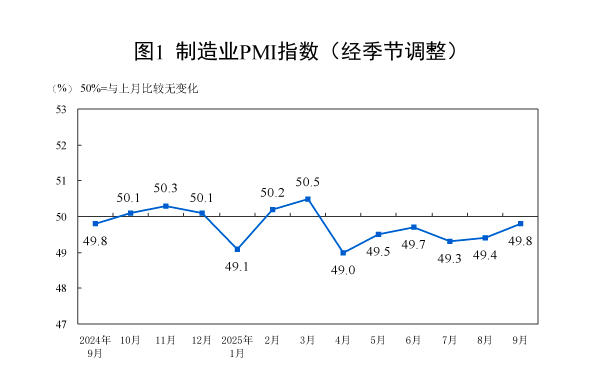
1. Report Industry Investment Rating No relevant content provided. 2. Core Viewpoints of the Report - In September 2025, the manufacturing PMI increased by 0.4 pct month - on - month to 49.8%, slightly exceeding expectations but still below the boom - bust line, while the non - manufacturing PMI dropped by 0.3 pct to 50.0%. The supply - demand relationship needs optimization, and whether production is "front - loaded" remains to be seen. External demand is stable, domestic demand recovers slowly, and the gap between the "purchase price of major raw materials - ex - factory price" continues to widen, putting pressure on enterprise profit restoration. Small - scale enterprise sentiment has significantly improved, and the sentiment of emerging manufacturing industries has also improved. Service industry sentiment has declined, and the construction industry has improved but is still at a relatively low level. The sustainability of PMI restoration needs to be observed. The bond market priced the fundamentals further on the day the data was released, and it is expected that as the pricing power of fundamentals on the bond market gradually increases, the bond market performance in the fourth quarter may be better than that in the third quarter [2][7]. 3. Summary by Related Catalogs 3.1 Event Description - In September 2025, the manufacturing PMI was slightly better than expected but below the boom - bust line, rising 0.4 pct month - on - month to 49.8% (Bloomberg consensus forecast: 49.6%), basically in line with seasonality. The non - manufacturing PMI dropped 0.3 pct to 50.0% (Bloomberg consensus forecast: 50.2%), remaining at a seasonal low. Among them, the service industry PMI dropped 0.4 pct to 50.1%, and the construction industry PMI rose slightly by 0.2 pct to 49.3%, both weaker than seasonality [5]. 3.2 Event Comment - **Manufacturing Industry** - Manufacturing sentiment has moderately recovered, but the supply - demand relationship needs optimization, and whether production is "front - loaded" remains to be seen. In September, the manufacturing PMI improved more than expected, rising 0.4 pct to 49.8%. The production index rose 1.1 pct to 51.9%, reaching a new high since Q2 this year, while the new order index only increased 0.2 pct to 49.7%. The gap between the "production - new order" index widened to 2.2 pct, indicating that the supply recovery intensity may be greater than the demand improvement. Enterprises' willingness to replenish inventory has increased, but there are signs of inventory accumulation, and production may be "front - loaded" [7]. - There are differentiations in external and internal demand and price structure. External demand is stable, domestic demand recovers slowly, and the price indicators have generally improved, but the gap between the "purchase price of major raw materials - ex - factory price" continues to widen, which may still restrict enterprise profit restoration. In September, the purchase price index of major raw materials remained in the expansion range of 53.2%, while the ex - factory price index dropped to 48.2%, and the gap between the two widened to 5.0 pct. External demand remained resilient, with the new export order index rising to 47.8%, while domestic demand recovery was still relatively slow, with the new order index only increasing 0.2 pct to 49.7% [7]. - Small - scale enterprise sentiment has significantly improved, and the sentiment of emerging manufacturing industries has also improved. In September, the PMI of large - scale enterprises reached 51.0%, remaining in the expansion range. Small - scale enterprises improved significantly, with the PMI rising 1.6 pct month - on - month, while the sentiment of medium - scale enterprises declined. In terms of industries, the PMI of the equipment manufacturing and high - tech manufacturing industries remained in the high - sentiment range above 51%, with significant improvements in industries such as automobiles and railway, ship, and aerospace equipment. The PMI of the consumer goods industry also rose to 50.6% [7]. - **Non - manufacturing Industry** - Service industry sentiment has declined, and the construction industry has improved but is still at a seasonal low. In September, the non - manufacturing business activity index dropped 0.3 pct to 50.0%, and the service industry index dropped 0.4 pct to 50.1%. The end of the summer vacation effect is an important factor, with the sentiment of consumer - related industries such as catering and cultural and entertainment significantly declining, while modern service industries such as finance and telecommunications maintained high sentiment. The business activity index of the construction industry rose slightly by 0.2 pct, but the absolute level of 49.3% was still below the boom - bust line, indicating that real estate and infrastructure investment may continue to be under pressure [7]. - **Bond Market Outlook** - The sustainability of PMI restoration needs to be observed. On the day the data was released, the bond market priced the fundamentals further, with the yield of the 10 - year active treasury bond dropping 2 BP. A series of growth - stabilizing policies have been implemented recently, and the investment of 500 billion yuan in new policy - based financial instruments may support infrastructure investment. The expectation of optimizing real estate market regulation policies in many places has increased, but whether the economy will continue to improve in an environment of weak domestic demand and prices remains to be seen. It is expected that as the pricing power of fundamentals on the bond market gradually increases, the bond market performance in the fourth quarter may be better than that in the third quarter [7].
制造业PMI连续两月回升 下阶段走势如何
Di Yi Cai Jing· 2025-09-30 02:57
Core Insights - The manufacturing PMI in China rose to 49.8% in September, indicating a slight recovery but still below the expansion threshold [1] - The non-manufacturing business activity index decreased to 50.0%, reflecting a slight slowdown in non-manufacturing activities [1] Manufacturing Sector - The manufacturing production index increased to 51.9%, marking a continuous expansion for five months [4] - The purchasing volume index rose to 51.6%, indicating improved procurement activities [4] - New orders index reached 49.7%, showing a stabilization in market demand [4] - The export new orders index improved to 47.8%, suggesting a narrowing decline in export demand [4] - The manufacturing purchase price index was 53.2%, while the factory price index fell to 48.2%, indicating mixed price trends across sectors [5] Non-Manufacturing Sector - The non-manufacturing business activity index remained stable at 50.0%, with the construction index at 49.3% and the services index at 50.1% [8] - The business activity expectation index for non-manufacturing remained above 55%, indicating stable optimism among enterprises [8] - The postal industry showed significant growth, with indices above 60%, reflecting active online shopping [8][9] Future Outlook - The manufacturing sector is expected to see continued growth in Q4, driven by macro policies and seasonal demand [5] - Non-manufacturing activities are anticipated to stabilize and recover, supported by year-end effects and holiday demand [10]

加大消费信贷投放 金融支持服务消费扩面提质
Jing Ji Ri Bao· 2025-09-24 23:59
Core Viewpoint - The recent policies issued by the Ministry of Commerce and the People's Bank of China aim to stimulate service consumption through financial and fiscal measures, enhancing the quality of service consumption and promoting economic growth [1][2]. Policy Synergy Effect - Service consumption is a crucial driver of economic growth, especially amid increasing external uncertainties and domestic economic adjustments [2]. - The People's Bank of China has implemented various financial support policies to boost service consumption supply and meet residents' service consumption needs [2]. - A specific initiative includes the establishment of a 500 billion yuan service consumption and elderly re-loan program, which has already seen nearly 60 billion yuan in applications from around 4,000 businesses [2]. Financial Support and Credit Expansion - The People's Bank of China has also set up a 500 billion yuan technology innovation and transformation re-loan program, which has expanded to 800 billion yuan in 2024, supporting projects in key service sectors [3]. - In the first half of the year, this program supported nearly 100 projects in hospitality, education, and tourism, with loan contracts totaling approximately 11.9 billion yuan [3]. - Financial institutions are focusing on enhancing credit supply in key consumption areas, with a reported loan balance of 2.79 trillion yuan in service consumption sectors, reflecting a year-on-year growth of 5.3% [5]. Innovation in Consumption Scenarios - The policies encourage financial institutions to support diverse service consumption scenarios and key project developments, aiming to transform traditional consumption [6][7]. - The integration of financial resources into various consumption scenarios, such as rural e-commerce and cultural tourism, is emphasized to enhance service supply capabilities [7]. Deepening in Niche Markets - Financial institutions are increasing support for niche markets like cultural tourism and sports, which enhances service consumption willingness and capacity [8]. - The "silver economy" is highlighted as a growing sector, with initiatives aimed at promoting elderly care services and related industries [8]. Future Outlook - As income levels rise, the shift from goods consumption to service consumption is expected to create more opportunities for financial institutions [9]. - Continuous policy reinforcement is suggested to guide funding towards essential sectors like elderly care and digital consumption, ensuring high-quality service supply [9].
金融业解决服务消费堵点应积极主动作为
Guo Ji Jin Rong Bao· 2025-09-20 02:15
Core Viewpoint - The recent joint issuance of the "Several Policy Measures to Expand Service Consumption" by nine government departments aims to address the bottlenecks in service consumption through a coordinated multi-departmental approach, emphasizing the importance of financial support and collaboration among various sectors [1] Group 1: Policy Measures Overview - The policy measures include nineteen specific tasks across five areas: cultivating service consumption promotion platforms, enriching high-quality service supply, stimulating new service consumption growth, enhancing financial support, and improving statistical monitoring systems [1] - The financial sector is highlighted as a key participant in resolving service consumption bottlenecks, with a call for proactive engagement and integration of monetary, credit, and capital market policies [1] Group 2: Financial Sector Initiatives - Financial institutions are encouraged to expand high-quality financial service offerings to meet the unmet financial demands of the service consumption sector and residents, particularly in areas like elderly care, childcare, and cultural tourism [2] - The central bank's establishment of a 500 billion yuan service consumption and elderly re-loan fund is emphasized as a tool to incentivize financial institutions to increase support for sectors such as accommodation and entertainment [2] Group 3: Consumer Credit Support - There is a push to enhance support for consumer credit to stimulate resident consumption potential, with initiatives like tax refunds and consumption vouchers being highlighted [3] - The number of tax refund stores is projected to reach 10,000 by mid-2025, tripling from the end of 2024, with a 98% increase in tax refund sales [3] Group 4: Financial Product Optimization - Financial institutions are urged to continuously optimize financial products and services to provide diverse, high-quality consumption options, focusing on key consumption areas such as food, housing, and entertainment [4] - There is a call for increased support for various types of loans, including first loans, renewal loans, and credit loans, to enhance the financial backing for the consumption sector [4] Group 5: Risk Management and Compliance - Financial institutions are advised to improve credit structure and risk management to ensure precise financial services, avoiding extremes in credit work that could overlook risks [4] - The importance of regulatory measures to enhance compliance and prevent financial bottlenecks in service consumption is emphasized, promoting a virtuous cycle of demand upgrading, supply optimization, and consumption expansion [4]
权威发布丨扩大服务消费从供需两端发力
Ren Min Ri Bao· 2025-09-18 01:27
Core Viewpoint - The Chinese government has introduced a series of policy measures aimed at expanding service consumption, which is seen as a crucial driver for economic growth and improving living standards [1][2][3]. Group 1: Policy Measures - The policy measures focus on addressing bottlenecks in service consumption development, emphasizing the combination of improving people's livelihoods and promoting consumption [1]. - Initiatives include creating high-profile sports events, expanding long-term care insurance, and supporting early childhood education to enhance service consumption [1]. - The measures aim to optimize supply and stimulate demand by promoting new consumption models and increasing quality service resources in sectors like culture and tourism [2]. Group 2: Market Dynamics - In the first half of the year, over 19 million foreign visitors entered China, marking a 30% year-on-year increase, with visa-free entries rising by 54% [3]. - The number of duty-free shops has tripled compared to the end of 2024, with a 248% increase in the number of people benefiting from duty-free refunds [3]. - The Ministry of Commerce is working to enhance high-quality consumption supply and create diverse consumption scenarios to boost inbound consumption [3]. Group 3: Service Quality Improvement - The government plans to enhance service supply quality by promoting innovation in service sectors through initiatives like "Artificial Intelligence+" [4]. - There is a focus on improving service levels in key areas such as childcare, elderly care, and tourism by increasing skilled labor supply and implementing credit systems [4][5]. - The establishment of a unified market environment is being prioritized to facilitate fair market access, especially for small and medium-sized enterprises [5]. Group 4: Financial Support - The People's Bank of China has allocated 500 billion yuan for service consumption and elderly care refinancing, encouraging financial institutions to increase lending in key service sectors [5]. - As of July, the loan balance in key service consumption areas reached 2.79 trillion yuan, reflecting a year-on-year growth of 5.3% [5].
央行:目前,金融机构申报服务消费与养老再贷款近600亿元
Sou Hu Cai Jing· 2025-09-17 08:36
Group 1 - The People's Bank of China has established a 500 billion yuan re-lending program to support service consumption and elderly care, aiming to guide financial institutions to increase credit investment in key sectors such as accommodation, catering, cultural and entertainment, education, resident services, and tourism [1] - Financial institutions have reported nearly 60 billion yuan in applications for the service consumption and elderly care re-lending, involving nearly 4,000 operating entities and over 5,700 loans [1] - A separate re-lending program for technological innovation and technological transformation was set up with an initial 500 billion yuan in April 2024, which has been expanded to 800 billion yuan this year to encourage banks to support credit for key equipment upgrade projects [1] Group 2 - In the first half of this year, the technological innovation and technological transformation re-lending supported nearly 100 projects in accommodation, catering, cultural education, and tourism sectors, with loan contracts signed amounting to approximately 11.9 billion yuan [1]