
家用电器

Search documents
本间高尔夫实控人14.7亿元购入百润股份6.01%股权
Zheng Quan Shi Bao Wang· 2025-09-10 16:10
Core Viewpoint - Liu Xiaodong, the controlling shareholder of BaiRun Co., plans to transfer 63 million shares, representing 6.01% of the company's total equity, to Liu Jianguo for a total consideration of RMB 1.47 billion, at a price of RMB 23.34 per share, which is calculated at a 10% discount to the closing price prior to the agreement [1][3]. Group 1 - Liu Jianguo holds 38.72% of the shares in Honma Golf through Kouunn Holdings Limited and has no other significant equity interests in listed companies [2]. - Liu Jianguo is a businessman from Wenzhou, Zhejiang, with a background in managing various companies, including Zhejiang Pentium Electric Co., and has significant ownership in Shanghai Pentium Enterprise Group [2]. - BaiRun Co. is well-known for its pre-mixed cocktails, particularly the RIO brand, and has seen its stock price increase nearly 15 times over two and a half years since mid-November 2018 [3]. Group 2 - BaiRun Co. began its foray into whiskey around 2020, raising RMB 1.006 billion through a private placement to fund whiskey aging projects, which are essential for producing the base liquor for pre-mixed cocktails [3]. - After the share transfer, Liu Xiaodong's holding will decrease to 34.58%, and the transfer aims to diversify the shareholder structure and bring in external resources to promote company development [3][4]. - Liu Jianguo has committed not to participate in the management of BaiRun Co. and will not reduce his holdings in the company for twelve months following the transfer [4].

2025年9月量化行业配置月报:高切低,布局低位消费-20250910
ZHESHANG SECURITIES· 2025-09-10 13:07
Quantitative Models and Construction 1. Model Name: Timing Model for Nonferrous Metals - **Model Construction Idea**: This model uses macroeconomic scoring to time the allocation between the CSI SW Nonferrous Metals Index and the Wind All A Index, leveraging the dominant role of copper and other industrial metals in the nonferrous metals sector[19][20] - **Model Construction Process**: - The macroeconomic score for copper is calculated based on global economic and inflationary factors - Allocation Rule: - If the macro score > 0, allocate to the CSI SW Nonferrous Metals Index - Otherwise, allocate to the Wind All A Index - Backtesting Period: March 2009 to September 2025 - Formula: Not explicitly provided, but the scoring system is based on historical macroeconomic data[19][20] - **Model Evaluation**: The model demonstrates strong timing ability, capturing the upward trends in the nonferrous metals sector, except during 2012-2013 when the sector underperformed despite a bullish signal[20] 2. Model Name: Comprehensive Allocation Strategy - **Model Construction Idea**: This strategy dynamically allocates weights to industries based on their economic cycle signals (upward, flat, or downward) and crowding levels, with flat-cycle industries receiving half the weight of upward-cycle industries[35] - **Model Construction Process**: - Identify industries with upward or flat economic cycle signals - Exclude industries with high crowding levels - Assign weights: - Upward-cycle industries: Full weight - Flat-cycle industries: Half weight - Monthly updates based on the latest signals[35] - **Model Evaluation**: The strategy underperformed its benchmarks in the most recent month, suggesting potential limitations in capturing short-term market dynamics[35] --- Model Backtesting Results 1. Timing Model for Nonferrous Metals - **Excess Return**: 245% relative to the Wind All A Index during the backtesting period (March 2009 - September 2025)[20] 2. Comprehensive Allocation Strategy - **1-Month Return**: 4.6% - **Excess Return vs. Equal-Weighted Index**: -5.7% - **Excess Return vs. CSI 800**: -3.9%[35][39] --- Quantitative Factors and Construction 1. Factor Name: Macroeconomic Score for Copper - **Factor Construction Idea**: This factor evaluates the economic and inflationary environment to assess the attractiveness of copper as a leading indicator for the nonferrous metals sector[19][21] - **Factor Construction Process**: - Historical macroeconomic data is used to calculate a score for copper - The score ranges from negative to positive, reflecting unfavorable to favorable conditions[21] - Formula: Not explicitly provided, but the scoring system is derived from macroeconomic indicators[21] 2. Factor Name: Sector Crowding Indicator - **Factor Construction Idea**: This factor measures the crowding level in various sectors to identify potential risks of over-concentration[32][34] - **Factor Construction Process**: - Calculate the crowding level for each sector based on historical trading data - Identify sectors exceeding the 95% warning threshold[32][34] --- Factor Backtesting Results 1. Macroeconomic Score for Copper - **Latest Score**: 4, indicating a historically high level of attractiveness for the nonferrous metals sector[19][21] 2. Sector Crowding Indicator - **Sectors Above 95% Threshold**: Nonferrous Metals, Electronics, Communication, Machinery, Comprehensive, Beauty & Personal Care, Defense, and Pharmaceuticals[32][34]
涉多只热门股!两大指数,正式发布!
Zheng Quan Shi Bao· 2025-09-10 11:50
Core Viewpoint - The launch of the CSI A500 Growth Index and CSI A500 Value Index provides diversified investment options for the market, reflecting the performance of representative listed companies in various industries in China [2][5]. Group 1: Index Launch Details - The CSI A500 Growth Index and CSI A500 Value Index were officially launched on September 10, 2025, by the China Securities Index Co., Ltd. [2][6]. - Both indices consist of 100 securities selected from the CSI A500 Index sample, which is considered the Chinese equivalent of the S&P 500 [2][3]. - The CSI A500 Growth Index is based on growth factor scores, while the CSI A500 Value Index is based on value factor scores, both using a base date of December 31, 2014, and a base point of 1000 [4][5]. Group 2: Index Composition and Characteristics - The CSI A500 Growth Index focuses on companies with high growth characteristics, using metrics such as average revenue growth rate, average net profit growth rate, and quarterly ROE year-on-year [2][4]. - As of September 9, 2025, the top sectors in the CSI A500 Growth Index include Industrial and Information Technology, each with weights exceeding 20%, while Communication Services, Materials, and Consumer Discretionary exceed 10% [3][5]. - The top ten weighted stocks in the CSI A500 Growth Index include Ningde Times, Zijin Mining, and BYD, with several being recent high-performing stocks [3][5]. Group 3: Value Index Characteristics - The CSI A500 Value Index selects securities based on value factor scores, utilizing metrics such as dividend yield, price-to-book ratio, cash flow to price ratio, and earnings to price ratio [4][5]. - The leading sectors in the CSI A500 Value Index are Financials and Industrials, each with weights over 20%, while Consumer Discretionary and Materials exceed 10% [4][5]. - The top ten weighted stocks in the CSI A500 Value Index include Gree Electric Appliances, China Ping An, and China Construction, indicating a focus on established companies with strong value characteristics [4][5]. Group 4: Upcoming Indices - In addition to the two indices launched, four more indices will be released on September 11, 2025, including the CSI A500 Relative Growth Index, CSI A500 Relative Value Index, CSI A500 Pure Growth Index, and CSI A500 Pure Value Index [6][7]. - The upcoming indices will assess both growth and value characteristics, with specific methodologies for selecting securities based on their respective styles [7].
【盘中播报】54只A股封板 通信行业涨幅最大
Zheng Quan Shi Bao Wang· 2025-09-10 06:40
Market Overview - The Shanghai Composite Index increased by 0.26% with a trading volume of 1,013.91 million shares and a transaction value of 16,316.30 billion yuan, which is a decrease of 6.89% compared to the previous trading day [1] - A total of 2,382 stocks rose, with 54 hitting the daily limit, while 2,848 stocks fell, including 5 hitting the lower limit [1] Industry Performance - The top-performing sectors include: - Communication: up 3.42% with a transaction value of 1,228.20 billion yuan, an increase of 43.45% from the previous day, led by Yuan Dao Communication, which rose by 20.01% [1] - Electronics: up 2.70% with a transaction value of 2,660.86 billion yuan, an increase of 6.48%, led by Si Quan New Materials, which rose by 19.33% [1] - Media: up 1.67% with a transaction value of 571.93 billion yuan, an increase of 15.06%, led by Happiness Blue Sea, which rose by 15.42% [1] - The sectors with the largest declines include: - Electric Equipment: down 1.29% with a transaction value of 2,193.34 billion yuan, a decrease of 12.65%, led by Shang Neng Electric, which fell by 8.98% [2] - Comprehensive: down 1.17% with a transaction value of 48.00 billion yuan, a decrease of 4.46%, led by Dong Yang Guang, which fell by 2.50% [2] - Basic Chemicals: down 1.06% with a transaction value of 746.27 billion yuan, a decrease of 20.65%, led by Qi De New Materials, which fell by 8.20% [2]
“出海”竞争:哪些新趋势?
2025-09-08 04:11
Summary of Key Points from Conference Call Records Industry Overview - China's foreign direct investment (FDI) stock ranks among the top globally, surpassing several developed economies since 2016, with 2022 seeing China, the US, the Netherlands, and the UK as leaders in FDI stock [1][2][3] - Despite a global decline in FDI stock in 2020, China's decline was relatively minor, indicating strong investment resilience [1][2] Structural Changes in Investment Patterns - The proportion of outbound mergers and acquisitions (M&A) by Chinese companies has significantly decreased from 44.1% in 2016 to less than 10%, while greenfield investments have become increasingly active [1][3] - The shift in motivation for overseas investments has moved from cross-border tax avoidance to industrial output, influenced by improvements in the international tax governance system [3] Sectoral and Regional Investment Distribution - Chinese companies exhibit notable differences in industrial layout across various economies: - Leasing and business services, as well as retail, are primarily concentrated in Asia and Latin America - Manufacturing is more prevalent in Europe and North America - Mining and construction dominate in Oceania and Africa, closely linked to local resource endowments and demands [1][4] - As of the end of 2022, approximately 29,000 domestic institutions had established 47,000 overseas enterprises in 190 countries, with these entities showing high employment demand and revenue growth [4] Revenue Contributions from Overseas Operations - In 2023, companies disclosing overseas income reported that overseas business revenue accounted for about 20% of total revenue, with the electronics sector leading both in scale and proportion [5] - Other significant sectors include power equipment, automotive, and home appliances, which collectively account for about 30% of their revenue from overseas operations [5] Emerging Opportunities in Specific Sectors - In the automotive sector, commercial vehicles have a higher proportion of overseas revenue compared to passenger vehicles, partly due to competitive disadvantages faced by fuel vehicles [6] - The rapid growth of the electric passenger vehicle market is increasingly supporting corporate profitability [6] - Emerging fields such as cross-border e-commerce, logistics, medical R&D outsourcing, and pet food show potential for significant growth, despite currently lower overseas revenue scales [6] Greenfield Investment Trends - Since 2022, China's overseas M&A scale has declined, while greenfield investment has surpassed M&A and has rapidly increased in 2023, creating hundreds of thousands of jobs [10] - Key sectors for greenfield investment include metals, electronic components, and automotive OEM, with significant investments also directed towards renewable resources and chemicals [12] Employment Creation and Regional Focus - Greenfield investments have created numerous job opportunities in regions such as ASEAN countries (Vietnam, Thailand, Cambodia, Malaysia) and Morocco and Mexico, particularly in electronics, consumer appliances, and automotive sectors [13] Implications of Regional and Sectoral Layouts - The differences in industrial layouts across regions provide insights for expanding overseas operations, with high concentrations of greenfield investments in raw materials and semiconductor sectors [14][15] - Local industrial demand and policies significantly influence the scale of Chinese investments in various regions, highlighting the importance of aligning investment strategies with regional needs [15]
业绩专题:上半年A股盈利增速放缓,后续有望温和回升
Dongguan Securities· 2025-09-08 02:58
Group 1 - The overall profit of A-shares in the first half of 2025 increased by 2.44% year-on-year, but the growth rate has slowed down compared to the first quarter [2][9][10] - The net profit of non-financial A-shares rose by 1.03% year-on-year, a decrease of 3.48 percentage points from the first quarter [9][10] - The net profit of the non-financial and non-oil and gas A-shares increased by 4.82% year-on-year, with a decrease of 3.08 percentage points from the first quarter [9][10] Group 2 - The total revenue of all A-shares increased by 0.03% year-on-year, marking a return to positive growth after a year of decline [15][19] - The revenue growth rates for the ChiNext and Sci-Tech Innovation Board were 7.04% and 4.81% respectively, while the North Stock A-share saw a growth of 5.66% [18][19] - The main board's revenue growth rate decreased by 0.5% year-on-year, but improved by 0.25 percentage points from the first quarter [19] Group 3 - The overall gross profit margin for A-shares was 17.84%, a slight increase from the first quarter [22][24] - The gross profit margins for the ChiNext and Sci-Tech Innovation Board were 23.25% and 28.98% respectively, with the latter maintaining a high level [24][25] - The gross profit margin for the main board decreased by 0.03 percentage points compared to the first quarter [24] Group 4 - Major expenses for non-financial enterprises saw a year-on-year decline, with sales expenses down by 2.29% and financial expenses down by 15.38% [29][30] - The revenue and cost growth rates for non-financial enterprises were -0.18% and -0.17% respectively, indicating a narrowing decline [29][30] - The overall economic environment is expected to improve, with policies aimed at boosting consumption and stabilizing infrastructure investment [30] Group 5 - The return on equity (ROE) for all A-shares remained stable at 7.73%, with slight variations across different sectors [33][34] - The sales net profit margin for all A-shares increased slightly to 7.87% [33][34] - The total asset turnover ratio for all A-shares improved, indicating better efficiency in asset utilization [33][34] Group 6 - In the upstream sector, the performance of the coal industry was weak, with revenue and net profit declining significantly [41][42] - The agricultural sector showed signs of recovery, with a revenue increase of 8.95% and a notable rise in net profit [42] - The machinery equipment sector experienced steady growth, with revenue and net profit increasing by 7.26% and 18.08% respectively [44] Group 7 - The real estate sector continued to face pressure, with a year-on-year revenue decline of 11.92% [46] - The consumer sector showed overall performance slowdown, with the automotive sector's revenue growth rate decreasing significantly [47] - The TMT sector exhibited mixed results, with the electronic sector showing strong growth while the media sector experienced a decline [48] Group 8 - The banking sector's net profit growth turned positive, with a year-on-year increase of 0.77% [49] - Non-bank financial institutions continued to perform well, with a net profit increase of 18.36% [49] - Other sectors such as transportation and defense showed improvement, while environmental and public utility sectors faced challenges [50]
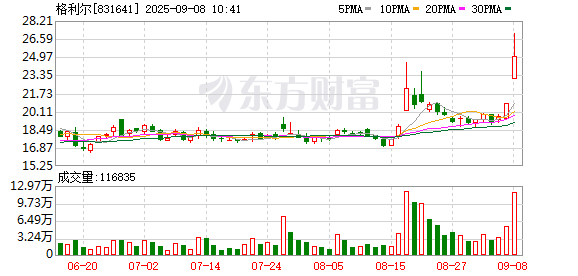
格利尔涨29.99%,股价创历史新高
Zheng Quan Shi Bao Wang· 2025-09-08 02:40
Company Performance - Greer stock reached an all-time high, increasing by 29.99% to a price of 27.05 yuan, with a trading volume of 5.132 million shares and a transaction amount of 133 million yuan, resulting in a turnover rate of 11.49% [2] - The latest total market capitalization of Greer in A-shares is 2.031 billion yuan, with a circulating market capitalization of 1.208 billion yuan [2] - The company reported a revenue of 241 million yuan for the first half of the year, a year-on-year decrease of 19.01%, while net profit was 3.1515 million yuan, a year-on-year increase of 178.34%, with basic earnings per share of 0.0400 yuan and a weighted average return on equity of 0.90% [2] Industry Overview - The home appliance industry, to which Greer belongs, has an overall increase of 1.57%, with 81 stocks rising, including Greer, Hefei Gaoke, and Sanhua Intelligent Control, which saw increases of 29.99%, 21.16%, and 10.00% respectively [2] - There are 18 stocks in the industry that experienced declines, with Hongzhi Technology, Hongchang Technology, and *ST Gauss showing decreases of 3.63%, 1.94%, and 1.44% respectively [2] Margin Trading Data - As of September 5, the latest margin trading balance for Greer is 3.0824 million yuan, with a financing balance of 3.0824 million yuan, reflecting a decrease of 1.6299 million yuan over the past 10 days, which is a 34.59% decline [2]

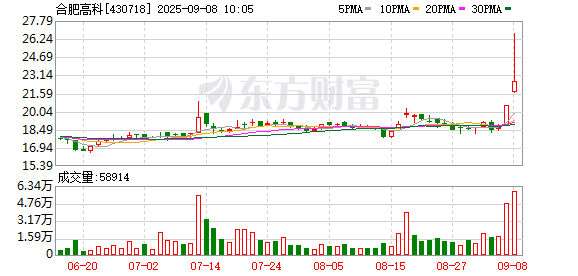
合肥高科涨21.16%,股价创历史新高
Zheng Quan Shi Bao Wang· 2025-09-08 02:04
Group 1 - Hefei Gaoke's stock price reached a historical high, increasing by 21.16% to 24.91 yuan, with a trading volume of 3.67 million shares and a transaction value of 90.27 million yuan, resulting in a turnover rate of 8.59% [2] - The total market capitalization of Hefei Gaoke in A-shares is 2.26 billion yuan, with a circulating market capitalization of 1.07 billion yuan [2] - The home appliance industry, to which Hefei Gaoke belongs, has an overall increase of 1.57%, with 81 stocks rising, including Hefei Gaoke, which ranks among the top gainers [2] Group 2 - The latest margin trading data shows that Hefei Gaoke's margin balance is 5.37 million yuan, with a financing balance of 5.37 million yuan, reflecting a decrease of 3.44 million yuan over the past 10 days, a decline of 39.02% [2] - The company's semi-annual report indicates that it achieved an operating income of 573 million yuan, a year-on-year increase of 7.93%, while net profit was 30.36 million yuan, a year-on-year decrease of 17.40%, with basic earnings per share of 0.33 yuan and a weighted average return on equity of 5.28% [2]
大消费行业周报(9月第1周):绍兴促消费政策聚焦多消费场景-20250908
Century Securities· 2025-09-08 02:01
Investment Rating - The report does not explicitly state an investment rating for the industry, but it suggests a positive outlook based on recent policy initiatives and market performance. Core Insights - The consumption policy in Shaoxing aims to stimulate various consumption scenarios, focusing on dining, nightlife, and supermarkets, with over 100 million yuan allocated for consumption incentives [1][2]. - The report highlights a mixed performance in the consumer sector, with textile and apparel, social services, and home appliances showing varied weekly changes, while specific stocks like Huanle Home and Hongzhi Technology saw significant gains [1][3]. - The State Council's recent directives on sports industry development are expected to enhance sports consumption and related sectors, with a target of exceeding 7 trillion yuan in total sports industry scale by 2030 [1][14]. Summary by Sections Market Weekly Review - The consumer sector showed a mixed performance with textile and apparel up by 1.37%, while food and beverage, home appliances, and retail sectors experienced declines [1][3]. - Notable stock performances included Huanle Home (+15.33%) and Hongzhi Technology (+38.13%), while stocks like Youyou Food (-10.91%) and Tianyin Electromechanical (-12.90%) faced declines [1][12][13]. Industry News and Key Company Announcements - The Shaoxing consumption policy is designed to boost dining and nightlife, providing subsidies for large dining events and incentives for 24-hour convenience stores [1][14]. - The State Council's opinion on sports industry development includes measures to expand sports product supply and stimulate consumer demand, aiming for a significant increase in sports-related consumption [1][15]. - Recent announcements from companies like Aokang Electric and others indicate ongoing market activities and strategic partnerships aimed at enhancing operational capabilities and market reach [1][17].
A股牛市持续,行业动态与投资策略分析
Sou Hu Cai Jing· 2025-09-06 11:06
Group 1 - A-share market shows strong upward trend supported by delayed tariff implementation and dovish Fed comments, with Shanghai Composite Index approaching 3900 points [1] - Public fund issuance, private fund management scale, and financing balance have all seen significant growth, indicating increased market activity [1] - The "stronger get stronger" trend remains evident, with cyclical stocks expected to perform well in the latter part of the bull market [1] Group 2 - Multiple industries, including electronics, home appliances, and non-bank financials, show improved performance in the mid-year reports, with upward revisions in expectations for several sectors [2] - Inventory cycles indicate that many industries are entering a passive destocking phase, while others are actively replenishing stock [2] - The current market environment is characterized by rising Fed rate cut expectations, which may enhance global risk appetite [2] Group 3 - Gold market is expected to maintain upward momentum, driven by factors such as Fed independence challenges and ongoing de-dollarization trends [3] - Three scenarios for Fed rate cuts are anticipated, ranging from moderate cuts to significant reductions in response to economic downturns [3] Group 4 - Over half of convertible bond issuers reported year-on-year revenue growth, with agriculture and forestry showing the highest profit growth [4] - Investors are advised to focus on companies with predictable mid-year performance and reasonable valuations, while avoiding those with disappointing results [4] Group 5 - The banking sector faces challenges with the renewal of high-interest deposits due to a significant amount maturing between Q4 2025 and Q1 2026 [5] - The chemical industry is entering a phase of capacity release, with a focus on supply-demand balance and potential price increases in the latter half of the year [5]