能源

Search documents
银河期货每日早盘观察-20251230
Yin He Qi Huo· 2025-12-30 02:08
期 货 眼 ·日 迹 每日早盘观察 银河期货研究所 2025 年 12 月 30 日 0 / 45 研究所 期货眼·日迹 | 股指期货:震荡不改上行趋势 3 | | --- | | 国债期货:市场突发调整,空单适度止盈 4 | | 蛋白粕:供应压力较大 | 盘面整体回落 5 | | --- | --- | | 白糖:内蒙糖厂已开始停机 | 产量预计略增 5 | | 油脂板块:商品情绪转弱,油脂反弹空间或有限 7 | | | 玉米/玉米淀粉:现货上涨,盘面高位震荡 7 | | | 生猪:出栏压力减少 | 盘面上涨较明显 8 | | 花生:花生现货稳定,花生盘面窄幅震荡 9 | | | 鸡蛋:需求表现一般 | 蛋价有所回落 10 | | 苹果:需求表现一般 | 果价稳定为主 11 | | 棉花-棉纱:新棉销售较好 | 棉价震荡偏强 12 | | 钢材:原料补库开启,钢价维持区间震荡 13 | | --- | | 双焦:驱动不明显,震荡运行 13 | | 铁矿:市场预期反复,矿价震荡运行 14 | | 铁合金:商品情绪回落,短期震荡运行 15 | | 金银:市场降温 金银大幅回调 16 | | --- | | 铂钯 ...
国泰君安期货商品研究晨报:能源化工-20251230
Guo Tai Jun An Qi Huo· 2025-12-30 01:32
1. Report Industry Investment Ratings - No specific industry investment ratings are provided in the report. 2. Core Views of the Report - The report provides daily research and analysis on various energy and chemical futures, including PX, PTA, MEG, rubber, synthetic rubber, LLDPE, PP, caustic soda, pulp, glass, methanol, urea, styrene, soda ash, LPG, propylene, PVC, fuel oil, low - sulfur fuel oil, container shipping index (European line), staple fiber, bottle chips, offset printing paper, and pure benzene. It analyzes the market trends, fundamentals, and provides corresponding trading suggestions for each product [2]. 3. Summary by Related Catalogs 3.1 PX, PTA, MEG - **PX**: High - level oscillation. Supply is marginally loose, with some domestic and overseas device changes. Demand from PTA devices decreases. It is expected to maintain a high - level oscillation before the holiday, and attention should be paid to position management [5][8]. - **PTA**: High - level oscillation. Supply increases as some devices restart. Demand from polyester has a marginal decline but remains at a high level. PTA maintains de - stocking, which is beneficial to the performance of the monthly spread and basis [9]. - **MEG**: The port inventory accumulates again, and the trend is still weak. Although there are some supply - side reduction expectations, the current inventory accumulation pattern is difficult to change. However, considering the cost factors, the inventory accumulation expectation is marginally improved, and interval operation is recommended [10]. 3.2 Rubber - Rubber shows a wide - range oscillation. The inventory in Qingdao has increased, and some tire enterprises have short - term maintenance plans at the end of the month and early next month, which has a certain impact on the overall tire enterprise capacity utilization rate [12][13]. 3.3 Synthetic Rubber - Synthetic rubber follows the decline of the commodity index. The fundamentals have weakened marginally in the past two weeks, and the futures price is at a premium to the spot price. It is expected to be weakly oscillating in the short term [15][17]. 3.4 LLDPE - For LLDPE, the upstream inventory is transferred, and the basis is stable. The raw material price rebounds, and the profit of the monomer link is compressed. The downstream demand is weak, and the supply side has some device changes. There is still supply - demand pressure in the medium term [18][19]. 3.5 PP - PP is expected to have a stable and oscillating market. Multiple PDH devices are planned for maintenance in January. The cost side has some changes, and the demand side is weak. The overall fundamentals have limited support at the end of the year, and attention should be paid to the marginal changes of PDH devices [21][22]. 3.6 Caustic Soda - Caustic soda is in a pattern of high production and high inventory. The demand side is weak, and the supply side has high - pressure due to high - start production in winter. The rebound space may be limited if manufacturers do not reduce production, and attention should be paid to the delivery pressure in January [24][26]. 3.7 Pulp - Pulp is in a weakly oscillating state. The price of imported pulp has increased in December, but the internal driving logic is differentiated. The overall demand is rigid, but the demand for different types of pulp varies. It is expected to be weakly oscillating [30][35]. 3.8 Glass - The price of glass raw sheets is stable. The spot price has ups and downs, and the overall market trading flexibility has increased, but the shipment in most areas is still average [37]. 3.9 Methanol - Methanol oscillates with support. The port inventory has increased significantly, and there is an expectation of further inventory accumulation. It oscillates repeatedly within the valuation range under the pattern of weak fundamentals and strong macro - environment. The cost side provides support for the lower valuation [40][42]. 3.10 Urea - Urea is in short - term oscillating operation. The inventory of urea enterprises has decreased, and the demand side has a phased improvement. The driving force is neutral, and the 05 contract has support below. The upper and lower fundamental price limits are estimated [44][47]. 3.11 Styrene - Styrene is in short - term oscillation. The supply - demand structure of the styrene industry chain provides some support for its price in 2026, but there are also risks such as high inventory of downstream products. It is expected to be in a wide - range oscillation with a low - front and high - back center of gravity throughout the year [48][51]. 3.12 Soda Ash - The spot market of soda ash has little change. The price is weakly stable and oscillating, and the trading is light. The comprehensive production has decreased, and the downstream demand is not strong [52]. 3.13 LPG and Propylene - **LPG**: The short - term supply is tight, and attention should be paid to the realization of the downward driving force. - **Propylene**: The spot supply - demand is tightening, and there is an expectation of a stop - falling and rebound [54][55]. 3.14 PVC - PVC is in a weakly oscillating state. The valuation is at a low level, and although there may be phased rebounds, the high - production and high - inventory structure is difficult to change in the short term. It is recommended to wait for the substantial large - scale maintenance plan on the supply side [63][64]. 3.15 Fuel Oil and Low - Sulfur Fuel Oil - **Fuel Oil**: The night - session volatility increases, and it may maintain a strong trend in the short term. - **Low - Sulfur Fuel Oil**: It is in a strongly oscillating state, and the spot price difference between high - and low - sulfur in the overseas market is temporarily stable [67]. 3.16 Container Shipping Index (European Line) - The container shipping index (European line) is in high - level oscillation. The core issues for the 2602 contract include the freight rate height, inflection point time, and price - decline rate. For the 2604 contract, short - selling on rallies has a relatively high probability of success. For the 2610 contract, pay attention to the progress of the second - stage peace talks in Gaza and short on rallies in the medium - to - long term [69][82]. 3.17 Staple Fiber and Bottle Chips - **Staple Fiber**: It is in high - level oscillation. The futures price is in weak consolidation, the spot price is stable, and the sales are mostly weak. - **Bottle Chips**: It is in high - level oscillation. The upstream raw material futures price has decreased, and the factory price has been lowered. The market trading atmosphere is weak [84][85]. 3.18 Offset Printing Paper - For offset printing paper, it is recommended to wait and see. The prices in the Shandong and Guangdong markets are stable, the scale paper mills' operating loads are basically stable, and the market new orders are few [87][88]. 3.19 Pure Benzene - Pure benzene is in short - term oscillation. The inventory in the East China port has increased, and the price has risen slightly. It is expected to be under pressure in the first quarter of 2026 and may rebound in the second quarter [92][93].
行业ETF美股盘初涨跌各异
Xin Lang Cai Jing· 2025-12-29 14:41
Group 1 - The semiconductor ETF declined by 0.93% [1] - Global technology stock index ETFs, technology sector ETFs, and internet stock index ETFs experienced declines of up to 0.82% [1] - The healthcare sector ETF increased by 0.2% [1] - The energy sector ETF rose by 0.74% [1]
12连板胜通能源:12月12日至29日期间股价涨幅近214% 明起停牌核查
Xin Lang Cai Jing· 2025-12-29 13:09
转自:智通财经 【12连板胜通能源:12月12日至29日期间股价涨幅近214% 明起停牌核查】智通财经12月29日电,胜通 能源(001331.SZ)公告称,公司股票自2025年12月12日至29日期间价格涨幅为213.97%,期间多次触及股 票交易异常波动情形,公司股票短期内价格涨幅较大,已严重背离公司基本面。为维护投资者利益,公 司将就股票交易波动情况进行停牌核查。公司股票自2025年12月30日起停牌,预计停牌时间不超过3个 交易日。 ...
CWG Markets外汇:比特币破九万关口
Xin Lang Cai Jing· 2025-12-29 10:28
Core Viewpoint - Bitcoin has surged above $90,000, becoming one of the most watched assets in the financial market amid increased global market volatility, driven by changes in risk appetite and capital flows rather than a single event [1][2][3] Market Sentiment - The overall market sentiment is influenced by rising energy prices and inflation expectations, leading to renewed investor interest in assets with scarcity and long-term value [1][2] Bitcoin and Other Cryptocurrencies - Bitcoin's daily increase of over 2% has had a significant positive impact on other major cryptocurrencies, such as Ethereum, XRP, and Solana, which have all risen by more than 3%, indicating a sector-wide recovery rather than a focus on a single asset [3][4] - The synchronized rise in cryptocurrency prices suggests an increase in market risk tolerance and reflects growing investor confidence in the overall outlook for digital assets [3][4] Traditional Market Insights - The slight increase in WTI and Brent crude oil prices has injected some vitality into the commodity market, with energy price fluctuations potentially impacting inflation expectations, corporate costs, and asset allocation logic across various financial markets, including forex, precious metals, and cryptocurrencies [4] - Some Asian stock markets have seen light trading activity towards the end of the year, but technology and growth sectors have shown relative stability [4] Investment Strategy - The current market is leaning towards "risk diversification" and "asset preservation" strategies, with investors likely to allocate both traditional and emerging assets to balance portfolio volatility [2][4] - Bitcoin's stability above the $90,000 mark holds psychological significance, reflecting changes in capital structure, and while the market may remain volatile in the short term, the cryptocurrency sector has a foundation for potential activity given adequate liquidity and demand for allocation [2][4]


美股指期货下跌,贵金属全线回落,现货白银冲高回落日内大跌6%,钯金跌超11%,WTI原油涨逾1%
Hua Er Jie Jian Wen· 2025-12-29 09:12
Core Viewpoint - The article highlights significant movements in the technology and industrial sectors, with a particular focus on the surge in precious metals, especially silver and copper, driven by structural factors and market dynamics. Group 1: Market Performance - European and Asian stock indices showed positive performance, with the Euro Stoxx 50 and DAX indices both rising by 0.4%, while the Nikkei 225 increased by 0.4% to 50,526.92 points [3] - U.S. stock index futures experienced slight declines, with the S&P 500 futures down over 0.1% and the Nasdaq futures down over 0.2% [2] Group 2: Precious Metals - Silver prices saw extreme volatility, initially breaking the $80 per ounce mark before retreating, while gold fell below $4,500 per ounce [4] - The strong performance of precious metals is attributed to unprecedented central bank gold purchases, significant inflows into ETFs, and a shift in the Federal Reserve's monetary policy towards a low-interest-rate environment [1][4] - The decline in real interest rates has reduced the holding costs of precious metals, enhancing their appeal as non-yielding assets [1] Group 3: Industrial Metals - London copper prices surged over 6%, reaching a historic high, driven by concerns over supply tightening and the positive sentiment from the precious metals market [9] - The price increase in copper is also linked to the overall bullish sentiment in the metals market, which has influenced industrial metals positively [9] Group 4: Cryptocurrency - Bitcoin rose nearly 2% to approximately $89,581, with a brief surge past the $90,000 mark during Asian trading hours, indicating strong interest from retail traders [5][14] - Ethereum also saw a price increase of 3.3%, reaching $3,032.46, reflecting a broader positive trend in the cryptocurrency market [5]

能源化工正在重塑全球并购交易格局
Zhong Guo Hua Gong Bao· 2025-12-29 06:37
Group 1: M&A Market Overview - The global M&A market in 2025 has surpassed the previous year's levels, with the energy and chemical sectors contributing over 60% of the transaction value increase, making them a key driver of the M&A market [1] - The surge in M&A activity in the energy and chemical sectors is attributed to the massive energy demand from AI data centers, the acceleration of traditional energy companies' consolidation, and the demand for low-carbon assets due to green transitions [1] Group 2: AI Technology and Energy Sector Integration - The rapid development of AI technology has led to a significant increase in energy consumption by data centers, with a single AI data center consuming as much electricity as 100,000 households, making energy supply a critical bottleneck for tech companies [2] - Companies like Alphabet are actively acquiring energy firms, such as the $4.75 billion acquisition of Intersect, to support their AI data center energy needs, indicating a new trend of "AI infrastructure driving cross-industry M&A" [2] Group 3: Traditional Energy Sector Transformation - Traditional energy companies are also accelerating consolidation and transformation, with the Middle East showing notable M&A activity, where the region's transaction value reached $53 billion in the first nine months of the year, a significant year-on-year increase [3] - The acquisition of chemical companies by traditional energy firms, such as the $13.4 billion acquisition by the UAE, is enhancing their influence in the global chemical market and supporting energy transition efforts [3] Group 4: Strategic Resource Acquisitions - M&A activities in the energy and chemical sectors are increasingly focused on securing key mineral resources essential for developing new energy technologies and facilitating energy transitions, with growing competition for lithium, cobalt, and rare earth elements [4] Group 5: Green Transition as a Catalyst - The global response to climate change has made green transitions a significant catalyst for M&A activities in the energy and chemical sectors, with companies acquiring low-carbon technologies and clean energy assets to accelerate sustainable development goals [5] - In Europe, many energy and chemical companies are integrating green assets through M&A, optimizing their product portfolios to include more environmentally friendly products and services [5] - Future M&A activities in the energy and chemical sectors are expected to remain active, driven by the deepening global energy transition and the integration of technology, particularly AI and big data, which will create new M&A opportunities [5]
2025年九大标志性交易:泡沫、蟑螂与367%的暴涨
Jin Rong Jie· 2025-12-29 06:26
Group 1: Market Trends and Dynamics - The year has been marked by high-stakes bets and rapid reversals, with significant volatility across various markets, including record highs in gold prices and fluctuations in mortgage giants [1] - Investors have heavily bet on changing political landscapes, inflated balance sheets, and fragile market narratives, leading to substantial stock market gains and crowded yield trades [1] - The geopolitical shift has significantly benefited European defense stocks, with companies like Rheinmetall AG and Leonardo SpA seeing stock price increases of approximately 150% and over 90% respectively [4][5] Group 2: AI and Technology Investments - Scion Asset Management disclosed protective put options on Nvidia and Palantir, raising concerns about the high valuations and spending plans of major AI players [2][3] - Nvidia's stock price fell significantly after the disclosure, reflecting the market's sensitivity to potential overvaluation in the AI sector [2] Group 3: Defense Sector Changes - The defense sector, previously avoided by asset managers due to ESG concerns, has seen a paradigm shift, with funds now focusing on defense-related investments [5] - A basket of European defense stocks has risen over 70% in 2025, indicating a strong market interest in this sector [5] Group 4: Currency and Alternative Assets - Concerns over heavy debt burdens in major economies have led investors to favor alternative assets like gold and cryptocurrencies, while showing reduced enthusiasm for government bonds and the dollar [6][7] - The narrative of "currency debasement" gained traction, particularly during periods of political instability, leading to record highs in both gold and Bitcoin [6][7] Group 5: South Korean Market Performance - The South Korean stock market has surged over 70% in 2025, driven by political efforts to boost the capital market and the global AI trend [8] - Despite the market's strong performance, local retail investors have been net sellers, indicating a lack of confidence in the domestic market [8] Group 6: Japanese Bond Market - The Japanese bond market has shifted from being a "widowmaker" trade to a favorable environment for short sellers, with benchmark yields rising significantly [10][11] - The 10-year Japanese government bond yield surpassed 2%, marking a significant change in the market dynamics [10] Group 7: Credit Market Developments - The credit market has seen substantial returns from strategic actions taken by funds like Pimco and King Street Capital Management, particularly in distressed situations [12] - A series of smaller but concerning events in the credit market have raised alarms about industry practices and borrower capabilities [17][18] Group 8: Fannie Mae and Freddie Mac - Fannie Mae and Freddie Mac have experienced a significant stock price increase of 367% from January to September 2025, driven by optimism regarding potential privatization [14][15] - The market remains speculative about the timing and feasibility of an IPO for these companies, despite the excitement surrounding their potential release from government control [14][15] Group 9: Turkish Lira and Emerging Markets - The Turkish lira has depreciated approximately 17% in 2025, highlighting the risks associated with high-yield investments in emerging markets amid political turmoil [16]


鸠山由纪夫直言:中国不应该独自对抗美国,应联合日韩应对压力
Sou Hu Cai Jing· 2025-12-29 05:05
Group 1 - Former Japanese Prime Minister Yukio Hatoyama suggested that China should not face U.S. trade pressure alone and should collaborate with other countries to counteract tariffs imposed by the Trump administration [1] - Japan expressed willingness to increase purchases of U.S. agricultural products and energy, but insisted that tariffs on steel and automobiles, which are crucial to Japan's export interests, must be exempted [3] - After negotiations failed, President Trump publicly pressured Japan, indicating that Japan had benefited from long-term trade and would face tariffs of over 10% as part of a new tariff system targeting countries with perceived trade imbalances [5] Group 2 - Japanese media reacted strongly to the situation, with Asahi Shimbun commenting that U.S.-Japan relations were nearing a breaking point, and potential retaliation from Japan could lead to broader impacts on finance, investment, and technology cooperation [6] - Hatoyama argued that Japan could no longer follow the U.S. unconditionally, and suggested that Japan should enhance its independence while avoiding direct confrontation with Trump, advocating for regional cooperation to mitigate U.S. pressure [8] - He noted that while China's power is growing, it is not suitable for China to bear the costs of a direct confrontation with the U.S., and emphasized the importance of cooperation among China, Japan, and South Korea to counter U.S. demands [10] Group 3 - In July 2019, Japan and the U.S. reached a framework trade agreement where the U.S. abandoned high punitive tariffs, and Japan committed to invest approximately $550 billion in various sectors including semiconductors, energy, and agriculture [15] - The agreement received mixed reactions in Japan, with supporters viewing it as a way to avoid the worst outcomes, while critics believed Japan was forced to accept the situation by making a significant investment [15] - The high tariff policies of the U.S. have increased trade uncertainty, prompting many countries to reassess their dependence on the U.S., making the proposed cooperation among China, Japan, and South Korea a necessary response to current pressures [15]

今年A股最强的红利,已涨幅超20%——兼论当下的红利投资策略
Sou Hu Cai Jing· 2025-12-29 03:28
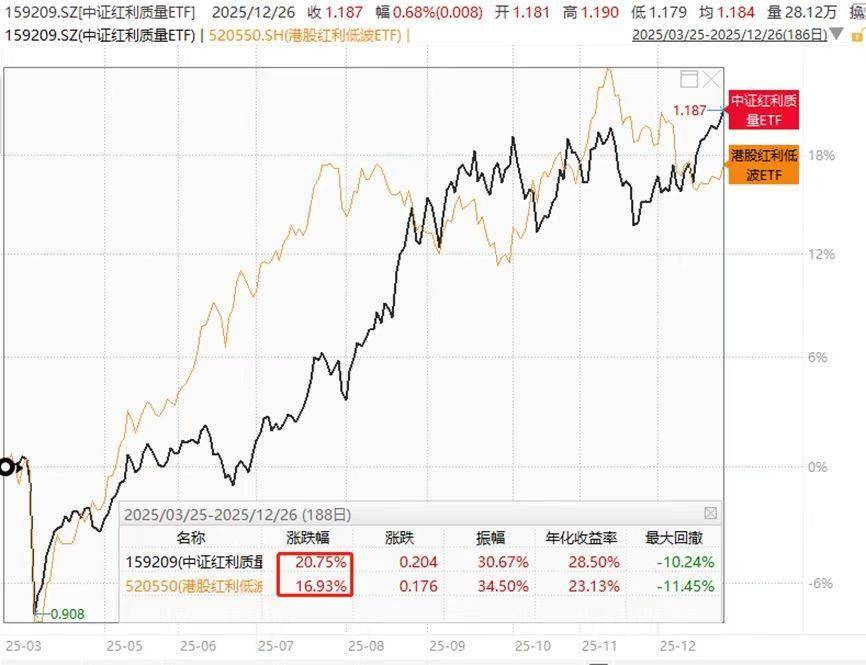
Group 1 - The core viewpoint is that dividend assets are gaining attention in the current market due to their certainty of returns and defensive characteristics, especially in a rising valuation environment and declining risk-free interest rates [1] - The market shows structural characteristics where some blue-chip stocks have limited price increases but offer attractive dividend yields of 3%-4% combined with annual growth expectations of 5%-10% [1] - Traditional dividend ETFs have seen their dividend yields exceed 5% again, significantly higher than the domestic ten-year government bond yield of less than 2% [1] Group 2 - Among various dividend strategies, the CSI Dividend ETF (515080.SH) is a classic high-dividend representative focusing on energy and finance, currently offering a dividend yield over 5% and demonstrating strong defensive characteristics in bear markets [2] - The CSI Dividend Quality ETF (159209.SZ) emphasizes "growth" and "profit quality," focusing on consumer and pharmaceutical sectors, with its total return index rising over 20% this year, led by Kweichow Moutai as its largest weighted stock [2] - The Hong Kong Dividend Low Volatility ETF (520550.SH) focuses on "high dividends" and "stability," with its total return index increasing over 28% this year, making it an ideal defensive choice during market fluctuations [3] Group 3 - For conservative investors, a combination of "A-share Dividend Quality (growth offensive) + Hong Kong Dividend Low Volatility (high-yield defensive)" is recommended, achieving dual diversification across markets and strategy factors [5] - Both products are characterized by low fees and monthly dividends, making them suitable for long-term holding to smooth out volatility and secure predictable returns [5]