证券业

Search documents
10月金融数据预测:信贷有望超季节性投放
CMS· 2025-11-10 12:02
Credit and Financing Data - New social financing (社融新增) is expected to be around 1 trillion RMB in October, with a growth rate of 8.6%[6] - New credit (信贷新增) is projected to be approximately 370 billion RMB, maintaining a growth rate of 6.6%[1] - M2 growth rate is anticipated to be about 8.2%[9] Loan Breakdown - Residential loans are estimated to increase by around 40 billion RMB, significantly lower than the previous year's 160 billion RMB[4] - Corporate loans are expected to rise by approximately 230 billion RMB, with a notable improvement in the financing environment index[4] - Non-bank financial loans are projected to total around 370 billion RMB, down from 500 billion RMB in the same month last year[4] Market Trends - The real estate market continues to face pressure, with new home sales in 30 major cities down by 5.7% year-on-year[4] - The automotive market shows growth, with retail sales of passenger vehicles reaching 2.387 million units, a year-on-year increase of 6%[4] - Government bond net financing is expected to be about 528.1 billion RMB, down from 925 billion RMB in the same month last year[8]

11月10日主题复盘 | 大消费强势反弹,存储、锂电持续活跃
Xuan Gu Bao· 2025-11-10 08:23
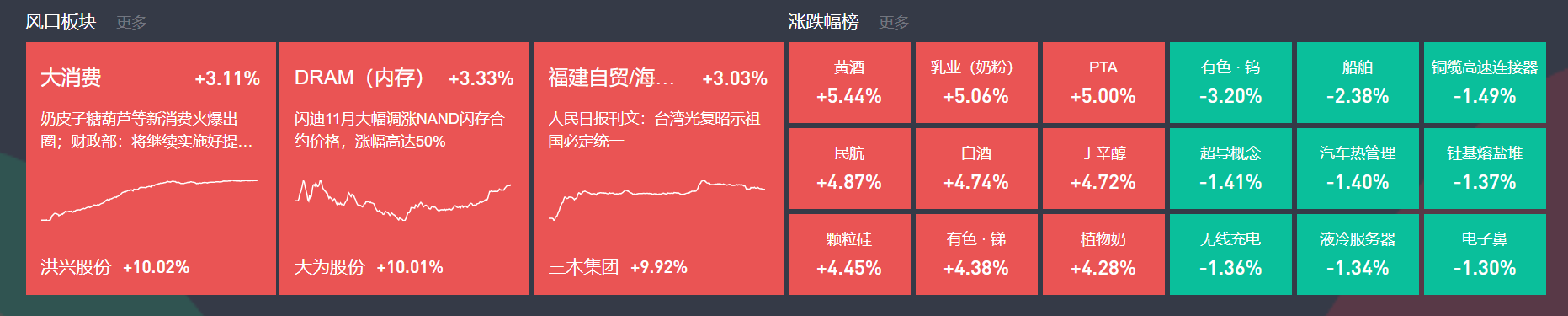
Market Overview - The market experienced fluctuations with mixed performance across the three major indices, with significant gains in the consumer sector, particularly in companies like China Duty Free and Shede Liquor, which saw nearly 20 stocks hitting the daily limit [1] - Financial stocks, including Northeast Securities and Ruida Futures, also surged, while the storage chip sector remained active with companies like Dawi Co. and Wanrun Technology reaching their daily limits [1] Consumer Sector - The consumer sector saw a collective surge, with stocks like Hongxing Co. and Dongbai Group hitting their daily limits, driven by the unexpected popularity of a new snack, "milk skin candy hawthorn," which has become a trending topic on social media [4] - The National Bureau of Statistics reported a year-on-year CPI increase of 0.2% in October, with core CPI rising to its highest level since March 2024 at 1.2% [4] Storage Sector - The storage sector continued its upward trend, with companies like Dawi Co., Shenkong Co., and Hefei Urban Construction hitting their daily limits, and Xiangnong Chip Creation rising by 15% to a new historical high [8] - SanDisk announced a significant price increase of 50% for NAND flash contracts, causing a ripple effect throughout the storage supply chain, leading to companies like Transcend and ADATA pausing shipments to reassess pricing [8][10] Lithium Battery Sector - The lithium battery sector remained strong, with companies like Furui Co. and Tianji Co. hitting their daily limits, supported by a projected increase in production across various lithium battery components [11] - The demand for lithium carbonate is expected to exceed supply in November, with a projected shortfall of 23,500 tons, indicating a favorable outlook for the lithium salt industry [13] Key Stock Performances - Notable stock performances included Hongxing Co. with a 10.02% increase, Dongbai Group at 9.96%, and Dawi Co. at 10.01%, reflecting the overall positive sentiment in their respective sectors [6][12] - The storage sector saw significant gains with Dawi Co. at 29.13, Shenkong Co. at 61.19, and Hefei Urban Construction at 12.43, highlighting the strong market interest in storage solutions [9][12]



刚刚!中美大利好!全线大涨
中国基金报· 2025-11-10 08:10
Market Overview - The A-share market showed mixed performance with the Shanghai Composite Index rising by 0.53% and the Shenzhen Component Index increasing by 0.18%, while the ChiNext Index fell by 0.92% [2] - A total of 3,376 stocks rose, with 92 hitting the daily limit up, while 1,957 stocks declined [3][4] - The total trading volume reached 21,943.71 billion, with a trading volume of 140,007.9 million [4] Consumer Sector Performance - The consumer sector experienced a collective surge, with nearly 20 stocks, including China Duty Free Group and Shede Spirits, hitting the daily limit up [5] - The latest data from the National Bureau of Statistics indicated that the Consumer Price Index (CPI) rose by 0.2% year-on-year in October, marking a shift from decline to growth, while the Producer Price Index (PPI) showed a narrowing year-on-year increase [5] Financial Sector Activity - Financial stocks, including Northeast Securities, saw significant gains, with Northeast Securities hitting the daily limit up [8] - Other notable financial stocks included GF Securities and Dongxing Securities, which rose by 3.74% and 3.10% respectively [8] Chemical Sector Trends - The chemical sector continued its strong performance, with companies like Luxi Chemical and Chengxing Chemical hitting the daily limit up [9] - Notable gainers included Dongyue Silicon Materials, which rose by 14.94%, and other chemical stocks showing increases around 10% [9] Storage Chip Sector Dynamics - The storage chip sector was notably active, with companies such as Dawi Co. and Wanrun Technology hitting the daily limit up [10] - Key performers included Shen Gong Co., which rose by 20%, and other stocks in the sector showing significant gains [10] Downward Adjustments - The robotics sector faced adjustments, with Zhejiang Rongtai hitting the daily limit down [11] - Other companies in the sector also experienced declines, indicating a potential correction phase [11] Global Market Influences - Positive global market sentiment was noted, with major Asian indices like the Seoul Composite Index rising over 3% and the Nikkei 225 Index increasing over 1% [11] - The U.S. market also showed signs of recovery, with pre-market indices trending upwards [13] Trade Relations Impact - Recent developments in U.S.-China trade relations, including the suspension of investigations into China's shipbuilding industry, contributed to market optimism [14][15] - The U.S. government nearing the end of a shutdown also provided a positive backdrop for market performance, with potential funding agreements being discussed [16]





央行重启国债买卖 长端利率债、“固收+”理财有望受益
Zhong Guo Ji Jin Bao· 2025-11-10 07:22
Core Viewpoint - The resumption of public market treasury bond trading by the central bank in October signals a positive outlook for the bond market, with expectations for long-term interest rates to decline and related investment products to benefit [1][2][3]. Group 1: Market Signals and Economic Impact - The central bank's resumption of treasury bond trading is seen as a signal for stabilizing growth, which is expected to boost confidence in the bond market [2][3]. - The People's Bank of China (PBOC) indicated that the overall operation of the bond market is good, with current interest rates in a policy-consistent range, which supports market expectations [2][3]. - The operation size of 20 billion yuan, while modest, carries significant signal value, enhancing confidence in the bond market, particularly for medium to long-term interest rate bonds [2][3]. Group 2: Interest Rate Trends and Investment Opportunities - Long-term interest rates for treasury bonds have begun to decline since late October, with expectations for further decreases, presenting investment opportunities in related financial products [3][4]. - The resumption of bond purchases by the central bank is expected to create a favorable environment for long-term interest rates to decline, benefiting bond-related investment products [4][5]. - Investors are advised to focus on bond products with longer durations and stable historical returns, as these are likely to benefit from the anticipated rise in bond prices [5][6]. Group 3: Strategic Investment Approaches - Institutions suggest increasing allocations to medium and short-term credit bonds, as the central bank's actions are expected to improve liquidity and compress credit spreads [6]. - Investment strategies should include optimizing portfolio structures, increasing liquidity through open-end or short-term products, and diversifying into "fixed income plus equity" products to balance risks [6][5]. - The current market environment allows for the inclusion of reasonably valued equity assets in investment strategies, leveraging "fixed income plus equity" products for better returns [6].
多空因素交织,农商行再入场
Southwest Securities· 2025-11-10 07:15
Report Industry Investment Rating No relevant content provided. Report's Core View - The bond market has shown a volatile downward trend recently due to a mix of bullish and bearish factors. The central bank's restart of open - market Treasury bond trading and the marginal weakening of macro - data have strengthened the expectation of policy easing, providing core support for the bond market. However, the strengthening of the equity market and the approaching implementation of the "Sales New Rules" have caused short - term disturbances to market sentiment. Despite short - term disturbances, the core logic supporting the bond market's improvement at the end of the year remains solid. As the suppression from the equity market eases and market forces undergo structural changes, bond market sentiment is expected to continue to recover, and short - term fluctuations may present good allocation opportunities [2][87][88]. - The central bank's open - market Treasury bond trading in October was relatively restrained. It is a regular operation to enrich the liquidity - injection toolbox, bringing longer - term and cheaper funds to the market, which is expected to maintain overall market liquidity and ease the fund - stratification phenomenon. The weakening of October's economic data may lead to a marginal increase in the market's expectation of reserve - requirement ratio cuts and interest - rate cuts, which could boost the year - end "long" sentiment in the bond market. The independent strength of the A - share market has temporarily boosted risk appetite and suppressed the bond market, but this suppression may be only temporary at the end of the year. The approaching implementation of the "Sales New Rules" has recently increased short - term market disturbances, but there is a possibility of a "sell - the - rumor, buy - the - news" market trend after the policy is officially implemented. Market forces are undergoing structural changes, with the active trading forces retreating, while rural commercial banks, which were previously conservative, have started to replenish their positions significantly, which is important for warming market sentiment and restoring confidence [2][88]. - If there is no increase in the expectation of interest - rate cuts to catalyze the bond - market rally, the market may show a narrow - range downward oscillation from November to December. Considering the weakening economic data, the market's expectation of reserve - requirement ratio cuts and interest - rate cuts may increase marginally, boosting the year - end "long" sentiment in the bond market. It is conservatively estimated that the lower limits of the yields of 30 - year and 10 - year Treasury bonds (old bonds) may be around 1.9% and 1.7% respectively. In terms of investment strategy, it is recommended to set the portfolio duration in the medium - to - long range. For allocation, it is advisable to select high - quality coupon - bearing assets as the bottom - position, adopting the "coupon + carry - trade" income approach, and exploring the allocation opportunities of 2 - year AA -/AA - rated credit bonds and 10 - year local government bonds. For trading, it is recommended to pay attention to the trading opportunities of medium - duration varieties such as secondary perpetual bonds that have experienced significant declines [2][89]. Summary by Relevant Catalog 1. Important Matters - In October, the central bank's open - market Treasury bond trading net - injected 20 billion yuan of liquidity. Through various central - bank loans, a total of 174.8 billion yuan of liquidity was injected, and through various open - market operations, a total of - 205.3 billion yuan of liquidity was injected. Among them, the net - injection scale of open - market Treasury bond trading reached 20 billion yuan [5]. - In November, the 3 - month term buy - back repurchase was carried out at the same volume. On November 5, 2025, the central bank conducted a 700 - billion - yuan buy - back repurchase operation with a 3 - month (91 - day) term, and the maturity scale of the 3 - month term buy - back repurchase in November was also 700 billion yuan [6]. - From January to October 2025, China's total import and export value was 37.31 trillion yuan, a year - on - year increase of 3.6%. In October, China's export value in US dollars decreased by 1.1% year - on - year, and the import value increased by 1.0% year - on - year [8]. 2. Money Market 2.1 Open - Market Operations and Fund - Rate Trends - From November 3 to November 7, 2025, the central bank injected 495.8 billion yuan through 7 - day reverse - repurchase operations, with 2068 billion yuan maturing, resulting in a net - injection of - 1572.2 billion yuan. From November 10 to November 14, 2025, it is expected that 495.8 billion yuan of base money will be matured and withdrawn. The policy rate of the 7 - day open - market reverse - repurchase was 1.40% from November 3 to November 7. As of November 7, R001, R007, DR001, and DR007 were 1.392%, 1.468%, 1.332%, and 1.413% respectively, with changes of - 1.53BP, - 2.46BP, 1.37BP, and - 4.21BP compared to October 31. The interest - rate centers also changed to some extent [11][12][15]. 2.2 Certificate of Deposit (CD) Rate Trends and Repurchase Transaction Situations - In the primary market of CDs, last week, the total CD issuance scale was 527.86 billion yuan, a decrease of 206.66 billion yuan from the previous week. The maturity scale was 376.87 billion yuan, a decrease of 187.44 billion yuan from the previous week, and the net - financing scale was 150.99 billion yuan, a decrease of 19.22 billion yuan from the previous week. As of the 45th week of 2025, the cumulative annual CD issuance scale had reached 29.04 trillion yuan. The institution with the largest CD issuance scale last week was city commercial banks, with a net - financing scale of 182.16 billion yuan. The CD issuance scales of state - owned banks, joint - stock banks, city commercial banks, and rural commercial banks were 118.15 billion yuan, 127.78 billion yuan, 237.78 billion yuan, and 48.69 billion yuan respectively, accounting for 22.2%, 24.0%, 44.7%, and 9.1% of the total issuance. The CD issuance rates of various types of banks decreased to some extent compared to the previous week [18][21][24]. - In the secondary market of CDs, the yields of CDs of all maturities increased overall. The yields of AAA - rated 1 - month, 3 - month, 6 - month, 9 - month, and 1 - year CDs increased by 6.05BP, 1.13BP, 0.73BP, 0.37BP, and 0.50BP respectively, and the 1Y - 3M spread was at the 54.41% quantile level [28]. 3. Bond Market - In the primary market, last week, the supply of discounted Treasury bonds and short - term Treasury bonds increased. A total of 54 interest - rate bonds were issued, with an actual issuance amount of 513.997 billion yuan and a net - financing amount of 318.843 billion yuan. From January to November, the net - financing pace of local government bonds was generally faster than that of Treasury bonds. As of November 7, 2025, the cumulative net - financing scale of various Treasury bonds was about 5.85 trillion yuan, and that of various local bonds was about 6.44 trillion yuan, with a more obvious increase in the supply scale of central - government finances compared to the 2021 - 2024 average [31]. - In the secondary market, the bullish market of the restarted Treasury bond trading has temporarily ended. As the implementation of the "Sales New Rules" approaches, interest rates have generally shown a volatile upward trend. The yields of 1 - year, 3 - year, 5 - year, 7 - year, 10 - year, and 30 - year Treasury bonds and the corresponding yields of China Development Bank bonds have all changed to some extent. The implied tax rate of 10 - year China Development Bank bonds increased slightly. The liquidity premium of active bonds has generally increased. The average spread between the active and sub - active bonds of 10 - year China Development Bank bonds was about - 6BP [31][45]. - The supply of Treasury bonds increased significantly last week. Among them, 5 Treasury bonds were issued, with an actual issuance amount of 295.89 billion yuan and a net - financing amount of 225.8 billion yuan; 32 local government bonds were issued, with an actual issuance amount of 91.607 billion yuan and a net - financing amount of - 5.457 billion yuan; 17 policy - financial bonds were issued, with an actual issuance amount of 126.5 billion yuan and a net - financing amount of 98.5 billion yuan. As of last week, the issuance scale of special refinancing bonds had reached 2.06 trillion yuan, mainly with long - and ultra - long - term maturities, and the issuance scale of bonds with maturities of 10 years and above was about 1.81 trillion yuan, accounting for about 88.02%. Regions with relatively large issuance scales include Jiangsu, Sichuan, Shandong, Guizhou, and Henan, accounting for about 35.67% of the total issuance scale [40][42]. 4. Institutional Behavior Tracking - Last week, the scale of leveraged trading fluctuated around a high - level center, with an average of about 7.97 trillion yuan. In the cash - bond market, the buying power of state - owned banks weakened, and they continued to prefer to increase their holdings of Treasury bonds with maturities of less than 5 years, but the buying scale decreased compared to the previous week. Rural commercial banks changed from selling to buying, with a total weekly increase in holdings of less than 5 billion yuan, which was a significant improvement compared to the previous week's net - selling of over 124 billion yuan. The承接 power of funds weakened, and securities companies sold about 31 billion yuan net. In contrast, the insurance industry's willingness to increase its holdings increased marginally, and it increased its holdings of policy - financial bonds with maturities of over 5 years [61][71]. - In September 2025, the overall inter - bank market institutional leverage ratio was about 118.68%, an increase of about 0.06 percentage points from August. The leverage ratios of commercial banks, securities companies, and other institutions in the inter - bank market in September were about 109.85%, 192.23%, and 133.25% respectively [61]. - The 20 - day moving average of the daily trading volume of inter - bank pledged repurchase last week was 7.37 trillion yuan, a change of about 430 billion yuan from the previous week. The average scale of leveraged trading last week was about 7.97 trillion yuan, and the daily leveraged - trading scales from November 3 to November 7 were 7.69 trillion yuan, 7.93 trillion yuan, 8.09 trillion yuan, 8.42 trillion yuan, and 7.72 trillion yuan respectively [67]. - Based on the net - buying data of institutional investors in the past 20 trading days, the recent average cost of adding positions in 10 - year Treasury bonds for major trading players such as rural commercial banks, securities companies, funds, and other products is around 1.830%. Rural commercial banks' behavior of adding positions at high prices was obvious last week, while the position - adding actions of securities companies and funds cooled down [74]. - According to the calculation methods in relevant reports, since the current spread between local government bonds and Treasury bonds is relatively high, both commercial banks and insurance companies can obtain relatively higher returns by investing in local government bonds [81]. 5. High - Frequency Data Tracking - In terms of high - frequency data, last week, the settlement price of rebar futures decreased by 3.42% week - on - week, the settlement price of wire rod futures remained unchanged at 0.00%, the settlement price of cathode - copper futures decreased by 1.54%, the cement - price index increased by 0.06%, and the Nanhua Glass Index increased by 0.74%. The CCFI index increased by 3.60% and the BDI index increased by 7.02% week - on - week. In terms of food prices, the wholesale price of pork increased by 2.42% and the wholesale price of vegetables increased by 1.58% week - on - week. The settlement prices of Brent crude - oil futures and WTI crude - oil futures decreased by 2.60% and 2.54% respectively week - on - week. The central parity rate of the US dollar against the RMB last week was 7.08 [84]. 6. Market Outlook - The bond market is expected to continue to recover as the suppression from the equity market eases and market forces undergo structural changes. Short - term fluctuations may present good allocation opportunities. It is conservatively estimated that the lower limits of the yields of 30 - year and 10 - year Treasury bonds (old bonds) may be around 1.9% and 1.7% respectively. In terms of investment strategy, it is recommended to set the portfolio duration in the medium - to - long range, select high - quality coupon - bearing assets as the bottom - position, and explore the allocation opportunities of 2 - year AA -/AA - rated credit bonds and 10 - year local government bonds. For trading, it is recommended to pay attention to the trading opportunities of medium - duration varieties such as secondary perpetual bonds that have experienced significant declines [87][88][89].
央行出手 这类产品要火?
Zhong Guo Ji Jin Bao· 2025-11-10 04:45
Core Viewpoint - The People's Bank of China (PBOC) has resumed government bond trading operations, signaling a positive outlook for the bond market and benefiting long-term interest rate bonds and "fixed income +" wealth management products [1][3][4]. Group 1: Market Signals and Economic Impact - The resumption of government bond trading operations is seen as a signal for stabilizing growth, which is expected to boost confidence in the bond market [3][4]. - PBOC Governor Pan Gongsheng indicated that the overall operation of the bond market is good, suggesting that current interest rates are within a policy-appropriate range [3][4]. - The operation of 20 billion yuan, although small, carries significant signal value, enhancing market confidence, particularly in medium to long-term interest rate bonds [3][4]. Group 2: Interest Rate Trends - Since late October, long-term interest rates on government bonds have begun to decline, with expectations for further decreases [5][6]. - The resumption of bond purchases by the PBOC is expected to support bond prices, benefiting medium to long-term fixed income products [6][7]. - Analysts suggest that the current environment allows for a favorable configuration of medium to short-term credit bonds, with potential for yield compression [6][7]. Group 3: Investment Strategies - Investors are advised to optimize their bond holdings by increasing allocations to daily open or short-term fixed products to enhance liquidity [7]. - Diversification is recommended to reduce the proportion of pure fixed income products, while increasing allocations to "fixed income +" products to balance risk [7]. - The current market conditions suggest that incorporating reasonably valued equity assets into investment strategies could be beneficial, leveraging "fixed income + equity" wealth management products [7].
央行出手,这类产品要火?
Zhong Guo Ji Jin Bao· 2025-11-10 04:32
Core Viewpoint - The People's Bank of China (PBOC) has resumed government bond trading operations, signaling a positive outlook for the bond market and benefiting long-term interest rate bonds and "fixed income +" wealth management products [1][2][3] Group 1: Market Signals and Economic Impact - The resumption of government bond trading operations is seen as a signal for stabilizing growth, which is expected to boost confidence in the bond market [2][3] - PBOC Governor Pan Gongsheng indicated that the overall operation of the bond market is good, suggesting that current interest rates are within a policy-acceptable range [2][3] - The operation size of 20 billion yuan, while not large, carries significant signal value, enhancing market confidence, especially in medium to long-term interest rate bonds [2][3] Group 2: Interest Rate Trends and Investment Opportunities - Long-term interest rates have begun to decline since late October, and further decreases are anticipated, providing investment opportunities in related wealth management products [3][4] - The bond market's performance is influenced by macroeconomic factors such as economic recovery and U.S.-China negotiations, which could affect market interest rates and bond prices [4][5] - The PBOC's bond purchases directly support interest rate bond prices, and narrowing yield spreads favor medium to long-term investments [5][6] Group 3: Investment Strategies and Recommendations - Investors are advised to prioritize wealth management products that include interest rate bonds and to consider the stability of historical returns [5][6] - There is a recommendation to increase allocations in medium to short-term credit bonds to secure stable coupon income and to adopt a strategy of "buying on dips" to capitalize on long-term interest rate fluctuations [6] - Diversifying investments to include equity assets within "fixed income +" products is suggested to balance risks and enhance returns in a low-interest-rate environment [6]
政策半月观:年内政策仍有三大期待
GOLDEN SUN SECURITIES· 2025-11-10 03:46
Policy Highlights - The recent US-China summit on October 30 resulted in mutual concessions, including the suspension of a 24% reciprocal tariff and a commitment to improve bilateral relations, with a visit from Trump to China planned for April 2026[3] - The "14th Five-Year Plan" was compared to the new "15th Five-Year Plan" proposal released on October 28, highlighting new initiatives in capital markets, fiscal policy, and supply-side structural reforms[4] - The central government aims to maintain GDP growth around 5% for 2026, emphasizing the importance of domestic consumption and economic stability[4] Economic Measures - The People's Bank of China will resume open market operations for government bonds and implement supportive monetary policies, including a potential personal credit relief initiative[4] - The State Council announced an additional 200 billion yuan in special bonds to support provincial investments, part of a total of 500 billion yuan in policy financial tools[5][21] - The Ministry of Finance introduced measures to enhance duty-free shop policies to stimulate consumption, including expanding product categories and improving management[6][28] Regional Development - Guangdong's leadership is tasked with setting a high standard in the "15th Five-Year Plan," focusing on economic stability and job security[2] - The development of the Chengdu-Chongqing economic circle is being prioritized, with specific targets for land use and ecological protection set for 2035[25] Industry Focus - The State-owned Assets Supervision and Administration Commission established a 51 billion yuan fund to support strategic emerging industries, including AI and aerospace[9] - Local initiatives in Anhui and Guizhou are promoting consumption and industry transformation, with Guizhou shifting from selling liquor to offering lifestyle experiences[8]
0.94%。煤炭持续强势,化工化肥行业
Xin Yong An Guo Ji Zheng Quan· 2025-11-10 03:23
Market Performance - The Shanghai Composite Index fell by 0.25% to 3997.56 points, while the Shenzhen Component dropped by 0.36% and the ChiNext Index decreased by 0.51%[1] - The Hang Seng Index closed down 0.92% at 26241.83 points, with the Hang Seng Tech Index down 1.80% and the Hang Seng China Enterprises Index down 0.94%[1] - The total market turnover in Hong Kong decreased to 2096.443 million HKD[1] Economic Indicators - The U.S. Senate is planning a test vote on a new proposal to end the government shutdown, which has lasted for 40 days[8] - China's Consumer Price Index (CPI) unexpectedly rose by 0.2% year-on-year in October, contrasting with a decline of 0.3% in September[12] - The core CPI in China, excluding food and energy, increased by 1.2% in October[12] Consumer Confidence - The U.S. consumer confidence index fell to 50.3 in early November, the lowest level in over three years, down from 53.6 in October[12] - The government shutdown is estimated to cost the U.S. economy approximately 15 billion USD per week and reduce the annualized GDP growth rate by 1.5 percentage points before mid-November[12] Sector Performance - Lithium battery stocks showed strength, while the pharmaceutical and biotechnology sectors experienced declines[1] - The chemical and fertilizer industries saw significant gains, particularly in coal and chemical sectors[1]
融创成首家境外债基本清“零”的大型房企|财富周历 动态前瞻
Sou Hu Cai Jing· 2025-11-10 00:55
A-share Market - In early November, over 35 brokerages have conducted research on companies in the photovoltaic component industry chain, semiconductor material stocks, and leading consumer electronics firms [2] - The 1388 companies listed on the ChiNext board reported a total operating income of 3.25 trillion yuan for the first three quarters of 2025, representing a year-on-year growth of 10.69%, with net profit reaching 244.66 billion yuan, up 18.69% year-on-year [2] - Beijing Bank and Shanghai Bank have signed stock repurchase loan commitment letters with several listed companies, with other banks like Ningbo Bank, Jiangsu Bank, and Nanjing Bank also expected to qualify for this loan business [2] - The Shanghai Stock Exchange reported that 2.3 million new A-share accounts were opened in October 2025, bringing the total new accounts for the first ten months to 22.46 million, a year-on-year increase of 10.57% [3] Financial Market - The Ministry of Finance successfully issued 4 billion USD in sovereign bonds in Hong Kong, with a total subscription amount of 118.2 billion USD, 30 times the issuance amount [4] - The Hong Kong Stock Exchange reported a record high in total revenue and net profit for the first three quarters of the year, with total revenue of 21.85 billion HKD, up 37% year-on-year, and net profit of 13.42 billion HKD, up 45% year-on-year [4][5] - The People's Bank of China conducted a 700 billion yuan reverse repurchase operation with a term of three months, and also conducted a 65.5 billion yuan 7-day reverse repurchase operation at a rate of 1.40% [4][5] Real Estate Sector - Sunac China announced that its approximately 9.6 billion USD offshore debt restructuring plan was approved by the Hong Kong High Court, making it the first large real estate company to achieve a "zero" status on offshore debt [3] - Country Garden's offshore debt restructuring plan was successfully passed with over 75% approval from creditors in both debt groups, indicating a significant milestone for the company [6] - The real estate market in major cities showed a recovery in transaction volume during September, with Shanghai leading in new and second-hand home transactions in October [7] Banking Sector - A total of 42 A-share listed banks reported net commission and fee income of 578.2 billion yuan for the first three quarters of 2025, a year-on-year increase of 4.60% [8]