
投资银行

Search documents
高盛:金价2026年底或升至4900美元
Xin Lang Cai Jing· 2025-11-18 11:25
Group 1: Market Insights - Goldman Sachs predicts that central banks may significantly increase gold purchases in November, with gold prices potentially rising to $4,900 by the end of 2026 [3] Group 2: Macroeconomic and Policy News - China's fiscal revenue from January to October reached 18.65 trillion yuan, a year-on-year increase of 0.8%, while fiscal expenditure was 22.58 trillion yuan, up 2% [4] - In October, China's foreign exchange settlement by banks was $214.2 billion, with a surplus of $17.7 billion, indicating a net inflow of cross-border funds [4] - The real estate market in China is stabilizing, with second-hand home transactions dominating, showing a 4.7% year-on-year increase in transaction area from January to October [4] Group 3: Employment and Inflation - Federal Reserve Vice Chairman Jefferson noted an increase in downside risks to employment, while inflation risks may have slightly decreased [5] - The White House's National Economic Council Director Hassett indicated mixed signals in the labor market, suggesting a potential slowdown [5] Group 4: International Economic Data - Japan's GDP contracted by 0.4% quarter-on-quarter in Q3, marking the first negative growth since Q1 2024, primarily due to weak exports and residential investment [6] - The European Commission forecasts a faster-than-expected economic expansion in the Eurozone, with GDP growth projected at 1.3% for the year [6] - India's trade deficit widened to a record $41.68 billion in October, influenced by increased gold imports and decreased exports to the U.S. [6] Group 5: Commodity and Industry News - Indonesia plans to implement an export tax of 7.5% to 15% on gold products starting next year [6] - Mysteel reported a decrease in iron ore arrivals in China, with total arrivals at 2,369.9 million tons, down 399.4 million tons week-on-week [7] - The coal market is experiencing a decline in operational rates, with a reported drop in production and inventory levels [8]

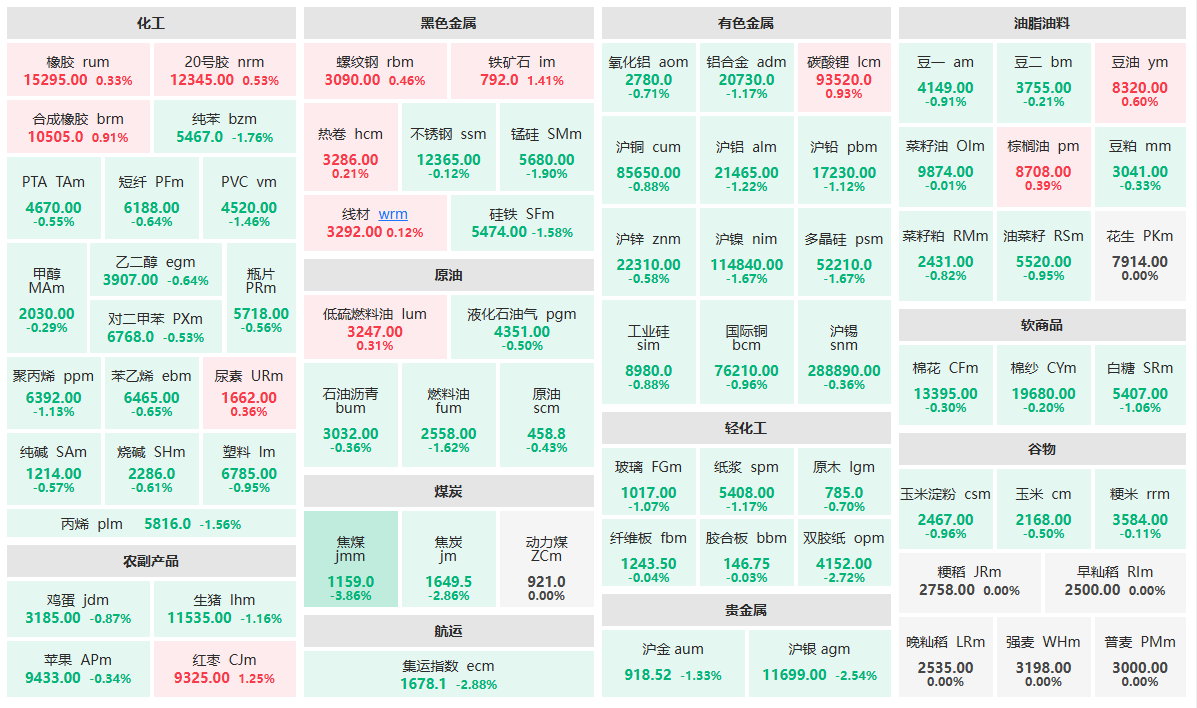
【11月18日期货收评】贵金属再次走弱
Sou Hu Cai Jing· 2025-11-18 08:20
农产品板块,白糖、生猪跌超1%,红枣涨超1% 智通财经:瑞银投资银行中国股票策略研究主管王宗豪在2026年展望报告中指出,预计中国股市将迎来又一个丰年,因包括创新领域发展等许多有利的驱动 因素将继续支撑市场。MSCI中国指数明年末目标位为100,较当前有14%的上涨空间。 智通财经:下任美联储主席的热门人选、现任美联储理事沃勒周一表示,支持在12月的政策会议上再次降息。他称,他越来越担心劳动力市场及招聘活动急 剧放缓。他表示,"劳动力市场依旧疲软,且已接近增长失速的临界水平",同时剔除关税影响后的通胀 "已相对接近" 美联储2%的目标水平。 | | 化工 | | | 黑色金属 | | | 有色金属 | | | 油脂油料 | | --- | --- | --- | --- | --- | --- | --- | --- | --- | --- | --- | | 橡胶 rum | | 20号胶 nrm | 螺纹钢 rbm | | 铁矿石 im | 氧化铝 aom 铝合金 adm | | 碳酸锂 lcm | ə qalında qal | 豆二 bm | | 15295.00 0.33% | | 12345.00 ...
高盛预计美储继续降息沪银价下跌
Jin Tou Wang· 2025-11-18 05:05
Group 1 - Silver futures are currently trading below 11827, with a recent opening at 11975 and a current price of 11793, reflecting a decline of 1.76% [1] - The highest price reached today was 12027, while the lowest was 11766, indicating a short-term oscillating trend in silver futures [1] - Goldman Sachs Asset Management's 2026 investment outlook report suggests a divergence in central bank policies across major markets, with potential rate cuts from the Federal Reserve due to a weak labor market [1] Group 2 - The European Central Bank is expected to maintain interest rates in the foreseeable future, while the Bank of England may resume rate cuts in December amid improving inflation and a weak labor market [1] - Japan's high inflation and strong growth may lead to interest rate hikes, supported by recent political changes and a shift towards expansionary fiscal policy [1] - Trade Nation's senior market analyst indicates that if silver prices fall below $50 this week, it could signal further declines as the market seeks reliable support [1] Group 3 - The Chicago Mercantile Exchange's FedWatch tool shows that recent cautious statements from Federal Reserve officials have reduced the likelihood of a rate cut in December to 43%, down from 62% the previous week [1] - The sentiment in the silver market remains strong, although prices have continued to decline, with resistance levels noted between 12000-12500 and support levels between 11500-11700 [2]
IC外汇平台:高盛表示金价有望在2026年底达到4900美元
Sou Hu Cai Jing· 2025-11-18 04:08
高盛分析师莉娜・托马斯团队测算显示,9月全球央行合计净购金量达64吨,较8月的21吨实现逾三倍增长,环比激增 204.8%,这一强劲势头有望延续至11月。 现货金价在10月突破每盎司4380美元的历史峰值,即便近期出现回调,截至最新统计仍稳定在4068美元/盎司水平,年内累计 涨幅高达55%,远超全球主要资产平均收益率。 全球经济复苏不均衡引发的增长预期分化、地缘政治冲突导致的风险溢价上升、黄金ETF资金的持续流入,以及市场对美联储 宽松周期的提前定价。黄金与美元资产的负相关性持续强化,2025年美元指数较年初下跌7.8%,而黄金储备在全球央行外汇 资产中的占比已升至18.3%,形成鲜明的反向联动。 高盛集团最新发布的专项报告显示,在季节性购金需求淡季落幕之后,各国央行的黄金增持行动再度进入加速通道。 高盛预测,2024年第四季度至2026年期间,全球央行月均净购金量将稳定在80吨左右。高盛重申2026年底金价将攀升至每盎司 4900美元的目标位,如果私人投资需求持续升温,这一目标存在上修空间。 全球央行连续三年购金超千吨,2025年前三季度累计购金634吨,这一规模已占据全球黄金年产量的三分之一以上。高盛指 ...

央行购金狂潮托底!高盛重申黄金4900美元目标价
Jin Shi Shu Ju· 2025-11-18 03:33
Core Viewpoint - Recent fluctuations in gold prices have raised questions about whether the strong upward trend seen this year is nearing its end, with prices dropping from a peak of approximately $4,400 per ounce to below $4,000, and experiencing a range between $3,900 and $4,205 [2][3] Group 1: Economic Indicators - The U.S. economy shows strong GDP growth, but rising unemployment and inflation present challenges for the Federal Reserve [3] - The unemployment rate increased from 3.4% in July to 4.3% in August, with significant layoffs announced, totaling 1.1 million in 2024, a 44% increase from the previous year [3] - The Consumer Price Index (CPI) rose from 2.3% to 3% in September, indicating inflationary pressures [3] Group 2: Market Dynamics - U.S. Treasury yields have decreased from 4.77% in January to 4.14%, while the dollar index fell from 109 to 99.5, creating favorable conditions for gold [4] - Historically, gold prices tend to move inversely to yields and the dollar, making gold more attractive as a safe-haven asset when yields decline and the dollar weakens [4] Group 3: Goldman Sachs' Forecast - Goldman Sachs has reassessed its gold price outlook for 2026, predicting that the recent pullback in gold prices will be short-lived due to ongoing central bank purchases [6] - The bank reported that central banks bought 64 tons of gold in September, a significant increase from 21 tons in August, and expects this trend to continue [6] - Goldman Sachs forecasts that central banks will average monthly purchases of 80 tons of gold from Q4 2025 to 2026, with a target price of $4,900 per ounce by the end of 2026 [6][7]
瑞银中国股票策略王宗豪:2026年中国股市预计又是丰年
Zheng Quan Shi Bao Wang· 2025-11-18 03:24
Core Viewpoint - UBS Investment Bank's China equity strategy head Wang Zonghao predicts a prosperous year for the Chinese stock market in 2026, driven by several favorable factors continuing from 2025, including advancements in innovation, particularly in AI, supportive policies for private enterprises and capital markets, ongoing fiscal expansion, ample liquidity under loose monetary policy, and potential capital inflows from domestic and foreign institutional investors [1] Group 1: Market Drivers - Continued development in innovative sectors, especially AI, is expected to support the market [1] - Supportive policies for private enterprises and capital markets will play a crucial role [1] - Ongoing fiscal expansion and sufficient liquidity due to loose monetary policy are significant factors [1] - Potential capital inflows from domestic and foreign institutional investors are anticipated [1] Group 2: Earnings and Valuation - Unlike the substantial valuation increases seen this year, 2026's stock performance is expected to be more driven by earnings [1] - Projected earnings per share growth of 10% is anticipated, supported by "anti-involution" measures and a decrease in depreciation and amortization expenses [1] - The target for the MSCI China Index by the end of 2026 is set at 100, indicating a 14% upside from current levels [1] Group 3: Sector Preferences - The outlook remains positive for sectors such as internet, hardware technology, and brokerage firms [1] - High-dividend stocks that are experiencing declining yields have been removed from consideration [1] - As global growth improves, some "overseas" stocks are expected to be included in the investment strategy [1]

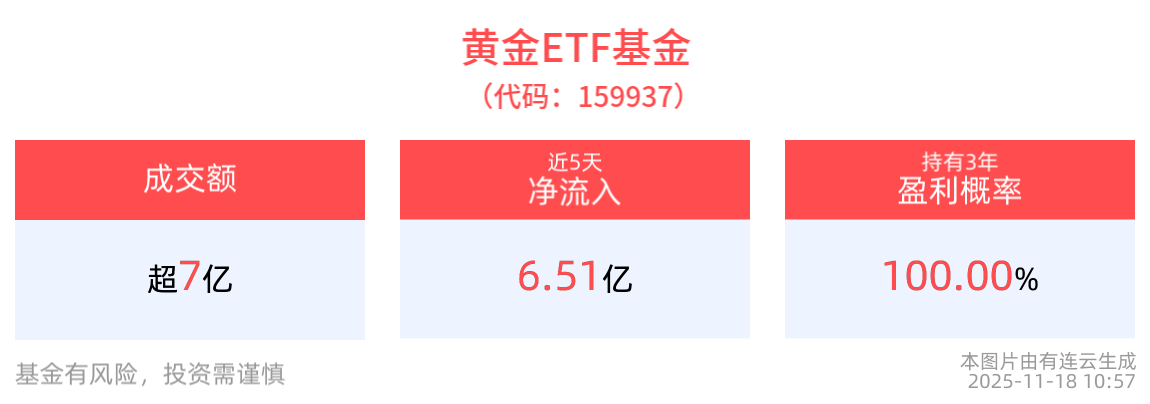
降息预期显著下行,金价震荡回调,黄金ETF基金(159937)昨日净流入超3.2亿元,大量资金提前布局逢低买入
Sou Hu Cai Jing· 2025-11-18 03:22
Core Insights - The recent performance of gold ETFs shows a decline of 1.00% as of November 18, 2025, with a latest price of 8.78 yuan, while over the past two weeks, there has been a cumulative increase of 0.97% [2] - Morgan Stanley forecasts that gold prices will reach $4,500 per ounce by 2026, driven by weak supply-demand balance and expectations of economic downturns [3] Market Performance - As of November 17, 2025, gold ETF trading volume was 1.95%, with a transaction value of 7.42 billion yuan, and the average daily transaction over the past week was 16.32 billion yuan [2] - On November 17, gold prices fluctuated, hitting a low of $4,006.8 per ounce before closing at $4,045.1 per ounce, reflecting a 1.2% decline in COMEX gold futures [2] Economic Indicators - Federal Reserve official Jefferson expressed cautious views on interest rate cuts, indicating rising risks in employment and a slight decrease in inflation risks, with a 42.9% probability of a 25 basis point cut in December [2] - Morgan Stanley highlights that the recent pullback in gold prices is influenced by signals of a weak U.S. economy and expectations of Federal Reserve easing, with a need to monitor U.S. economic data and Fed policy [3] Fund Flows - The latest net inflow into gold ETFs was 321 million yuan, with a total of 651 million yuan net inflow over the past five trading days, averaging 130 million yuan per day [3]
今日期货市场重要快讯汇总|2025年11月18日
Sou Hu Cai Jing· 2025-11-18 00:12
Group 1: Precious Metals Futures - Spot gold prices experienced significant volatility, initially breaking through $4050/oz with a daily increase of 0.14%, followed by a rapid decline, losing key support levels at $4040, $4030, $4020, and $4010/oz, with a maximum daily drop of 1.87% [1][2] - New York futures gold also saw fluctuations, dropping from above $4050/oz (with a daily decrease of 0.55%) to below $4030/oz, with a maximum daily decline of 2.07% [3][4] - Goldman Sachs indicated that central banks may significantly purchase gold in November, predicting gold prices could rise to $4900/oz by the end of 2026 [6] Group 2: Energy and Shipping Futures - Goldman Sachs adjusted its outlook for oil prices, forecasting average prices for Brent and WTI crude oil to drop to $56/barrel and $52/barrel by 2026, respectively, due to strong global supply (excluding Russia), leading to a significant surplus of 2 million barrels per day [7] - However, it is expected that oil prices will rebound to long-term target levels of $80/barrel for Brent and $76/barrel for WTI by the end of 2028 [8] Group 3: Macroeconomic and Market Impact - Federal Reserve official Waller signaled a key policy direction, supporting a 25 basis point rate cut at the December 9-10 meeting, while expressing caution about a 50 basis point cut, noting that a 25 basis point reduction would not restore employment growth to previous levels [9][10][11] - It was also noted that U.S. GDP growth is expected to slow in the second half of 2025 [12] - In the U.S. stock market, major indices closed lower, with the Dow down 1.18%, Nasdaq down 0.84%, and S&P down 0.91%, while many popular Chinese concept stocks fell significantly, with Xpeng down over 10% and Manbang down over 11% [13][14]
高盛:各国央行可能在11月大量购金 维持明年底4900的金价预期
Ge Long Hui A P P· 2025-11-18 00:07
Core Viewpoint - Goldman Sachs indicates that central banks may have purchased a significant amount of gold in November as part of a long-term trend to diversify reserves against geopolitical and financial risks [1] Group 1: Gold Price Forecast - Goldman Sachs reaffirms its expectation that gold prices will reach $4,900 by the end of 2026, with potential for further increases if private investors continue to diversify their portfolios [1] - Year-to-date, gold prices have risen by 55%, driven by economic and geopolitical concerns, increased inflows into exchange-traded funds, and expectations of further interest rate cuts in the U.S. [1] Group 2: Central Bank Purchases - Goldman Sachs estimates that central banks purchased 64 tons of gold in September, up from 21 tons in August [1]
高盛:全球央行购金势头加速 金价2026年底有望升至4900美元
Zhi Tong Cai Jing· 2025-11-17 22:36
过去三年,央行增持已成为推动金价飙升的关键动力。现货金价今年曾在10月突破每盎司4380美元的历 史高位,尽管近几周有所回落,截至本周一仍约报4068美元,年内累计上涨达55%。推动因素包括全球 经济及地缘政治不确定性升温、黄金ETF流入增加,以及市场押注美联储进一步降息。 高盛在报告中强调,央行"持续且高企"的购金行为将是未来数年黄金市场的核心支撑力量。该行维持此 前预测,即2024年第四季度至2026年,全球央行平均每月净购金将维持在约80吨水平。 智通财经APP获悉,高盛集团最新报告显示,在夏季购金淡季结束后,全球央行正重新加速买入黄金, 中国央行在9月向外汇储备新增约15吨黄金,推动全球官方部门当月购金规模大幅回升。 根据高盛分析师Lina Thomas等人的估算,全球央行9月合计购金约64吨,较8月的21吨增加逾三倍。该 行指出,强劲的购金势头很可能延续至11月,反映出央行持续多元化储备、对冲地缘政治及金融风险的 长期趋势。 高盛表示,随着央行购金态势延续、投资需求增强,以及美联储货币政策转向宽松,黄金在未来几年将 继续作为全球金融体系中的关键避险资产保持强势。 在此背景下,高盛重申金价将在2026 ...