
白酒

Search documents
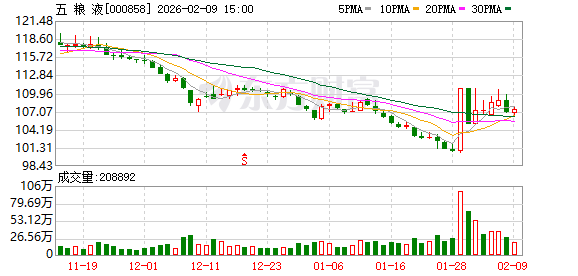
五粮液:公司与集团公司是两个独立的法人主体
Zheng Quan Ri Bao· 2026-02-09 12:12
(文章来源:证券日报) 证券日报网讯 2月9日,五粮液在互动平台回答投资者提问时表示,公司与集团公司是两个独立的法人 主体,拥有各自独立的资产、负债与权益,品牌属于集团的资产,上市公司使用该品牌,理应支付对 价。 ...


流动性&交易拥挤度&投资者温度计周报:公募基金仍为当前市场主要增量资金-20260209
Huachuang Securities· 2026-02-09 11:46
Group 1: Liquidity - The issuance of equity public funds has decreased to 8.42 billion units, down from 32.79 billion units, but remains at a historically high level[8] - The net outflow of margin financing has increased to 52.1 billion CNY, marking a 2% percentile over the past three years[13] - The net inflow of southbound funds has surged to 49.83 billion CNY, reaching a historical high and representing a 96% percentile[40] Group 2: Trading Congestion - The trading heat for the non-ferrous metals sector has increased by 17 percentage points to 49%[46] - The trading heat for the liquor sector has risen by 10 percentage points to 15%[53] - The trading heat for the communication sector has also increased by 10 percentage points to 47%[66] - The trading heat for the home appliance sector has decreased by 12 percentage points to 47%[53] Group 3: Investor Sentiment - The net inflow of retail investor funds in the A-share market was 162.44 billion CNY, a decrease of 54.4 billion CNY from the previous value, placing it at the 87.4% percentile over the past five years[2] - The Shanghai Composite Index fell by 2.5% on February 2, leading to an increase in self-media search interest in A-shares[73]
饮酒思源系列(二十六):如何看待茅台价格波动幅度加大?
Changjiang Securities· 2026-02-09 11:46
Investment Rating - The industry investment rating is "Positive" and maintained [9] Core Insights - The report highlights that the online demand for Moutai has shown strong explosive growth, supporting the price stability of Moutai. Additionally, some inventory replenishment demand has amplified the price fluctuations of Moutai. On the supply side, changes in the delivery rhythm have also caused certain disturbances to Moutai's wholesale prices [2][7] Summary by Sections Moutai Price Fluctuations - Since the beginning of 2026, Moutai's wholesale prices have experienced volatility. The price of original Moutai bottles dropped to around 1505 CNY per bottle at the start of 2026 but subsequently broke through the 1600 CNY and 1700 CNY thresholds by the end of January. As of February 5, 2026, the price rose to 1660 CNY per bottle [6][17] - For bulk Moutai, the price initially fell to 1490 CNY per bottle, then rose to 1650 CNY by the end of January, before dropping to 1570 CNY in early February, and finally rebounding to 1610 CNY by February 5 [6][17] Demand and Supply Analysis - Demand: The "i Moutai" app had over 15.31 million active users in January 2026, with more than 1.45 million users purchasing desired products, resulting in over 2.12 million transactions. The explosive online demand has supported Moutai's strong price performance. Additionally, some channel replenishment and purchasing demand have further increased price volatility [7][18] - Supply: During the Spring Festival peak season, demand is favorable, but the overall supply of Moutai is tight, with limited channel inventory. Some regions have applied for additional quotas, and certain distributors have begun selling March quotas for Moutai [7][18] Short-term and Long-term Price Outlook - In the short term, Moutai is expected to achieve a narrow bottom fluctuation as supply is gradually controlled, and demand is recovering. The acceleration of pre-holiday supply will help control prices post-holiday. In the long term, Moutai's price fluctuations will be determined by economic growth and supply growth factors [8][21] - The report emphasizes that Moutai's price fluctuations are fundamentally driven by supply and demand relationships. Demand is closely related to residents' income and consumer confidence, while supply is influenced by Moutai's pricing strategy. Since 2009, the number of Moutai bottles that urban residents can purchase monthly has fluctuated around a historical average of 2 bottles [8][22]

2026年2月:中国酒类行业展望
Zhong Cheng Xin Guo Ji· 2026-02-09 11:21
Investment Rating - The report maintains a stable investment rating for the Chinese liquor industry, indicating that the overall credit quality of the industry is not expected to change significantly in the next 12 to 18 months [5]. Core Insights - The liquor industry is closely tied to macroeconomic conditions and per capita income levels. Recent years have seen consumption pressures due to economic slowdown, low investment, and policy restrictions, leading to negative revenue and profit growth for large-scale enterprises [6][8]. - The white liquor sector has been experiencing a continuous decline in production since 2017, with a "volume and price drop" scenario expected to persist into 2025 due to high inventory and slow market movement [6][14]. - The beer industry remains stable with high market concentration, but faces challenges from reduced consumption in dining and entertainment venues. The trend towards product premiumization and innovation continues to drive growth [5][26]. - Overall, the liquor industry is under pressure from weak economic recovery and consumption policies, with expectations of continued downward pressure on revenue and profits in the future [10][39]. Summary by Sections Key Points - The liquor industry's demand is significantly affected by macroeconomic conditions and per capita income. Recent economic factors have led to a decline in revenue and profit growth for large-scale enterprises [6][9]. - White liquor production has been decreasing since 2017, with a projected "volume and price drop" scenario continuing into 2025 due to high inventory levels and slow market activity [14][25]. - The beer industry maintains a high concentration level, with stable production capacity utilization. However, the reduction in dining and entertainment venues has negatively impacted beer consumption [26][37]. Analytical Approach - The analysis focuses on the credit fundamentals of the liquor industry, examining key indicators affecting consumption since 2025, including disposable income, consumer confidence, and policy adjustments [7]. Industry Fundamentals - The liquor industry's demand is closely linked to macroeconomic conditions and disposable income levels. Recent years have seen consumption pressures due to economic slowdown and policy restrictions [8][9]. - The white liquor sector has been facing a continuous decline in production, with a significant drop in output expected in 2025 due to high inventory and slow market movement [14][25]. Financial Performance - Since 2025, white liquor enterprises have generally experienced significant declines in operating performance, while beer companies have benefited from optimized product structures [39][40]. - The overall debt levels of liquor companies are low, and while debt service indicators have declined, they remain favorable. Group companies have access to financing channels that support their debt repayment capabilities [39][40].
兴证策略张启尧团队:拥挤度已出现新老易位、高低易位
Xin Lang Cai Jing· 2026-02-09 11:17
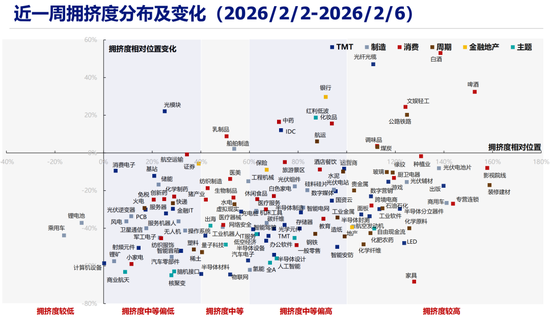
Core Insights - The article discusses the "crowding degree" indicator developed by the Xingsheng Strategy Team, which reflects the trading sentiment of popular sectors through four dimensions: volume, price, funds, and analyst forecasts. This indicator is used to quantitatively track market sentiment changes and has significant implications for short-term stock price movements [1][2][3]. Group 1: Market Sentiment Analysis - The crowding degree has shown a shift in major sectors, with some dividend and consumer sectors reaching high levels, while many popular themes have seen their crowding degree drop to moderate or even low levels [5][119]. - The TMT (Technology, Media, and Telecommunications) sector shows varying crowding levels, with specific components like optical fiber and cable at a high level, while servers and computing devices are at a lower level [10][13][21][31][38]. Group 2: Sector-Specific Crowding Levels - In the manufacturing sector, the crowding degree for passenger vehicles and lithium batteries is low, while hydrogen energy is at a moderate high level [50][51][172]. - The financial and real estate sectors show a high crowding degree in real estate, while banks and insurance are at moderate high levels [213][216][217]. - The cyclical sector indicates a high crowding degree in coal and petrochemicals, with steel at a moderate high level [55][56][60][229].

紧急预警!12件中国白酒商标疑在印尼被抢注
Mei Ri Jing Ji Xin Wen· 2026-02-09 11:01
Core Viewpoint - A warning has been issued regarding the potential mass registration of trademarks for 12 Chinese liquor brands in Indonesia, including Kuaijishan and others, prompting companies to take action to address the issue [1][3]. Group 1: Trademark Registration Issue - The China Trademark Association has issued a warning about 12 liquor brands that may have been registered in Indonesia, which could lead to infringement disputes for domestic companies using these trademarks overseas [3]. - The brands involved include Kuaijishan, Fenggu, Baofeng, Baiyunbian, and others, covering various types of liquor such as strong aroma, light aroma, rice aroma, and yellow wine [3]. - The applications for these trademarks were submitted in late November 2025, and their status indicates "application submitted" [3]. Group 2: Company Responses - Companies like Kuaijishan and Zhijiang Distillery are already addressing the trademark registration issue with the help of specialized trademark service providers [2][3]. - Kuaijishan, a leading yellow wine company, has been expanding its overseas business, with international sales revenue reaching 6.857 million yuan in the first three quarters of 2025 [3]. Group 3: Industry Insights - Industry experts emphasize the need for Chinese liquor companies to shift from passive responses to proactive defenses in the face of increasing cross-border intellectual property challenges [4]. - The importance of establishing a comprehensive trademark protection system is highlighted as a crucial step for achieving brand internationalization [4]. Group 4: Historical Context - This is not the first instance of Chinese liquor brands facing trademark registration issues abroad; a notable case involved Wuliangye, which faced a similar situation in South Korea in the early 2000s [5]. - Wuliangye successfully opposed the registration of its trademark in South Korea, serving as a warning for other Chinese companies to ensure proper trademark arrangements before entering international markets [5]. Group 5: Legal Perspectives - Legal experts stress that overseas trademark registration is not merely a legal formality but a strategic foundation for global business survival and development [6]. - Companies are advised to prioritize trademark arrangements as part of their international expansion strategy [6].

白酒不是黄金白银
Sou Hu Cai Jing· 2026-02-09 10:45
Core Viewpoint - The recent surge in the A-share liquor sector, particularly with stocks like Moutai, is driven by short-term demand due to the upcoming Spring Festival and a stabilization in prices, but it is essential to recognize that liquor is fundamentally a consumer product, not a speculative asset like gold or silver [1][3]. Group 1: Market Dynamics - The liquor sector has seen a collective surge, with many stocks hitting the daily limit up, reigniting hope among investors [1]. - Two main catalysts for this resurgence are the price stabilization of leading brands like Moutai and the seasonal increase in demand during the Spring Festival, a peak consumption period for liquor in China [1][3]. - The dividend yields of quality liquor companies have become significantly higher than bank deposit rates, attracting attention in a low-interest-rate environment [3]. Group 2: Industry Challenges and Perspectives - There are contrasting views within the industry regarding the sustainability of the current rebound; some believe it is merely a technical correction that does not alter the long-term weak outlook for the sector [3]. - Historical data indicates that the liquor index has consistently underperformed the broader market over the past few years, facing structural challenges such as demographic changes, shifts in consumer habits, and overcapacity [3]. - Some analysts predict that 2025 may mark the bottom of the industry cycle, with significant risk already released, and a moderate recovery expected in 2026 [3]. Group 3: Investment Sentiment and Recommendations - There is a prevailing "missing out anxiety" among investors, driven by high gold prices and the recent liquor rebound, leading to potential irrational investment behaviors [3]. - Investors are cautioned against making decisions based solely on short-term price fluctuations without a deep understanding of the industry's fundamentals, as this could lead to losses [3][5]. - The industry advocates for a balanced approach to investment, emphasizing the importance of long-term consumption attributes and resilience against economic cycles, rather than speculative short-term gains [5].

山西汾酒(600809):全国化2.0深度扎根,均衡发力空间广阔
Soochow Securities· 2026-02-09 10:29
Investment Rating - The report maintains a "Buy" rating for Shanxi Fenjiu [1] Core Insights - Shanxi Fenjiu is positioned as a leading brand in the clear aroma liquor segment, benefiting from differentiated flavor profiles, national expansion, and a multi-price product strategy, with a significant growth potential projected to reach 600-700 billion RMB in revenue in the medium to long term [13][14] - The company is actively exploring brand rejuvenation and targeting younger consumers through innovative marketing strategies and product offerings [22][28] - The nationalization strategy 2.0 is being implemented, focusing on deepening market penetration and optimizing product management across various regions [30][33] Summary by Sections 1. Clear Aroma Liquor Expansion - The clear aroma liquor segment is expected to grow significantly, with Shanxi Fenjiu's market share projected to increase from 0.7% to 4.5% from 2016 to 2024 [20] - The company is targeting a "three-way split" market structure in the next high-end price segment, with substantial growth opportunities identified [20][21] 2. Multi-Price Product Strategy - Shanxi Fenjiu has a diverse product portfolio across various price segments, which enhances its growth potential and resilience against market fluctuations [51] - The company has introduced a "four-wheel drive" strategy for product management, focusing on key product lines to optimize resource allocation [53][54] 3. Channel Management and Organizational Efficiency - The company has refined its channel management through the "Fen Enjoy Benefits" system, which enhances pricing stability and incentivizes sales performance [19][30] - Shanxi Fenjiu's sales team remains stable, with a clear career progression path that fosters motivation and productivity among frontline sales personnel [19][30] 4. Financial Projections - Revenue forecasts indicate a steady growth trajectory, with total revenue expected to reach 37,875 million RMB in 2026, and net profit projected at 12,416 million RMB [1] - The company's earnings per share (EPS) is anticipated to grow from 10.04 RMB in 2024 to 10.18 RMB in 2026, reflecting a positive outlook for profitability [1]

宜宾力争白酒年营收破3000亿元
Bei Jing Shang Bao· 2026-02-09 10:21
Core Viewpoint - The Yibin Municipal People's Congress has approved the 15th Five-Year Plan, focusing on strengthening the high-quality liquor industry, particularly aiming for Wuliangye to become a Fortune Global 500 company and increasing annual revenue to over 300 billion yuan [1] Group 1: Economic Development - Yibin will continue to promote the growth of the high-quality liquor industry during the 15th Five-Year Plan period [1] - The plan includes support for Wuliangye to achieve the status of a Fortune Global 500 enterprise [1] - The goal is to enhance the revenue of the liquor industry to exceed 300 billion yuan annually [1] Group 2: Industry Support and Services - The initiative aims to strengthen a number of mid-tier liquor companies [1] - There will be improvements in various supporting services such as R&D design, bottling and storage, inspection and testing, financial services, brand marketing, and digital empowerment [1]
14只白酒股上涨 贵州茅台1524.96元/股收盘
Bei Jing Shang Bao· 2026-02-09 10:21
Core Viewpoint - The white liquor sector has experienced a significant adjustment over the past five years, with current valuations and institutional positions at historical lows, suggesting potential for stock price recovery ahead of fundamental improvements [1] Group 1: Market Performance - On February 9, the Shanghai Composite Index closed at 4123.09 points, up 1.41% [1] - The white liquor sector closed at 2306.55 points, increasing by 0.95%, with 14 stocks in the sector rising [1] Group 2: Individual Stock Performance - Kweichow Moutai closed at 1524.96 CNY per share, up 0.66% [1] - Wuliangye closed at 107.36 CNY per share, up 0.34% [1] - Shanxi Fenjiu closed at 174.70 CNY per share, down 0.23% [1] - Luzhou Laojiao closed at 121.29 CNY per share, down 1.25% [1] - Yanghe Brewery closed at 55.66 CNY per share, up 0.76% [1] Group 3: Analyst Insights - Tianfeng Securities indicates that the white liquor sector is likely in the final stage of fundamental clearing, with stable prices for Moutai being a positive signal for marginal improvement [1] - The report suggests that the sector's valuation recovery may occur ahead of performance recovery [1]