外卖

Search documents
【环球财经】银河国际:Grab第三季度业绩超预期 上调目标价至7.20美元
Xin Hua Cai Jing· 2025-11-05 11:15
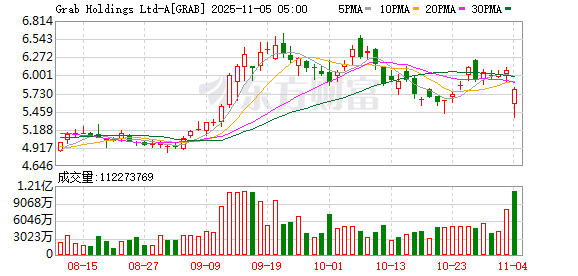
Core Viewpoint - Grab Holdings reported strong Q3 2025 performance, exceeding market expectations in revenue and adjusted EBITDA, leading to an upgraded target price from $7.00 to $7.20 by CGS International [2] Group 1: Financial Performance - Q3 revenue reached $873 million, representing a 7% quarter-over-quarter increase and a 22% year-over-year increase [2] - Adjusted EBITDA was $136 million, with a 25% quarter-over-quarter growth and a 51% year-over-year growth, surpassing expectations from CGS International and Bloomberg [2][3] Group 2: Business Drivers - Strong growth in Grab's core businesses, Deliveries and Mobility, contributed to robust GMV growth both year-over-year and quarter-over-quarter [2] - Key drivers included higher user engagement, product innovations like GrabMart and Saver, increased advertising penetration among merchant partners, and strong loan issuance in the financial services sector [2] Group 3: Financial Services and Future Outlook - In the financial services segment, loan issuance grew by 23% quarter-over-quarter and 56% year-over-year, with management confident in achieving breakeven by the second half of 2026 [3] - CGS International raised Grab's EPS expectations, anticipating positive adjusted EBITDA across all business segments by FY 2027 [3]

网经社陈礼腾:美团构建的骑手保障体系是一个多层次、全方位的网络
Sou Hu Cai Jing· 2025-11-05 05:07
Core Viewpoint - Meituan has officially announced the nationwide coverage of rider pension insurance subsidies, marking a significant development in the welfare protection for delivery riders in the industry [1] Summary by Relevant Sections Welfare Protection Network - Meituan has established a multi-tiered welfare protection network covering all riders, which includes participation in the "New Employment Form Occupational Injury Protection" pilot program since July 2022, expanding to 17 provinces this year [1][4] - As of September 2023, Meituan has paid over 2 billion yuan in insurance premiums, covering 13 million riders [1] Timeline of Initiatives - The timeline of Meituan's initiatives includes the start of pilot programs in 2021, the introduction of pension insurance subsidies in 2024, and the nationwide rollout of these subsidies by October 27, 2025, two months ahead of schedule [5][6] Innovative Aspects of the Protection System - The rider protection system includes basic guarantees such as pension subsidies, occupational injury insurance, and accidental injury insurance, which address the fundamental social security needs of riders [7][9] - Advanced protections include serious illness care, educational funds for children, and vocational training funds, marking the first time such benefits cover all riders and their families [7][9] - Additional work benefits include meal provisions, annual free experiences, travel subsidies, and health screenings for female riders [7][9] Flexibility and Inclusivity - The Meituan plan is characterized by its inclusivity, covering all types of riders across the industry without restrictions on qualifications, locations, or working hours [10][11] - Riders can choose their insurance locations, and the subsidy payment process has been optimized for convenience, reflecting the flexible nature of their work [10] Comparison with Competitors - Compared to competitors like JD and Ele.me, Meituan's pension insurance subsidies are available to all riders nationwide, while JD focuses on full-time riders and Ele.me on its own platform riders [11] - Meituan's approach is designed to ensure comprehensive coverage without imposing limitations on the type or duration of work [11] Industry Impact - The establishment of this welfare system positions riders as a more formal profession, enhancing their occupational security and setting a higher standard for welfare among blue-collar and flexible employment groups [12]


星巴克变国货了...
Ge Long Hui· 2025-11-05 04:16
Group 1 - BGY Capital acquired 60% stake in Starbucks China for $4 billion, while Starbucks retains 40% and its intellectual property, allowing for additional revenue through licensing [1] - BGY Capital has a strong track record with an annualized return of over 25%, indicating a high likelihood of success for this investment [1] - Starbucks has seen a decline in business last year and the first half of this year, but there are signs of recovery in the latter half, highlighting its unique positioning in the coffee market [1] Group 2 - The ISM Manufacturing PMI for October in the U.S. was 48.7, below expectations and the lowest in eight months, which may support the expectation of a rate cut in December [1] - Goldman Sachs and other foreign banks maintain their forecast for a rate cut in December [1] Group 3 - The AI investment competition concluded with Alibaba's Qianwen and DeepSeek as the top two models, both of which were profitable, while others like GPT and Gemini incurred losses [2] - The recent volatility in the U.S. stock market may have contributed to the performance of domestic AI models, which are better at high-low trading strategies [2] Group 4 - The Hong Kong property market is showing signs of recovery, with mainland buyers' total purchases nearing 1,000 units in the first nine months [2] - The CLL index, reflecting Hong Kong property prices, has slightly increased, leading to positive performance in related stocks [2]
美国科技巨头闪电撤离中国,400名在华员工全被解雇;印度富豪逾8亿美元资产遭查封;诺基亚将退市;零跑回应一汽收购其股权丨邦早报
创业邦· 2025-11-05 00:08
Group 1 - SAS Institute has completely withdrawn from the Chinese market after 25 years, laying off all 400 employees and will continue operations through third-party partners [1] - Leap Motor responded to rumors of FAW Group acquiring its shares, stating that the news is untrue [1] - The Chinese government announced a 9-day holiday for the 2026 Spring Festival, leading to a 63% increase in flight bookings compared to the same period in 2025 [2] Group 2 - The AI model competition "Alpha Arena" concluded with Alibaba's Qwen winning, achieving a 22.32% return, while other models, including GPT-5, suffered significant losses [8][9] - Nokia plans to delist from the Paris Stock Exchange, citing trading volume and administrative costs as reasons [9] - The global AI glasses market is rapidly growing, with shipments expected to reach 4 million units by 2029, driven by major tech companies like Google and Apple [22] Group 3 - The Indian online brokerage Groww's parent company is set to launch an IPO, potentially valuing the company at $7 billion [10] - Beta Technologies, an electric aircraft manufacturer, raised over $1 billion in its IPO, pricing shares at $34 [10] - The robotics industry saw a revenue increase of 29.5% year-on-year in the first three quarters, with significant production growth in both industrial and service robots [22][23]

饿了么变淘宝闪购,互联网大厂为何热衷改名?
3 6 Ke· 2025-11-04 23:59
Core Viewpoint - Ele.me has rebranded to Taobao Flash Purchase, marking a strategic shift from an independent food delivery platform to an "instant retail" fulfillment infrastructure, aiming for a "30-minute delivery" goal in collaboration with Taobao [1][12][14] Group 1: Company Strategy - The rebranding to Taobao Flash Purchase is part of a strategic positioning adjustment, integrating Ele.me's services with Taobao's traffic to enhance user experience and operational efficiency [1][14] - Taobao Flash Purchase is currently in a gray testing phase, focusing on instant delivery services for food and daily necessities [1][12] - The name change has generated significant public interest, with the new brand quickly becoming associated with the goal of "everything delivered to your home" [1][12][14] Group 2: Market Performance - Taobao Flash Purchase has achieved a peak daily order volume of 1.2 billion, with a weekly average of 80 million orders, contributing to a 20% increase in daily active users for Taobao [12] - The service has seen a 670% increase in supermarket and convenience store orders during the recent Double 11 shopping festival, with over 70% of cities reporting a more than 200% increase in late-night snack orders [12][14] Group 3: Brand Transition - The rebranding reflects a broader trend in the internet industry where companies change names to signify strategic upgrades, brand transformations, or mergers [3][6] - Historical examples include major companies like Meta (formerly Facebook) and Apple (formerly Apple Computer), which rebranded to reflect their expanded business scopes [6][9] - The name change aims to refresh the brand image and communicate a new narrative to users, although the effectiveness of such changes can vary [3][10][11]


中经评论:让平台经济承载更多民生温度
Zhong Guo Jing Ji Wang· 2025-11-04 23:28
Core Points - Meituan is launching a nationwide pension insurance subsidy program for delivery riders starting in November, where the platform will cover half of the insurance costs for riders who meet certain income criteria [1][4] - The program aims to address the lack of pension insurance among riders, many of whom come from rural areas and may not have adequate retirement savings [1][4] - The initiative is part of a broader trend in the industry, with competitors like JD and Ele.me also exploring social security options for their riders [1][4] Group 1 - The program allows riders to purchase pension insurance if they have earned above the local social security contribution base for at least three months in the past six months [1] - For example, in Beijing, the minimum contribution base is 7,162 yuan, with the monthly pension insurance cost being 1,432.4 yuan, where Meituan subsidizes 716.2 yuan [1] - The implementation of this program is significant as it represents a nationwide effort to provide social security for riders, addressing long-term financial security concerns [1][4] Group 2 - The complexity of providing social security for riders is highlighted by the fact that over 7 million riders are registered on Meituan, with only about 10% being full-time [2] - Many riders view delivery work as a temporary job, leading to challenges in determining where and how their social security contributions should be made [2] - The financial burden on companies is substantial, with annual costs potentially reaching billions of yuan for these subsidies [3] Group 3 - The push for social security for riders is driven by market competition, as companies seek to retain riders and ensure service reliability during peak times [4] - Government policies are also influencing this trend, with regulatory bodies promoting the protection of rights for new employment forms and increasing participation rates in social security [4] - Meituan's approach of allowing voluntary contributions with platform subsidies is seen as a practical solution that respects rider preferences while encouraging participation [4]
放过双十一 刘强东才能讲出新故事
Sou Hu Cai Jing· 2025-11-04 19:37
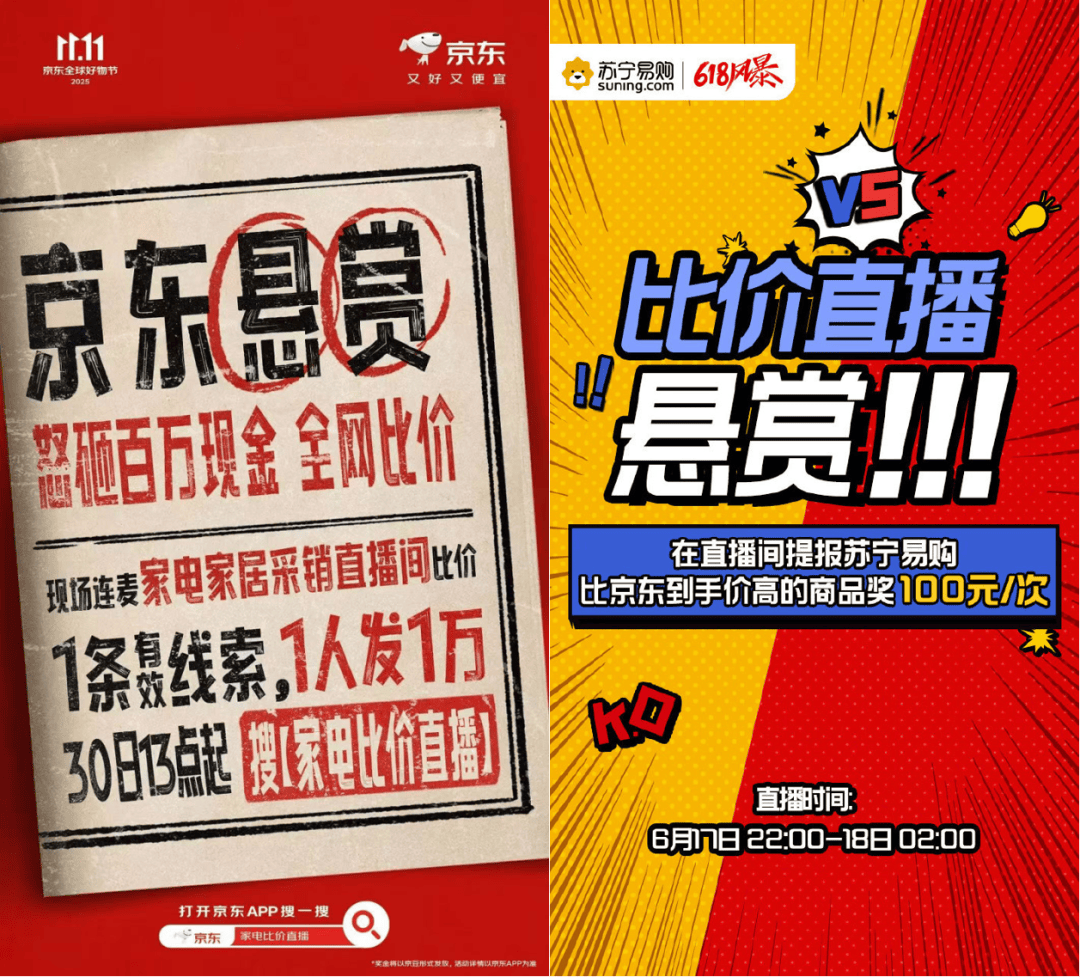
Core Viewpoint - The recent promotional strategies of JD.com, particularly the "million cash reward" for price comparison, reflect a reliance on outdated marketing tactics that may not resonate with today's consumers [1][3][4]. Group 1: Marketing Strategies - JD.com is attempting to revive old promotional tactics, such as cash rewards for price comparisons, reminiscent of strategies used over a decade ago [3][4]. - The current price comparison campaign is limited to the home appliance category, neglecting other significant categories like clothing and beauty products, which may not effectively enhance JD.com's low-price perception [4]. - The marketing approach appears to lack innovation, as evidenced by the repetitive nature of campaigns and the recent replacement of JD.com's retail marketing head [3][4]. Group 2: Competitive Landscape - JD.com faces increasing competition from platforms like Pinduoduo and Douyin, which are gaining market share without relying heavily on traditional promotional tactics [9]. - The company's efforts to expand into new areas, such as food delivery and local services, have shown initial promise but face challenges in sustaining momentum against competitors [6][9]. - JD.com's ambition to surpass Alibaba's Tmall has been complicated by the emergence of Pinduoduo, shifting the focus from leading the market to merely competing for second place [8][9]. Group 3: Leadership and Strategy - Liu Qiangdong's personal involvement in various initiatives, such as the food delivery business, reflects a hands-on leadership style but raises questions about the long-term strategic direction of JD.com [6][8]. - The company's historical successes in marketing, such as the 618 shopping festival, contrast sharply with its current reliance on outdated methods, indicating a potential strategic blind spot [8]. - There is a need for JD.com to adopt more effective and innovative business practices rather than relying on traditional marketing strategies to drive growth [9].

UberQ3总预订额大增21%,营业利润不及预期,盘前跌超4%|财报见闻
Hua Er Jie Jian Wen· 2025-11-04 13:45
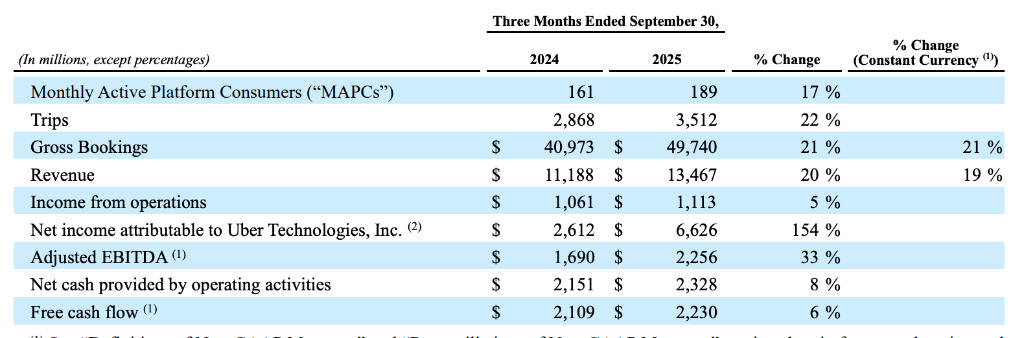
Core Viewpoint - Uber's Q3 financial results showed strong operational metrics despite lower-than-expected profitability, with total bookings reaching $49.7 billion, a year-over-year increase of over 20%, marking the largest growth in 2023 [1][4] Financial Performance - For the three months ended September 30, 2023, Uber reported: - Revenue of $13.467 billion, a 20% increase year-over-year [2] - Net income attributable to Uber Technologies, Inc. of $6.626 billion, a 154% increase [2] - Adjusted EBITDA of $2.256 billion, up 33% [2] - Monthly Active Platform Consumers (MAPCs) increased by 17% to 189 million [2][8] - Total trips increased by 22% to 3.512 billion [2] Business Growth and Challenges - Total bookings for Q3 reached $49.7 billion, driven by strong demand in both ride-hailing and delivery services, reflecting a significant rebound in overall travel activity [4] - The company provided a broad Q4 guidance, projecting total bookings between $52.25 billion and $53.75 billion, which is lower than the 22% growth seen in Q3 [3] - The delivery business saw adjusted EBITDA surge by 47% to $921 million, outpacing the mobility business's 21% growth [5] - Freight business remained stagnant with total bookings flat at $1.3 billion and an adjusted EBITDA loss of $20 million [5][8] Strategic Focus - CEO Dara Khosrowshahi outlined six strategic growth areas, including expanding ride-hailing and delivery services, developing a mixed platform of human and autonomous vehicles, and leveraging generative AI [6] - The company has divested approximately $1.4 billion from its $10.3 billion investments in other companies to prioritize these strategic initiatives [6] Market Reaction - Following the earnings report, Uber's stock price fell over 4% to $99.72 per share, despite a year-to-date increase of over 57% [6]
不容外卖店铺拿AI“照骗”撑门面
Zhong Guo Jing Ji Wang· 2025-11-03 13:53
Core Points - The article highlights the misuse of AI technology by some food delivery vendors to create misleading images that falsely represent their establishments, leading to consumer deception [1][2] - It emphasizes the potential risks of allowing such practices to proliferate, including damage to consumer rights and market order, as well as food safety concerns [1] Group 1 - Some vendors are using AI to enhance their storefront images, creating a false impression of popularity and quality [1] - There are sellers on e-commerce platforms offering services to modify storefront images and create deceptive videos to help vendors bypass platform scrutiny [1] - The reliance on false advertising undermines consumer rights, particularly the right to informed choice, and those who produce and sell these deceptive materials may face legal consequences [1] Group 2 - The implementation of the "Artificial Intelligence Generated Synthetic Content Identification Measures" in September mandates that users must declare and label generated content [2] - Food delivery platforms are urged to enhance their AI image recognition technology and take action against misleading advertisements by removing them promptly [2] - The article advocates for vendors to prioritize genuine business practices and quality over deceptive tactics to build long-term customer trust [2]
三大外卖平台上线“堂食”标志 外卖点餐即将告别“盲盒时代”
Chang Sha Wan Bao· 2025-11-03 13:26
Core Viewpoint - The National Market Supervision Administration has introduced new regulations requiring food delivery platforms to clearly label "no dine-in" restaurants, enhancing oversight of food safety in the delivery sector [13]. Group 1: Regulatory Changes - The new regulations aim to address issues related to "ghost restaurants" that operate without physical storefronts, ensuring that all online food service providers have legitimate business licenses and physical locations [13]. - The regulations specify that platforms must conduct thorough checks on the qualifications of food service providers and ensure compliance with food safety standards [13]. - The draft regulations prohibit the use of the same business license for multiple online stores on the same platform, targeting the issue of "one license, multiple stores" that compromises food quality [13]. Group 2: Platform Responses - Major food delivery platforms like Meituan, JD.com, and Ele.me have begun implementing their own labeling systems for dine-in restaurants, although the criteria and processes for certification vary among them [10]. - Meituan has reported that over 1.4 million merchants have completed the certification for the "dine-in" label since its introduction [10]. - JD.com has positioned itself as a "quality delivery" service, allowing only "quality dine-in restaurants" to join its platform and has introduced initiatives like "24-hour kitchen live streaming" [11]. Group 3: Consumer Insights - Consumers express a preference for ordering from restaurants with dine-in labels, associating them with higher reliability and food safety [10]. - The introduction of clear labeling and the emphasis on transparency in food preparation processes are expected to enhance consumer confidence in food delivery services [14].