
外卖

Search documents
为什么很多年轻人,不去学技术,而是选择送外卖、跑滴滴?
Sou Hu Cai Jing· 2025-11-01 10:17
Core Viewpoint - The article challenges the perception that young people are not pursuing long-term career development or technical skills, highlighting that their choices are influenced by various practical constraints rather than a lack of ambition. Group 1: Reasons for Choosing Delivery and Ride-Hailing Jobs - High costs of learning technical skills deter young people, as mastering a trade can take one to two years with significant financial burden and initial low income [1][2] - Rapid technological advancements create uncertainty, making it less appealing to invest time in learning skills that may quickly become obsolete [4] - The flexibility and autonomy of delivery and ride-hailing jobs are attractive, allowing young workers to set their own schedules and potentially earn more than traditional jobs [6] Group 2: Skills Required in Delivery and Ride-Hailing Jobs - Delivery workers and ride-hailing drivers require specific skills, such as navigating city traffic, optimizing routes, and managing customer relationships, which involve experience and expertise [8]



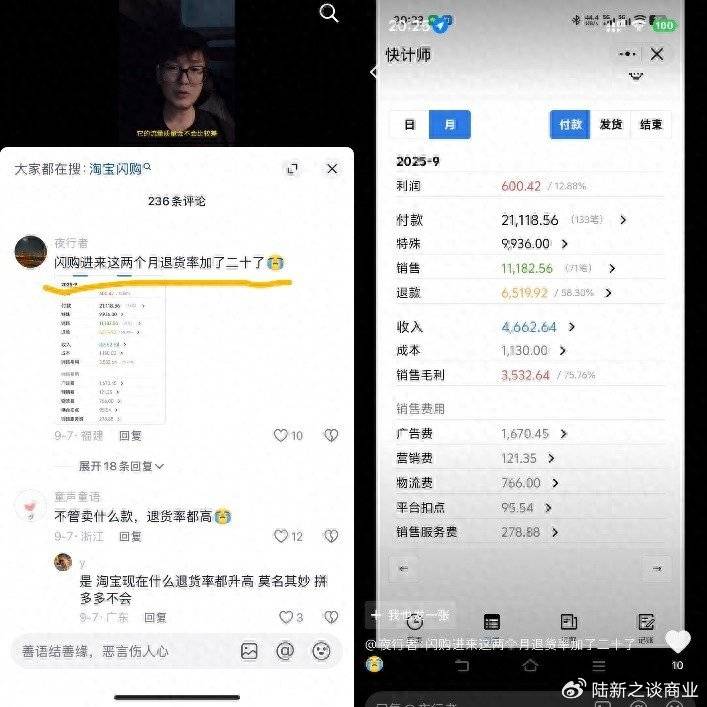
双11未到退货率飙升,淘宝商家控诉“外卖补贴引来太多羊毛党”
Sou Hu Cai Jing· 2025-11-01 04:10
Core Insights - The current "Double Eleven" shopping festival is impacted by the influx of traffic from the food delivery sector, leading to a significant increase in return rates among e-commerce sellers [1][4] - Many sellers report that despite increased traffic, conversion rates have not improved, indicating that a large portion of the new users are non-purchasing visitors [4][10] - The phenomenon of "only browsing without buying" has become more pronounced, with sellers expressing dissatisfaction with the current sales performance compared to previous years [1][3] Group 1: E-commerce and Delivery Dynamics - The integration of food delivery services into the e-commerce platform has altered the consumer base, resulting in a rise in ineffective traffic characterized by users who browse but do not purchase [4][10] - Sellers have noted that the efficiency of marketing tools like Taobao's direct traffic service has decreased, likely due to the influx of new users from the food delivery sector [4][6] - The high return rates, with some sellers reporting increases of up to 20%, suggest that the low-cost delivery promotions have attracted price-sensitive consumers rather than loyal customers [4][10] Group 2: Strategic Implications for Alibaba - Alibaba's strategy aims to merge food delivery and e-commerce to create a comprehensive consumer platform, referred to as the "Big Taobao Strategy" [7][9] - Despite the strategic intent, the actual consumer behavior indicates that the relationship between food delivery and e-commerce is superficial, with many users not converting to actual purchases [10] - The significant financial investment in the food delivery sector, estimated at 300-400 billion yuan from July to September, has led to resource allocation issues within the e-commerce platform [10][12] Group 3: Market Trends and Seller Sentiment - The trend of increasing return rates in e-commerce has been exacerbated by the competitive pricing strategies in the food delivery market, indicating a potential long-term challenge for online retailers [3][10] - Sellers are expressing concerns about being used to support the food delivery sector at the expense of their own e-commerce operations, highlighting a need for clearer strategic direction [12] - The expectation of a seamless integration between food delivery and e-commerce remains unfulfilled, as evidenced by the ongoing challenges faced by sellers during the current shopping festival [10][12]

为什么美团宁愿被骂,也不搞社保样板间?
盐财经· 2025-10-31 11:10
Core Viewpoint - Meituan's new pension insurance subsidy program for delivery riders aims to enhance social security coverage nationwide, allowing riders to choose their insurance location and providing a 50% subsidy on contributions [2][4][10]. Group 1: Social Security System for Delivery Riders - The new pension insurance subsidy will cover all delivery riders across the country, addressing a significant gap in social security for this workforce [2][4]. - The program is designed to be inclusive, with benefits available to all types of riders, potentially impacting millions [2][10]. - The current social security system for delivery riders is already more advanced than that of many blue-collar workers [5][26]. Group 2: Comparison with Other Platforms - JD.com has adopted a different approach by providing full social security benefits for its full-time riders, but this excludes part-time riders [7][8]. - Meituan's model is more inclusive, allowing riders to self-select their participation in the pension scheme, thus accommodating the high percentage of part-time riders [12][13]. Group 3: Structure of the Social Security Program - Meituan's program consists of a "three-tier" structure: a basic safety net, an advanced support network, and a work benefits network [16][17]. - The basic safety net includes pension insurance subsidies and new occupational injury insurance, which has already covered over 13 million riders [17][18]. - The advanced support network offers additional benefits such as serious illness assistance and family coverage, extending support beyond just the riders [18][21]. Group 4: Flexibility and Sustainability - The program emphasizes flexibility and sustainability, recognizing the diverse and transient nature of the delivery rider workforce [12][13][28]. - Meituan's approach combines shared cost structures among the platform, riders, and government, ensuring long-term viability [28][31]. - The design of the program allows for a basic coverage for all while offering optional advanced benefits, catering to individual needs [28][32]. Group 5: Industry Impact and Future Outlook - The improvements in income and social security for delivery riders have positioned them among the top tier of blue-collar workers in China [26]. - Meituan's model serves as a potential template for addressing social security for other flexible employment groups, demonstrating a viable alternative to traditional models [32][33]. - The gradual and pragmatic approach taken by Meituan reflects a commitment to long-term improvements in social security for delivery riders, moving from "zero coverage" to a more comprehensive system [33][34].

覆盖全国骑手、惠及全行业:美团骑手保障迈出一大步
格隆汇APP· 2025-10-31 10:29
Core Viewpoint - Meituan has established a comprehensive social security system for its delivery riders, marking a significant shift in the gig economy towards enhanced worker protection rather than mere subsidies [4][6][15]. Group 1: Overview of the New Security System - The new social security system covers millions of flexible workers, making it the first of its kind in the industry [4][5]. - This system signifies the end of the "no protection era" for delivery riders, with Meituan setting a precedent that may compel other companies to follow suit [7][21]. - The system is structured in a "multi-layered tower" format, addressing the full lifecycle needs of riders, transitioning from survival support to development assistance [7][8]. Group 2: Structure of the Security System - The foundational layer includes nationwide coverage for all Meituan riders, providing pension insurance, occupational injury insurance, and accident insurance, with no restrictions on qualifications or location [7][8]. - The advanced layer innovatively includes coverage for riders' families, offering critical illness care, education funds for children, and vocational training funds, thus expanding the traditional boundaries of corporate welfare [8][9]. - The welfare layer provides various benefits such as meal subsidies, family travel allowances, free annual health check-ups, and special care for female riders, enhancing their professional recognition [8][9]. Group 3: Implementation and Historical Context - Meituan's commitment to this system has been long-term, beginning with pilot programs in 2021 and culminating in nationwide coverage by October 2023 [9][12]. - The company has engaged in extensive dialogue with riders, holding nearly 500 meetings to gather feedback and optimize the program [10][12]. - Since July 2022, Meituan has paid over 2 billion yuan in new occupational injury insurance for more than 13 million riders [12]. Group 4: Broader Implications for the Industry - The establishment of this system is seen as a model for social security innovation in the gig economy, potentially influencing other platforms to adopt similar measures [15][21]. - The initiative addresses the unique characteristics of China's flexible employment structure, which includes approximately 240 million flexible workers [16][18]. - Meituan's approach contrasts with the "elite protection" model of some competitors, which fails to provide widespread benefits to part-time and transitional workers [17][18]. Group 5: Economic and Strategic Impact - The new security system is expected to enhance Meituan's operational efficiency by reducing rider turnover and improving service quality [27][29]. - By focusing on long-term stability rather than short-term incentives, Meituan is shifting its competitive strategy from price wars to structural advantages [30][31]. - This initiative aligns with national policies aimed at optimizing social security systems and promoting equitable growth [26][30].

巴西,互联网最后的战场
3 6 Ke· 2025-10-31 09:42
Group 1: Market Entry and Competition - Meituan's brand Keeta has officially launched in Brazil, with initial operations in Santos and São Vicente, and has already won a legal battle against Didi's 99Food regarding competition law [1] - The São Paulo court ruled that the contract terms preventing restaurants from working with Keeta are invalid, highlighting the competitive tension in the Brazilian market [1] - The Brazilian market is attracting various internet companies, including Temu, Shopee, TikTok, and Kwai, indicating a growing interest in the region [1] Group 2: Super App Definition and Landscape - Super apps are defined as platforms that allow users to access multiple services such as messaging, payments, e-commerce, and ride-sharing within a single application [2] - Latin America, particularly Brazil, is still in the mid-stage of ecological fragmentation, with platforms like Rappi and Mercado Livre focusing on single domains without forming a true "super entry" [2] Group 3: Digital Economy Potential in Brazil - Brazil has a high smartphone penetration rate of over 80%, creating a significant "digital vacuum" for internet services [7] - The country has a large and active internet user base, with approximately 183 million internet users and an internet penetration rate of 86.2% as of 2024 [10] - Brazil's GDP per capita is around $11,178, indicating a moderate purchasing power that supports potential consumer market growth [10] Group 4: Financial System and Digital Payment Innovations - Nubank has emerged as a leading digital bank in Brazil, with over 60% of adults holding a Nubank account and a valuation of approximately $65 billion [15] - The introduction of the PIX payment system has facilitated real-time transactions without the need for credit cards, significantly enhancing online payment habits [16] - The rapid adoption of PIX, which completed over 1.77 billion transactions within 46 days of launch, has positioned Brazil as a favorable environment for internet companies [16] Group 5: Challenges for Super App Development - The decentralized nature of social networks in Brazil, where users engage in various small groups, poses challenges for the creation of a centralized super app [18] - Regulatory scrutiny from the Brazilian Central Bank and competition authorities has made it difficult for platforms to monopolize services, impacting the feasibility of super apps [19] - The high cost of user acquisition for financial apps in Brazil is significantly greater than in other Latin American countries, complicating the business model for potential super apps [22] Group 6: Future Outlook - While Brazil may not produce a super app akin to WeChat, it is developing a decentralized network ecosystem that integrates payments, logistics, and social interactions [23] - The digital economy in Brazil is expected to evolve, with various players exploring different models to capture market opportunities [23]


QuestMobile:外卖竞争激活关联场景消费,电影演出、酒旅等平台月活双位数增
Jing Ji Wang· 2025-10-31 08:11
Core Insights - The report by QuestMobile highlights significant growth in the food delivery market driven by competition, which is expected to boost sales during the upcoming Double 11 shopping festival [1][2]. Group 1: Market Dynamics - The food delivery market has seen rapid growth since July, with platforms like JD and Taobao entering the market, leading to a new competitive landscape [1]. - Daily order volume in the food delivery market surged from approximately 100 million in May to over 200 million by August [1]. - Taobao's flash purchase feature reached a peak of 120 million daily orders in August, with monthly active users nearing 370 million [1]. Group 2: User Engagement - In Q3, monthly active users for Taobao, Meituan, and JD experienced significant growth, with Taobao's monthly active users approaching 1 billion in August and September, marking a historical high [1]. - The average usage frequency and duration per user for Taobao and JD saw double-digit growth in September [1]. Group 3: Advertising and Revenue - The rapid development of food delivery services has significantly increased the advertising value for platforms, with Taobao's advertising revenue market share rising by approximately 2 percentage points compared to last year [1]. Group 4: Broader Market Impact - The food delivery boom has positively impacted related sectors, with active users in tourism, performances, and hotel services showing notable growth of 11.9% and 16.1% year-on-year in September [5]. - The overall online retail growth rate has rebounded to 9.8%, with online service consumption increasing by 20.2% from January to September [8]. Group 5: Competitive Landscape - The market is becoming increasingly competitive, with consumers opting for multiple platforms for comparison. The overlapping user base among Taobao, Meituan, and JD grew by nearly 20% year-on-year in September [8]. - The number of active delivery riders has expanded significantly, with a 140% increase in monthly active users for rider apps compared to January [8]. Group 6: Industry Standards - In response to intense competition, platforms are focusing on building food safety ecosystems and enhancing service quality, with continuous upgrades to rider support and protection systems [11].

美团反攻,外卖行业的护城河是神话还是笑话?
3 6 Ke· 2025-10-31 00:42
Core Viewpoint - The takeaway from the article is that the food delivery industry, after ten years of development, is facing intense competition and challenges, particularly for Meituan, which is attempting to navigate a saturated market while maintaining its competitive edge through various strategies [2][12]. Industry Overview - The food delivery industry has evolved over the past decade, transitioning from a phase of rapid growth to one characterized by intense competition and market saturation [4][12]. - The emergence of a "three-legged" competitive landscape, with Meituan, Ele.me, and JD.com as key players, has led to a significant shift in market dynamics [4][12]. Company Performance - Meituan recently set a record with a $3 billion bond issuance, aiming to sell approximately $2 billion in U.S. dollar notes and an equivalent of $1 billion in offshore RMB notes [2][3]. - In Q2 2025, Meituan's revenue increased by 11.7% year-on-year to RMB 91.8 billion, but its core local business operating profit dropped significantly to RMB 3.7 billion due to fierce competition [6]. - The adjusted EBITDA and net profit for Meituan fell by 81.5% and 89% respectively, indicating substantial financial pressure [6]. Competitive Landscape - Meituan and Ele.me have historically dominated over 90% of the market share, but the entry of JD.com and the rise of Taobao's flash purchase service have intensified competition [5][12]. - The market share is expected to stabilize at a ratio of 4.5:4.5:1 among Alibaba, Meituan, and JD.com, reflecting a contraction in Meituan's profitability [5][12]. Strategic Initiatives - In response to market pressures, Meituan is focusing on technology upgrades to enhance delivery efficiency and exploring new growth areas through diversified services [9][11]. - The company is implementing a "30-minute delivery" upgrade plan and investing in smart delivery systems, including drone technology, to improve operational efficiency [9][11]. - Meituan is also transitioning from a single food delivery platform to a comprehensive instant retail platform, expanding its service offerings beyond just food [11]. Future Outlook - The article suggests that the current "three-legged" competitive structure is unlikely to change in the short term, with a focus on differentiated competition becoming essential for survival [12][13]. - The future of the food delivery industry is expected to be characterized by a multi-faceted competitive landscape, where the emphasis shifts from scale expansion to value creation [13].

90后数学家王虹拿下超级大奖;陈天桥将投10亿美元算力支持发现式智能;泡泡玛特中东首店开业;OpenAI回应筹备IPO丨邦早报
创业邦· 2025-10-31 00:08
Group 1 - The 2025 Hurun Women Entrepreneurs List was released, with Zhong Huijuan from Hansoh Pharmaceutical becoming China's richest woman for the first time, with a wealth of 141 billion yuan [1] - Young mathematician Wang Hong from Guangxi won the 2025 Salem Prize, which is considered a precursor to the Fields Medal, and was also awarded at the World Chinese Mathematicians Conference [1] - OpenAI is reportedly preparing for an IPO, with a potential valuation of up to $1 trillion, which could be one of the largest IPOs in history [2] Group 2 - Li Cao from Leap Motor clarified that the company focuses on self-research of core technologies and respects Huawei as a benchmark for China's technological independence [2] - Xiaomi's "Giant Energy Saving" series was clarified by executives as a product line name rather than a performance metric, with energy efficiency exceeding national standards [4] - JD.com launched a promotional campaign offering free food delivery as part of its 11.11 shopping festival, with a total of 1 million free orders available [6] Group 3 - JD.com founder Liu Qiangdong treated 150,000 full-time delivery riders to KFC as a reward for their hard work during the 11.11 sales event [8] - Chen Tianqiao announced a $1 billion investment in computing power to support innovative AI research, emphasizing the importance of discovery in AI [8] - Giant Network responded to the departure of its former CEO, stating that the company is focused on reducing internal conflicts and improving decision-making efficiency [10] Group 4 - Didi announced a freight payment guarantee, committing to fully cover drivers' unpaid earnings if not received within seven days after order completion [10] - Pop Mart opened its first store in the Middle East, which operates 24 hours a day, marking a significant expansion for the brand [10] - Taobao is set to launch a "Taobao Convenience Store" project, offering a wide range of products online with a focus on quality and service standards [13] Group 5 - The skincare brand "LAN" responded to consumer concerns about compliance with regulatory standards, stating that their product registrations are valid [13] - Apple CEO Tim Cook avoided questions regarding iPhone Air production cuts during a recent earnings call, maintaining the company's policy of not disclosing specific model sales [13] - The NBA approved Mark Walter as the new owner of the Los Angeles Lakers, with a total valuation of $10 billion for the team [14] Group 6 - Ford announced an additional investment of $170 million in Argentina for the production of hybrid Ranger vehicles, set to begin in 2027 [14] - Wikipedia subtly criticized Elon Musk's AI-driven encyclopedia GrokiPedia, emphasizing its human-operated nature in a fundraising announcement [14] - Tesla is recalling 6,197 Cybertruck vehicles in the U.S. due to potential issues with the installation of off-road light bars [17] Group 7 - YouTube is undergoing a restructuring focused on AI applications, offering voluntary buyout options to employees considering leaving the company [17] - Volkswagen reported a net loss of €1.072 billion in Q3 2025, with a significant decline in profits attributed to increased electric vehicle production and additional costs [18] - Nvidia plans to invest up to $1 billion in AI startup Poolside, potentially increasing its valuation significantly [18] Group 8 - Intel is in preliminary talks to acquire AI chip startup SambaNova Systems, with potential valuation lower than its previous funding round [18] - Shunwei Capital led a multi-million yuan angel round investment in Zhefei Aviation Technology, indicating continued interest in the aviation sector [18] - Pyromind Dynamics completed a $10 million seed round financing to expand its team and product development in the reinforcement learning sector [18]

美团Keeta在巴西启动运营
Xin Lang Cai Jing· 2025-10-30 23:41
Core Viewpoint - Meituan's international food delivery brand Keeta officially launched operations in Brazil on October 30, 2023, starting in the cities of Santos and São Vicente, with plans to expand to São Paulo by the end of the year [1] Group 1 - Keeta has commenced its operations in Brazil, marking a significant step in its international expansion strategy [1] - The initial launch cities are Santos and São Vicente, indicating a phased approach to market entry [1] - The company aims to enter São Paulo, Brazil's largest city, by the end of 2023, highlighting its growth ambitions in the region [1]
孩子王拟赴港上市;亚马逊将裁减近1.4万个岗位
Sou Hu Cai Jing· 2025-10-30 13:54
Capital Dynamics - Keurig Dr Pepper has secured $7 billion in financing from a private equity firm to facilitate its $18 billion acquisition of JDE Peet's, aiming to reduce net leverage post-acquisition. The deal is expected to close in the first half of 2026, significantly enhancing KDP's acquisition leverage and reshaping the global coffee and beverage competitive landscape [3]. Sale Dynamics - Private equity firms HSG Sequoia China and CPE Yuanfeng are reportedly bidding for a major stake in Burger King's China operations, with the final buyer expected to be announced alongside the company's financial report later this month. If successful, the acquisition could leverage PE capital and supply chain expertise to revitalize Burger King's performance in lower-tier markets [5]. Listing Dynamics - Kidswant announced plans to issue H-shares and list on the Hong Kong Stock Exchange by October 27, 2025. The company is in discussions with intermediaries regarding the issuance and listing, which requires approval from various regulatory bodies. This move aims to advance the company's international strategy and enhance its brand influence in the family service sector [7]. Business Expansion - Meituan's international delivery brand Keeta has launched operations in Abu Dhabi, UAE, providing reliable delivery services and a diverse product selection. This expansion solidifies Meituan's international business presence in the Gulf Cooperation Council (GCC) region [10]. Financial Performance - Procter & Gamble reported a 20% increase in net profit for the first quarter of fiscal year 2026, with net sales reaching $22.39 billion, a 3% year-over-year growth. The beauty segment saw a 6% increase in net sales, while the grooming segment grew by 5%. The company anticipates total sales growth of 1% to 5% for the fiscal year [14][16]. - Beiersdorf's sales for the first three quarters of 2025 reached €7.5 billion, with an organic growth of 2.0%. The consumer business segment also grew by 2.0%, driven primarily by the Derma and skin science divisions [18]. Organizational Changes - Amazon announced plans to cut nearly 14,000 jobs as part of an internal restructuring aimed at focusing investments on critical business areas. The company expects to continue hiring in key strategic areas in 2026 [19][21]. - Puma appointed Maria Valdes as Chief Brand Officer, responsible for brand marketing and innovation, as part of a restructuring to enhance overall brand impact [22][24]. - Reebok has established a new European headquarters and appointed Marc Le Roux as the new CEO for Europe, aiming to accelerate retail expansion and strengthen brand culture in the region [26].
