国防

Search documents
欧洲刚宣布稀土喜讯,冯德莱恩转身对中国发难,中国早已留好后手,反制已到位
Sou Hu Cai Jing· 2025-12-18 16:44
Group 1 - The EU has become increasingly reliant on China for rare earth materials, with a dependency rate of 98%, which directly impacts key industries such as renewable energy, military, and aerospace [4] - In September 2025, China exported 2,582 tons of rare earth magnets to the EU, marking a 21% month-on-month increase and reaching a recent high [1] - The EU is planning to impose a 50% tariff on Chinese steel and has initiated 20 anti-dumping investigations, indicating a shift towards protectionist measures against Chinese imports [1] Group 2 - The EU's recent sanctions against 12 Chinese companies, accused of helping Russia evade sanctions, have raised concerns among European businesses about the potential disruption of supply chains [1][9] - China's recent export controls on rare earth materials include a compliance review system, which could impact global supply chains and create a "valve" controlled by China [7] - The EU's Critical Raw Materials Act aims to reduce reliance on single third-country suppliers to below 65% by 2030, but challenges remain due to slow progress in domestic rare earth projects [6] Group 3 - European companies are facing production disruptions due to China's tightened rare earth export controls, with some firms experiencing a 40% drop in imports and a 15% increase in production costs [9] - The political tensions between the EU and China are creating a complex environment for businesses, as companies like those in Bavaria are successfully navigating through established "green channels" for importing rare earth materials [10] - The EU's internal contradictions regarding its approach to China are evident, as it seeks to balance geopolitical alignment with the U.S. while also recognizing the necessity of maintaining stable supply chains from China [6]


核心争议:可持续投资格局有何转变?2026 年将塑造行业的新兴主--Big Debates How has sustainable investing shifted and what emerging themes are likely to shape the landscape in 2026
2025-12-18 02:35
Summary of Key Points from the Conference Call Industry Overview - The focus of the conference call is on **sustainable investing** and its evolution in 2025, with implications for 2026. The discussion highlights the impact of policy changes, corporate strategies, and macroeconomic factors on sustainable investment trends [1][7][8]. Core Insights - **Shift in Sustainable Investing**: Sustainable investing has evolved significantly in 2025, influenced by policy uncertainty and changes in corporate sustainability strategies. The investment focus has broadened to include sectors like Defence, indicating a shift in investor sentiment [7][8][9]. - **Emerging Themes for 2026**: Key themes identified for 2026 include: - **Climate Resilience**: Recognizing the need for adaptation solutions alongside mitigation efforts due to heightened climate risks [24]. - **AI Risks and Responsible AI**: Increased investor interest in the risks associated with AI, including cybersecurity and job displacement [23]. - **Cybersecurity**: A growing theme as cyber threats increase, with sustainability funds currently underweight in cybersecurity investments [23]. - **Resource Efficiency and Energy Security**: These are critical from a sustainability perspective, reflecting a broader understanding of security beyond traditional definitions [23]. Corporate Engagement and Analysis - **Importance of Corporate Engagement**: As corporate targets become less central to sustainability investors, the credibility of corporate sustainability strategies is increasingly important. Investors are focusing on understanding the challenges companies face in executing their strategies [15][16]. - **Return to Fundamental Analysis**: There is a noted return to fundamental analysis within sustainable investing, emphasizing the importance of capital expenditure allocation and the returns on green investments [17]. Changes in Corporate Strategies - **Pragmatic Approach to Decarbonization**: Corporates are adopting more realistic and achievable targets for decarbonization, particularly in industrial sectors. Investors express concerns about excessive cuts to targets that could lead to complacency [13][16]. - **Long-term Commitments**: While near-term climate commitments may be adjusted, long-term commitments to net zero are expected to remain, with two main pathways for decarbonization identified for Europe [10][11]. Market Dynamics - **Broader Investment Universe**: The easing of exclusion policies related to weapons has expanded the investable landscape, allowing for greater inclusion of companies that are improving their sustainability practices [18]. - **Investor Sentiment**: The cooling of ESG sentiment has led to a reevaluation of the value of sustainable investing, with a focus on identifying future cash flow risks and avoiding controversy risks [22]. Conclusion - The sustainable investing landscape is undergoing significant changes, driven by macroeconomic factors, policy shifts, and evolving corporate strategies. Investors are increasingly focused on pragmatic approaches, corporate engagement, and emerging themes such as climate resilience and cybersecurity as they navigate this evolving environment [1][7][23][24].
泰DEPA-BOI携手推出新措施提升产业竞争力
Shang Wu Bu Wang Zhan· 2025-12-16 16:25
Core Insights - Thailand's Digital Economy Promotion Agency (DEPA) and the Board of Investment (BOI) have launched new measures to enhance industrial competitiveness through a "Digital Service Account" mechanism [1] Group 1: Policy Overview - The new policy provides subsidies of up to 30% of the investment amount for companies adopting digital technologies developed or improved by certified Thai digital entrepreneurs [1] - The maximum subsidy for a single entity can reach 100 million Thai Baht, with projects required to be completed within one year [1] Group 2: Target Industries - The initiative aims to promote the application of digital technologies in key industries such as agriculture and biotechnology, smart electronics, high-value food, integrated medical technology, next-generation automobiles, defense, biofuels and chemicals, and robotics [1] - The support encompasses technologies including enterprise resource connection systems (requiring integration of at least three data functions), artificial intelligence, machine learning, big data, and data analytics [1] Group 3: Eligibility Criteria - For small and medium-sized enterprises (SMEs), the minimum investment amount must reach 20 million Thai Baht, while other enterprises must invest at least 50 million Thai Baht (excluding land and working capital) [1] - The new measures are expected to accelerate the digital transformation of Thai companies and enhance the country's technological competitiveness [1]

UK's FTSE 100 falls as oil, defence stocks weigh; domestic unemployment climbs
Reuters· 2025-12-16 10:51
Core Viewpoint - London's FTSE 100 index experienced a decline, primarily driven by losses in the energy and defense sectors, as investors evaluated new jobs data that bolstered expectations for an interest rate cut by the Bank of England later in the week [1] Group 1: Market Performance - The FTSE 100 index slipped on Tuesday, indicating a negative market trend [1] - Losses were particularly noted in the energy and defense stocks, which contributed to the overall decline of the index [1] Group 2: Economic Indicators - Fresh jobs data was released, which played a significant role in shaping investor sentiment [1] - The jobs data reinforced expectations for an interest rate cut by the Bank of England, suggesting a potential shift in monetary policy [1]

大摩盘点美股航空航天/国防/太空三大板块估值变化 哪些标的值得关注?
智通财经网· 2025-12-15 08:53
Group 1: Aerospace Sector - The aerospace sector's valuation has risen above historical levels, with a current NTM EV/EBITDA trading at approximately 18 times, up from about 16 times at the beginning of the year, outperforming the S&P 500 index by a median premium of about 15% [2][3] - Strong air traffic has been a key driver for this valuation increase, highlighted by record passenger screenings by the TSA [2] - Despite some initial concerns regarding supply chain challenges and tariffs, the sector's valuation quickly rebounded as negative impacts did not materialize [2] Group 2: Defense Sector - The valuation multiples for major U.S. defense contractors have improved, with the current NTM P/E median at about 20 times, up from approximately 17 times at the beginning of 2025 [4] - The expansion in valuation multiples is partly due to alleviated concerns over potential defense spending cuts, as these cuts have not occurred [4] - Key government funding initiatives, including approximately $24 billion for the Iron Dome and $150 billion for overall defense, have provided support for the sector [4] Group 3: Space Sector - The space sector has experienced significant volatility, with the NTM EV/Sales median peaking above 10 times in September before dropping to about 4 times in November, and currently recovering to around 6 times [6] - Major IPOs in the sector, such as Voyager and Firefly, initially saw rapid market capitalization growth but have since declined below their issue prices due to investor caution [6] - Companies like Rocket Lab and Planet Labs are highlighted as strong performers, trading at approximately 35 times and 11 times NTM EV/EBITDA, respectively, supported by operational success and a new business model focus [6][7]


美国50%关税逼宫,印度转头访华,不做他国棋子
Sou Hu Cai Jing· 2025-12-11 06:07
Core Viewpoint - The article discusses how India is rapidly adjusting its foreign policy in response to the U.S. imposing a 50% tariff on Indian goods, particularly in the context of India's strategic partnerships with China and Europe, while rejecting the role of a pawn in great power games [1][3]. Group 1: U.S. Tariff Impact - The U.S. announced a 50% tariff on Indian goods, citing India's continued energy purchases from Russia as the reason, which disrupted India's diplomatic rhythm [1][8]. - The tariff specifically targeted key sectors such as textiles, pharmaceuticals, and electronic components, leading to a stalemate in ongoing trade negotiations [8]. - The U.S. also strengthened ties with Pakistan, signing multiple security and economic agreements, which further aggravated India's concerns about its influence in South Asia [8][10]. Group 2: India's Diplomatic Strategy - In response to U.S. pressure, India accelerated its engagement with China and Russia, while also deepening ties with Europe, indicating a multi-directional alliance strategy [3][10]. - India's diplomatic approach is characterized by a desire for strategic autonomy, avoiding becoming a pawn in the geopolitical rivalry between major powers [27]. - Despite the challenges, India remains committed to maintaining cooperation with the U.S. in high-tech investments and AI development, recognizing the importance of the U.S. market [19][21]. Group 3: Engagement with Russia and China - India has invited Russian President Putin for a visit, marking a significant moment since the Ukraine conflict began, and signed agreements on energy supply and military technology [12]. - Modi's attendance at the Shanghai Cooperation Organization summit and meetings with Chinese and Russian leaders were pre-planned, reflecting a cautious approach to repairing relations with China [13]. - India's military procurement strategy is diversifying, with a notable decrease in reliance on Russian arms, dropping from nearly 70% to below 40% over the past 15 years [15][17]. Group 4: Strengthening Ties with Europe - The EU has initiated a new strategic agenda with India, focusing on technology, investment, and security cooperation, marking a shift in the historically slow development of India-EU relations [23][25]. - The EU's advantages in renewable energy and technology sectors align with India's interests, fostering a collaborative environment [25]. - Upcoming agreements, including a new free trade deal, are expected to be finalized by early 2026, emphasizing energy cooperation to reduce India's dependence on Russian fossil fuels [25][27].

Rolls-Royce share price eyes a rebound as a bullish pattern forms
Invezz· 2025-12-10 10:23
Core Viewpoint - Rolls-Royce has transformed from a pandemic laggard to a top performer in the FTSE 100 Index, with significant stock price appreciation and strong demand across its business segments [2][3]. Group 1: Stock Performance - Rolls-Royce share price has increased from a low of 1,020p on November 24 to 1,110p, marking a rise of over 100% from its lowest level in January [1] - The stock has surged from 62.15p in 2022 to 1,112p, representing a 1,527% increase, elevating its market capitalization to over $126 billion [2] - The stock price has shown positive technical indicators, remaining above the 50-day and 100-day Exponential Moving Averages, suggesting bullish control [9] Group 2: Financial Outlook - The company expects full-year operating profit to be between £3.1 billion and £3.2 billion, with free cash flow projected between £3.0 billion and £3.1 billion [3] - Despite strong stock performance, Rolls-Royce maintains a trailing P/E ratio of 16.9, which is lower than the S&P 500 Index average of 22, indicating it is not overly expensive [6] Group 3: Business Growth Drivers - Rolls-Royce has received significant orders from airlines such as IndiGo and Malaysia Airlines, contributing to its recovery as active flying hours surpass pre-pandemic levels [4] - The company is benefiting from a boom in the defense industry, with potential large contracts, including a €50 billion spending package in Germany [4] - The Small Modular Reactors (SMR) business has gained traction, with orders from the UK government and expansion plans into the US market, supported by a recent $800 million investment announcement [5][6]

“中国赶上了西方,但未来西方可能赶不上中国了”
Guan Cha Zhe Wang· 2025-12-08 11:47
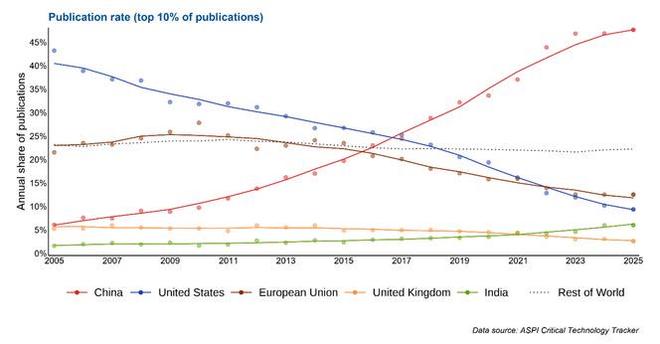
Core Viewpoint - China has achieved a dominant position in defining modern technologies, surpassing other regions in various fields such as artificial intelligence, defense, aerospace, energy, and biotechnology [1][3]. Group 1: Technological Advancements - A report by the Australian Strategic Policy Institute indicates that China leads in 66 out of 74 key technologies, while the U.S. maintains an advantage in only 8 [1]. - In the AI sector, China is ahead in 7 out of 8 technologies; in advanced materials and manufacturing, it leads in all 13 technologies; and in defense, aerospace, robotics, and transportation, it ranks first in all 7 technologies [1]. - In the energy and environment sector, China leads in 9 out of 10 technologies, and in biotechnology, genetics, and vaccines, it is ahead in 5 out of 9 technologies [1]. Group 2: Recent Technological Achievements - Recent months have seen China showcase remarkable technological feats, including a bionic robot the size of a mosquito for battlefield reconnaissance and the completion of the world's highest bridge [2]. - The DeepSeek team introduced a mathematical reasoning model, DeepSeekMath-V2, which has demonstrated significant capabilities in theorem proving, marking a milestone in AI development [2]. Group 3: Investment and Policy - China's technological achievements are closely linked to substantial investments in strategic emerging industries, amounting to 8.6 trillion yuan since the start of the 14th Five-Year Plan [6]. - Analysts highlight the difference in governance models, with China being described as an "engineering state" focused on practical solutions, while the U.S. is characterized as a "lawyerly society" that often resorts to legal measures [6][7]. Group 4: Comparative Analysis - Australia's recent AI strategy, which includes a budget of 30 million AUD (approximately 140 million yuan) for AI safety research, is seen as significantly less robust compared to China's comprehensive industrial policies [7]. - The speed of China's technological acceleration is noted as unprecedented compared to other regions, with experts suggesting that the West may struggle to catch up [8].
重磅!特朗普发布第二任期《国家安全战略》(全文&与以前有何不同&美国媒体评论)
美股IPO· 2025-12-06 23:00
Group 1 - The article emphasizes the need for a coherent and focused global engagement strategy for the United States to maintain its status as the world's strongest and most influential nation [3][4][5] - It critiques past U.S. strategies post-Cold War for failing to align with core national interests and for misjudging the American public's willingness to bear global burdens [4][5] - The article highlights the importance of prioritizing core national interests in U.S. foreign policy, focusing on security, economic stability, and the protection of American values [7][10] Group 2 - The article outlines the core objectives of U.S. strategy, including the protection of national sovereignty, economic interests, and the well-being of its citizens [7][8] - It stresses the need for a resilient national infrastructure capable of withstanding various threats, including military attacks and foreign influence [8] - The article advocates for a strong military presence and advanced defense systems to safeguard U.S. interests and deter potential adversaries [8][9] Group 3 - The article discusses the importance of maintaining a robust economy as the foundation of U.S. power, emphasizing the need for a strong industrial base and innovative energy sector [8][9] - It highlights the necessity of protecting intellectual property and fostering technological advancements to sustain economic leadership [9] - The article calls for a focus on re-industrialization and energy independence to bolster economic resilience and reduce reliance on foreign sources [12][18] Group 4 - The article outlines the U.S. approach to foreign relations, advocating for a pragmatic and principle-driven diplomacy that prioritizes American interests [11][13] - It emphasizes the need for burden-sharing among allies and partners, particularly in defense spending and regional security responsibilities [14][15] - The article critiques the past U.S. approach to China, calling for a rebalancing of economic relations to ensure fairness and protect American economic independence [25][26] Group 5 - The article identifies the strategic importance of the Western Hemisphere, advocating for a return to Monroe Doctrine principles to safeguard U.S. interests in the region [16][18] - It discusses the need for a proactive stance against foreign adversaries in the Western Hemisphere, emphasizing cooperation with regional allies to combat illegal immigration and drug trafficking [19][20] - The article highlights the importance of economic partnerships and investment opportunities in the region to strengthen U.S. influence and counter external threats [22][23]

欧元EURUSD惊魂未定:零售提振有限,欧央行更像是在“拖时间”
Xin Lang Cai Jing· 2025-12-04 23:37
Group 1 - Eurozone retail sales data for October showed a year-on-year growth of 1.5%, exceeding market expectations of 1.3%, indicating some resilience in consumer demand [1][2] - However, month-on-month retail sales remained flat at 0.0%, suggesting a temporary halt in growth momentum [1] - The internal growth structure revealed a divergence, with food, beverage, and tobacco sales increasing by 0.3% month-on-month, while non-food sales (excluding automotive fuel) decreased by 0.2% [2] Group 2 - The annual growth rate for non-food products (excluding automotive fuel) was 2.1%, significantly higher than the 0.9% for food products, indicating relatively strong discretionary spending [3] - The data reflects a complex picture of the Eurozone consumer market under inflationary pressures and high interest rates, with overall demand not collapsing but growth momentum clearly weakening [3] - European Central Bank (ECB) officials expressed satisfaction with current policy settings, indicating no immediate need for further rate cuts, as inflation appears to be under control [3] Group 3 - In the U.S., initial jobless claims fell to a three-year low of 191,000, suggesting employers are still trying to retain employees despite recent layoffs [4][5] - The four-week moving average of new claims dropped to 214,750, the lowest level since January, indicating limited actual layoffs and easing concerns about a rapidly deteriorating labor market [5] - Despite a recent surge in announced layoffs, the actual number of layoffs remains low, providing some reassurance to market sentiment [5] Group 4 - Challenger, Gray & Christmas reported that U.S. employers announced 71,321 layoffs in November, a 53% decrease from the previous month, but still the highest level for November since 2022 [8] - The total planned layoffs for the first eleven months of the year reached approximately 1.171 million, a 54% increase year-on-year, marking the highest annual total since the pandemic [8] - The contrast between increased layoff plans and a lack of corresponding rises in unemployment claims indicates a "no layoff, no hiring" state in the labor market [9] Group 5 - In Ireland, revised domestic demand grew by 2.3% quarter-on-quarter, driven by an 8.3% surge in investment, despite a slight GDP decline of 0.3% [18] - Hungary announced an 11% increase in the minimum wage to combat economic stagnation and political pressure, which may lead to increased costs for businesses [18] - The ECB reiterated its commitment to maintaining a stable exchange rate and monitoring internal demand, with a focus on achieving inflation targets [19]