
焦炭

Search documents
2025年1-11月中国焦炭产量为4.6亿吨 累计增长3.2%
Chan Ye Xin Xi Wang· 2026-01-05 03:38
上市企业:国际实业(000159),美锦能源(000723),蓝焰控股(000968),山西焦煤(000983),长春燃 气(600333),安泰集团(600408),云维股份(600725) 数据来源:国家统计局,智研咨询整理 知前沿,问智研。智研咨询是中国一流产业咨询机构,十数年持续深耕产业研究领域,提供深度产业研 究报告、商业计划书、可行性研究报告及定制服务等一站式产业咨询服务。专业的角度、品质化的服 务、敏锐的市场洞察力,专注于提供完善的产业解决方案,为您的投资决策赋能。 相关报告:智研咨询发布的《2026-2032年中国焦炭行业投资战略分析及发展前景研究报告》 根据国家统计局数据显示:2025年11月中国焦炭产量为0.4亿吨,同比增长2.3%;2025年1-11月中国焦 炭累计产量为4.6亿吨,累计增长3.2%。 2020-2025年1-11月中国焦炭产量统计图 ...


光大期货:1月5日矿钢煤焦日报
Xin Lang Cai Jing· 2026-01-05 02:29
Demand - From January to November, national fixed asset investment decreased by 2.6% year-on-year, with a widening decline of 0.9 percentage points compared to January to October. Real estate development investment fell by 15.9%, a decline that expanded by 1.2 percentage points compared to the previous period. Infrastructure investment decreased by 1.1%, with a decline of 1 percentage point compared to January to October. Manufacturing investment grew by 1.9%, a slowdown of 0.8 percentage points compared to January to September, indicating a continued downward trend in investment growth and weak steel demand [1][2] - In December, weekly average demand for rebar was 2.08 million tons, down 7% from November, while hot-rolled coil demand was 3.08 million tons, down 3% from November. Overall, December steel demand was in line with seasonal characteristics, remaining stable year-on-year. In January, demand is expected to weaken significantly due to falling temperatures and the upcoming Spring Festival [1][2] Supply - From January to November, China's crude steel production was 891.67 million tons and 774.05 million tons, down 4% and 2.3% year-on-year, respectively. In November, crude steel and pig iron production were 6.987 million tons and 6.234 million tons, down 10.9% and 8.7% year-on-year. Daily average pig iron production in December was 2.2658 million tons, down from November [2] - In December, production of the five major steel products, including rebar and hot-rolled coil, decreased, with weekly production of the five major products down by 58.9 million tons, rebar down by 21.7 million tons, and hot-rolled coil down by 25.5 million tons. Steel mills continued to reduce production, alleviating supply pressure significantly [2] Inventory - In December, inventory of the five major steel products decreased by 1.428 million tons, with rebar inventory down by 972,000 tons and hot-rolled coil inventory down by 237,000 tons. However, total inventory of the five major products increased year-on-year by 1.4862 million tons, with rebar and hot-rolled coil inventories up by 345,100 tons and 701,300 tons, respectively. The accelerated decline in inventory in December, amid production cuts, alleviated both total inventory and structural contradictions, particularly in rebar, where many regions experienced specification shortages, providing strong support for steel prices [2][3] Exports - In November, China exported 9.98 million tons of steel, an increase of 200,000 tons from October, representing a month-on-month growth of 2.04%. Cumulatively, from January to November, steel exports reached 10.772 million tons, up 6.7% year-on-year. However, starting January 1, 2026, the implementation of the "Steel Product Export License Management" system is expected to increase export pressure, leading to a noticeable decline in export volume [3] Costs - In December, iron ore prices remained firm, while the fourth round of coke price reductions was implemented, leading to improved profitability for long-process steel mills and a narrowing of losses for short-process steel mills. The profitability of 247 steel mills rose to 38.1%, indicating a potential weakening of cost support for steel prices. However, in January, steel mills are expected to replenish raw materials, which may lead to stronger performance in raw material prices compared to finished products [3][4] Summary - The steel market in December faced insufficient contradictions and weak driving forces, resulting in continued narrow fluctuations in steel prices. In January, demand is expected to weaken significantly due to falling temperatures and the upcoming Spring Festival, while supply may increase as steel mill profitability improves. The market is anticipated to shift to a scenario of strong supply and weak demand, with inventory entering a period of accumulation. Additionally, the implementation of the steel product export license system and customs tax verification is expected to lead to a temporary decline in steel exports, increasing supply-demand pressure and potentially leading to weaker steel prices [4]
产业经济周观点:看好恒科-20260104
Huafu Securities· 2026-01-04 12:55
Group 1 - The report highlights that the Chinese economy is showing signs of improvement, with the three major PMI indices rising into the expansion zone. In December 2025, the manufacturing PMI, non-manufacturing business activity index, and composite PMI output index were 50.1%, 50.2%, and 50.7%, respectively, marking increases of 0.9, 0.7, and 1 percentage points from the previous month [8]. - The manufacturing PMI has returned to expansion, with significant improvements in both production and demand. The production index was at 51.7% (+1.7), and the new orders index was at 50.8% (+1.6), both surpassing the critical point [8]. - The report indicates that policy coordination is expected to strengthen economic recovery, with a focus on fiscal preemptive measures and continued liquidity easing. This is anticipated to enhance market confidence in the ongoing economic recovery [8]. Group 2 - The report notes that the Hong Kong stock market experienced a decline in December 2025, with the Hang Seng Index falling by 0.88%, the Hang Seng China Enterprises Index down by 2.37%, and the Hang Seng Technology Index decreasing by 1.48% [15]. - Despite the overall decline, the military industry sector, commercial aerospace, and rare earth permanent magnets showed strong performance, leading the market [16]. - The report emphasizes that the advanced manufacturing sector, cyclical industries, and technology sectors saw significant gains, while the pharmaceutical and medical sectors experienced deeper declines [22][31]. Group 3 - The report highlights that foreign capital index futures positions weakened, with net short positions in IC, IF, and IM expanding, while IH net positions remained at zero [42]. - The report also mentions that the onshore and offshore RMB swap rates have declined, with the domestic bond plus swap yield lower than the US Treasury yield [45]. Group 4 - Upcoming key events include the US non-farm payroll and ISM PMI data, which are expected to be closely monitored in the coming week [47].
《黑色》日报-20251231
Guang Fa Qi Huo· 2025-12-31 01:26
1. Report Industry Investment Ratings - No industry investment ratings are mentioned in the reports [1][3][6][7][8] 2. Core Views of the Reports Steel Industry - Yesterday's steel prices remained stable. Steel production continued to decrease and inventories declined. There was a large supply - demand gap for rebar, with good inventory reduction, while hot - rolled coil inventory reduction was still slow. Seasonal decline in apparent demand led to weak demand. Although production cuts and strong raw materials supported steel prices to repair upwards from low levels, the weak demand limited the upward drive. Rebar price fluctuations were expected to be in the 3000 - 3200 range, and hot - rolled coil in the 3150 - 3350 range. It was recommended to wait and see for unilateral operations [1] Iron Ore Industry - Yesterday, the 09 iron ore contract fluctuated. In terms of fundamentals, the supply side was in the shipping peak season, with some mines ramping up production at the end of the year. Although the arrival volume decreased slightly, it was still at a high level in the same period of history. Based on shipping calculations, the arrival volume would remain high in the next two weeks, but it would enter the off - season in the first quarter of next year, and the impact of weather on supply needed attention. On the demand side, the molten iron output remained flat week - on - week, at a historically low level. Some steel mills resumed production, while others were under maintenance. The profitability of steel mills improved, but due to the off - season and many overhauls, the subsequent resumption of production was expected to be limited. In terms of inventory, iron ore inventory was at a high level in the same period, and it would continue to accumulate due to high future arrival volumes and low off - port volume in the off - season. Although the short - term resumption of molten iron production was limited, winter storage and pre - festival restocking might support the ore price. In the future, iron ore would transition from a supply - demand surplus to a supply - demand weakness. The price was capped by high inventory, and the demand could not absorb the supply increase when priced above $110 in the off - season. There was support from the restocking expectation of steel mills with low inventory. In the short term, the focus was on the molten iron trend and the restocking rhythm of steel mills, and in the long term, on the negotiation situation. It was expected that the iron ore price would fluctuate strongly. Short - term operations were recommended, with the reference range of 770 - 840 [3] Coke Industry - Yesterday, the coke futures rebounded in a fluctuating manner. On the spot side, the third round of price cuts for coke was implemented on December 22, and the fourth round was launched on the 29th. The port price fell in advance and was currently stable with a weak trend. On the supply side, the coking coal prices in the Shanxi market showed mixed trends, and the auction prices of various coal types showed signs of bottom - rebounding. Coke price adjustment lagged behind coking coal, squeezing the coking profit and reducing the start - up rate. On the demand side, steel mills increased maintenance due to losses, molten iron output declined, and steel prices fluctuated at a low level, with the intention to suppress coke prices. In terms of inventory, ports, steel mills, and coking plants all increased their inventories, and the overall inventory increased slightly. Coke supply - demand weakened. The coke futures fell in advance, and the spot price decline referred to the coking coal decline space. For strategies, after three rounds of spot price cuts, the basis weakened, and the expected - driven rebound was difficult to sustain. It was recommended to short the coke 2605 contract on rallies, and pay attention to the strategy of going long on coking coal and short on coke for arbitrage [6] Coking Coal Industry - Yesterday, the coking coal futures rebounded in a fluctuating manner. On the spot side, the auction prices of Shanxi coking coal turned to a mixed trend, Mongolian coal quotes fluctuated with futures, the auction failure rate rebounded again recently, and traders were cautious about restocking. The thermal coal market continued to decline. On the supply side, near the end of the year, coking coal production might continue to decline; for imported coal, the port inventory was at a high level at the end of the year, and mines carried out shipping volume ramping up. On the demand side, steel mill losses and maintenance decreased, and molten iron output remained stable, but the coking profit declined, the daily output of coking plants decreased slightly, and the market's restocking demand weakened. In terms of inventory, coal washing plants, coke enterprises, mines, ports, steel mills, and ports all increased their inventories, and the overall inventory increased slightly. The policy focused on ensuring the long - term coal supply for power plants. For strategies, the rebound expectation was over - priced in advance. Unilateral operations were recommended to short on rallies, and pay attention to the strategy of going long on coking coal and short on coke for arbitrage [7] Ferrosilicon and Ferromanganese Industry - Ferrosilicon: Yesterday, the ferrosilicon price continued to be strong, breaking through the previous pressure level, and the spot market was also strong, with discussions about capacity elimination in Shaanxi. On the supply side, this week's ferrosilicon production continued to decline, but the decline narrowed compared with the previous period. The production cuts were mainly concentrated in Shaanxi and Gansu, while production in Inner Mongolia and Qinghai increased slightly. In terms of steel - making demand, the molten iron output was basically flat week - on - week, with some steel mills under maintenance and some resuming production. With more large - scale overhauls and weak demand, the molten iron output was expected to remain stable in the short term, and the steel - making demand would be stable. In terms of non - steel demand, downstream restocking increased near the end of the month, but the downstream acceptance of high prices was poor. In terms of exports, overseas inquiries and transactions were okay near Christmas, but the acceptance of high prices was insufficient, and there were still impacts from the re - export trade of Russia and North Korea. On the cost side, the semi - coke price decreased slightly, and low - cost power regions had an advantage. Looking forward, the supply - demand contradiction of ferrosilicon still needed to be alleviated, but the production cut expectation was priced in. The improvement expectation of the demand side was insufficient, and the price lacked upward momentum. Attention should be paid to the expectation change and the semi - coke price. In the short term, the price was expected to fluctuate within the range of 5650 - 5900 [8] - Ferromanganese: Recently, ferromanganese was strongly running, and the spot market was stable. On the supply side, the production increased slightly, and the supply remained at a normal level in the same period of history. Recently, new capacities in Inner Mongolia were released, and the short - term production still had room for growth. There were rumors of production cuts in Guangxi and Guizhou, but they were not implemented. In terms of steel - making demand, the molten iron output was basically flat week - on - week, with some steel mills under maintenance and some resuming production. With more large - scale overhauls and weak demand, the molten iron output was expected to remain stable in the short term, and the steel - making demand would be stable. The price - pressing sentiment of steel mills in the copper - aluminum industry was strong. In terms of inventory, the factory inventory remained at a high level, and the inflection point had not appeared, and the supply - demand contradiction still existed. On the cost side, the manganese ore price was stable, and some overseas mines raised their January quotes. The low - inventory situation supported the ore price. Overall, ferromanganese was in a state of self - supply surplus but relatively balanced in the whole market. The manganese ore supported the ferromanganese price, and the key was the production cut amplitude and the end - year winter storage restocking expectation of steel mills. The short - term supply - demand contradiction was priced in, and there was no clear trend - reversal signal. It was expected that the price would fluctuate downward. The strategy was mainly range - trading, with the reference range of 5700 - 6000 [8] 3. Summary by Relevant Catalogs Steel Industry Steel Prices and Spreads - Rebar spot prices in East China, North China, and South China remained unchanged at 3300 yuan/ton, 3170 yuan/ton, and 3260 yuan/ton respectively. Rebar futures contracts 05, 10, and 01 increased by 4 yuan/ton, 1 yuan/ton, and 7 yuan/ton respectively. Hot - rolled coil spot prices in East China and South China remained unchanged, while the North China price increased by 10 yuan/ton. Hot - rolled coil futures contracts 05, 10, and 01 decreased by 5 yuan/ton, 5 yuan/ton, and 3 yuan/ton respectively [1] Cost and Profit - The billet price remained unchanged at 2940 yuan/ton, and the slab price remained at 3730 yuan/ton. The cost of Jiangsu electric - furnace rebar decreased by 1 yuan/ton to 3209 yuan/ton, and the profit of East China hot - rolled coil increased by 10 yuan/ton to - 12 yuan/ton [1] Production - The daily average molten iron output decreased slightly by 0.1 to 226.5 tons, with no significant change. The output of five major steel products decreased by 1.1 tons to 796.8 tons. Rebar production increased by 2.7 tons to 184.4 tons, and hot - rolled coil production increased by 1.6 tons to 293.5 tons [1] Inventory - The inventory of five major steel products decreased by 36.8 tons to 1258.0 tons, rebar inventory decreased by 18.3 tons to 434.3 tons, and hot - rolled coil inventory decreased by 13.5 tons to 377.2 tons [1] Transaction and Demand - The building materials trading volume decreased by 2.5 to 11.3, a decrease of 20.8%. The apparent demand of five major steel products decreased by 1.7 to 833.6 tons, rebar apparent demand decreased by 6.0 to 202.7 tons, and hot - rolled coil apparent demand increased by 8.8 to 307.0 tons [1] Iron Ore Industry Iron Ore - Related Prices and Spreads - The warehouse - receipt costs of different iron ore powders showed different trends. The 05 - contract basis of some iron ore powders increased, and the 5 - 9 spread decreased by 1.0 to 22.0, while the 1 - 5 spread increased by 0.5 to 20.0 [3] Spot Prices and Price Indexes - The spot prices of some iron ore powders at Rizhao Port decreased, and the Singapore Exchange 62% Fe swaps remained unchanged, while the Platts 62% Fe increased by 1.0 to 107.9 [3] Supply - The 45 - port arrival volume decreased by 76.7 tons to 2646.7 tons, the global shipping volume decreased by 128.0 tons to 3464.5 tons, and the national monthly import volume decreased by 74.7 tons to 11054.0 tons [3] Demand - The 247 - steel - mill daily average molten iron output remained unchanged at 226.6 tons, the 45 - port daily average off - port volume increased by 1.6 to 315.1 tons, the national monthly pig iron output decreased by 320.6 tons to 6234.3 tons, and the national monthly crude steel output decreased by 212.6 tons to 6987.1 tons [3] Inventory Changes - The 45 - port inventory increased by 176.2 tons to 15858.66 tons, the 247 - steel - mill imported ore inventory increased by 136.2 tons to 8860.2 tons, and the inventory available days of 64 steel mills decreased by 2.0 to 19.0 [3] Coke Industry Coke - Related Prices and Spreads - The prices of Shanxi and Rizhao Port quasi - first - grade wet - quenched coke remained unchanged. The coke 01 contract decreased by 6, and the 05 contract increased by 35. The coking profit decreased by 11 [6] Upstream Coking Coal Prices and Spreads - The coking coal (Shanxi warehouse - receipt) price remained unchanged at 1230 yuan/ton, and the coking coal (Mongolian coal warehouse - receipt) price increased by 5 to 1159 yuan/ton [6] Supply - The daily average output of all - sample coking plants decreased by 0.3 to 62.7 tons, and the 247 - steel - mill daily average output increased by 0.3 to 46.8 tons [6] Demand - The 247 - steel - mill molten iron output remained unchanged at 226.6 tons [6] Inventory Changes - The total coke inventory increased by 12.2 tons to 912.6 tons, the all - sample coking plant coke inventory increased by 1.1 tons to 92.2 tons, the 247 - steel - mill coke inventory increased by 8.5 tons to 642.2 tons, and the port inventory increased by 2.5 tons to 178.2 tons [6] Supply - Demand Gap Changes - The coke supply - demand gap remained at - 0.2 tons [6] Coking Coal Industry Coking Coal - Related Prices and Spreads - The price of Shanxi medium - sulfur main - coking coal (warehouse - receipt) remained unchanged at 1230 yuan/ton, and the Mongolian 5 raw coal (warehouse - receipt) price increased by 5 to 1159 yuan/ton. The coking coal 01 contract increased by 35, and the 05 contract increased by 32. The sample coal mine profit decreased by 1 [7] Overseas Coal Prices - The Australian Peak Downs coking coal arrival price remained unchanged at 230 US dollars/ton, the Jingtang Port Australian main - coking coal ex - warehouse price increased by 20 to 1560 yuan/ton, and the Guangzhou Port Australian thermal coal ex - warehouse price decreased by 1.9 to 698 yuan/ton [7] Supply - The raw coal output decreased by 2.7 tons to 853.4 tons, and the clean coal output decreased by 0.6 tons to 438.2 tons [7] Demand - The all - sample coking plant daily average output decreased by 0.3 to 62.7 tons, and the 247 - steel - mill daily average output increased by 0.3 to 46.8 tons [7] Inventory Changes - The Fenwei coal mine clean coal inventory increased by 1.7 tons to 134.9 tons, the all - sample coking plant coking coal inventory increased by 3.4 tons to 1039.7 tons, the 247 - steel - mill coking coal inventory increased by 1.7 tons to 806.7 tons, and the port inventory increased by 13.3 tons to 299.5 tons [7] Ferrosilicon and Ferromanganese Industry Spot Prices and Spreads - Ferrosilicon: The spot prices in different regions increased to varying degrees, and the main - contract closing price increased by 74 to 5676 yuan/ton. Ferromanganese: The spot prices in different regions also increased, and the main - contract closing price increased by 80 to 5862 yuan/ton [8] Cost and Profit - Ferrosilicon: The production cost in Inner Mongolia increased slightly, and the production profit increased. Ferromanganese: The manganese ore prices in Tianjin Port remained stable, and the production costs in different regions remained unchanged [8] Manganese Ore Supply - The manganese ore shipping volume increased by 15 to 85.2 tons, the arrival volume increased by 2.5 to 40.8 tons, and the off - port volume decreased by 3.5 to 55.7 tons [8] Supply - Ferrosilicon: The production decreased slightly, and the production enterprise start - up rate decreased. Ferromanganese: The start - up rate increased, and the production increased [8] Demand - The 247 - steel - mill daily average molten iron output remained unchanged at 226.6 tons, the five - major - steel - product output decreased by 1.1 tons to 796.8 tons, the ferrosilicon demand remained unchanged at 1.8 tons, and the ferromanganese demand increased by 0.0 to 11.3 tons [8] Inventory Changes - Ferrosilicon: The inventory of 60 sample enterprises decreased by 0.2 tons to 6.4 tons, and the average available days decreased by 0.4 to 15.4 days. Ferromanganese: The inventory of 63 sample enterprises increased by 0.1 tons to 38.6 tons, and the average available days increased by 0.1 to 16 days [8]
《黑色》日报-20251230
Guang Fa Qi Huo· 2025-12-30 02:46
Report Industry Investment Ratings - No relevant information provided. Core Views Steel Industry - Steel prices are supported by production cuts and strong raw materials but lack upward momentum due to weak demand. The price range for rebar is expected to be between 3000 - 3200, and for hot-rolled coils between 3150 - 3350. It is recommended to wait and see for unilateral operations and avoid going long on the rebar-iron ore ratio [1]. Iron Ore Industry - Iron ore prices are expected to fluctuate strongly. The supply will remain high in the short term, but the demand is limited. The price range is expected to be between 770 - 840. Short-term long positions can be attempted [4]. Coke Industry - Coke supply and demand have weakened. It is recommended to short the coke 2605 contract on rallies and consider the strategy of longing coking coal and shorting coke [7]. Coking Coal Industry - Coking coal prices are expected to decline. It is recommended to short on rallies and consider the strategy of longing coking coal and shorting coke [8]. Ferrosilicon and Ferromanganese Industry - Ferrosilicon supply and demand contradictions still exist, and prices are expected to be weak. It is recommended to short when the price rebounds above the Ningxia production cost [9]. Summary by Directory Steel Industry Steel Prices and Spreads - Rebar and hot-rolled coil spot and futures prices in different regions showed varying degrees of increase or decrease. For example, the rebar spot price in East China increased from 3290 to 3300 yuan/ton [1]. Cost and Profit - Steel billet and slab prices remained unchanged, while the cost and profit of different steel products showed different trends. For example, the cost of Jiangsu electric furnace rebar decreased by 17 yuan/ton, and the profit of East China hot-rolled coils decreased by 16 yuan/ton [1]. Production and Inventory - The daily average pig iron output decreased slightly, and the production of five major steel products decreased slightly. The inventory of five major steel products decreased by 2.8%, and the rebar inventory decreased by 4.0% [1]. Transaction and Demand - The building materials trading volume increased by 19.8%, the apparent demand for five major steel products decreased by 0.2%, the apparent demand for rebar decreased by 2.9%, and the apparent demand for hot-rolled coils increased by 2.9% [1]. Iron Ore Industry Iron Ore Prices and Spreads - The warehouse receipt costs of various iron ore varieties increased, and the basis of some varieties decreased. The 5 - 9 and 1 - 5 spreads increased [4]. Supply - The arrival volume at 45 ports decreased by 2.8%, the global shipping volume decreased by 3.6%, and the national monthly import volume decreased by 0.7% [4]. Demand - The daily average pig iron output of 247 steel mills remained unchanged, the daily average port clearance volume at 45 ports increased by 0.5%, the national monthly pig iron output decreased by 4.9%, and the national monthly crude steel output decreased by 3.0% [4]. Inventory Changes - The inventory at 45 ports increased by 1.1%, the imported iron ore inventory of 247 steel mills increased by 1.6%, and the available days of inventory for 64 steel mills decreased by 9.5% [4]. Coke Industry Coke Prices and Spreads - The prices of Shanxi and Rizhao Port quasi - first - class wet - quenched coke decreased, and the coke futures prices also decreased. The coking profit decreased [7]. Supply - The weekly coke production decreased slightly [7]. Demand - The pig iron output remained unchanged, and the steel mills' willingness to suppress coke prices increased [7]. Inventory - The total coke inventory increased by 1.4%, and the inventories of ports, steel mills, and coking plants all increased [7]. Coking Coal Industry Coking Coal Prices and Spreads - The prices of Shanxi medium - sulfur main coking coal and Mongolian 5 raw coal decreased slightly, and the coking coal futures prices decreased [8]. Supply - The weekly production of raw coal and clean coal decreased slightly, and the coal mine inventory increased [8]. Demand - The pig iron output remained stable, the coking profit decreased, and the coking plant's production decreased slightly [8]. Inventory - The inventories of washing plants, coking enterprises, coal mines, ports, steel mills, and ports all increased [8]. Ferrosilicon and Ferromanganese Industry Spot Prices and Spreads - The closing prices of ferrosilicon and ferromanganese futures increased slightly, and the spot prices remained unchanged [9]. Cost and Profit - The production costs of ferrosilicon and ferromanganese in different regions remained stable, and the production profits remained unchanged [9]. Supply - The weekly ferrosilicon production decreased slightly, and the ferromanganese production increased slightly [9]. Demand - The pig iron output remained unchanged, the steel mill's procurement volume decreased slightly, and the demand for ferrosilicon and ferromanganese remained stable [9]. Inventory Changes - The inventory of ferrosilicon enterprises decreased slightly, and the inventory of ferromanganese enterprises increased slightly [9].
综合晨报-20251230
Guo Tou Qi Huo· 2025-12-30 02:08
Industry Investment Ratings No information provided in the reports about industry investment ratings. Core Views - Geopolitical conflicts such as the US - Ukraine meeting and Saudi's air - strikes in Yemen bring geopolitical premiums to oil prices, while the short - term cease - fire is difficult, which restricts Russia's oil production and export [1]. - Precious metals have a significant decline recently. Although supported by the Fed's easing prospects and geopolitical risks, the large increase driven by funds has accumulated risks, and exchanges have adjusted margins and trading restrictions [2]. - Different metals and energy products have their own supply - demand situations and price trends. For example, copper shows tight supply in 2026 Q1, while aluminum's follow - up rise lacks fundamental drive [3][4]. - Agricultural products' prices are affected by factors like weather, supply, and demand. For instance, South American weather impacts soybean prices, and domestic policies and procurement affect domestic soybean prices [34][37]. - Building materials and chemical products' prices are also influenced by supply - demand relationships and policies. For example, PVC has a high - supply and low - demand pattern, and polypropylene's demand is weak [27][26]. Summary by Categories Metals - **Copper**: Overnight, LME copper decreased in position to 96,000. It has priced in the tight supply of copper concentrates in 2026, especially Q1. The domestic spot discount has widened, and the SMM social inventory has increased to 214,800 tons. Hold an option combination of selling a call option with a strike price of 104,000 and buying a put option with a strike price of 98,000 [3]. - **Aluminum**: Overnight, precious metals' sharp decline led to a fall in non - ferrous metals. Shanghai aluminum mainly followed the rise, with weak fundamental drive, poor apparent demand and spot feedback. Long positions should be held with the 40 - day line as support, and the trend may adjust if it breaks [4]. - **Zinc**: TC continues to decline, refineries' production cuts continue, and the SMM zinc social inventory has decreased by 13,000 tons to 111,900 tons. The supply - side pressure has weakened, but consumption is in the off - season. The price of Shanghai zinc may fluctuate between 22,800 - 23,800 yuan/ton [6]. - **Nickel**: The price of Shanghai nickel has adjusted. The quota of Indonesian nickel mines in 2026 will be reduced to 2.5 billion tons, and the mineral benchmark price formula will be modified. The short - term market is dominated by policy sentiment, and it is advisable to wait and see [8]. - **Tin**: Overnight, the weighted position of Shanghai tin decreased, and it may continue to fall towards the long - term moving average. It is recommended to hold a call option with a strike price of 350,000 and observe the adjustment range [9]. - **Lithium Carbonate**: It has a limit - down. The futures price is in a strong - side shock, but above 120,000 yuan, it deviates from the fundamentals, and it is short - term bearish [10]. Energy - **Fuel Oil & Low - Sulfur Fuel Oil**: Geopolitical factors support prices in the short term, but do not change the supply - surplus situation. Low - sulfur supply is affected by overseas refinery operations, and the demand for ship fuel is weak. It is expected to maintain a weak - side operation [20]. - **Asphalt**: Since December, the weekly shipment has been below 400,000 tons. The geopolitical conflict may bring a phased rebound, but it will eventually return to the price - pressured pattern due to supply - demand looseness [21]. Building Materials - **Steel (including rebar and hot - rolled coil)**: The night - session steel prices fluctuated. Rebar's apparent demand decreased in the off - season, while hot - rolled coil's demand recovered. The supply pressure is gradually relieved, and the price may fluctuate in a range [13]. - **Iron Ore**: The global shipment has increased, and the domestic arrival volume may increase in the future. With the iron - making water production likely at the bottom, there is support for the short - term price, but it is expected to fluctuate [14]. - **Coke and Coking Coal**: The prices of both fluctuated downward. The supply of carbon elements is abundant, and the downstream demand has some resilience, but the pressure on raw material prices remains. The price may face fundamental pressure after correcting the premium or discount [15][16]. Chemicals - **Methanol**: The methanol market is strong. The port inventory increased last week, but it is expected to enter a de - stocking cycle in the medium - term. It is advisable to pay attention to the 5 - 9 spread positive arbitrage [23]. - **Pure Benzene**: The night - session oil price rebounded, and the pure benzene price slightly declined. The port inventory is high, but the supply - demand pressure may ease in the future. It is advisable to consider the spread positive arbitrage in the medium - term [24]. - **Polypropylene, Plastic, and Propylene**: The demand support for the market is weak. The supply of polyethylene is expected to increase, and the demand for polypropylene is also weak [26]. Agricultural Products - **Soybeans and Related Products**: South American weather improves, and the market is worried about US soybean exports. Domestic soybean and soybean meal inventories are high. The price of soybean meal is expected to oscillate at the bottom [34]. - **Corn**: The spot price of corn in Northeast China and North Ports is strong. The cold weather makes farmers reluctant to sell. The price of Dalian corn futures may oscillate strongly in the short - term [38]. - **Pigs**: The spot price of pigs increased over the weekend. The short - term price may remain strong, but there is a high probability of a second bottom - probing in the first half of next year [39]. - **Eggs**: The spot price of eggs is in a low - level oscillation. The 2 - month contract may be weak, while the 4 - and 5 - month contracts in the first half of next year may be relatively strong [40]. - **Cotton**: Zhengzhou cotton decreased yesterday. Although the new cotton production increased this year, the commercial inventory is low, and the sales progress is fast. The price shows an oscillating and strong trend [41]. - **Sugar**: The international sugar supply is sufficient, and the US sugar faces pressure. The production progress in Guangxi is slow, and the Zhengzhou sugar has rebounded, but the rebound may be limited [42]. - **Apples**: The futures price oscillates. The cold - storage trading is scarce, and the market demand is in the off - season. It is advisable to maintain a bearish view [43]. Others - **Shipping (Container Freight Index - Europe Line)**: The current spot freight rate is around $2900/FEU. Before the Spring Festival, the freight rate may first rise and then fall. The market will become clearer after the release of the opening - cabin price in mid - January [19]. - **Paper Pulp**: The paper pulp price dropped significantly yesterday. The short - term rise is limited by weak downstream demand. The port inventory has been decreasing for five consecutive weeks [45]. - **Stock Index**: A - share indices were mixed yesterday, and stock index futures closed down. In a loose liquidity and strong - RMB environment, A - shares are expected to oscillate strongly, and it is advisable to track the rotation opportunities of different sectors [46]. - **Treasury Bonds**: Treasury bond futures generally closed down on December 29, 2025. The short - end has strong certainty, and it is advisable to participate in the curve - steepening strategy in the short - term [47].
山西焦化(600740.SH):截止目前公司未生产天然气
Ge Long Hui· 2025-12-29 09:23
Core Viewpoint - Shanxi Coking Coal (600740.SH) has announced its main products, which include metallurgical coke, methanol, industrial naphthalene, coal tar, coking benzene, modified asphalt, and carbon black, while currently not producing natural gas [1] Group 1 - The company specializes in various chemical and coal-related products [1] - The product portfolio does not include natural gas production at this time [1]

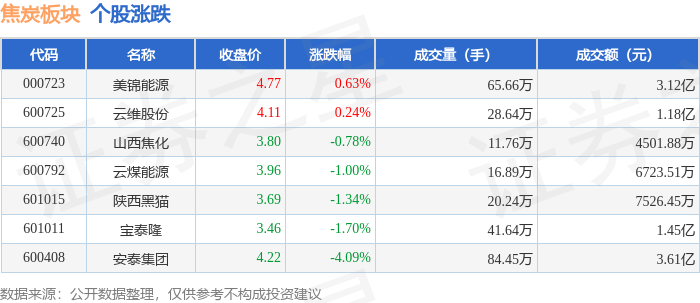
焦炭板块12月29日跌0.64%,安泰集团领跌,主力资金净流出3539.15万元
Zheng Xing Xing Ye Ri Bao· 2025-12-29 09:02
Group 1 - The coke sector experienced a decline of 0.64% on December 29, with Antai Group leading the drop [1] - The Shanghai Composite Index closed at 3965.28, up 0.04%, while the Shenzhen Component Index closed at 13537.1, down 0.49% [1] - Major stocks in the coke sector showed mixed performance, with Meijin Energy rising by 0.63% and Antai Group falling by 4.09% [1] Group 2 - The net outflow of main funds in the coke sector was 35.39 million yuan, while retail investors saw a net inflow of 55.77 million yuan [1] - Detailed fund flow data indicates that Meijin Energy had a net inflow of 24.14 million yuan from main funds, while Antai Group faced a significant outflow of 44.09 million yuan [2] - Retail investors contributed positively to Antai Group with a net inflow of 55.65 million yuan, despite the overall negative trend in main and speculative funds [2]


广发期货日报-20251229
Guang Fa Qi Huo· 2025-12-29 05:08
Report Industry Investment Ratings No relevant information provided. Core Views Steel - Steel prices are expected to remain volatile. The upward elasticity of steel prices is constrained by weak demand, but the price is supported by steel mills' production cuts and inventory reduction. The reference range for rebar is 3000 - 3200, and for hot-rolled coils is 3150 - 3350. The rebar 1 - 5 positive spread can be gradually exited, and attention can be paid to the strategy of going long on the May rebar - iron ore ratio [1]. Iron Ore - Iron ore prices are expected to fluctuate. The supply is still at a high level, demand is weak, and inventory is accumulating. The short - term supply - demand contradiction is difficult to form a trend - like decline. The price is suppressed by high inventory above and supported by the replenishment expectation of steel mills with low inventory below. It is recommended to mainly conduct short - term range operations on the 05 contract, with the reference range of 760 - 810 [4]. Coke - Coke futures have fallen in advance. After the third round of spot price cuts, the basis has weakened, and the rebound driven by expectations is difficult to sustain. It is recommended to take profit on long positions in the coke 2605 contract and switch to shorting on rallies. Arbitrage suggests going long on coking coal and shorting on coke [7]. Coking Coal - The rebound expectation of coking coal has been overdrawn in advance. It is recommended to take profit on long positions and switch to shorting on rallies. Arbitrage suggests going long on coking coal and shorting on coke [7]. Ferrosilicon - The supply - demand contradiction of ferrosilicon still needs to be alleviated, but the production cut expectation has been priced in. The improvement expectation on the demand side is insufficient, and the price rebound lacks sustainability. It is expected that the price will fluctuate in the range of 5500 - 5700 in the short term [9]. Ferromanganese - The supply of ferromanganese has increased slightly, and the supply - demand contradiction still exists. The price is expected to continue to operate weakly. It is recommended to short when the price rebounds above the spot cost in Ningxia, with short - term operations as the main strategy [9]. Summary by Directory Steel Price and Spread - Rebar and hot - rolled coil spot prices mostly declined, and futures prices showed mixed trends. For example, the spot price of rebar in East China decreased from 3310 to 3290 yuan/ton, and the 05 contract price of hot - rolled coils increased from 3280 to 3283 yuan/ton [1]. Cost and Profit - Steel billet prices decreased by 10 yuan/ton, and the cost of some steel products decreased slightly. The profit of hot - rolled coils in North China decreased from - 99 to - 105 yuan/ton [1]. Supply - The daily average pig iron output decreased slightly, and the output of five major steel products decreased by 1.1 tons. However, rebar and hot - rolled coil production increased, with rebar production increasing by 2.7 tons (1.5%) and hot - rolled coil production increasing by 1.6 tons (0.6%) [1]. Inventory - The inventory of five major steel products decreased by 36.8 tons (- 2.8%), the rebar inventory decreased by 18.3 tons (- 4.0%), and the hot - rolled coil inventory decreased by 13.5 tons (- 3.5%) [1]. Transaction and Demand - The building materials transaction volume increased by 1.6 (19.1%), the apparent demand for five major steel products decreased by 1.7 tons (- 0.2%), the apparent demand for rebar decreased by 6.0 tons (- 2.9%), and the apparent demand for hot - rolled coils increased by 8.8 tons (2.9%) [1]. Iron Ore Price and Spread - The cost of iron ore warehouse receipts and spot prices mostly increased slightly, and the 5 - 9 spread increased by 0.5 (2.3%), while the 1 - 5 spread decreased by 1.0 (- 5.1%) [4]. Supply - The global iron ore shipment volume decreased by 128.0 tons (- 3.6%), and the 45 - port arrival volume decreased by 76.7 tons (- 2.8%) [4]. Demand - The daily average pig iron output of 247 steel mills remained unchanged, the 45 - port daily average ore handling volume increased by 1.6 tons (0.5%), and the national monthly pig iron and crude steel output decreased [4]. Inventory - The 45 - port inventory increased by 176.2 tons (1.1%), the imported ore inventory of 247 steel mills increased by 136.2 tons (1.6%), and the inventory available days of 64 steel mills decreased by 2.0 days (- 9.5%) [4]. Coke and Coking Coal Price and Spread - Coke and coking coal futures prices mostly declined. For example, the 01 contract price of coke decreased by 19 yuan/ton (- 1.1%), and the 01 contract price of coking coal decreased by 18 yuan/ton (- 1.8%) [7]. Supply - Coke production decreased slightly, and coking coal production decreased slightly. The daily average output of all - sample coking plants decreased from 63.0 to 62.7 tons (- 0.5%), and the raw coal output decreased from 856.1 to 853.4 tons (- 0.3%) [7]. Demand - The pig iron output of 247 steel mills remained unchanged, and the demand for coke decreased [7]. Inventory - Coke and coking coal inventories in ports, steel mills, and coking plants all increased. The total coke inventory increased from 900.5 to 912.6 tons (1.4%), and the coking coal inventory in all - sample coking plants increased from 1036.3 to 1039.7 tons (0.3%) [7]. Ferrosilicon and Ferromanganese Price and Spread - The ferrosilicon主力合约 price decreased by 20.0 yuan/ton (- 0.4%), and the ferromanganese主力合约 price decreased by 6.0 yuan/ton (- 0.1%) [9]. Cost and Profit - The production cost of ferrosilicon in some regions decreased, and the production profit increased. The production cost of ferromanganese in Inner Mongolia decreased by 6.7 yuan/ton (- 0.1%) [9]. Supply - Ferrosilicon production decreased slightly, and ferromanganese production increased slightly. Ferrosilicon production decreased by 0.1 tons (- 1.34%), and ferromanganese weekly production increased by 0.4 tons (2.34%) [9]. Demand - The demand for ferrosilicon and ferromanganese in steelmaking remained stable, and the steel mills' price - pressing sentiment in steel tenders was strong [9]. Inventory - The inventory of ferrosilicon and ferromanganese in some sample enterprises changed slightly. The inventory of 60 sample ferrosilicon enterprises decreased by 0.2 tons (- 2.4%), and the inventory of 63 sample ferromanganese enterprises increased by 0.1 tons (0.4%) [9].
煤焦:基本面表现仍弱,盘面震荡运行
Hua Bao Qi Huo· 2025-12-29 03:17
Group 1: Investment Rating - No investment rating information is provided in the report. Group 2: Core Viewpoint - The recent market sentiment has slightly improved, and prices have seen a phased rebound. However, the fundamentals are still weak, lacking support for price rebounds, and are expected to remain volatile before the holiday [3]. Group 3: Summary by Relevant Content Market Performance - Last week, the coking coal and coke futures prices fluctuated widely and closed slightly higher on a weekly basis. Spot prices of coking coal in various regions showed weak stability. Steel mills completed the third round of price cuts for coke. After the price drop, downstream may replenish raw materials, but there is still an expectation of further price cuts in the market [3]. Fundamental Analysis - **Supply**: Last week, coal mines reduced production at the end of the year. Coking enterprises started to replenish inventory moderately, but overall market transactions remained weak, and mine - end inventories continued to accumulate. The raw coal output of coking coal mines decreased by 5.4 tons week - on - week, and the daily output of clean coal decreased by 1.8 tons week - on - week. Raw coal and clean coal inventories increased by 4.2 tons and 10.1 tons respectively. The average daily customs clearance volume at Ganqimaodu Port last week was 19.44 tons, a decrease of 1.26 tons from the previous week and an increase of 13.78 tons year - on - year. The customs clearance volume declined significantly in the second half of the week. The current inventory in the port supervision area is at a relatively high level. According to the bilateral agreement between China and Mongolia, the three major ports will be closed on December 29 for the Mongolian National Liberation and Independence Day and resume on December 30; they will be closed again on January 1 for New Year's Day and resume on January 2 [3]. - **Demand**: Demand remained stable. The average daily hot metal output of steel mill blast furnaces stopped falling at 226.58 tons, a slight increase of 0.03 tons week - on - week and a decrease of 1.29 tons year - on - year, and is expected to remain at this level in the short term [3].