有色金属

Search documents
收评:沪指低开高走涨0.39%,有色、稀土板块集体走强
Feng Huang Wang Cai Jing· 2026-02-27 07:17
Market Overview - The market experienced fluctuations with mixed performance across the three major indices, resulting in the Shanghai Composite Index rising by 0.39% while the Shenzhen Component and ChiNext fell by 0.06% and 1.04% respectively [2] - Approximately 3,164 stocks rose, with 91 hitting the daily limit up, while 1,884 stocks declined, indicating a predominance of gainers in the market [2] Sector Performance - The metals and rare earth sectors showed strong performance, with companies like Zhangyuan Tungsten and Xianglu Tungsten hitting the daily limit up, and Zhong Rare Earth Materials also reaching the limit up [1][2] - The chemical and non-ferrous metal sectors were notably active, driven by price increases, with stocks like Cihua Co. rising over 32% and Jin Zheng achieving a rise of over 58% [2] - The glass fiber sector faced declines, with International Composites dropping nearly 10% [1] Trading Activity - The trading volume remained high, with daily transactions exceeding 2 trillion yuan for four consecutive trading days, indicating sustained market activity post the Spring Festival [2] - The Shanghai Composite Index recorded a cumulative increase of 1.09% for the month, reflecting a "narrow fluctuation after a surge" trend, while the Shenzhen Component and ChiNext showed cumulative increases of 2.04% and a decrease of 1.08% respectively [2] Notable Stocks - The stock of YN Holdings surged by 115%, marking the highest increase for the month, driven by interest in both computing power and electricity concepts [2] - The tungsten concept stocks continued to rise, with Zhangyuan Tungsten experiencing a significant increase of 78% this month [2] - The rare earth sector remained active, with Shenghe Resources reaching a historical high [2]

商务预报:2月16日至22日食用农产品价格略有上涨 生产资料价格略有下降
Shang Wu Bu Wang Zhan· 2026-02-27 07:15
Group 1: Agricultural Products Market - The national edible agricultural product market price increased by 0.5% from the previous week [1] - The average wholesale price of 30 types of vegetables is 5.60 yuan per kilogram, up by 1.3%, with celery, lettuce, and cabbage rising by 5.7%, 5.0%, and 4.1% respectively [1] - The average wholesale price of 6 types of fruits saw a slight increase, with citrus, pears, and grapes rising by 1.0%, 1.0%, and 0.7% respectively [1] - Wholesale prices of aquatic products slightly increased, with large hairtail, silver carp, and carp rising by 1.2%, 0.7%, and 0.3% respectively [1] - The wholesale price of pork is 18.98 yuan per kilogram, up by 0.5%, while lamb and beef increased by 0.3% and 0.1% respectively [1] - Grain and oil wholesale prices remained stable, with soybean oil and rapeseed oil rising by 0.1%, while peanut oil and rice remained unchanged, and flour decreased by 0.2% [1] - Poultry product wholesale prices showed a slight decline, with white strip chicken remaining stable and eggs decreasing by 0.6% [1] Group 2: Production Materials Market - Prices of non-ferrous metals continued to decline, with copper, aluminum, and zinc decreasing by 1.1%, 0.3%, and 0.1% respectively [2] - Rubber prices slightly decreased, with synthetic rubber and natural rubber falling by 0.3% and 0.2% respectively [2] - Steel prices remained stable with slight declines, where ordinary medium plates and welded steel pipes were priced at 3620 yuan and 3708 yuan per ton, respectively, while hot-rolled strip steel and rebar decreased by 0.1% [2] - Coal prices remained stable, with thermal coal and coking coal priced at 777 yuan and 1043 yuan per ton, respectively, while anthracite coal decreased by 0.1% [2] - Prices of basic chemical raw materials remained stable, with sulfuric acid, soda ash, and polypropylene unchanged, while methanol decreased by 0.2% [2] - Wholesale prices of finished oil showed slight increases, with 95 gasoline and 0 diesel remaining stable, while 92 gasoline increased by 0.2% [2] - Fertilizer prices saw a slight increase, with urea rising by 0.3%, while compound fertilizers remained unchanged [2]

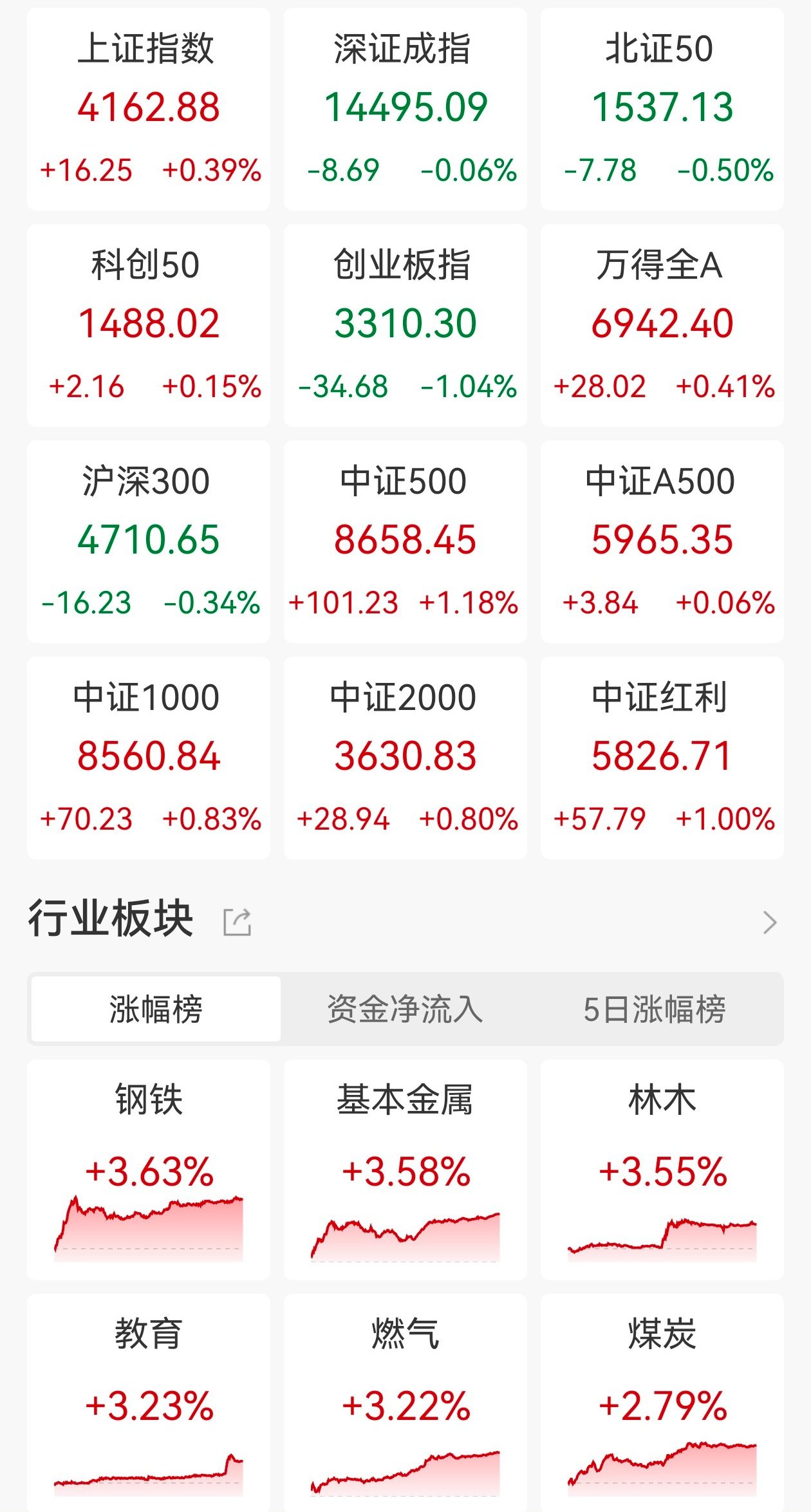
A股收评:三大指数涨跌不一,创业板指跌逾1%,小金属、稀土、有色金属集体爆发
Ge Long Hui· 2026-02-27 07:07
Market Overview - The A-share market showed mixed performance today, with the Shanghai Composite Index rising by 0.39% to close at 4162 points, while the Shenzhen Component Index fell by 0.06% and the ChiNext Index dropped by 1.04% [1] - The total market turnover was 2.51 trillion yuan, a decrease of 51.2 billion yuan compared to the previous trading day, with over 3200 stocks experiencing gains [1] Sector Performance - The small metals, rare earth, and non-ferrous metals sectors surged due to price increases, with companies like Xiamen Tungsten and Zhongtung High-tech hitting the daily limit [1] - The precious metals sector strengthened as spot gold reached 5200 USD, leading to a limit-up for Hunan Gold [1] - Power stocks rallied, with multiple stocks like Yunnan Energy hitting the daily limit [1] - The coal sector also performed well, with Yongtai Energy leading the gains [1] - Other sectors with notable increases included lithium mining, public utilities, and cultivated diamonds [1] Declining Sectors - The glass and fiberglass sector saw a decline, with International Composite Materials dropping nearly 10% [1] - The semiconductor equipment sector weakened, with Shengmei Shanghai leading the losses [1] - The PCB and components sectors also faced declines, with Mingyang Circuit falling over 8% [1] - Other sectors with significant drops included composite collectors, soft drinks, and paper [1] Top Gainers - The top gainers over the past five days included sectors such as forestry, steel, and basic metals, with respective increases of 3.58%, 3.63%, and 3.55% [2] - Other notable gainers included education, coal, and gas sectors, with increases of 3.23%, 3.22%, and 2.79% respectively [2]


各国持续制定战略小金属政策,工业有色ETF鹏华(159162)涨超3.8%
Xin Lang Cai Jing· 2026-02-27 06:59
Group 1 - The U.S. plans to utilize an AI model developed by the Department of Defense to establish reference prices for critical mineral trades globally, starting with germanium, gallium, antimony, and tungsten [1] - Industrial metals are experiencing a rise due to strong demand signals, with the U.S. January SIM manufacturing PMI significantly rebounding to 52.6, well above the expected 48.5 [1] - Domestic inventory accumulation of copper and aluminum has slowed down ahead of the Spring Festival, with processing enterprises showing decent operating rates and strong downstream purchasing activity following price declines [1] Group 2 - The Zhongzheng Industrial Nonferrous Metals Theme Index (H11059) has surged by 3.78%, with component stocks such as Xiamen Tungsten rising by 10.00% [1] - The Zhongzheng Industrial Nonferrous Metals Theme Index tracks 30 large-cap listed companies involved in copper, aluminum, lead-zinc, and rare earth metals, reflecting the overall performance of the industrial nonferrous metals sector [2] - The top ten weighted stocks in the Zhongzheng Industrial Nonferrous Metals Theme Index account for 55.71% of the index, including companies like Luoyang Molybdenum and Northern Rare Earth [2]





供需错配支撑铜价持续上行 对产业链上下游影响几何?
Zheng Quan Ri Bao Zhi Sheng· 2026-02-27 06:36
产业上下游影响分化 本报记者 冯雨瑶 2026年开年以来,铜价持续高位运行。生意社数据显示,截至2月26日,现货铜价最新为10.20万元/ 吨,同比增长32.51%。 供需错配支撑铜价上行 对于驱动铜价上涨的因素,上海钢联铜事业部分析师曾健辉告诉记者:"其一是供应的扰动为铜价提供 了上涨的逻辑支撑,铜精矿供应偏紧;其二是需求导向,传统领域需求不减,另外新能源、AI智能电 气化等对于铜消费又存在强预期;其三地缘政治冲突使得市场避险情绪升温,贵金属大幅上涨,带动铜 的避险属性。" 摩根大通最新预测,2026年全球铜市场将出现13万吨供应缺口,工业金属供需格局迎来关键转向。作为 新能源、电网、AI算力与高端制造的核心原材料,铜的短缺将直接抬升价格中枢,重塑产业链利润分 配,国内具备资源与产能优势的铜业龙头将显著受益。 供给端刚性约束是缺口形成的核心原因。据了解,全球铜矿勘探开发周期长达5年至8年,过去十年矿企 资本开支偏低,新增产能释放缓慢;主力矿山品位持续下滑、产区地缘扰动频发,进一步压制供给弹 性。国金证券报告指出,2025年铜矿产量指引多次下调,2026年预计增量有限。 而反观需求端,AI数据中心等正成为拉动 ...

工业、基础材料:津巴布韦锂矿出口禁令扰动影响可控
HTSC· 2026-02-27 05:47
Investment Rating - The industry investment rating is "Overweight" for both Electric Equipment & New Energy and Nonferrous Metals [6]. Core Views - The export ban on lithium ore and lithium concentrate from Zimbabwe is expected to have limited medium to long-term supply-side disruptions, as the ban primarily targets lithium concentrate and companies with local lithium sulfate processing capabilities will be less affected [1][3]. - The Zimbabwean government aims to promote local lithium salt plant construction, and several Chinese mining companies are already in the process of building or planning lithium salt plants, which should mitigate long-term supply issues [1][3]. - The short-term tightening of lithium supply may lead to price increases for upstream raw materials, but the overall impact on the lithium battery supply chain is manageable [1][4]. Summary by Sections Section 1: Zimbabwe's Lithium Supply - Zimbabwe is the world's second-largest hard rock lithium supplier, with an estimated shipment of about 140,000 tons of LCE in 2025, accounting for 8.5% of global supply [2]. - In 2025, China is expected to import 1,204,000 tons of spodumene, with Zimbabwe being the second-largest source, contributing 15.5% of imports [2]. Section 2: Lithium Processing Capacity - Currently, Zimbabwe has only one lithium sulfate plant in operation, with an annual capacity of 50,000 tons, while another project is expected to start production in 2027 [2]. Section 3: Export Recovery and Supply-Side Repair - The resumption of exports will depend on two conditions: companies must hold valid mining rights and approved processing plans, and downstream processing capacity must be established [3]. - Chinese companies are expected to restore export volumes, with the government providing a timeline for the resumption of exports after local processing capacity is developed [3]. Section 4: Price Transmission and Company Recommendations - The demand for lithium is expected to remain strong, with significant procurement activities from state-owned enterprises leading to increased prices and project cash flow improvements [4]. - Recommended companies include: - Hunan Yunneng (301358 CH) with a target price of 112.98 and a "Buy" rating [8]. - Fulmin Precision (300432 CH) with a target price of 29.38 and a "Buy" rating [8]. - CATL (300750 CH) with a target price of 566.18 and a "Buy" rating [8]. - EVE Energy (300014 CH) with a target price of 96.96 and a "Buy" rating [8].

资金行为研究双周报:担保比例提至高位,资金调仓节奏加快
ZHONGTAI SECURITIES· 2026-02-27 04:20
Market Overview - Institutional funds are experiencing a turbulent outflow from the ChiNext Index and the Wind All A Index, while retail funds are steadily net inflowing into both indices[5] - After February 9, the outflow momentum of institutional funds from the ChiNext Index and Wind All A Index has intensified, showing a fluctuating outflow trend[5] Market Capitalization and Valuation Style - Small-cap indices are seeing synchronized accumulation of funds from both institutions and retail investors, while the outflow of institutional funds from high-valuation indices has slowed down[11] - As of February 11, institutional funds have shown a marginal narrowing in outflow from high-valuation indices, while retail funds have significantly net inflowed into these indices[11] Industry Style - Institutional behavior shows significant differentiation, with increased attention on cyclical manufacturing; net inflow into this sector turned positive after February 24[19] - Institutional funds have shown a fluctuating outflow from the technology sector, with a notable shift from net inflow to outflow after February 11[19] Sector Analysis - In the upstream resources sector, institutional funds are seeing reduced outflow momentum in non-ferrous metals, while basic chemicals are experiencing net inflows from both institutions and retail investors[24] - The downstream consumer staples sector shows no significant inflow momentum from institutional funds, while the discretionary consumer sector is experiencing notable outflows, particularly in light industry manufacturing and home appliances[44] Leverage Fund Situation - As of February 25, the total margin financing and securities lending balance is approximately 2.65 trillion yuan, reflecting a slight decrease from the previous period[73] - The average guarantee ratio in the market has risen to 295.71%, positioning it at the 99.3 percentile over the past decade, indicating a historically high level[73]
A股午评:创业板指跌超1% 算力租赁概念逆势爆发
2 1 Shi Ji Jing Ji Bao Dao· 2026-02-27 04:05
Market Overview - The market experienced fluctuations in early trading, with the Shanghai Composite Index turning negative again and the ChiNext Index dropping over 1% [1] - By the end of the trading session, the Shanghai Composite Index fell by 0.17%, the Shenzhen Component Index decreased by 0.68%, and the ChiNext Index declined by 1.46% [1] - The total trading volume in the Shanghai and Shenzhen markets was 1.59 trillion yuan, a decrease of 53 billion yuan compared to the previous trading day [1] Sector Performance - The computing power leasing concept saw a collective surge, with stocks like Huasheng Tiancheng achieving three consecutive daily limits in five days, and stocks such as Tuo Wei Information, Litong Electronics, and Chengdi Xiangjiang hitting daily limits [1] - The non-ferrous metals sector was notably active, with Zhangyuan Tungsten achieving five daily limits in seven days, and stocks like Xianglu Tungsten and Zhong Rare Metals also hitting daily limits [1] - The AI programming concept strengthened, with Jin Modern and Puyuan Information both reaching the 20% daily limit [1] - The space photovoltaic concept rebounded, with Jun Da Co., Ltd. hitting the daily limit [1] - Conversely, the electronic cloth concept continued to adjust, with Honghe Technology hitting the daily limit down [1]




长江有色:宏观施压与资金离场抛压快速释放 27日镍价或下跌
Xin Lang Cai Jing· 2026-02-27 03:58
春节后镍供需:供应宽松,需求偏弱 春节后镍市整体呈现供应宽松、需求偏弱的格局。供应端,海外镍原料供应预期稳定,前期政策扰动逐 步降温,国内炼厂陆续复产,整体供给充裕,暂无实质性短缺对价格形成支撑。需求端,传统不锈钢领 域复苏节奏偏慢,钢厂多以刚需采购为主,备货意愿不强;新能源电池端则处于季节性走弱阶段,高镍 需求尚未进入旺季水平,整体需求对镍价拉动不足。 库存与成交 当前市场镍库存维持高位,现货交投氛围清淡,贸易商观望情绪浓厚,下游拿货积极性不高,价格缺乏 有效买盘托底,整体成交表现偏弱。 镍期货市场:宏观施压与资金离场抛压快速释放 ,隔夜伦镍收跌1.75%;伦镍最新收盘报17730,比前 一交易日下跌315美元/吨,跌幅为1.75%,成交量为7859手,国内市场,沪镍主力合约最新收报139100 元/吨,跌幅为1.25%。 伦敦金属交易所(LME)2月26日伦镍库存报289506吨,较前一交易日库存量增加1698吨。 长江镍业网讯:今日沪镍期货全线低开为主;主力月2605合约开盘报140280跌580元/吨,9:20分沪镍 主力2605合约报138570跌2290元/吨;沪期镍开盘低开低走,盘面维持弱势震荡 ...

A股午评:创业板指半日跌1.46%再失3300点,算力租赁及AI编程概念股走高,有色金属板块活跃
Jin Rong Jie· 2026-02-27 03:43
Core Viewpoint - The A-share market is experiencing a volatile and differentiated trend, with significant movements in various sectors, particularly in rare metals and space photovoltaic concepts, while some hardware stocks related to computing power are facing declines [1][2][6]. Market Dynamics - Rare metal stocks have become the market's focal point, with companies like Xiamen Tungsten, Zhongtung High-tech, and Jiangxi Tungsten Equipment reaching historical highs. The small metal sector index has risen over 40% this year, driven by supply-demand tensions and strategic pricing restructuring [2]. - The space photovoltaic concept remains strong, with stocks like Jun Da and Double Good Energy hitting their limits, supported by the dual catalysts of Elon Musk's strategy and accelerated domestic satellite internet construction [3]. - The electric power and grid equipment sector is active, with companies like Gan Energy and Huayin Power achieving consecutive gains, bolstered by the National Energy Administration's new power system construction pilot list [4]. - The gas turbine and quantum technology concepts are also on the rise, with stocks like Feiwo Technology and Geer Software showing significant gains [5]. Hardware Sector Performance - In contrast, computing power hardware stocks, including CPO and optical fiber, are mostly experiencing declines, influenced by the overnight drop in Nvidia and concerns over the sustainability of the AI bubble [6]. Institutional Insights - Orient Securities notes that the market is experiencing accelerated rotation among sectors, indicating a potential decrease in risk appetite. However, there is still potential for index growth, suggesting a focus on mid-term industry trends and cyclical price increases [7]. - Qianhai Open Source Fund's chief economist highlights technology and resources as key investment themes, emphasizing the need for in-depth exploration of sectors with rising prosperity or technological breakthroughs [8]. - CITIC Construction emphasizes the opportunity for heavy asset industries to reverse their challenges, driven by rising inflation expectations and improved profitability in sectors like chemicals and construction materials [8]. - Everbright Securities points out that assets with low or negative carbon attributes will gain green premiums as the domestic assessment mechanism shifts towards carbon emission controls [8].