非银金融

Search documents
融资资金继续买入中际旭创29亿元丨资金流向日报
2 1 Shi Ji Jing Ji Bao Dao· 2025-12-02 02:49
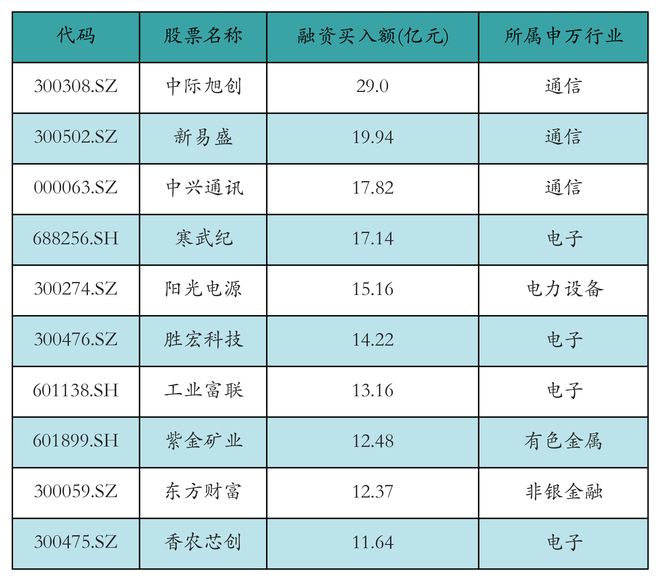
Market Overview - The Shanghai Composite Index rose by 0.65% to close at 3914.01 points, with a daily high of 3914.46 points [1] - The Shenzhen Component Index increased by 1.25% to close at 13146.72 points, reaching a high of 13149.4 points [1] - The ChiNext Index saw a rise of 1.31%, closing at 3092.5 points, with a peak of 3093.96 points [1] Margin Trading and Securities Lending - The total margin trading and securities lending balance in the Shanghai and Shenzhen markets reached 24,767.41 billion yuan, with a financing balance of 24,591.4 billion yuan and a securities lending balance of 176.02 billion yuan, marking an increase of 106.91 billion yuan from the previous trading day [2] - The Shanghai market's margin trading balance was 12,605.47 billion yuan, up by 57.11 billion yuan, while the Shenzhen market's balance was 12,161.94 billion yuan, increasing by 49.8 billion yuan [2] - A total of 3,454 stocks had margin buying, with the top three being Zhongji Xuchuang (29.0 billion yuan), Xinyi Sheng (19.94 billion yuan), and Zhongxing Communications (17.82 billion yuan) [2] Fund Issuance - A total of 52 new funds were issued, including various bond and equity funds such as Su Xin Su Jiang Bond A, Huaxia Zhuo An Bond C, and Jin Ying Zhong Zheng Hong Kong Stock Connect High Dividend Investment Index C [3][4][5] - The funds cover a range of investment types, including bond funds, mixed funds, and equity funds, with notable issuers like Huaxia Fund Management and Ping An Fund Management [3][4][5] Top Net Purchases on the Dragon and Tiger List - The top net purchases on the Dragon and Tiger list included Zhongxing Communications with a net buy of 153.72 million yuan, followed by Guangqi Technology (73.97 million yuan) and Beijing Junzheng (44.10 million yuan) [6][7] - Other notable stocks included Shida Group, Aerospace Development, and Pengding Holdings, with significant net purchases and price increases [7]




A股市场大势研判:A股全天震荡拉升,沪指重返3900点
Dongguan Securities· 2025-12-02 02:36
Market Overview - The A-share market experienced a rally, with the Shanghai Composite Index returning above 3900 points, closing at 3914.01, up 0.65% [1] - The Shenzhen Component Index and the ChiNext Index also saw significant gains, closing at 13146.72 (up 1.25%) and 3092.50 (up 1.31%) respectively [1] Sector Performance - The top-performing sectors included non-ferrous metals (up 2.85%), communication (up 2.81%), and electronics (up 1.58%) [2] - Conversely, the weakest sectors were agriculture, forestry, animal husbandry, and fishery (down 0.43%) and environmental protection (down 0.23%) [2] Concept Indexes - Notable concept indexes that performed well included smart speakers (up 3.71%) and AI mobile phones (up 3.39%) [2] - Underperforming concepts included horse racing (down 0.92%) and digital watermarking (down 0.75%) [2] Economic Indicators - The manufacturing PMI for November was reported at 49.2%, a slight increase of 0.2 percentage points from the previous month, indicating a modest improvement but still below the expansion threshold [4] - The non-manufacturing business activity index fell to 49.5%, marking the first contraction in three years, primarily due to seasonal effects and diminishing impacts from policy measures [4] Market Outlook - The report suggests that the domestic economic fundamentals are expected to gradually improve under a backdrop of policy support, aiming for a growth target of around 5% for the year [5] - Key upcoming events include the political bureau meeting and the central economic work conference in December, which will set the policy direction for 2026 [5] - A balanced allocation strategy is recommended, focusing on sectors such as non-ferrous metals, new energy, technology growth, and dividend stocks [5]
43股获杠杆资金净买入超亿元
Zheng Quan Shi Bao Wang· 2025-12-02 02:15
Group 1 - As of December 1, the total market financing balance reached 2.47 trillion yuan, an increase of 10.21 billion yuan from the previous trading day, marking five consecutive days of increases [1] - The financing balance for the Shanghai Stock Exchange was 1.25 trillion yuan, up by 5.28 billion yuan, while the Shenzhen Stock Exchange's balance was 1.21 trillion yuan, increasing by 4.88 billion yuan [1] - A total of 1,937 stocks received net financing purchases on December 1, with 520 stocks having net purchases exceeding 10 million yuan, and 43 stocks exceeding 100 million yuan [1] Group 2 - The top net financing purchase on December 1 was for Huadian Co., with a net purchase of 573 million yuan, followed by Xiangshan Chip and Zijin Mining with net purchases of 560 million yuan and 462 million yuan, respectively [2] - In terms of industry, the electronics, non-ferrous metals, and non-bank financial sectors had the highest concentration of stocks with net purchases exceeding 100 million yuan, with 16, 8, and 4 stocks respectively [1][2] - The main board had 28 stocks with significant net purchases, while the ChiNext board had 9 and the Sci-Tech Innovation board had 6 [1] Group 3 - The average ratio of financing balance to circulating market value for stocks with significant net purchases was 4.35%, with Dongfang Caifu having the highest ratio at 8.84% [2] - Other stocks with high financing balance ratios included Dongfang Jinggong at 8.60%, Xiangshan Chip at 8.37%, and Huagong Technology at 7.96% [2] - The financing net purchase rankings for December 1 included stocks from various sectors, with notable performances from electronic and machinery equipment industries [2][3]



中银晨会聚焦-20251202
Bank of China Securities· 2025-12-02 01:27
Core Insights - The manufacturing PMI index for November is at 49.2%, showing a slight month-on-month increase of 0.2 percentage points, indicating a minor recovery within the contraction zone [6][7] - The new orders index for November is also at 49.2%, with a month-on-month increase of 0.4 percentage points, while the new export orders index rose by 1.7 percentage points to 47.6%, likely driven by the upcoming holiday shopping season [6][7] - The production index stands at 50.0%, reflecting a month-on-month increase of 0.3 percentage points, indicating stability at the threshold level [6][7] Macroeconomic Overview - Manufacturing purchasing and inventory intentions are still in the contraction zone, suggesting a need for further improvement in procurement sentiment [6][7] - Fixed asset investment projects, particularly in infrastructure and affordable housing, are expected to gain momentum towards the end of the year and the beginning of the next [6][7] Market Performance - The Shanghai Composite Index closed at 3914.01, up by 0.65%, while the Shenzhen Component Index rose by 1.25% to 13146.72 [3] - The performance of various industry indices shows that non-ferrous metals and telecommunications sectors led with increases of 2.85% and 2.81%, respectively, while agriculture and forestry sectors saw declines [4] Sector Analysis - The manufacturing sector's price index showed a recovery in November, with the main raw material purchase price index rising by 1.1 percentage points to 53.6%, indicating a high level of activity [7] - The equipment manufacturing and raw materials industries are sensitive to downstream fixed asset investments, with some signs of demand recovery in November [8]




决胜A股12月:聚焦科技主线的回归
Sou Hu Cai Jing· 2025-12-02 00:44
Market Overview - In November, the A-share market exhibited a downward trend, contrasting with optimistic expectations at the beginning of the month [1] - Major indices, including the Shanghai Composite Index, fell by 1.67%, the CSI 300 by 2.46%, and the Wind All A Index by 2.22% [2] - The ChiNext Index dropped by 4.23%, and the Sci-Tech 50 fell by 6.24%, indicating a significant adjustment in growth-style sectors [2] Sector Performance - Defensive sectors such as comprehensive services, banking, textiles, petrochemicals, and light manufacturing showed relative stability, while sectors like computers, automobiles, electronics, and non-bank financials experienced substantial declines [2] - Over 60% of stocks recorded negative returns, highlighting a marked reduction in market profitability [2] Market Adjustment Reasons - The decline in the market is attributed to multiple factors, including a cooling global AI investment theme, which negatively impacted growth sectors [3] - Concerns over the domestic economic recovery were underscored by a manufacturing PMI drop to 49.0 in October and a 5.5% year-on-year decline in industrial profits [3] - An unexpected tightening of overseas liquidity, driven by strong U.S. employment data, has also contributed to market pressures [3] December Market Outlook - The A-share market is expected to maintain a volatile pattern in December, with a focus on economic fundamentals and liquidity events [4] - The upcoming Federal Reserve meeting in mid-December and the Central Economic Work Conference in China are critical for market direction [4] Investment Strategy Recommendations - A "defensive + growth" allocation strategy is recommended, focusing on high-dividend, low-valuation sectors such as banking and utilities for stability [5] - Growth sectors with reasonable valuations, including energy storage, military, AI computing, power grid equipment, and semiconductors, are identified as having mid-term investment value [5][6] Sector-Specific Insights - The energy storage sector is projected to grow over 40% due to increased demand and policy support [6] - The military sector benefits from the transition between the 14th and 15th Five-Year Plans, showing high earnings visibility [6] - The AI computing sector has seen a doubling in domestic server shipments year-on-year, driven by surging demand [6] - The power grid equipment sector is supported by accelerated construction and increased overseas exports [6] - The semiconductor sector is driven by demand from AI chips and automotive semiconductors, indicating strong earnings elasticity [6] Conclusion - The market will continue to navigate between "overseas liquidity pressures" and "domestic policy support capabilities" in December [7] - Investors are advised to monitor key domestic and international policy signals while maintaining a defensive position and gradually increasing allocations in high-growth areas [7]
2025信用月报之十一:信用利差低位还能持续多久-20251201
HUAXI Securities· 2025-12-01 15:01
1. Report's Industry Investment Rating - There is no mention of the industry investment rating in the report. 2. Core Viewpoints of the Report - Since mid - July 2025, credit spreads have been in a low - level oscillation pattern. The duration of the low - level credit spreads depends on interest rate trends and liquidity. The shift from low - level oscillation to widening is usually accompanied by rising interest rates and institutional behavior disturbances [15]. - During the low - level oscillation of credit spreads, different varieties perform differently. High - cost - effective varieties favored by institutions have larger compression amplitudes. The amplitude of credit spreads of each variety is not small, especially in longer periods, and the cost - effectiveness can be judged by the position of credit spreads in the oscillation range [23][24]. - In December, institutions still have the willingness to allocate assets in advance for the next year. If interest rates oscillate downward and the capital side is stable, it is conducive to maintaining the low - level oscillation of credit spreads, but the buying power of credit bonds usually weakens, which may restrict the market performance [27]. 3. Summary According to the Directory 3.1 Credit Spreads in the Low - Level Oscillation Period: How to Allocate 3.1.1 Credit Bonds: The Cost - Effectiveness of 3 - Year Varieties Increases - In November, interest rates were in a low - volatility oscillation and rose slightly. Credit bond yields generally increased, with high - rating varieties, 3 - year, and 10 - year bonds performing relatively weakly. Credit spreads showed a differentiated trend, with 1 - year spreads basically unchanged, 3 - year spreads widening by 3 - 6bp, and spreads of AA+ and below 5 - year bonds narrowing by 5 - 8bp [11]. - The buying power of credit bonds weakened from strong to weak in November, and the proportion of transactions within 1 year continued to increase. Funds still had a large net purchase of credit bonds, while the net purchase of credit bonds by wealth management products, other asset management products, and money market funds decreased year - on - year [11][12]. - Since mid - July 2025, credit spreads have shown a low - level oscillation pattern. By reviewing the three previous periods of low - level credit spread oscillation since 2021, three rules were summarized. The duration of low - level credit spreads depends on interest rate trends and liquidity; different varieties perform differently during the low - level oscillation; and the amplitude of credit spreads in the low - level oscillation period is not small, and cost - effective varieties can be judged by their positions [15][23][24]. - In December, institutions still have the willingness to allocate assets in advance, but the decline in interest rates driven by transactions may be less than in previous Decembers due to the new regulations on fund sales fees. If interest rates oscillate downward and the capital side is stable, it is conducive to maintaining the low - level oscillation of credit spreads, but the buying power usually weakens [27]. - Currently, the credit spreads of 3 - year and 10 - year varieties have relatively high cost - effectiveness. It is recommended to control the duration of credit bond allocation and seize structural opportunities. In December, the opening scale of amortizing bond funds is still large, which may boost the demand for 2 - 3 - year credit bonds. For accounts with stable liability ends, they can pre - layout medium - to high - grade 5 - year varieties [32][35]. 3.1.2 Bank Perpetual and Tier - 2 Bonds: Wait for the New Regulations on Fund Sales Fees to be Implemented - In November, the yields of bank perpetual and tier - 2 bonds generally increased, with large - scale banks performing weaker. The spreads of large - scale bank bonds mostly widened, while the spreads of 4 - 5 - year AA - perpetual bonds narrowed. Compared with medium - and short - term notes of the same term, large - scale bank bonds were generally oversold [39]. - Currently, bank perpetual and tier - 2 bonds are waiting for the official release of the new regulations on fund sales fees. The trading sentiment of trading accounts is cautious, but the demand of some allocation accounts has increased. In December, due to the weak buying power of credit bonds and potential valuation fluctuations, accounts with unstable liability ends are advised to participate cautiously, while some accounts with stable liability ends can consider allocating medium - to high - grade varieties [40][44]. 3.2 Urban Investment Bonds: Net Financing Declined Year - on - Year, and Ultra - Long - Term Bonds Performed Well - In November, the net financing of urban investment bonds was positive, but both year - on - year and month - on - month declined. The issuance of medium - and long - term bonds increased, and the weighted average issuance interest rate generally decreased [47]. - The net financing performance of each province was differentiated in November, with about one - third of the provinces having negative net financing. The yields of urban investment bonds showed a differentiated performance, with medium - to high - grade varieties generally increasing and low - grade long - term varieties slightly decreasing [48][50]. - From the perspective of broker transactions, the buying sentiment of urban investment bonds weakened in November, with the TKN ratio and low - valuation ratio both decreasing. The trading of medium - and long - term bonds was active in the first three weeks, and the trading proportion of AA(2) bonds increased slightly [57]. 3.3 Industrial Bonds: Supply Increased Significantly, and the Proportion of Medium - and Long - Term Issuance Rose - In November, the issuance and net financing of industrial bonds increased significantly year - on - year. The issuance of medium - and long - term bonds increased, and the issuance interest rate generally decreased, with a larger decline in the 3 - 5 - year term [60][61]. - The yields of industrial bonds showed a differentiated performance, with medium - to high - grade yields generally increasing and 3 - 5 - year low - grade yields declining against the trend. The spreads of 3 - 5 - year AAA, 3 - year AA+ and AA widened, while the spreads of other varieties mostly narrowed [64]. - The yields of public bonds in various industries generally increased slightly. High - grade medium - and long - term varieties performed weaker, while the 3 - 5 - year AA yields generally declined [67]. 3.4 Bank Perpetual and Tier - 2 Bonds: Supply Increased, and Trading Sentiment Weakened - In November, the supply of bank perpetual and tier - 2 bonds increased significantly, with both issuance and net financing increasing year - on - year. The yields of these bonds generally increased, with large - scale bank medium - and long - term varieties performing weaker. The spreads of large - scale bank bonds mostly widened, and compared with medium - and short - term notes, some varieties performed weakly [70][72]. - From the perspective of broker transactions, the number of transactions of bank perpetual and tier - 2 bonds increased significantly month - on - month, but the trading sentiment weakened. The TKN ratio and low - valuation ratio of secondary capital bonds and perpetual bonds decreased, and the trading of urban commercial bank capital bonds also showed a weakening sentiment, with the trading of urban commercial bank perpetual bonds extending the duration [77].
12月1日深港通非银(983053)指数跌0.35%,成份股海德股份(000567)领跌
Sou Hu Cai Jing· 2025-12-01 12:02
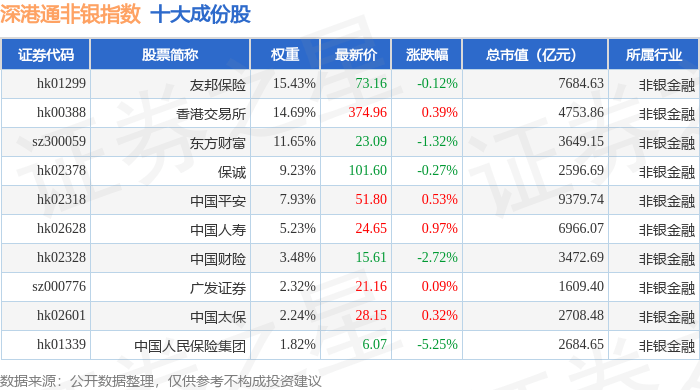
Core Viewpoint - The Shenzhen-Hong Kong Stock Connect Non-Bank Index (983053) closed at 7020.28 points on December 1, experiencing a decline of 0.35% with a trading volume of 20.159 billion yuan and a turnover rate of 0.54% [1] Group 1: Index Performance - On the same day, 34 constituent stocks rose, with Changjiang Securities leading with a 2.27% increase, while 20 stocks fell, with Haide Shares leading the decline at 9.97% [1] - The top ten constituent stocks of the Shenzhen-Hong Kong Stock Connect Non-Bank Index are detailed, with AIA Group holding the highest weight at 15.43% and a latest price of 73.16 yuan, despite a slight decrease of 0.12% [1] Group 2: Market Capitalization - The total market capitalization of the top ten stocks ranges from 1.609 billion yuan for Guangfa Securities to 7,684.63 billion yuan for AIA Group, indicating significant variations in company sizes within the index [1] Group 3: Capital Flow - The net outflow of main funds from the index's constituent stocks totaled 1.288 billion yuan, while retail investors saw a net inflow of 1.046 billion yuan, indicating differing investor behaviors [1] - Detailed capital flow data shows that Bohai Leasing had a net inflow of 36.79 million yuan from main funds, while Changjiang Securities experienced a net outflow of 13.50 million yuan [2]





12月1日深证国企ESGR(470055)指数涨0.83%,成份股冠捷科技(000727)领涨
Sou Hu Cai Jing· 2025-12-01 10:58
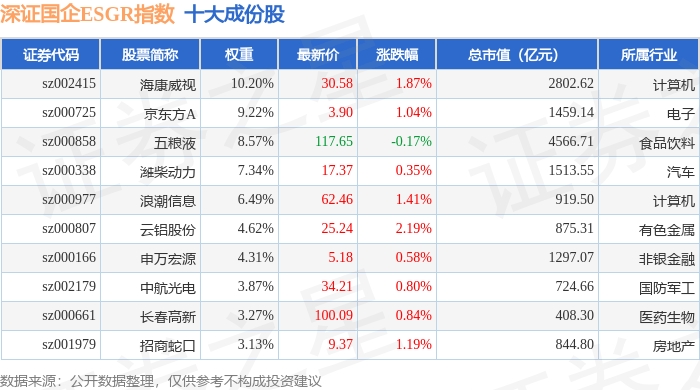
Core Viewpoint - The Shenzhen State-Owned Enterprises ESGR Index (470055) closed at 1569.4 points on December 1, with a gain of 0.83% and a trading volume of 25.363 billion yuan, indicating a positive market sentiment for state-owned enterprises [1] Group 1: Index Performance - The ESGR Index had 32 stocks rising and 16 stocks falling on the reporting day, with the top gainer being AOC Technology, which rose by 9.89%, while Digital Certification led the declines with a drop of 3.22% [1] - The index's turnover rate was 1.02%, reflecting moderate trading activity among investors [1] Group 2: Major Constituents - The top ten constituents of the ESGR Index include Hikvision (10.20% weight, market cap of 280.262 billion yuan), BOE Technology Group (9.22% weight, market cap of 145.914 billion yuan), and Wuliangye Yibin (8.57% weight, market cap of 456.671 billion yuan) [1] - Other notable constituents include Weichai Power (7.34% weight, market cap of 151.355 billion yuan) and Inspur Information (6.49% weight, market cap of 91.950 billion yuan) [1] Group 3: Capital Flow - On the reporting day, the net inflow of main funds into the ESGR Index constituents totaled 599 million yuan, while retail investors experienced a net outflow of 315 million yuan [1][2] - The main funds showed significant interest in AOC Technology with a net inflow of 410 million yuan, while retail investors had a notable outflow of 228 million yuan from the same stock [2] Group 4: Recent Adjustments - The ESGR Index underwent adjustments, adding 15 new stocks and removing 15 stocks, indicating a dynamic rebalancing of the index [3] - New additions include Yunda Co., Ltd. (market cap of 137.46 billion yuan) and Taisheng Wind Power (market cap of 73.76 billion yuan), while notable removals include Zhongke Sanhuan and BOE Technology Group [3]

枕戈待旦候东风
China Post Securities· 2025-12-01 10:45
Market Performance Review - In November, all major stock indices experienced declines, with the adjustment range expanding compared to the previous month. As of November 28, the Shanghai Composite Index fell by 1.67%, the Shenzhen Component Index by 2.95%, and the ChiNext Index by 4.23% [4][13] - The market faced external disturbances, leading to increased downward pressure, particularly after the Federal Reserve hinted at no interest rate cuts in December and concerns over valuation bubbles in the overseas AI industry [4][13] Future Outlook and Investment Views - The report suggests a cautious approach, waiting for triggers for a spring market rally. It notes that the current market phase is characterized by a lack of positive guidance, making it difficult for the market to transition smoothly from the first phase of the bull market to the second [5][31] - The report emphasizes the importance of policy direction in determining market style, recommending a focus on commercial aerospace and low-altitude economy sectors for December, given recent policy developments and upcoming rocket launches [6][32] Sector Performance - Defensive sectors showed resilience, with the top-performing industries in November being comprehensive (4.07%), banking (2.99%), and textile and apparel (2.95%). In contrast, technology and growth sectors like computers and automobiles faced significant declines [17][19] - The report highlights a shift towards defensive strategies, as previously strong sectors like technology continue to adjust while traditional defensive sectors outperform [17][19] High-Frequency Data Tracking - The report indicates a slight recovery in personal investor sentiment, with the sentiment index reaching 2.24% as of November 28, although overall sentiment declined throughout November [25][27] - Financing sentiment has also decreased, with net outflows observed in financing accounts, indicating a retreat of high-risk capital from the market [27][28]
20年数据透视,这些板块或成12月主线机遇
天天基金网· 2025-12-01 09:41
x 大大基金 链接您与财富 20年数据透视 这些板块或成12月主线机遇 复盘2005年至2024年12月份申万一级行业表现,从上涨概率来看,家 用电器、银行、食品饮料、社会服务、通信、石油石化、商贸零售7个 板块在12月实现上涨的概率均超过60%。从涨幅均值看,非银金融以 5.85%的平均涨幅居首,银行、食品饮料、家用电器等行业紧随其后。 | | 指数名称 | 涨幅均值 | 上涨概率 | | --- | --- | --- | --- | | | 家用电器 | 4.30% | 80% | | 2 | 銀行 | 5.08% | ୧5% | | 3 | 食品饮料 | 4.86% | ୧୧% | | 4 | 社会服务 | 4.27% | ୧୮% | | 5 | 道信 | 3.77% | ୧୮% | | 6 | 石油石化 | 2.56% | ୧୮% | | 7 | 商贸零售 | 2.26% | ୧୮% | | 8 | 美容护理 | 2.81% | 60% | | 9 | 农林牧渔 | 2.44% | 60% | | 10 | 煤炭 | 2.01% | 60% | | 11 | 有色金属 | 1.66% | 60% | ...