智能手机

Search documents
大行评级|高盛:小米持续推进高端化策略 予其“买入”评级及目标价53.5港元
Ge Long Hui· 2025-12-29 05:47
Core Viewpoint - Goldman Sachs reports that Xiaomi's latest release of the 17 Ultra smartphone series reflects its ongoing strategy to move upscale, with a focus on penetrating the market for products priced above 6000 yuan in China and accelerating the development of high-end products overseas [1] Group 1: Product Strategy - Xiaomi's product line has become richer with the introduction of the 17 Ultra smartphone series, indicating a commitment to high-end market penetration [1] - The company is expected to prioritize high-end product development as a key task entering next year [1] Group 2: AI Development - Xiaomi is accelerating its AI development this year, with plans to integrate self-developed chipsets, the Surge OS, and the MiMo large language model into a potential AI-native consumer terminal expected to launch in 2026 [1] Group 3: Competitive Positioning - The company is in the early stages of a multi-year ecological expansion under its human-vehicle-home ecosystem strategy, supported by a robust balance sheet and strong ecosystem integration capabilities [1] - Xiaomi's deep involvement in the supply chain provides it with cost advantages that are expected to enhance its competitiveness in the electric vehicle sector [1] Group 4: Investment Rating - Goldman Sachs has assigned a "Buy" rating to Xiaomi, with a target price of 53.5 Hong Kong dollars [1]

最高20亿美元,小米遭“二号人物”林斌大举套现
Huan Qiu Lao Hu Cai Jing· 2025-12-29 03:57
Group 1 - Xiaomi's co-founder and vice chairman, Lin Bin, plans to sell up to $5 billion of Class B shares annually starting December 2026, with a total cap of $20 billion [1] - The proceeds from Lin's share sales will primarily fund the establishment of an investment fund focusing on emerging technologies and sports [1] - Lin Bin has a history of share reductions, including a significant sale in 2020 that raised nearly 8 billion HKD, which previously caused a notable drop in Xiaomi's stock price [1] Group 2 - Xiaomi's stock price has recently experienced a downward trend, currently at 39.64 HKD per share, representing a market capitalization of approximately 1 trillion HKD, down over 30% from its peak in September [2] - Despite the recent decline, Xiaomi's stock has seen a year-to-date increase of nearly 15% due to strong performance earlier in the year [2] - For the first three quarters, Xiaomi reported a revenue of 340.37 billion CNY, a year-on-year increase of 32.5%, and an adjusted net profit of 32.82 billion CNY, up 73.5% [2] - In Q3 alone, Xiaomi achieved a revenue of 113.12 billion CNY, a 22.28% increase year-on-year, with an adjusted net profit reaching a record high of 11.31 billion CNY, up 80.92% [2] - The company's new business segments, including smart electric vehicles and AI, turned profitable in Q3, generating an operating income of 700 million CNY and revenue of 29 billion CNY, a growth of over 199% [2] - However, Xiaomi faces challenges, with Q3 global smartphone shipments at 43.3 million units, a slight increase of 0.5%, but revenue from this segment fell by 3.1% to 45.97 billion CNY [2] - The average selling price (ASP) of smartphones decreased from 1102.2 CNY to 1062.8 CNY year-on-year, impacting overall performance [2]
“二号人物”拟减持不超20亿美元股票 小米早盘一度跌超3%
Mei Ri Jing Ji Xin Wen· 2025-12-29 02:43
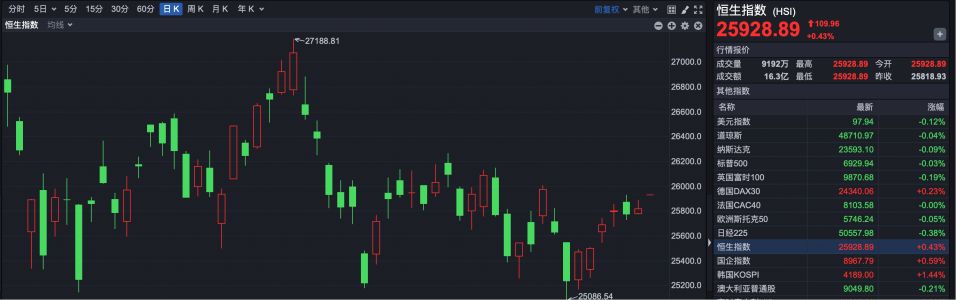
每经记者|曾子建 每经编辑|袁东 12月29日早盘,港股市场经过节假日休市之后继续小幅高开。 截至发稿,恒生指数报25928.89点,上涨109.96点,涨幅0.43%。 炒股就看金麒麟分析师研报,权威,专业,及时,全面,助您挖掘潜力主题机会! 港股速报 | "二号人物"拟减持不超20亿美元股票 小米早盘一度跌超3% 恒生科技指数报5547.79点,上涨48.49点,涨幅0.88%。 焦点公司方面,小米集团(HK01810)昨晚发布公告,公司联合创始人、执行董事、副董事长林斌计划自2026年12月开始,每12个月出售金额不超过5亿美 元的公司B类普通股,累计出售总金额不超过20亿美元。此外,林斌此次减持款项将用于成立投资基金。 公开资料显示,2010年,林斌与雷军共同创立小米,出任总裁至2019年,后担任副董事长。创业初期,林斌凭借自身人脉为小米招揽诸多关键人才,在供应 商战略合作、产品运作和销售等方面也发挥了关键作用,帮助小米在竞争激烈的智能手机市场崛起。 值得注意的是,此前林斌已多次减持小米集团股票。其中,2019年8月,林斌通过大宗交易套现3.7亿港元。时隔一年,2020年9月,林斌套现79.97亿港元 ...

大行评级|招银国际:预期明年苹果将迎来“创新大年”,偏好苹果供应链
Ge Long Hui· 2025-12-29 02:02
招银国际研究部副主管及科技行业分析师伍力恒表示,尽管受记忆体涨价及内地补贴红利退坡影响,明 年全球智能手机出货量预测按年下降5%,至11.8亿部,但苹果将迎来"创新大年",包括发布备受期待的 首部折叠屏手机,有助进一步巩固领先地位,故偏好苹果供应链。该行看好立讯精密、鸿腾精密、比亚 迪电子、舜宇光学、瑞声科技等供应商,料将受惠AI手机、AI眼镜及AI伺服器的加速渗透,当中立讯 精密、比亚迪电子来自苹果的收入占比均达到六成。 财经频道更多独家策划、专家专栏,免费查阅>> 责任编辑:栎树 ...

雷军增持林斌减持,小米的“兄弟同心”呢?
Xin Lang Cai Jing· 2025-12-29 01:20
Core Viewpoint - The capital operations of Xiaomi's founders, Lei Jun and Lin Bin, have diverged significantly, with Lei Jun recently increasing his stake by HKD 100 million to support the stock price, while Lin Bin announced a plan to sell off USD 2 billion worth of shares over four years, raising concerns about internal discord and future risks for the company [2][3][6]. Group 1: Capital Operations - Lei Jun's recent purchase of HKD 100 million in Xiaomi shares aimed to bolster the stock price amid a downturn [2][6]. - Lin Bin's plan involves selling up to USD 500 million annually for four years, totaling USD 2 billion (approximately RMB 14 billion), which is particularly striking given the timing [2][6][7]. - Lin Bin has a history of cashing out, having previously sold nearly HKD 4 billion in August 2019, USD 1 billion in September 2020, and HKD 179 million in June 2024 [2][6]. Group 2: Market Reaction and Challenges - The announcement of Lin Bin's sell-off comes as Xiaomi faces multiple challenges, including rising storage chip costs affecting smartphone margins and increased competition in the automotive sector [3][7]. - Lin Bin currently holds about 8.56% of Xiaomi's shares, and the planned reduction is less than 2%, which some supporters view as a normal asset allocation [3][7]. - The market's reaction has been negative, interpreting Lin Bin's actions as detrimental to investor confidence, especially given the company's recent stock buybacks and Lei Jun's increase in holdings [3][7]. Group 3: Internal Dynamics and Future Implications - Lin Bin's decision to reduce his stake raises questions about potential undisclosed risks within Xiaomi, particularly as the company approaches a critical phase in its automotive deliveries in 2026 [4][8]. - The contrasting actions of the two founders suggest a shift from a "dual-core" leadership model to a "single-core" model under Lei Jun, leading to speculation about the company's strategic direction [4][8]. - The timing of Lin Bin's announcement, coinciding with a period when investor confidence is crucial, highlights possible strategic disagreements within the founding team [8].

林斌拟减持小米股权:最高套现20亿美元 要成立投资基金公司
Sou Hu Cai Jing· 2025-12-28 15:06
Core Viewpoint - Xiaomi's co-founder Lin Bin plans to sell up to $5 billion of Class B shares annually starting December 2026, with a total cap of $20 billion, which is perceived as a negative signal for the company's stock price [2][5][8]. Group 1: Lin Bin's Share Reduction Plan - Lin Bin's plan to reduce his holdings is primarily aimed at establishing an investment fund [5]. - The announcement of Lin Bin's share reduction comes at a challenging time for Xiaomi, potentially exacerbating investor concerns [5][8]. - Lin Bin has a history of share reductions, having previously sold shares in 2019 and 2020, raising significant capital [9][11]. Group 2: Current Challenges Facing Xiaomi - Xiaomi is facing rising costs for key components like storage chips, which are impacting the gross margins of its smartphone business [6]. - Despite record deliveries in the automotive sector, there are warnings about increased competition and declining margins in the automotive industry in 2026 [6]. - The aftermath of a high-profile share placement in March 2025 has led to significant losses for institutional investors, with the stock price currently down 26% from the placement price [6]. - Negative public sentiment surrounding Xiaomi's brand image has been exacerbated by controversial statements from CEO Lei Jun, leading to increased scrutiny and criticism [6][8]. Group 3: Management's Response - Lei Jun has invested over HKD 100 million to buy back shares, signaling confidence in the company's value [6]. - Xiaomi's charitable initiatives, including a donation of HKD 55 million to support engineering awards, aim to improve its public image [8]. - Lin Bin's commitment to future charitable donations from his share sales is intended to reassure stakeholders about his intentions [13].

小米联创林斌抛巨额减持计划:总额不超20亿美元,称所得主要用于成立投资基金
Xin Lang Cai Jing· 2025-12-28 14:01
根据小米官网,林斌,出生于1968年2月,于1990年7月取得中山大学无线电电子工程学士学位,再于 1992年6月取得Drexel University理学硕士学位。现任小米集团联合创始人、执行董事、副董事长、小米 香港基金会理事长。林斌于2010年和雷军一起共同创办公司,出任公司总裁直至2019年,之后出任副董 事长。 小米联合创始人林斌再次计划减持。 12月28日,小米(1810.HK)公告称,获公司联合创始人、执行董事、副董事长林斌通知,林斌计划自 2026年12月开始,在符合相关法律法规以及香港联合交易所有限公司证券上市规则相关要求的前提下, 每12个月出售金额不超过5亿美元的本公司B类普通股,累计出售总金额不超过20亿美元的本公司B类普 通股。 小米指出,林斌减持计划所得款项主要用于成立投资基金公司。林斌对本集团业务前景充满信心并将长 期服务于本集团。 去年6月,林斌因减持套现超过1亿港元引发外界对于其违反减持承诺的讨论。当时林斌通过微博称,针 对这几天网上关于基金会减持小米股票的讨论,跟大家澄清一下:自己的基金会是2019年设立的,按照 当初设立的法律规定,基金会的全部资产,只能用于慈善公益和教育 ...
小米副董事长林斌计划减持不超过20亿美元
Guan Cha Zhe Wang· 2025-12-28 13:02
Core Viewpoint - Xiaomi Group's co-founder and vice chairman Lin Bin plans to sell up to $500 million of Class B ordinary shares annually starting December 2026, with a total sale cap of $2 billion. The proceeds will primarily fund the establishment of an investment fund, while Lin expresses confidence in the company's business outlook and commitment to Xiaomi's long-term success [1]. Group 1 - Lin Bin's share reduction plan is set to begin in December 2026, allowing for annual sales of up to $500 million [1]. - The total amount Lin Bin intends to sell is capped at $2 billion [1]. - Lin Bin aims to use the proceeds from the share sales to establish an investment fund company [1]. Group 2 - Lin Bin has a history of share reductions, having previously sold shares in August 2019, September 2020, and June 2024 [6]. - In 2019, Lin Bin cashed out approximately HKD 370 million within three days and promised not to sell shares for 12 months [6]. - In September 2020, he sold 350 million shares for nearly HKD 8 billion and announced a five-year lock-up for remaining shares [6]. Group 3 - As of June 30, 2025, Lin Bin holds approximately 2.155 billion shares of Xiaomi, representing 8.31% of the total share capital, making him the second-largest shareholder [6]. - Xiaomi's stock price has been on a downward trend, closing at HKD 39.22 per share on December 28, with a market capitalization of around HKD 1 trillion, down over 30% from its peak in September [6]. - For Q3 2025, Xiaomi reported a quarterly revenue of CNY 113.1 billion, a year-on-year increase of 22.3%, and a record net profit of CNY 11.3 billion, up 80.9% [6].

小米联创林斌拟未来减持不超20亿美元股份
Sou Hu Cai Jing· 2025-12-28 12:59
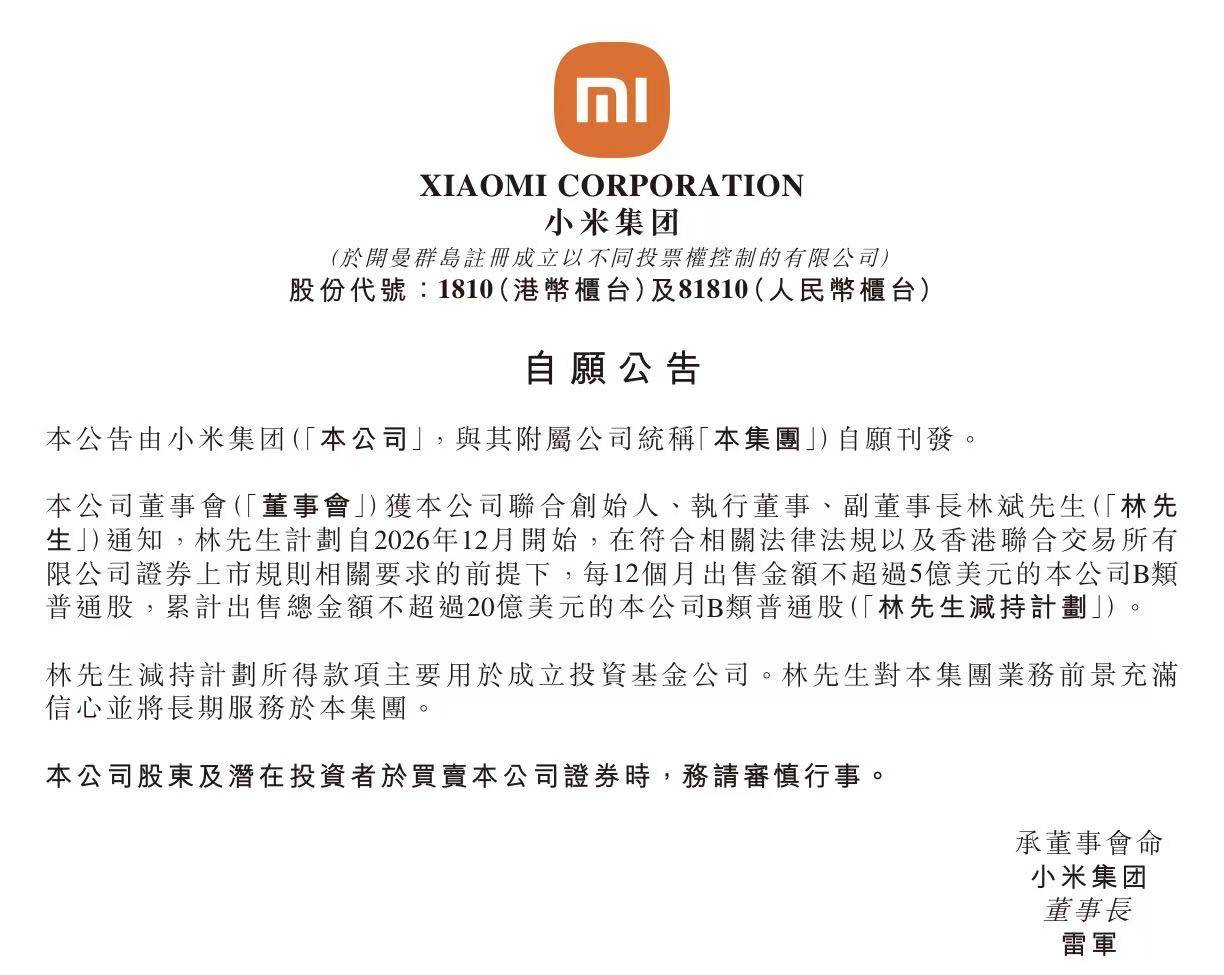
今日小米集团在港交所公告,公司联合创始人、执行董事、副董事长林斌计划自 2026 年 12 月开始,在符合相关法律法规以及香港联合交易所有限公司证券 上市规则相关要求的前提下,每 12 个月出售金额不超过 5 亿美元的公司 B 类普通股,累计出售总金额不超过 20 亿美元的公司 B 类普通股。 公告称,林斌减持计划所得款项主要用于成立投资基金公司。林斌对本集团业务前景充满信心并将长期服务于本集团。 ...
小米突发!刚刚公告,大举减持!
券商中国· 2025-12-28 12:52
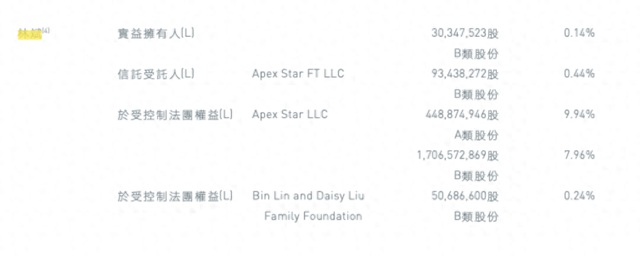
Core Viewpoint - Xiaomi Group's co-founder Lin Bin plans to sell up to $5 billion of Class B shares annually starting December 2026, with a total cap of $20 billion (approximately 140 billion RMB) [2][4]. Group 1: Shareholding and Selling Plan - Lin Bin's share sale proceeds will primarily fund the establishment of an investment fund company, indicating his confidence in Xiaomi's business prospects [4]. - Lin Bin holds approximately 1.835 billion Class B shares, representing about 8.56% of the company's issued share capital, valued at over $10 billion based on the latest market capitalization [5]. - In June of the previous year, Lin Bin sold 10 million shares for approximately 1.79 million HKD, with the proceeds allocated for charitable purposes, including a 100 million RMB donation to his alma mater, Sun Yat-sen University [5]. Group 2: Stock Performance - Since late September, Xiaomi's stock price has been on a downward trend, closing at 39.22 HKD per share on December 24, reflecting a cumulative decline of over 36% from its June peak of 61.45 HKD [6]. Group 3: Financial Performance - In Q3, Xiaomi reported revenue of 113.1 billion RMB, a year-on-year increase of 22.3%, marking the fourth consecutive quarter of revenue exceeding 100 billion RMB [8]. - The adjusted net profit for Q3 was 11.3 billion RMB, up 80.9% year-on-year, with total revenue for the first three quarters reaching 340.4 billion RMB, nearing last year's total [8]. - The smartphone segment generated 46 billion RMB in Q3, maintaining a top-three global position with 43.3 million units shipped, marking nine consecutive quarters of year-on-year growth [8]. - The innovative business segment, including smart electric vehicles and AI, contributed 29 billion RMB in Q3, with a year-on-year growth exceeding 199%, and achieved a positive operating profit of 700 million RMB for the first time [8]. - The IoT and lifestyle products segment generated 27.6 billion RMB in Q3, reflecting a year-on-year increase of 5.6%, with over 1 billion connected IoT devices on the platform [8].