
商贸零售

Search documents
【盘中播报】69只A股封板 有色金属行业涨幅最大
Zheng Quan Shi Bao Wang· 2025-07-24 06:41
| 申万行业 | 行业涨跌(%) | 成交额(亿元) | 比上日(%) | 领涨(跌)股 | 涨跌幅(%) | | --- | --- | --- | --- | --- | --- | | 有色金属 | 2.13 | 1142.95 | 41.65 | 龙磁科技 | 14.53 | | 商贸零售 | 2.08 | 231.80 | 29.13 | 中国中免 | 10.00 | | 美容护理 | 2.03 | 86.92 | 41.48 | 拉芳家化 | 10.02 | | 钢铁 | 1.66 | 201.40 | -8.57 | 包钢股份 | 10.04 | | 房地产 | 1.51 | 189.96 | -2.61 | 海南机场 | 10.11 | | 社会服务 | 1.40 | 144.24 | 2.91 | 西藏旅游 | 9.99 | | 医药生物 | 1.32 | 1377.88 | 12.22 | 康芝药业 | 20.00 | | 非银金融 | 1.03 | 906.63 | -5.68 | 海德股份 | 10.08 | | 建筑材料 | 1.01 | 249.20 | -17.09 | 西藏天路 ...
今日59只A股封板 商贸零售行业涨幅最大
Zheng Quan Shi Bao Wang· 2025-07-24 05:12
Market Overview - The Shanghai Composite Index increased by 0.48% as of the morning close, with a trading volume of 961.23 million shares and a total transaction value of 1,133.02 billion yuan, representing a decrease of 2.25% compared to the previous trading day [1]. Industry Performance - The top-performing sectors included: - Retail: Increased by 2.31% with a transaction value of 191.00 billion yuan, led by China Duty Free Group, which rose by 10.00% [1]. - Non-ferrous Metals: Increased by 2.29% with a transaction value of 874.12 billion yuan, led by Longi Green Energy, which rose by 14.35% [1]. - Real Estate: Increased by 2.06% with a transaction value of 152.98 billion yuan, led by Hainan Airport, which rose by 10.11% [1]. - Steel: Increased by 2.03% with a transaction value of 175.98 billion yuan, led by Baosteel, which rose by 10.04% [1]. - The sectors with the largest declines included: - Banking: Decreased by 0.92% with a transaction value of 211.32 billion yuan, led by Qilu Bank, which fell by 2.53% [2]. - Communication: Decreased by 0.82% with a transaction value of 449.61 billion yuan, led by Taicheng Light, which fell by 8.68% [2]. - Public Utilities: Decreased by 0.79% with a transaction value of 226.43 billion yuan, led by Huadian New Energy, which fell by 4.77% [2]. Summary of Key Stocks - Notable gainers included: - China Duty Free Group: +10.00% [1]. - Longi Green Energy: +14.35% [1]. - Hainan Airport: +10.11% [1]. - Notable decliners included: - Qilu Bank: -2.53% [2]. - Taicheng Light: -8.68% [2]. - Huadian New Energy: -4.77% [2].



重磅官宣!引爆涨停潮
Zheng Quan Shi Bao· 2025-07-24 04:09
Group 1 - The A-share market showed an overall upward trend on July 24, with the Hainan sector experiencing significant growth, becoming one of the market's highlights [1][2] - The Hainan sector surged over 9% by midday, with multiple stocks hitting the daily limit, including Kangzhi Pharmaceutical, Hainan Airport, and Hainan Highway [4][6] - Major industry sectors such as retail, steel, and real estate saw gains exceeding 2%, while sectors like communication and banking underperformed [4] Group 2 - The China Electric Power Construction Company (China Power Construction) reached its daily limit, with trading volume exceeding 150 billion yuan, marking a near ten-year high [9] - The government announced that the Hainan Free Trade Port will officially start operations on December 18, 2025, with significant policy changes including an increase in zero-tariff goods from 21% to 74% [8] - The new policies will allow for a broader range of zero-tariff goods and more flexible trade management, enhancing the operational environment for businesses in Hainan [8]


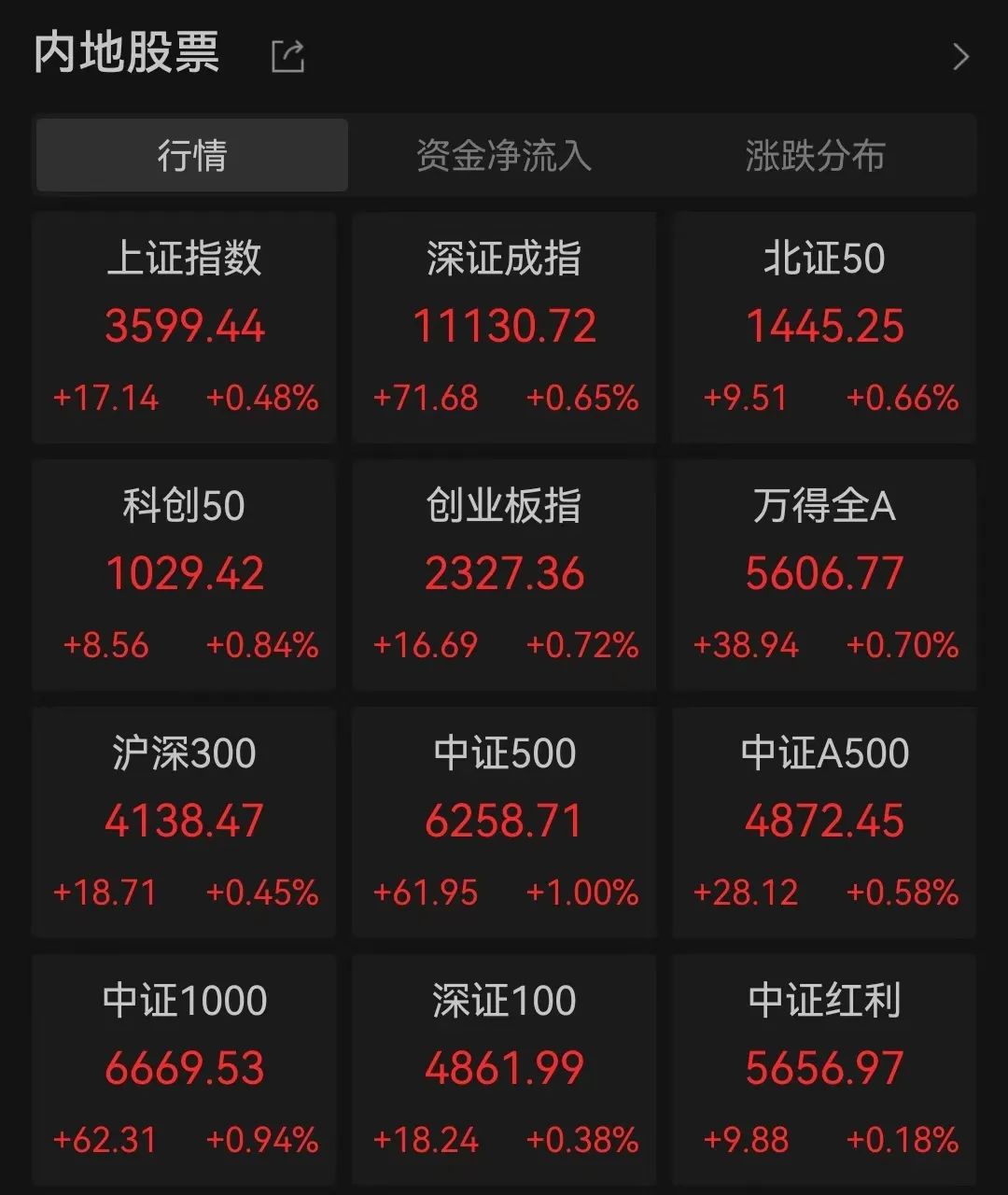
【盘中播报】沪指涨0.25% 商贸零售行业涨幅最大
Zheng Quan Shi Bao Wang· 2025-07-24 03:13
| 石油石化 | | | | 华锦股份 | | | --- | --- | --- | --- | --- | --- | | 通信 | -0.69 | 309.07 | -9.44 | 太辰光 | -7.55 | | 银行 | -0.87 | 142.87 | -6.44 | 长沙银行 | -2.32 | | 公用事业 | -0.97 | 161.51 | -27.59 | 华电新能 | -4.77 | 证券时报·数据宝统计,截至上午10:28,今日沪指涨0.25%,A股成交量692.57亿股,成交金额7971.62亿 元,比上一个交易日减少10.11%。个股方面,3708只个股上涨,其中涨停49只,1473只个股下跌。从 申万行业来看,商贸零售、房地产、钢铁等涨幅最大,涨幅分别为2.05%、1.75%、1.69%;公用事业、 银行、通信等跌幅最大,跌幅分别为0.97%、0.87%、0.69%。(数据宝) 今日各行业表现(截至上午10:28) | 申万行业 | 行业涨跌(%) | 成交额(亿元) | 比上日(%) | 领涨(跌)股 | 涨跌幅(%) | | --- | --- | --- | --- | - ...
7月22日电子、医药生物、电力设备等行业融资净买入额居前
Zheng Quan Shi Bao Wang· 2025-07-23 03:22
Core Insights - As of July 22, the latest market financing balance reached 1,919.613 billion yuan, an increase of 15.048 billion yuan compared to the previous trading day [1] - Among the 23 primary industries under Shenwan, the electronic industry saw the largest increase in financing balance, rising by 2.381 billion yuan [1] - The industries with notable increases in financing balance also include pharmaceuticals, electric equipment, and machinery, with increases of 1.413 billion yuan, 1.359 billion yuan, and 1.126 billion yuan respectively [1] - Conversely, eight industries experienced a decrease in financing balance, with the computer, home appliance, and retail industries seeing the largest declines of 0.114 billion yuan, 0.095595 billion yuan, and 0.090656 billion yuan respectively [2] Industry Financing Balance Changes - The coal industry had the highest growth rate in financing balance, with a latest balance of 15.839 billion yuan, reflecting a 2.48% increase [1] - Other industries with significant increases include construction decoration, banking, and building materials, with growth rates of 2.25%, 1.70%, and 1.65% respectively [1] - The steel, retail, and home appliance industries reported the largest declines in financing balance, with latest balances of 14.479 billion yuan, 21.545 billion yuan, and 26.662 billion yuan, showing decreases of 0.48%, 0.42%, and 0.36% respectively [2]
消费板块拐点将至?2025中报前瞻揭示消费配置机遇
Sou Hu Cai Jing· 2025-07-22 07:46
Core Viewpoint - The consumer sector is showing signs of recovery, with various sub-sectors experiencing growth and opportunities as domestic consumption trends improve [1][10]. Group 1: Consumer Sector Overview - Since early 2025, there has been a gradual recovery in consumer sentiment, with domestic demand contributing 68.8% to GDP growth in the first half of the year, and final consumption expenditure contributing 52% [1]. - The implementation of policies such as the "Special Action Plan to Boost Consumption" has injected vitality into the consumer market, leading to significant increases in tourism and dining revenues during holidays [1]. - The upcoming mid-year reporting season is expected to be a critical point for validating the recovery in the consumer sector [1]. Group 2: Food and Beverage Sector - The food and beverage industry is experiencing structural differentiation, with the liquor sector under pressure while leading brands maintain steady growth due to strong brand influence [2]. - The beer sector benefits from consumption upgrades and product innovation, while the snack sector is growing due to health-conscious and personalized consumption trends [2]. Group 3: Textile and Apparel Sector - The textile and apparel industry is seeing a recovery in demand, particularly in the sportswear segment, driven by increased awareness of fitness among consumers [3]. - Major sports brands are investing in R&D to launch high-tech, high-performance products to meet consumer demands for quality and functionality [3]. Group 4: Retail Sector - The traditional retail sector is facing challenges from online shopping, leading to a decline in consumption; however, cross-border e-commerce leaders are showing strong growth [4]. - The high growth in import and export trade in Yiwu and the opening of global trade centers are providing new opportunities for cross-border e-commerce companies [4]. Group 5: Social Services Sector - The social services sector is witnessing a surge in cross-border tourism demand, supported by inbound travel policies and the travel needs of younger and older demographics [5]. - Online travel agencies are launching personalized and diverse travel products to cater to varying consumer needs [5]. Group 6: Light Manufacturing Sector - The light manufacturing industry is facing short-term export pressures, but segments like home furnishings, packaging, and pet food are performing well [6]. - The recovery in the real estate market is boosting demand in the home furnishings sector, while the packaging industry benefits from the growth of e-commerce and express delivery [6]. Group 7: Home Appliances Sector - The home appliances industry is experiencing a significant recovery in domestic demand, driven by government subsidies for replacing old appliances [7]. - While the export market faces uncertainties due to tariff policies, long-term growth potential remains strong as global economies recover and Chinese brands enhance their competitiveness [7]. Group 8: Hong Kong Stock Market - The Hong Kong consumer sector is characterized by scarce assets and high growth in earnings, indicating strong performance among leading companies [8]. Group 9: Trend in Niche Markets - The trendy toy industry is seeing strong performance from leading companies, with significant growth in revenue, net profit, and profit margins [9]. - The high-end and trendy gold jewelry sectors are achieving growth through unique designs and brand advantages, catering to young consumers' demand for personalized, high-quality products [9]. - The new-style tea beverage sector is showing significant differentiation, with leading brands achieving double-digit growth and strong store expansion [9]. Group 10: Policy Outlook - The government is expected to continue implementing policies to boost domestic consumption, with fiscal subsidies playing a crucial role in driving growth [10]. - Sectors such as home appliances and consumer electronics are likely to benefit from policies promoting the replacement of old products, while offline service consumption is set to see new development opportunities [10].
市场形态周报(20250714-20250718):本周指数普遍上涨-20250721
Huachuang Securities· 2025-07-21 07:12
Quantitative Models and Construction Methods 1. Model Name: Heston Model - **Model Construction Idea**: The Heston model is used to calculate the implied volatility of near-month at-the-money options, serving as a market fear index. It reflects market participants' expectations of future volatility [7] - **Model Construction Process**: The Heston model is a stochastic volatility model where the variance of the asset price follows a mean-reverting square-root process. The model is defined by the following equations: $$ dS_t = \mu S_t dt + \sqrt{v_t} S_t dW_t^S $$ $$ dv_t = \kappa (\theta - v_t) dt + \sigma \sqrt{v_t} dW_t^v $$ where: - \( S_t \): Asset price - \( v_t \): Variance of the asset price - \( \mu \): Drift term - \( \kappa \): Speed of mean reversion - \( \theta \): Long-term variance - \( \sigma \): Volatility of variance - \( W_t^S, W_t^v \): Two Wiener processes with correlation \(\rho\) [7] - **Model Evaluation**: The Heston model is widely recognized for its ability to capture the stochastic nature of volatility, making it suitable for modeling market fear indices [7] --- Quantitative Factors and Construction Methods 1. Factor Name: Multi-Industry Timing Factor (Scissors Difference) - **Factor Construction Idea**: This factor is based on the difference in the number of stocks with bullish and bearish signals within an industry. It aims to identify timing opportunities by analyzing the divergence between bullish and bearish signals [14] - **Factor Construction Process**: - Define the number of stocks with bullish signals (\(N_{bullish}\)) and bearish signals (\(N_{bearish}\)) in an industry on a given day - If no bullish or bearish signals are present, set the respective count to 0 - Calculate the scissors difference as: $$ \text{Scissors Difference} = N_{bullish} - N_{bearish} $$ - Normalize the scissors difference to obtain a ratio: $$ \text{Scissors Ratio} = \frac{N_{bullish} - N_{bearish}}{N_{bullish} + N_{bearish}} $$ - Use this ratio to construct an industry timing strategy [14] - **Factor Evaluation**: The backtesting results show that the scissors difference timing model outperforms the respective industry indices in all cases, demonstrating excellent historical performance [14] --- Model Backtesting Results 1. Heston Model - Implied volatility for major indices: - **Shanghai 50**: 13.5% (down 0.91% from last week) - **Shanghai 500**: 15.29% (down 0.11% from last week) - **CSI 1000**: 16.79% (down 1.3% from last week) - **CSI 300**: 13.65% (down 0.83% from last week) [9] --- Factor Backtesting Results 1. Multi-Industry Timing Factor (Scissors Difference) - Backtesting results for selected industries: - **Real Estate**: Strategy annualized return 13.18%, maximum drawdown -34.3%; Index annualized return -1.21%, maximum drawdown -75.09% - **Light Manufacturing**: Strategy annualized return 21.84%, maximum drawdown -37.91%; Index annualized return 2.76%, maximum drawdown -67.79% - **Coal**: Strategy annualized return 28.73%, maximum drawdown -24.76%; Index annualized return -0.1%, maximum drawdown -69.7% - **Pharmaceuticals**: Strategy annualized return 19.22%, maximum drawdown -42.71%; Index annualized return 6.69%, maximum drawdown -55.37% [15][16]
【盘中播报】45只A股封板 有色金属行业涨幅最大
Zheng Quan Shi Bao Wang· 2025-07-18 07:06
Core Viewpoint - The A-share market shows a mixed performance with a slight increase in the Shanghai Composite Index, while the non-ferrous metals sector leads the gains among various industries [2] Industry Performance - The non-ferrous metals sector experienced the highest increase of 1.66%, with a transaction volume of 806.93 billion yuan, up by 82.56% from the previous trading day [2] - The steel industry rose by 0.98%, with a transaction volume of 114.66 billion yuan, an increase of 35.33% compared to the last trading day [2] - The coal industry saw a rise of 0.84%, with a transaction volume of 68.80 billion yuan, up by 83.14% from the previous day [2] - Other notable sectors include basic chemicals and defense industry, both increasing by 0.74% [2] Stock Highlights - Leading stocks in the non-ferrous metals sector include Haixing Co., which rose by 10.03% [2] - In the steel sector, Baogang Co. increased by 5.97% [2] - Yunmei Energy in the coal sector saw a rise of 10.05% [2] - Other significant gainers include Fumiao Technology in basic chemicals, which surged by 20.02% [2]
“上市公司新质生产力调研行”第三站走进小商品城
Shang Hai Zheng Quan Bao· 2025-07-17 10:18
Group 1 - The core viewpoint of the articles highlights the transformation of the small commodity city in Yiwu, Zhejiang, from a traditional commercial property management service provider to an international trade comprehensive service provider, aiming to create an ecological moat in the trade chain [1] - The small commodity city has seen significant growth in foot traffic and foreign visitors, with an average daily foot traffic of approximately 200,100, representing a 4.3% increase, and an average of 3,448 foreign visitors daily, marking a 4.9% increase from January to June this year [1] - The manager of the small commodity city, Bao Hua, discussed the company's strategic transformation, emphasizing a development strategy that focuses on market leadership, digital integration, and platform support [1] Group 2 - The manager of the Southern CSI A500 ETF, Zhu Henghong, identified five common characteristics of successful digital transformation in retail enterprises, including full-chain data integration and AI-driven operational optimization [2] - The retail industry is undergoing a dual-driven transformation characterized by efficiency revolution and consumer segmentation, with a notable trend towards online-offline integration and the rise of discount and value-oriented consumption [2] - Future activities will continue to be organized by Southern Fund and Shanghai Securities Journal to enhance investors' understanding of quality companies' competitive advantages and development potential [2]

商贸零售行业:6月社零数据跟踪报告-6月社零总额同比+4.8%,增速同比提升、环比下降
Wanlian Securities· 2025-07-17 08:15
Investment Rating - The industry is rated as outperforming the market, with an expected relative increase of over 10% in the next six months [46]. Core Insights - In June 2025, China's total retail sales of consumer goods reached 42,287 billion yuan, showing a year-on-year growth of 4.8%, which is an increase of 2.8 percentage points compared to the same period last year, although it represents a month-on-month decline of 1.6 percentage points [2][14]. - The growth rate of retail sales in urban and rural areas has both declined, with urban growth at 4.8% and rural growth at 4.5% [16][21]. - Online retail sales from January to June 2025 totaled 74,295 billion yuan, reflecting a year-on-year increase of 8.5%, accounting for 30.27% of total retail sales [4][38]. Summary by Sections Overall Performance - The total retail sales in June 2025 were 42,287 billion yuan, with a year-on-year increase of 4.8% and a month-on-month decline of 1.6% [2][14]. - The Consumer Price Index (CPI) rose by 0.1% year-on-year in June, compared to a decrease of 0.1% in May [14][15]. Segment Analysis - Among 16 categories of goods, five categories (Chinese and Western medicines, beverages, tobacco and alcohol, cosmetics, and petroleum products) experienced negative growth, while others showed positive growth, particularly home appliances and audio-visual equipment, cultural office supplies, and furniture, all exceeding 20% growth [3][20]. - Essential goods like grain and oil (+8.7%) and daily necessities (+7.8%) saw a decline in growth rates, while furniture (+28.7%) and automobiles (+4.6%) showed increased growth [20][24]. Online Retail - Online retail sales for the first half of 2025 reached 74,295 billion yuan, with a year-on-year growth of 8.5% [4][38]. - The cumulative online retail sales of physical goods amounted to 61,191 billion yuan, with a growth of 6.0% [41]. Investment Recommendations - The report suggests focusing on sectors such as food and beverages, social services, and retail, highlighting opportunities in the gold and jewelry market due to its appeal as a safe-haven asset, and the cosmetics sector, which is seeing increased acceptance of domestic brands [9][42][44]. - The report emphasizes the potential for growth in home appliances and furniture due to ongoing government subsidies and policies aimed at boosting consumption [8][42].