
房地产

Search documents
长江证券:2025年年度业绩预告 盈利景气修复可期
Xin Lang Cai Jing· 2026-02-08 09:13
Group 1 - The overall A-share pre-announcement rate has improved, indicating a potential recovery in profitability [1][7] - As of February 3, 2026, approximately 3,000 out of 5,478 A-share companies have disclosed their 2025 annual performance forecasts, resulting in a disclosure rate of 54.0% and a pre-announcement rate of 37.0%, up from 33.7% in 2024 [1][7] - In the 2025 annual performance forecasts, there are 623 companies expecting profit increases and 378 companies expecting profit decreases [1][7] Group 2 - Large-cap stocks are expected to show better profitability compared to small-cap stocks, with the ChiNext board having a higher pre-announcement rate [2][8] - The maximum profit change for major indices in 2025 is projected to be 55.2% for CSI 300, 82.8% for SSE 50, 54.7% for CSI 500, and 50.8% for CSI 1000 [2][8] - The pre-announcement rates for major indices are 63.2% for CSI 300, 83.3% for SSE 50, 59.0% for CSI 500, and 49.4% for CSI 1000 [2][8] Group 3 - In terms of industry performance, the defense and electronics sectors have shown high disclosure and pre-announcement rates, indicating a strong potential for profitability improvement [3][9] - The highest disclosure rates among primary industries are coal (81%), real estate (78%), agriculture, forestry, animal husbandry, and fishery (74%), and computer industry (72%) [3][9] - The highest pre-announcement rates are in non-bank financials (96.2%), non-ferrous metals (67.6%), automotive (52.7%), and steel (50.0%) [3][9] Group 4 - The market outlook for 2026 suggests a gradual bull market, with signs of a profitability bottom emerging and ample liquidity supporting corporate earnings [4][10] - Valuation metrics are near historical averages, with a low interest rate environment providing upward valuation momentum [4][10] - There is significant potential for increased market capitalization in the Chinese stock market as long-term capital flows in [4][10] Group 5 - The industry allocation outlook favors technology and cyclical sectors, with a focus on U.S. stocks and commodities [5][11] - Key areas of interest include technology, domestic circulation, strategic security, and opening up to foreign markets, driven by policy directions from the next five-year plan [5][11] - The market is expected to experience a more comprehensive bull market driven by technological manufacturing and certain cyclical trends [5][11]

本周热度变化最大行业为石油石化、食品饮料:市场情绪监控周报(20260202-20260206)-20260208
Huachuang Securities· 2026-02-08 08:43
- The report constructs a "total heat" indicator by aggregating the browsing, self-selection, and click counts of individual stocks, normalized as a percentage of the total market on the same day, and then multiplied by 10,000, with a value range of [0,10000][7] - The "total heat" indicator is used as a proxy for "sentiment heat" to track the attention levels of broad-based indices, industries, and concepts[7] - The broad-based indices are divided into groups: CSI 300, CSI 500, CSI 1000, CSI 2000, and "others," with the total heat indicators of the constituent stocks summed up to obtain the heat of these indices[8] - A simple rotation strategy is constructed based on the weekly heat change rate, buying the broad-based index with the highest heat change rate MA2 at the end of each week, and staying out of the market if the "others" group has the highest change rate[12] - The rotation strategy based on the broad-based heat change rate MA2 has an annualized return of 8.74% since 2017, with a maximum drawdown of 23.5%, and a return of 5.2% in 2026[15] - The weekly heat change rate MA2 for the main broad-based indices shows that the CSI 300 had the highest increase of 3.34% compared to the previous week, while the CSI 500 had the largest decrease of 5.98%[15] - The heat change rate MA2 for the Shenwan first-level industries shows that the oil and petrochemical industry had the highest increase of 58.0% compared to the previous week, while the electronics industry had the largest decrease of -14.1%[26] - The heat change rate MA2 for the Shenwan second-level industries shows that the top five industries with the highest positive change rates are jewelry, planting, liquor II, lighting equipment II, and oil service engineering[26] - The heat change rate for concepts shows that the top five concepts with the highest positive change rates are Huawei Digital Energy, horse racing concept, duty-free shops, Huawei Euler, and pumped storage[27] - Two simple portfolios are constructed: one selects the top 10 stocks with the highest total heat from the top five concepts with the highest heat change rates each week, and the other selects the bottom 10 stocks with the lowest total heat from the same concepts[30] - The historical performance of the portfolios shows that the bottom group can achieve an annualized return of 15.71% with a maximum drawdown of 28.89%[32]
A股策略周报 20260208:高切低与简单题-20260208
SINOLINK SECURITIES· 2026-02-08 08:23
Group 1 - The global asset market has entered a "Risk-off" mode due to multiple events, including a cooling job market and a retreat in AI industry narratives, leading to a significant decline in cryptocurrency markets and a drop in US Treasury yields [3][11] - There has been a noticeable shift from growth to value in global stock markets, driven by concerns over AI technology evolving from an enabler to a disruptor, resulting in a sell-off of major software stocks [3][13] - The earnings signals from key tech stocks during the earnings season, such as AMD, ARM, and Qualcomm, have not met optimistic market expectations, raising doubts about their ability to deliver on capital expenditure commitments [3][18] Group 2 - The current concerns in the capital market regarding the AI industry are indicative of the first phase of the trading cycle nearing its end, as the market begins to reassess the true impact of AI technology on various industries [4][26] - The differentiation within the AI sector has already begun, with hardware and software performance diverging since Q4 2025, marking the start of a broader market style shift [4][31] - The capital market is expected to transition into a second phase where the focus will shift back to the actual technological impacts of AI, leading to increased volatility and differentiation among sectors [4][27] Group 3 - The domestic A-share market has also experienced a significant style shift, with domestic demand-related assets outperforming, despite external demand not showing signs of weakness [5][40] - Recent data indicates a strong performance in South Korea's exports and a record high in China's port container throughput, suggesting a synchronized recovery between internal and external demand [5][48] - The consumption and financial sectors in China are showing high potential returns, with specific attention to the stabilization of premium liquor prices and the upcoming consumption data post-holiday [5][46] Group 4 - As the global AI industry cycle transitions into its second phase, the focus is shifting towards tangible assets that cannot be easily disrupted by AI, with a revaluation of global physical assets beginning [5][53] - Specific investment recommendations include revaluing physical assets based on low inventory and demand stabilization, as well as focusing on sectors like energy, metals, and Chinese equipment exports that are positioned for recovery [5][53] - The financial sector is expected to benefit from the expansion of capital markets and a bottoming out of long-term asset returns, highlighting opportunities in non-bank financials [5][53]
周末五分钟全知道(2月第2期):天时地利人和:新一轮上涨周期
GF SECURITIES· 2026-02-08 06:09
——周末五分钟全知道(2 月第 2 期) [Table_Summary] 报告摘要: [分析师: Table_Author]刘晨明 SAC 执证号:S0260524020001 SFC CE No. BVH021 010-59136616 liuchenming@gf.com.cn [Table_ 相关研究: DocReport] | 创业板 50 指数:龙头出海, | 2026-02-04 | | --- | --- | | 链动全球:指数研选系列报告 | | | "沃什预期"与美元潮落: | 2026-02-01 | | 全球股市定价锚的切换与重 | | | 构:——港股&海外周聚焦(2 | | | 月第 1 期) | | | 中美最新财报中的行业配置 | 2026-02-01 | | 线索 | | [联系人: Table_Contacts] 毕露露 18600442697 bilulu@gf.com.cn [Table_Page] 投资策略|专题报告 2026 年 2 月 8 日 证券研究报告 [Table_Title] 天时地利人和:新一轮上涨周期 识别风险,发现价值 请务必阅读末页的免责声明 1 / ...
高频数据扫描:沃什,一个准备管理货币的财政鹰派
Bank of China Securities· 2026-02-08 05:35
Report Industry Investment Rating - Not provided in the given content Core Viewpoints of the Report - Trump-nominated next Fed Chair Wash has monetary - policy characteristics including monetarism, fiscal hawkishness, and a "vision" of rate cuts. If Wash takes office, he may review past Fed policies and establish a monetarist - like policy concept. The realization of his rate - cut "vision" depends on the coordination of fiscal policy. If the coordination fails, the interest - rate outlook may be more volatile. If the coordination is successful, the Fed may gradually shrink its balance sheet, and inflation may further decline [3]. - Upstream price indicators continue to rise. In the week of February 6, the average wholesale price of pork decreased by 1.12% week - on - week, the average wholesale price of 28 key - monitored vegetables decreased by 1.46% week - on - week, and the price index of edible agricultural products increased by 0.20% week - on - week on January 30. Domestic cement price index decreased by 0.52% week - on - week, South China Iron Ore Index decreased by 1.89% week - on - week, the operating rate of coking enterprises with a capacity of over 2 million tons increased by 0.18% week - on - week, the inventory index of rebar increased by 12.05% week - on - week, and the blast - furnace operating rate of 247 domestic steel mills increased by 0.67% week - on - week. The price index of production materials increased by 0.90% week - on - week on January 30 [3]. - In the US - Iran negotiations, tough stances and opportunities for easing are intertwined. In this week, the average prices of Brent and WTI crude - oil futures decreased by 1.25% and increased by 0.15% week - on - week respectively. The average weekly price of LME copper spot decreased by 1.79%, the average weekly price of aluminum spot decreased by 4.99%, and the copper - to - gold ratio increased by 3.93% week - on - week [3]. Summary by Directory High - Frequency Data Scanning - Wash's policy concept features include monetarism, fiscal hawkishness, and a rate - cut "vision". The realization of the rate - cut "vision" depends on the coordination of fiscal policy [1][3]. - Upstream price indicators: In the week of February 6, the average wholesale price of pork decreased by 1.12% week - on - week, the average wholesale price of 28 key - monitored vegetables decreased by 1.46% week - on - week, and the price index of edible agricultural products increased by 0.20% week - on - week on January 30. Domestic cement price index decreased by 0.52% week - on - week, South China Iron Ore Index decreased by 1.89% week - on - week, the operating rate of coking enterprises with a capacity of over 2 million tons increased by 0.18% week - on - week, the inventory index of rebar increased by 12.05% week - on - week, and the blast - furnace operating rate of 247 domestic steel mills increased by 0.67% week - on - week. The price index of production materials increased by 0.90% week - on - week on January 30 [3]. - US - Iran negotiations: In this week, the average prices of Brent and WTI crude - oil futures decreased by 1.25% and increased by 0.15% week - on - week respectively. The average weekly price of LME copper spot decreased by 1.79%, the average weekly price of aluminum spot decreased by 4.99%, and the copper - to - gold ratio increased by 3.93% week - on - week [3]. High - Frequency Data Panoramic Scanning - Provides week - on - week changes of various high - frequency data, including food, other consumer goods, bulk commodities, energy, non - ferrous metals, ferrous metals, real estate, and shipping. For example, the average wholesale price of pork decreased by 1.12% week - on - week, and the price index of production materials increased by 0.90% week - on - week [17]. - Presents the latest values and historical data of high - frequency indicators related to important macro - indicators, such as LME copper spot settlement price year - on - year, crude - steel daily output year - on - year, etc. [18]. Comparison of High - Frequency Data and Important Macro - Indicator Trends - Shows the relationship between high - frequency data and important macro - indicators through multiple charts, such as the relationship between RJ/CRB price index year - on - year and export amount year - on - year, and the relationship between production materials price index year - on - year and PPI industrial year - on - year [22]. Important High - Frequency Indicators in the US, Europe, and Japan - Displays the relationship between US weekly economic indicators and actual economic growth rate, US initial jobless claims and unemployment rate, etc. through charts [87]. Seasonal Trends of High - Frequency Data - Analyzes the seasonal trends of high - frequency data, including the seasonal trends of 30 large - and medium - sized cities' commercial - housing transaction area, LME copper spot settlement price, etc. [102]. High - Frequency Traffic Data in Beijing, Shanghai, Guangzhou, and Shenzhen - Presents the year - on - year changes of subway passenger volume in Beijing, Shanghai, Guangzhou, and Shenzhen [149].
行业景气度跟踪报告(2026年2月):涨价品种出现分化,券商景气度高增
ZHESHANG SECURITIES· 2026-02-08 04:25
Upstream Sector - In the upstream cyclical products, there is a price divergence, with only gold prices rising while silver and other industrial metals have declined[1] - The PPI for coal mining and washing has improved, with a year-on-year growth of -8.9% in December, up from -11.80% in November[41] - Brent crude oil prices have decreased by 6.2% to $66.30 per barrel, while WTI crude oil prices fell by 4.7% to $62.14 per barrel[15] Midstream Sector - In the steel sector, iron ore and rebar prices have increased week-on-week, with rebar prices at 3,002 RMB per ton, up 1.6%[16] - The chemical products price index has decreased by 0.9% week-on-week, indicating a downward trend in major chemical product prices[16] - The shipping industry is experiencing a decline, with the Baltic Dry Index down by 5.6%[16] TMT Sector - The semiconductor sales cycle is on the rise, with a year-on-year growth of 22.9% in China[17] - The software industry has seen a cumulative profit growth of 7.3% year-on-year[17] - The film box office revenue in China has decreased by 69.11% year-on-year, indicating a significant drop in the media sector[17] Downstream Consumption - The price of Feitian Moutai has increased, supporting the strength of the liquor market[19] - The number of breeding sows in China has decreased by 2.9% year-on-year, indicating a decline in the agricultural sector[19] - The retail sales of consumer goods in December have shown a year-on-year decline of 0.9%[19] Financial and Real Estate Sector - The cumulative year-on-year decline in China's commercial housing sales area is 8.7%[20] - The cumulative year-on-year decline in real estate development investment is 17.2%[20] - The total trading volume in the two markets has increased, with the margin financing balance remaining high, indicating a robust brokerage environment[20]
房地产行业:春节住房消费那些事儿,看这篇就够了!
58安居客研究院· 2026-02-08 00:20
春节假期,既是阖家团圆的时刻,也是住房消费的重要观察窗口。根据 58 同城、 安居客的调研,我们全面拆解 2026 年春节住房消费的核心趋势——从住房消费倾向、 看房选址,到决策因素、优惠影响,每一处细节都折射出当下购房者的理性与务实。 住房消费倾向:春节住房相关消费整体呈"轻量级、体验型"特征 春节住房相关消费呈现"轻量级、体验型"特征,以"小额居家改善(家具家电购 置)"为绝对主流,大额置业相关计划(看房、装修)以"前期咨询"为主,租房需求 极弱,超三成人群暂无住房相关消费规划。筹备购置家具或家电占比最高(46.5%), 远超其他品类,这与此前调研中"适度消费为主流"的趋势高度匹配。(买房)看房/ 咨询楼盘占比 24.4%,该占比不算高,表明春节仅为置业需求的"信息积累期",而非 实际成交窗口期。 合作洽谈联系方式:微信:13818400935;邮箱:husixu01@58.com; 1 数据来源:《春节置业调查-2026 居住趋势展望》报告,该问题为多选题 春节调研报告系列 春节调研报告系列 2026 春节住房消费那些事儿,看这篇就够了! 代际越年轻,居住消费需求越活跃 中年人居住稳定,居家改善意愿突出 ...
看好2026年恒生指数!中信里昂,再出风水研报
券商中国· 2026-02-07 23:29
Core Viewpoint - The report from Citic Lyon emphasizes that 2026 will mark a departure from the hesitant trials of the Year of the Snake, with the Year of the Horse bringing a confident and powerful momentum to the market [5]. Market Predictions - The report provides a month-by-month forecast for the Hang Seng Index in 2026, predicting a poor start in February, followed by a series of upward movements from March to June, with the strongest performance expected in June. A significant decline is anticipated in December, before a rebound in January 2027 [5][6]. Industry Predictions - **Wood Sector**: Expected to be the strongest throughout the year, with a rebound anticipated towards the end of the year, benefiting agriculture and related industries [6]. - **Fire Sector**: Predicted to perform well, particularly in energy production and communication, but may face challenges in the last two months of the year due to excessive water influence [6]. - **Earth Sector**: Expected to have a moderate performance, with potential strength in construction materials like sand and cement, while real estate may struggle [6]. - **Metal Sector**: Forecasted to have a strong year, particularly in machinery manufacturing and construction steel, with a focus on innovation in financial products [6]. - **Water Sector**: Anticipated to be the weakest element, with stagnation expected in shipping and tourism, and limited growth in trade-related sectors [7]. Review of 2025 Predictions - The report reflects on the unpredictable nature of 2025, highlighting significant fluctuations in the Hang Seng Index, including unexpected declines and rebounds, aligning with earlier predictions of market behavior [8][10].

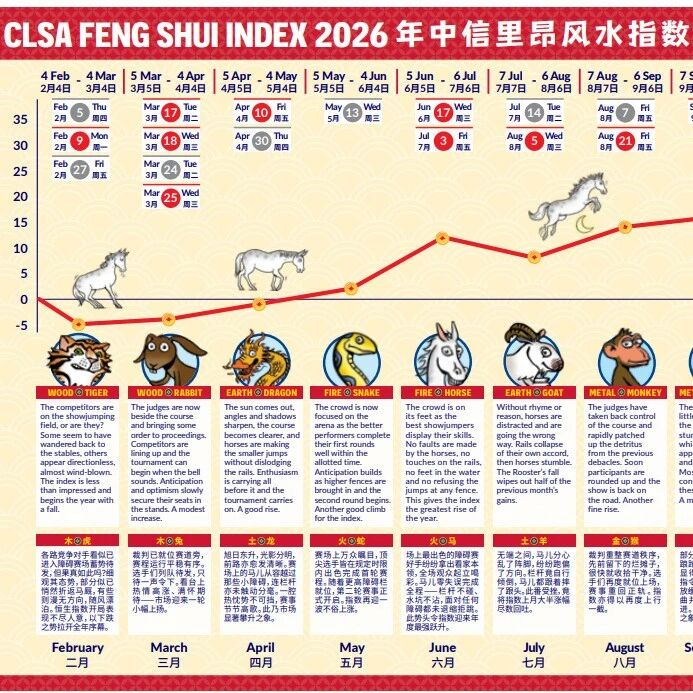
策略周报:持股过节,还是持币过节?
Guoxin Securities· 2026-02-07 10:50
Market Trends - The probability of A-shares rising before and after the Spring Festival exceeds 70%[1] - The average trading volume decreases by 4.0% in the week before the festival, while it increases by 22.3% in the week after[11] - The Shanghai Composite Index has an 81% probability of rising in the week before the festival, with an average increase of 1.8%[15] Fund Flows - Leverage funds show a significant outflow before the festival, with an average net buy of -66.9 billion CNY, and a shift to inflow after the festival with a net buy of 14.2 billion CNY[18] - ETF funds experience net inflows of 214.3 billion CNY before the festival, but the inflow slows down after, averaging 171.9 billion CNY[18] - Foreign capital inflow remains stable, with a net inflow probability of 60-70% during the festival period[16] Investment Strategy - Holding stocks during the festival is recommended due to a favorable market outlook and historical data supporting this strategy[19] - The current macroeconomic policy remains positive, with expectations of a return to liquidity easing in the U.S. and a bullish sentiment in the domestic market[19] - A balanced allocation strategy is advised, focusing on technology, AI applications, and traditional value sectors like real estate and liquor[20]
策略周报:持股过节,还是持币过节?-20260207
Guoxin Securities· 2026-02-07 08:16
Core Conclusions - The probability of A-shares rising before and after the Spring Festival exceeds 70%, with a trend of reduced trading volume before the holiday and increased volume afterward [1][11] - Historical data shows that leveraged funds typically flow out before the holiday and flow back in afterward, while ETF funds show a pattern of inflow before and a slowdown in inflow after, contributing to the observed changes in trading volume and style differentiation in A-shares [2][16] - Current macroeconomic policies are positive, and overseas risks are manageable, suggesting that holding stocks during the holiday may be a better strategy, with a balanced allocation focusing on technology, particularly AI applications, and attention to cyclical sectors and real estate [2][19] Trading Volume and Style Differentiation - A-shares typically experience reduced trading volume before the Spring Festival, averaging a 4.0% decrease, while trading volume increases by an average of 22.3% after the holiday [11][13] - The probability of the Shanghai Composite Index rising in the week before the Spring Festival is 81%, with an average increase of 1.8%, while the probability for the week after is 76%, with an average increase of 1.3% [15] - Growth and value styles perform similarly before and after the holiday, but large-cap stocks outperform small-cap stocks before the holiday, while small-cap stocks significantly outperform large-cap stocks afterward, with a 87.5% probability of small-cap stocks rising in the week after [12][15] Fund Flow Analysis - Leveraged funds show a significant outflow before the Spring Festival, with an average net buy of -66.9 billion yuan, while they exhibit a net inflow of 14.2 billion yuan after the holiday [16][18] - ETF funds experience net inflows averaging 214.3 billion yuan before the holiday, but the net inflow decreases to 171.9 billion yuan after, with a lower probability of net inflows [16][18] - Foreign capital flows show little change before and after the holiday, maintaining a net inflow probability of 60-70% [16][17] Sector Allocation Strategy - The technology sector remains a key focus, driven by the AI wave, with expectations for the market to shift from hardware to application development [20] - There are opportunities in traditional value sectors, such as undervalued real estate and liquor stocks, as the spring market rally progresses [20][21] - The cyclical sector is also worth monitoring due to emerging demand from AI and new energy industries, alongside improving supply-demand dynamics in resource sectors [20]