创新药

Search documents
A股公司盈利增速将呈现前低后高态势
Zheng Quan Shi Bao· 2026-01-04 17:30
Core Viewpoint - The chief A-share strategist of CITIC Securities, Qiu Xiang, predicts that the profit growth rate of A-share companies will show a trend of low-to-high from 2026 onwards, influenced by the dynamics of the China-US relationship [1] Group 1: Market Phases - The market is expected to be divided into three phases based on the China-US trade agreement and the US midterm elections: 1. The first phase is from now until the trade agreement is finalized, where the market's upward slope is expected to slow down 2. The second phase is from the agreement's implementation to the end of the US midterm elections, during which A-shares may experience sustained growth in a stable external environment 3. The third phase follows the midterm elections, where external uncertainties may increase sharply, prompting investors to refocus on domestic issues [1] Group 2: Investment Opportunities and Sector Allocation - Four major themes are highlighted for investment opportunities: 1. The manufacturing sector's competition for global pricing power, with a focus on industries such as non-ferrous metals, chemicals, and new energy, which can convert market share advantages into pricing power and profit margin increases 2. The globalization of Chinese enterprises, which significantly expands market capitalization and profit growth potential, with key industries including machinery, innovative pharmaceuticals, electric equipment, and military industry 3. The continuation of the technology trend, particularly in AI, which further expands commercial applications and enhances the competitive advantages of Chinese companies, focusing on sectors like semiconductors, computing power, edge hardware, and AI applications 4. The potential for unexpected recovery in domestic demand, where despite general industry conditions being average, there exists significant room for recovery and valuation elasticity in domestic demand-sensitive sectors [1]


2025年度医药业绩前瞻
2026-01-04 15:35
Summary of Pharmaceutical Industry Conference Call Industry Overview - The pharmaceutical industry is projected to rank 18th among 31 primary industries in 2024, with an increase of 11.94%. However, the overall performance has been average, with a recent decline of 2% ranking it 28th among the same industries [2][4]. - The innovative drug sector is showing signs of recovery after four years of a bear market, while other sectors are gradually overcoming negative impacts from cost control measures [3][4]. Key Insights Innovative Drugs - Despite a low market sentiment, the innovative drug sector is experiencing continuous improvements, with significant industry benefits such as the $100 million upfront payment for Zai Lab's CD3DL3 tri-antibody product licensed to AbbVie [3][5]. - Recommended companies for investment in the innovative drug space include Innovent Biologics, China National Pharmaceutical Group, and Lepu Biopharma, all of which have low-risk clinical data or licensing agreements [6]. Medical Devices - The medical device sector is nearing the end of inventory destocking, with expectations for improved quarterly performance in 2026. Significant growth in bidding volumes is anticipated [3][6]. - Key companies to watch include Aohua, Carrier, Mindray, and United Imaging, particularly in high-value consumables like electrophysiology and neurosurgery [6][7]. Traditional Chinese Medicine (TCM) - The TCM sector is expected to recover gradually from Q2 2025 to Q1 2026, with hospital-based TCM likely to lead the recovery [9][10]. - The impact of the "15th Five-Year Plan" and the addition of essential drug lists are seen as potential benefits for the sector [9][11]. CRO and API Sectors - The CRO sector is performing well, with companies like WuXi AppTec and Pharmaron expected to see continued growth in orders and revenue [12]. - The API sector is closely tied to manufacturing trends, with companies like Tianyu Co., Starlight, and Tonghe expected to reach performance inflection points by 2026 [12][13]. Performance Expectations for 2025 - The pharmaceutical industry is expected to show a mixed performance in 2025, with notable growth in specific companies: - New Biotech's innovative product revenue is projected to grow over 50% - Yuan Dong's net profit growth is expected to be between 15%-20% - Tonghua Dongbao's revenue growth is anticipated at 40%-50% [15]. Conclusion - The pharmaceutical industry is navigating a complex landscape with varying performance across sectors. The innovative drug and medical device sectors present significant investment opportunities, while TCM is on the cusp of recovery. The CRO and API sectors are also positioned for growth, making them attractive for investors looking for potential returns in the coming years.
2025中国创新药十大牛股,真相有点意外
3 6 Ke· 2026-01-04 13:06
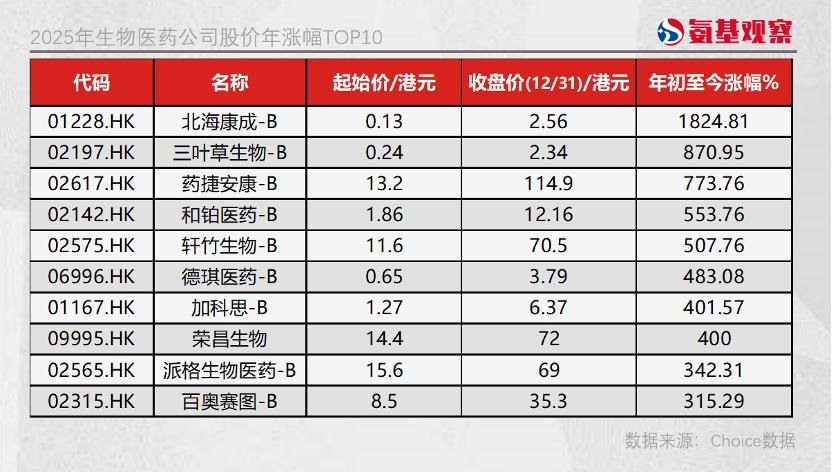
Core Insights - The innovative drug sector is experiencing a significant bull market, with the entry threshold for top-performing stocks raised considerably [1] - In 2024, the median increase for the top 10 innovative drug companies was 57.9%, with the highest increase reaching 132.6%. In 2025, this trend intensified, with the median increase for the top 10 soaring to 495.41% and the highest increase hitting 1824% [2] Group 1: Top Performing Companies - Beihai Kangcheng-B achieved the highest increase in 2025, with a staggering 1824% rise, surprising many in the market [5] - Sanleaf Biotech-B followed with an impressive 870% increase, despite facing significant operational challenges, including a cash flow crisis and a major refund demand from GAVI [10][11] - Yaojie Ankang-B, despite being controversial, saw its stock price rise nearly ninefold in a short period, reaching a market cap close to 270 billion HKD [12][13] - Heptagon Pharmaceuticals-B ranked fourth with a 553% increase, driven by its dual-engine model of R&D and business development [14][15] - Xuan Bamboo Biotech-B, a newly listed company, achieved a 507% increase, benefiting from positive clinical trial results and inclusion in national insurance directories [17][18] - Deqi Pharmaceuticals-B saw a 483% increase, attributed to its innovative AI-driven T-cell connector platform [19][20] - Jike Si-B experienced a 401% increase, driven by its advancements in KRAS-targeted therapies [22][23] - Rongchang Biotech achieved a 400% increase, with its product Taite Xip demonstrating significant potential across multiple indications [24][25] - Paige Biotech saw a 342% increase, largely due to its GLP-1 pipeline's market momentum [27] - Baiaosaitu-B rounded out the top ten with a 315% increase, supported by strong revenue growth and positive market expectations for its upcoming H+A listing [28][30] Group 2: Market Dynamics - The surge in stock prices for many companies is not solely based on fundamental improvements but also reflects speculative trading behaviors [4] - The innovative drug sector's long-term health relies on the emergence of stocks driven by genuine innovation rather than short-term speculation [4] - The market's focus on liquidity and sentiment has led to significant price increases, but these may not be sustainable as market conditions change [31]
中信建投:多重利好推动港股大涨 A股有望迎来开门红行情
智通财经网· 2026-01-04 11:44
Group 1 - The A-share market is expected to experience a "New Year opening red" trend due to improved liquidity and exchange rate conditions compared to the previous two years [1][3] - Key sectors to focus on include semiconductors, AI, non-bank financials, new energy, and machinery equipment, with a long-term positive outlook on industrial metals, small metals, and innovative pharmaceuticals [1] - The market sentiment index has risen to 80, indicating high investor enthusiasm, and the "cross-year market" is likely to continue into January [2] Group 2 - The geopolitical tension from the U.S. military action in Venezuela is expected to lead to short-term increases in gold and oil prices, while the long-term impact on international oil prices may be negative [4] - China's heavy reliance on Venezuelan crude oil, which accounts for 80% of its imports, poses risks to certain chemical products due to potential instability in raw material supply [4] - The domestic technology sector, particularly semiconductors and AI chips, is positioned as a core driver of market performance, supported by government policies promoting smart devices and venture capital initiatives [4]

国产药在去年上市新药中占比超85%
Di Yi Cai Jing· 2026-01-04 10:53
Core Insights - China has achieved record highs in the number of approved innovative drugs and total external licensing transactions, with approximately 30% of global drug pipelines being in development in China [2][4] - The National Medical Products Administration (NMPA) aims to continue promoting innovative drugs with new mechanisms and targets, supported by institutional backing and improvements in the payment system for innovative drugs [2][6] Group 1: Innovative Drug Approvals - In 2025, China approved 76 innovative drugs, significantly surpassing the 48 approved in 2024, marking a historical high [2] - Among the approved drugs, domestic products accounted for over 85%, with 80.85% of chemical drugs and 91.30% of biological products being domestically developed [3][2] - The number of first-in-class innovative drugs approved in China reached 11, with 4 being independently developed in China [4] Group 2: External Licensing Transactions - The total amount for external licensing transactions of innovative drugs in China exceeded $130 billion in 2025, with over 150 transactions, doubling from the previous year [6] - This growth reflects international recognition of the value of Chinese innovative drugs and is supported by ongoing reforms in drug review and approval processes [6][8] Group 3: R&D Pipeline and Quality - China's R&D pipeline now accounts for about 30% of the global total, a significant increase from just 4% a decade ago [4] - The quality of domestic drug development has improved, with contributions to early clinical pipelines for next-generation therapies like ADCs and bispecific/trispecific antibodies nearing or exceeding 50% globally [4] Group 4: Policy and Market Dynamics - The NMPA plans to enhance support for urgently needed drugs and improve the regulatory framework for drug trials and market exclusivity [7][8] - The introduction of the commercial insurance innovative drug directory is expected to facilitate access to high-priced innovative drugs, potentially boosting market sales [9] - The Chinese innovative drug market is projected to grow significantly, with estimates suggesting a market size of approximately 740 billion RMB in 2025 and a compound annual growth rate of 24.1% from 2024 to 2030 [10]

中信证券:人心思涨环境下 开年后A股市场或震荡向上
智通财经网· 2026-01-04 09:41
Core Viewpoint - The report from CITIC Securities indicates that the biggest expected divergence in 2026 will stem from the balance between external and internal demand, with a trend towards imposing tariffs on external demand and subsidizing internal demand, marking an important beginning this year [1][7]. Market Overview - The market is expected to experience a higher probability of upward movement after the New Year, given the relatively low funding enthusiasm at the end of last year and the prevailing sentiment of wanting to see market growth [1][8]. - The overall market sentiment is currently restrained, with many investors waiting for the right entry point, suggesting limited potential for significant market corrections in the absence of major unexpected risks [8]. Investment Strategy - The company recommends adopting a mindset focused on "earning performance money rather than expecting valuation money" for mid-term investments, favoring sectors with lower heat and concentration but increasing attention and catalysts, such as chemicals, engineering machinery, electric power equipment, and new energy [1][10]. - There is a cautious approach towards high prosperity and high heat sectors that have seen stagnant stock prices, while new industry themes like commercial aerospace are expected to continue to evolve and warrant ongoing attention [1][10]. Performance Analysis - In 2025, the median return for actively managed public funds tracked by CITIC Securities was 28.2%, ranking third over the past decade, with a significant disparity in returns between the top and bottom deciles [2]. - The overall performance of the A-share and Hong Kong stock markets in 2025 can be divided into five phases, with notable fluctuations driven by external factors such as tariff impacts and AI application narratives [3][4]. Structural Market Dynamics - The significant money in the structural bull market in 2025 primarily came from the correction of expected divergences and performance growth, particularly in the context of external and internal demand dynamics [4]. - The report highlights that the market's perception of external demand has shifted from optimism to caution, with geopolitical factors influencing expectations throughout the year [7]. Future Outlook - The anticipated structural adjustments in trade policies, including increased tariffs and stricter export controls, indicate a shift in China's approach to external trade, aiming to balance external and internal demand [7]. - The report emphasizes that the market may struggle to quickly price in these significant structural changes, which could serve as both a source of expected divergence and potential performance growth [7].

中信证券:开年后市场震荡向上的概率更高
Xin Lang Cai Jing· 2026-01-04 08:31
Core Viewpoint - The market is experiencing a structural bull market driven by a significant re-evaluation of China's technological capabilities and the complexities of US-China relations, alongside resilient external demand and an explosion in AI inference demand [1][2][3] Group 1: Market Performance and Expectations - In 2025, the median return of actively managed public funds is projected to be 28.2%, ranking third in the past decade and sixth in the last twenty years [1][12] - The overall market performance can be divided into five phases, with the total return of the CSI All A Shares Index at 27.7% and the Hang Seng Tech Index at 23.4% for the year [2][13] - The first phase shows a brief market excitement before the Spring Festival, while the second phase sees a significant rally in the Hang Seng Tech Index due to a shift in narrative regarding China's autonomous technology [2][13] Group 2: Structural Bull Market Dynamics - The "big money" in the structural bull market comes from substantial expected differences and performance growth, primarily driven by the correction of pessimistic expectations regarding external demand and the AI industry's evolution [3][14] - The market's perception of external demand shifted from pessimism to optimism throughout the year, culminating in a consensus on external demand exposure by year-end [3][14] - The AI industry's demand surge has filled gaps during transitional phases, leading to significant valuation recoveries for key companies [4][14] Group 3: Liquidity and Market Dynamics - Incremental liquidity is viewed as a result of the expected difference and performance realization, rather than a primary driver of market growth [5][15] - The net inflow of ETFs was 230.6 billion yuan for the year, indicating that liquidity does not directly correlate with market index increases [5][15] - The market is not lacking in funds but rather in investable assets and imaginative space [5][15] Group 4: Future Expectations and Strategies - The largest expected difference for 2026 will stem from balancing external and internal demand, with a trend towards taxing external trade and subsidizing domestic demand [6][16] - The market sentiment at the end of 2025 was relatively restrained, suggesting a higher probability of upward market movement in early 2026 [7][17] - Investment strategies should focus on sectors with lower heat and concentration but increasing attention and catalysts, such as chemicals, engineering machinery, and renewable energy [9][19]
新药周观点:2025年约101款创新药国内获批上市,行业蓬勃发展-20260104
Guotou Securities· 2026-01-04 08:17
Investment Rating - The report indicates a positive outlook for the biopharmaceutical industry, highlighting the approval of approximately 101 innovative drugs in 2025, marking a significant growth in the sector [3]. Core Insights - The innovative drug sector in China is experiencing robust growth, with 63 domestic innovative drugs (62% of total approvals) and 38 imported innovative drugs (38% of total approvals) approved in 2025 [3]. - The report suggests several companies to watch, including those with high certainty for overseas expansion and those with potential overseas data catalysts [2][20]. - The report emphasizes the importance of upcoming catalysts such as academic conferences and data releases that could impact the sector positively [2]. Summary by Sections Weekly New Drug Market Review - From December 29, 2025, to January 4, 2026, the top five gainers in the new drug sector were Youzhiyou (+12.45%), Aidi Pharmaceutical (+8.07%), Yongtai Biological (+6.72%), Kaituo Pharmaceutical (+6.25%), and Yahong Pharmaceutical (+4.07%). The top five losers were Jakes (+-15.53%), Yunding Xinyao (-15.06%), Kedi (-11.73%), Gelei Pharmaceutical (-8.64%), and Kangning Jere (-8.06%) [1][16]. Weekly Focused Stocks - The report recommends focusing on companies with MNC certification and high certainty for overseas volume, such as Sanofi Pharmaceutical, Lianbang Pharmaceutical, and Kelun Biotech. It also highlights companies with potential overseas data catalysts like Betta Pharmaceuticals and Hengrui Medicine [2][20]. Weekly New Drug Industry Analysis - The report notes that 2025 saw a record high in the number of approved innovative drugs in China, with a total of approximately 101 drugs approved by NMPA, excluding new indications, modified new drugs, biosimilars, traditional Chinese medicine, and vaccines [3][21]. Weekly New Drug Application Approval & Acceptance - No new drug or new indication applications were approved this week, but four new drug or new indication applications were accepted [4][27]. Weekly New Drug Clinical Application Approval & Acceptance - This week, 18 new drug clinical applications were approved, and 52 new drug clinical applications were accepted [5][30].
国产药在去年上市新药中占比超85%,今年产业政策如何扶持?
Di Yi Cai Jing· 2026-01-04 07:45
Core Insights - In 2025, China approved a record 76 innovative drugs, significantly surpassing the 48 approved in 2024, marking a historic high for the country [1][2] - The total value of innovative drug licensing transactions from China exceeded $130 billion in 2025, with over 150 transactions, also a record high [1][4] - Domestic innovative drugs accounted for over 85% of the newly approved drugs in 2025, indicating a strong growth in local pharmaceutical development [2][3] Group 1: Drug Approval and Market Dynamics - The National Medical Products Administration (NMPA) reported that 38 out of 47 chemical drugs approved in 2025 were domestically developed, representing 80.85% of the total [1] - Among the 23 biological products approved, 21 were domestic, accounting for 91.30% [1] - The number of innovative drugs in the pipeline in China represents approximately 30% of the global total, positioning China as the second-largest contributor worldwide [2] Group 2: International Recognition and Investment - The significant increase in licensing transactions reflects international recognition of the value of Chinese innovative drugs, with the total transaction amount doubling from the previous year [4] - The NMPA is committed to enhancing the approval process for urgently needed drugs, particularly those with new mechanisms and targets, to further stimulate innovation [5] - New policies encouraging foreign investment in the pharmaceutical sector signal China's openness to global capital in drug innovation [5] Group 3: Market Growth and Future Projections - The Chinese innovative drug market is projected to reach approximately 740 billion RMB in 2025, with an overall growth rate of about 35% [7] - By 2030, the market size is expected to exceed 2 trillion RMB, with a compound annual growth rate of 24.1% from 2024 to 2030 [7] - The introduction of the commercial insurance innovative drug directory is anticipated to enhance market access for high-priced innovative drugs, potentially increasing sales [6]
净买入超1.4万亿港元,科技龙头获大举增持
Bei Jing Ri Bao Ke Hu Duan· 2026-01-04 05:54
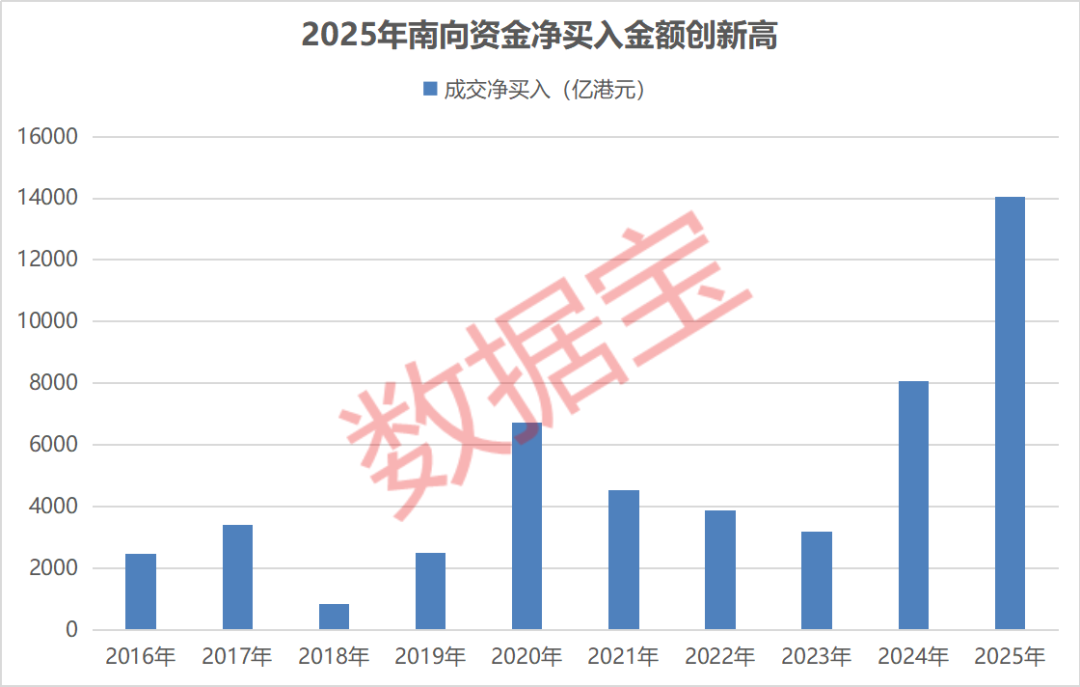
Core Insights - In 2025, southbound capital recorded a net purchase of 14,048.44 billion HKD, marking a historical high and a 73.89% increase from 2024 [1] - The total net inflow of southbound capital since the launch of the Shanghai-Hong Kong Stock Connect has exceeded 51,000 billion HKD [1] - By the end of December, the market value of shares held by southbound capital reached 61,408.83 billion HKD, accounting for over 12% of the total market capitalization of Hong Kong stocks [1] Monthly Trends - Throughout 2025, there were 8 months where net purchases by southbound capital exceeded 1,000 billion HKD, with September seeing the highest net purchase of 1,885.18 billion HKD [1] - The first quarter of 2025 saw a strong performance in the Hong Kong stock market, with the Hang Seng Index rising by 15.25% and the Hang Seng Tech Index increasing by 20.74% [1] Institutional Insights - Multiple institutions indicate that southbound capital is becoming a core force in reshaping the Hong Kong stock market landscape, transitioning from speculative traders to a pricing anchor [3] - Under the backdrop of domestic and international interest rate cuts, it is expected that southbound capital will maintain a net inflow trend into 2026 [3] Active Stocks - In 2025, 137 stocks were listed as active trading stocks, with Alibaba-W leading in total trading volume at 18,779.65 billion HKD [4] - Eight stocks received net purchases exceeding 10 billion HKD from southbound capital, primarily technology leaders, with Alibaba-W netting 1,778.69 billion HKD [4] Stock Performance - Alibaba-W achieved a cumulative increase of 78.6% in 2025, marking its highest annual growth since listing, while its revenue for Q3 2025 was reported at 247.795 billion RMB, a 5% year-on-year increase [4] - Meituan-W, despite a cumulative decline of 31.91% in 2025, still saw a net purchase of 732.99 billion HKD from southbound capital [5] Industry Insights - By the end of 2025, the top three industries by market value held by southbound capital were financials, information technology, and consumer discretionary, with values of 15,703.51 billion HKD, 11,791.08 billion HKD, and 9,961.09 billion HKD respectively [7] - The materials and healthcare sectors experienced the fastest growth in market value, with increases of 238.92% and 125.51% respectively, driven by rising prices of metals and the growing demand for innovative drugs [7][8]