基础设施

Search documents
深化国际开放合作新里程碑,土耳其五大领军企业落户昌平
Bei Jing Ri Bao Ke Hu Duan· 2025-09-16 08:43
Group 1 - The establishment of the Turkey-China (Beijing Changping) Trade Center marks a significant achievement in international investment attraction for the Changping District, serving as a new milestone for deepening international cooperation [1][3] - Five leading Turkish companies have settled in the Changping Trade Center, including two Fortune 500 companies: YEO, a listed company in the renewable energy sector, and GES Group, renowned in energy construction [3] - The G20 Young Entrepreneurs Alliance China Headquarters played a crucial role in facilitating this collaboration, leveraging its global network and resource integration capabilities to enhance communication and cooperation between Changping District and international enterprises [3][5] Group 2 - The Turkish Ministry of Trade sent an official congratulatory letter, emphasizing that the establishment of the Trade Center is a valuable practice to strengthen bilateral cooperation between Turkey and China [5] - The initiative is expected to deepen exchanges and connections between young entrepreneurs from both countries, injecting new vitality into mutual prosperity [5] - Changping has attracted several multinational corporate regional headquarters through its "Two Zones" construction policy, establishing high-end innovation platforms such as the Zhongguancun National Laboratory and Beijing Life Science Research Institute [5]


8月重磅经济数据出炉
21世纪经济报道· 2025-09-15 12:06
Economic Overview - In August, the industrial added value of large-scale enterprises increased by 5.2% year-on-year and 0.37% month-on-month [1] - The service production index rose by 5.6% year-on-year in August [1] - The total retail sales of consumer goods grew by 3.4% year-on-year and 0.17% month-on-month in August [1] - From January to August, fixed asset investment (excluding rural households) increased by 0.5% year-on-year, while excluding real estate development investment, it grew by 4.2% [1][5] Investment Trends - Manufacturing investment increased by 5.1% year-on-year from January to August, although the growth rate is declining [5] - Infrastructure investment (excluding power, heat, gas, and water production and supply) grew by 2.0%, down 1.2 percentage points from January to July [5] - Real estate development investment decreased by 12.9% year-on-year, with the decline rate widening by 0.9 percentage points compared to the previous period [5][7] Real Estate Market - The real estate market is experiencing fluctuations, but the decline in sales and housing prices is narrowing, indicating progress towards stabilization [7] - Recent adjustments in housing policies in some cities have shown positive effects, leading to improved market transactions [7] - Continued efforts are needed to promote the stabilization of the real estate market, including enhancing the supply of high-quality housing [7] Consumer Market - The retail sales of consumer goods showed resilience, with significant growth in key categories such as furniture and home appliances [10] - The film industry also saw a substantial increase, with box office revenue and audience numbers rising by 48.6% and 66.9% year-on-year, respectively [10] - Despite some downward pressure, the overall consumer market remains stable, supported by various consumption promotion policies [10][11] Export and Import Dynamics - In August, the total goods import and export volume increased by 3.5% year-on-year, with exports growing by 4.8% and imports by 1.7% [11] - Exports to the U.S. saw a significant decline of 32.9%, which was a major drag on overall export performance [11] - However, exports to non-U.S. and non-ASEAN regions increased by 6.4%, indicating efforts to explore new markets amid tariff pressures [11] Price Trends - The Producer Price Index (PPI) decreased by 2.9% year-on-year in August, but the decline rate narrowed compared to the previous month [12] - Factors contributing to the PPI changes include improved market competition, increased demand in emerging industries, and the effects of consumption-boosting policies [12] - The current PPI remains in a declining range, which poses challenges for industrial enterprises [12]
民间投资为何持续下滑?国家统计局答一财
Di Yi Cai Jing· 2025-09-15 03:43
Group 1 - Private investment growth has faced pressure, with a continuous decline for three months and a year-on-year decrease of 2.3% from January to August [1][3] - Fixed asset investment (excluding rural households) increased by 0.5% year-on-year during the same period, indicating a broader economic context [1][3] - The decline in private investment is significantly influenced by the real estate sector, which saw a 16.7% drop in private investment, pulling down overall private investment growth by 4.5 percentage points [3] Group 2 - Excluding real estate development, private project investment showed a year-on-year increase of 3%, outpacing overall investment growth [3] - Manufacturing sector private investment grew by 4.2%, accounting for 40.6% of total private investment, with 16 out of 31 manufacturing industries experiencing double-digit growth [3][4] - Notable growth in private investment was observed in the automotive manufacturing and transportation equipment sectors, with increases of 22.6% and 16.2% respectively [3] Group 3 - Private enterprises are key players in innovation and have increased investment in emerging industries, contributing to a positive shift in the industry [4] - High-tech industries, particularly information services and professional technical services, saw private investment growth of 26.7% and 17.6% respectively from January to August [4] - Infrastructure private investment rose by 7.5%, surpassing the overall infrastructure investment growth rate by 5.5 percentage points, with significant contributions from the electricity, gas, and water supply sectors [4] Group 4 - The ongoing high-quality development in China is expected to create more space for private investment, particularly in green industries like new energy vehicles and solar power [5] - Private enterprises demonstrate resilience and adaptability, responding effectively to market demands and external challenges [5] - Strong policy support, including the implementation of the Private Economy Promotion Law, is enhancing the environment for private investment and encouraging stable growth [5]

前8月全国固定资产投资326111亿元,制造业投资增长较快|快讯
Hua Xia Shi Bao· 2025-09-15 02:51
Core Insights - Fixed asset investment in China maintained growth in the first eight months of the year, with manufacturing investment growing rapidly [2] Investment Overview - From January to August, total fixed asset investment (excluding rural households) reached 32,611.1 billion yuan, a year-on-year increase of 0.5% [2] - Excluding real estate development investment, fixed asset investment grew by 4.2% [2] Sector Performance - Infrastructure investment increased by 2.0% year-on-year [2] - Manufacturing investment saw a growth of 5.1% [2] - Real estate development investment declined by 12.9% [2] Real Estate Market - The sales area of newly built commercial housing was 57,304 million square meters, down 4.7% year-on-year [2] - The sales amount of newly built commercial housing was 55,015 billion yuan, a decrease of 7.3% [2] Industry Breakdown - Investment in the primary industry grew by 5.5% year-on-year [2] - Investment in the secondary industry increased by 7.6% [2] - Investment in the tertiary industry declined by 3.4% [2] Private Investment - Private investment decreased by 2.3% year-on-year [2] - Excluding real estate development investment, private investment grew by 3.0% [2] High-Tech Industry - Investment in high-tech industries showed significant growth, with information services, aerospace and equipment manufacturing, and computer and office equipment manufacturing increasing by 34.1%, 28.0%, and 12.6% respectively [2] Monthly Trends - In August, fixed asset investment (excluding rural households) experienced a month-on-month decline of 0.20% [2]
招商证券:关注交通顺周期板块边际改善趋势 以及红利中长期配置价值
智通财经网· 2025-09-15 02:25
Core Viewpoint - The transportation industry is expected to have an overall increase of +2.6% in 2025, underperforming the CSI 300 index, which is projected to rise by +23.6% [1] Transportation Industry Overview - The transportation industry shows significant structural differentiation, with logistics benefiting from advancements in unmanned logistics vehicle technology and anti-involution policies, while the infrastructure sector weakens due to market style shifts [1] - From the beginning of 2025 to mid-year, the logistics sector performed relatively well, while the infrastructure sector declined [1] Logistics Sector - The logistics sector is expected to continue benefiting from the "anti-involution" policy, with price recovery anticipated [4] - The first half of 2025 saw rapid growth in demand for the logistics industry, but profitability was pressured by price competition [4] - Price recovery began in May 2025, with various regions starting to increase prices in August [4] Infrastructure Sector - The port container throughput maintained rapid growth in the first half of 2025, with expectations for this trend to continue in the second half [2] - Major highways are expected to show stable performance, with dividend expectations remaining stable despite recent stock price adjustments [2] - The current valuation of major ports is considered low within the infrastructure asset category, presenting a potential investment opportunity [2] Shipping Sector - The shipping sector experienced weak performance in the first half of 2025, but a marginal improvement is expected in the second half, particularly for oil tankers [3] - The outlook for oil tankers is positive due to OPEC+ production increases and limited industry supply [3] - The dry bulk shipping sector is anticipated to benefit from new project launches and longer shipping distances, which may lead to price recovery [3] Aviation Sector - The aviation industry saw overall profitability recovery in the first half of 2025, driven by demand growth and declining oil prices [5] - Major airlines reported reduced losses, with some low-cost carriers experiencing profit growth [5] - The recovery of international routes is expected to continue, positively impacting hub airports [5]

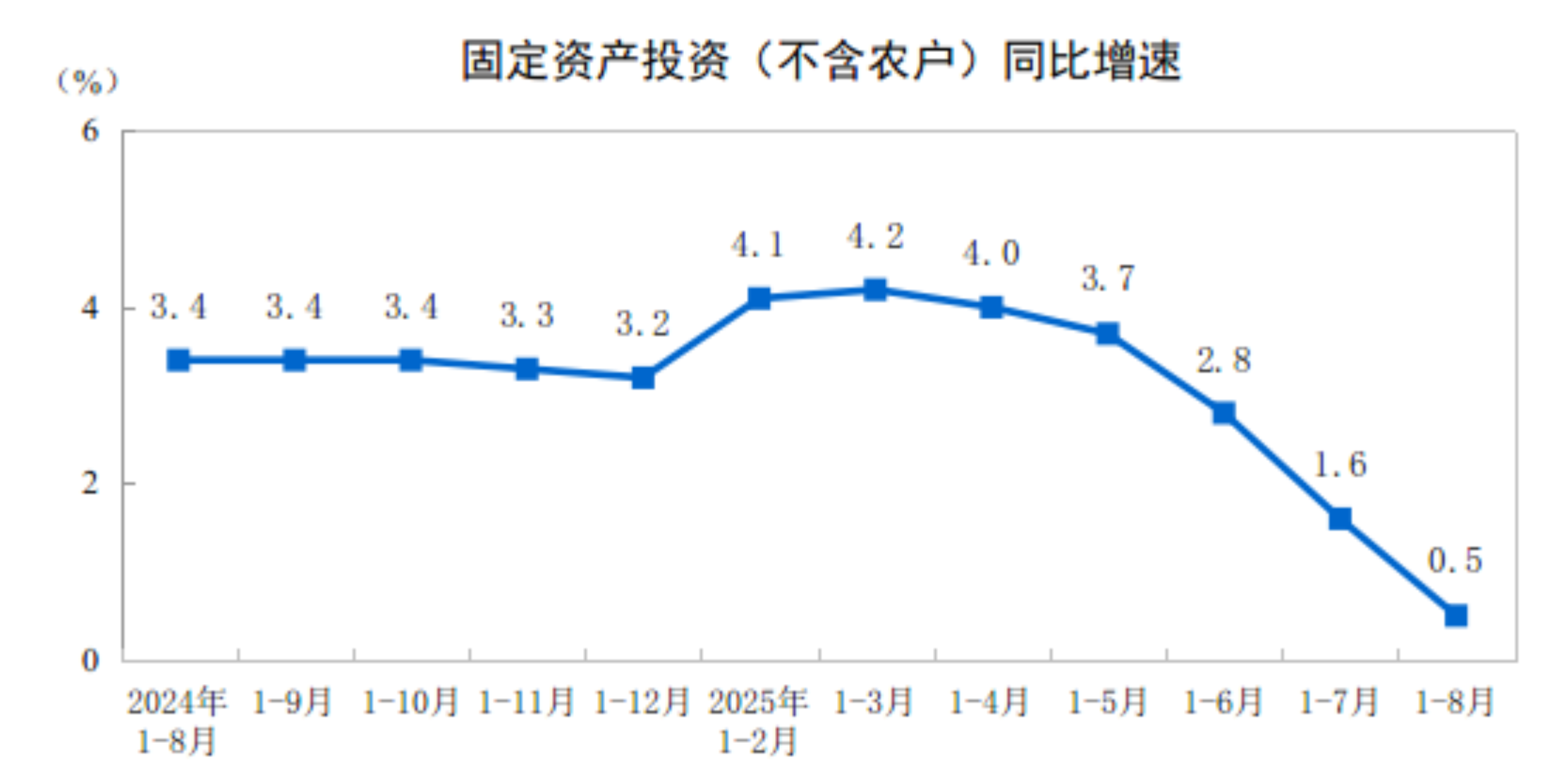
1—8月份,全国固定资产投资(不含农户)同比增长0.5%
Di Yi Cai Jing· 2025-09-15 02:19
Core Insights - National fixed asset investment (excluding rural households) reached 32.6111 trillion yuan from January to August 2025, showing a year-on-year growth of 0.5% [1] - Private fixed asset investment experienced a year-on-year decline of 2.3% [1] Investment by Industry - First industry investment totaled 646.1 billion yuan, with a year-on-year increase of 5.5% [3] - Second industry investment amounted to 11.8246 trillion yuan, growing by 7.6% [3] - Third industry investment was 20.1404 trillion yuan, reflecting a decline of 3.4% [3] - Within the second industry, industrial investment grew by 7.7%, with mining investment increasing by 3.0%, manufacturing investment by 5.1%, and investment in electricity, heat, gas, and water production and supply rising by 18.8% [3] - In the third industry, infrastructure investment (excluding electricity, heat, gas, and water production and supply) grew by 2.0%, with water transport investment increasing by 15.9%, water conservancy management investment by 7.4%, and railway transport investment by 4.5% [3] Investment by Region - Eastern region investment declined by 3.5% year-on-year [3] - Central region investment increased by 2.5% [3] - Western region investment grew by 2.3% [3] - Northeastern region investment saw a decline of 6.0% [3] Investment by Registration Type - Domestic enterprises' fixed asset investment increased by 0.5% year-on-year [4] - Investment from Hong Kong, Macau, and Taiwan enterprises grew by 2.3% [4] - Foreign enterprises' fixed asset investment decreased by 15.4% [4]
贵阳1-7月固定资产投资同比增长3.4%
Sou Hu Cai Jing· 2025-09-04 06:38
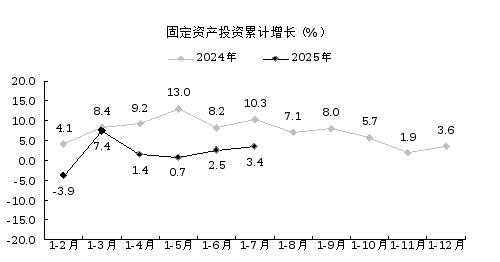
Group 1 - The core viewpoint of the article indicates that from January to July, the fixed asset investment in Guiyang has shown a slight recovery, with a year-on-year growth of 3.4% [1] Group 2 - By industry, the first industry investment decreased by 58.8%, while the second industry investment increased by 5.4%, and the third industry investment grew by 3.8% [1] Group 3 - In terms of specific fields, industrial investment increased by 5.5%, infrastructure investment decreased by 0.3%, and private investment grew by 3.5% [1]
创业板超七成上市公司盈利,营收净利增速领跑A股
第一财经· 2025-09-03 10:26
Core Viewpoint - The overall performance of companies listed on the ChiNext board shows strong growth in revenue and net profit for the first half of 2025, leading the A-share market [3][4]. Financial Performance - A total of 1,384 ChiNext companies reported a combined revenue of 2.05 trillion yuan, with an average revenue of 1.48 billion yuan, representing a year-on-year growth of 9.03% [3]. - The net profit for these companies reached 150.54 billion yuan, with an average of 109 million yuan, marking a year-on-year increase of 11.18% [3]. - The net profit excluding non-recurring items was 130.93 billion yuan, with an average of 95 million yuan, reflecting a growth of 11.80% year-on-year [3]. Profitability and Growth - Over 70% of the listed companies achieved profitability, with more than half reporting a year-on-year increase in net profit [5][6]. - Specifically, 1,028 companies were profitable, accounting for 74.28%, and 728 companies saw a net profit growth, representing 52.6% [6]. - In key sectors such as advanced manufacturing, digital economy, and green low-carbon, over 800 companies generated a combined revenue of 1.34 trillion yuan, with a net profit of 113.92 billion yuan, showing growth rates of 9.87% and 15.90% respectively [6]. Sector Performance - In the green low-carbon sector, over 190 companies achieved a revenue of 507.35 billion yuan, growing by 10.85%, and a net profit of 49.70 billion yuan, increasing by 25.55% [6]. - The new energy vehicle industry saw a revenue growth of 11.45% and a net profit increase of 23.38% [7]. - The digital economy sector, comprising over 300 companies, reported a revenue of 370.95 billion yuan, up 8.66%, and a net profit of 29.22 billion yuan, up 40.03% [7]. Investment and R&D - Companies on the ChiNext board showed a significant recovery in investment expansion, with long-term asset investments totaling 182.23 billion yuan, a year-on-year increase of 9.43% [13]. - R&D expenditures across ChiNext companies reached 94.99 billion yuan, growing by 5.35% year-on-year, with 188 companies spending over 100 million yuan on R&D [12][13]. - The second quarter of 2025 saw a notable increase in R&D spending, with 49.87 billion yuan invested, reflecting a quarter-on-quarter growth of 10.51% [12].



营收超2万亿,净利润超1500亿!创业板上半年成绩单来了
天天基金网· 2025-09-03 05:28
Core Viewpoint - The overall performance of companies listed on the ChiNext board has significantly improved in the first half of 2025, achieving a total revenue exceeding 2 trillion yuan and a net profit exceeding 150 billion yuan, with year-on-year growth rates of over 9% and 11% respectively, leading the A-share market [2][4]. Group 1: Financial Performance - ChiNext companies collectively achieved a revenue of 2.05 trillion yuan in the first half of 2025, with an average revenue of 1.48 billion yuan, representing a year-on-year growth of 9.03% [4]. - The total net profit reached 150.54 billion yuan, with an average net profit of 109 million yuan, reflecting a year-on-year increase of 11.18% [4]. - Over 70% of ChiNext companies reported profits, with more than half experiencing a year-on-year increase in net profit, an increase of 4.86 percentage points compared to the previous year [5]. - In Q2 2025, ChiNext companies achieved a revenue of 1.10 trillion yuan, a quarter-on-quarter growth of 14.95%, and a net profit of 78.82 billion yuan, a quarter-on-quarter growth of 9.90% [5]. Group 2: Key Growth Areas - ChiNext companies are actively integrating into the broader economic development landscape, focusing on innovation-driven strategies in advanced manufacturing, digital economy, and green low-carbon sectors, with over 800 listed companies in these areas [6]. - In the first half of 2025, these three key sectors generated a total revenue of 1.34 trillion yuan, with a year-on-year growth of 9.87%, and a net profit of 113.92 billion yuan, with a year-on-year growth of 15.90% [7]. - The green low-carbon sector showed strong performance, with over 190 companies achieving a revenue of 507.35 billion yuan, a year-on-year increase of 10.85%, and a net profit of 49.70 billion yuan, a year-on-year increase of 25.55% [8]. - The digital economy sector, with over 300 companies, reported a revenue of 370.95 billion yuan, a year-on-year growth of 8.66%, and a net profit of 29.22 billion yuan, a year-on-year growth of 40.03% [8]. - The advanced manufacturing sector achieved a revenue of 461.13 billion yuan, a year-on-year increase of 9.79% [8]. Group 3: Notable Highlights - The top 100 companies by market capitalization on the ChiNext board generated a revenue of 937.23 billion yuan, a year-on-year increase of 14.59%, and a net profit of 102.45 billion yuan, a year-on-year increase of 21.56% [11]. - Overseas revenue for ChiNext companies grew significantly by 21.26% in the first half of 2025, with notable increases in the electronics and communication sectors [11]. - The consumer electronics, automotive, and small home appliance sectors saw net profit increases of 16.80%, 9.57%, and 21.94% respectively, driven by policies supporting consumption recovery [12]. - Research and development expenditures for ChiNext companies totaled 94.99 billion yuan, a year-on-year increase of 5.35%, with a significant number of companies investing heavily in R&D [12]. - Long-term asset investments by ChiNext companies reached 182.23 billion yuan, reflecting a year-on-year growth of 9.43%, indicating a strong recovery in investment expansion intentions [13].

营收超2万亿,净利润超1500亿!创业板上半年成绩单来了
中国基金报· 2025-09-02 15:56
Core Viewpoint - In the first half of 2025, companies listed on the ChiNext board achieved significant improvements in operating performance, with total revenue exceeding 2 trillion yuan and net profit surpassing 150 billion yuan, marking year-on-year growth rates of over 9% and 11% respectively, leading the A-share market [2][4]. Group 1: Overall Performance - ChiNext companies reported total revenue of 2.05 trillion yuan, with an average revenue of 1.48 billion yuan, reflecting a year-on-year increase of 9.03% [4]. - The total net profit reached 1505.42 billion yuan, with an average net profit of 1.09 billion yuan, showing a year-on-year growth of 11.18% [4]. - Over 70% of ChiNext companies were profitable, with more than half experiencing year-on-year net profit growth, an increase of 4.86 percentage points compared to the previous year [4]. - In Q2 2025, ChiNext companies achieved total revenue of 1.10 trillion yuan, a quarter-on-quarter increase of 14.95%, and total net profit of 788.20 billion yuan, up 9.90% quarter-on-quarter [4]. Group 2: Key Growth Areas - ChiNext companies are actively integrating into the broader economic development landscape, focusing on innovation-driven strategies in advanced manufacturing, digital economy, and green low-carbon sectors, with over 800 listed companies in these areas [6]. - In the first half of 2025, these three key sectors collectively generated revenue of 1.34 trillion yuan, a year-on-year increase of 9.87%, and net profit of 1139.19 billion yuan, up 15.90% [6]. - The green low-carbon sector showed strong performance, with over 190 companies achieving revenue of 507.35 billion yuan, a year-on-year increase of 10.85%, and net profit of 496.99 billion yuan, up 25.55% [6]. - The digital economy sector, with over 300 companies, reported revenue of 3709.48 billion yuan, a year-on-year increase of 8.66%, and net profit of 292.15 billion yuan, up 40.03% [7]. - The advanced manufacturing sector saw revenue of 4611.34 billion yuan, a year-on-year increase of 9.79% [7]. Group 3: Highlights of Performance - The top 100 companies on the ChiNext board achieved revenue of 9372.31 billion yuan, a year-on-year increase of 14.59%, and net profit of 1024.54 billion yuan, up 21.56% [9]. - Overseas revenue for ChiNext companies grew significantly by 21.26%, with notable increases in the electronics and communication sectors [9][10]. - Various industries showed strong performance, with consumer electronics, automotive, and small appliances experiencing net profit growth of 16.80%, 9.57%, and 21.94% respectively [10]. - Research and development expenditures totaled 949.89 billion yuan, a year-on-year increase of 5.35%, with 188 companies spending over 100 million yuan on R&D [10][11]. - Long-term asset investments by ChiNext companies reached 1822.32 billion yuan, reflecting a year-on-year increase of 9.43%, indicating a recovery in investment expansion willingness [11].