
耐用消费品

Search documents
金融“活水”润消费 引擎升级促增长
Xiao Fei Ri Bao Wang· 2025-07-01 02:36
Core Viewpoint - The recent joint issuance of the "Guiding Opinions on Financial Support for Boosting and Expanding Consumption" by six Chinese government departments signals a strong commitment to expanding domestic demand, stimulating consumption, and promoting high-quality development [1][4] Group 1: Policy Measures - The "Opinions" propose 19 key measures across six areas, providing a clear direction for financial support of consumption and a roadmap for consumption upgrades [1] - Specific measures include innovative financing models, extending loan terms, and developing intellectual property pledge financing to address challenges in service consumption [2][3] Group 2: Consumption Trends - China's retail sales of consumer goods reached 41.326 trillion yuan in May 2025, with a year-on-year growth of 6.4%, indicating strong resilience and potential in the consumption market [1] - The focus on improving service consumption, particularly in sectors like cultural tourism, sports entertainment, and education, highlights the importance of these areas for driving consumer spending [2] Group 3: Financial Support Mechanisms - The need for systemic reforms to establish a long-term financial support mechanism for consumption is emphasized, aiming to enhance residents' consumption capacity and willingness [1][3] - The integration of data credit, consumer finance, and supply chain finance is proposed to improve financial understanding of emerging consumption industries [3] Group 4: Implementation and Collaboration - The "Opinions" call for a collaborative approach among various departments to ensure effective implementation, including data sharing and resource integration [3] - Establishing a classification assessment mechanism and incentive system for financial institutions is suggested to enhance their role in supporting consumption [3]
行业ETF风向标丨中证A500指数快速反弹,华泰柏瑞中证A500ETF(563360)规模突破200亿元,跃居同类产品第一
Mei Ri Jing Ji Xin Wen· 2025-06-30 07:07
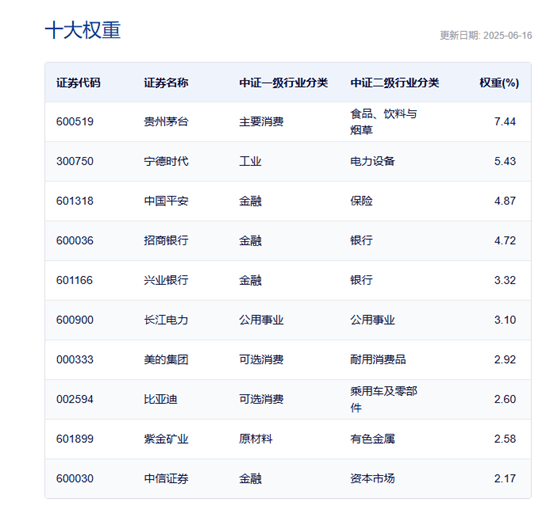
Core Viewpoint - The A-share market has seen a strong rebound with a significant inflow of funds into ETFs, reaching a total scale of over 4.3 trillion yuan, marking a historical high and a year-to-date increase of 15% [1] Group 1: ETF Performance - The Huatai-PineBridge CSI A500 ETF (563360) has attracted substantial capital, with a net inflow of 11.279 billion yuan over just five trading days, achieving an average daily trading volume of 2.55 billion yuan [1] - As of June 27, 2023, the Huatai-PineBridge CSI A500 ETF's scale surpassed 20.256 billion yuan, making it the largest in its category, with a total share count of 19.898 billion [1] - The fund's share count increased by 2.613 billion shares year-to-date, reflecting a change rate of 15.12% [1] Group 2: Investment Logic - Global allocation funds have reached historical highs in U.S. equities, while China's position remains at the bottom, creating potential for long-term capital inflow into Chinese stocks if macroeconomic conditions continue to improve [2] Group 3: Fund Characteristics - The Huatai-PineBridge CSI A500 ETF offers a low-cost investment option with a management fee of 0.15% per year and a custody fee of 0.05% per year, making it one of the most competitively priced equity index products in the A-share market [3] - The fund has a quarterly dividend assessment mechanism, providing investors with flexible capital management options [3] Group 4: Index Composition - The CSI A500 Index selects 500 securities with larger market capitalizations and better liquidity from various industries, focusing on sectors such as electronics, power equipment, pharmaceuticals, and national defense [4] - The index's major weighted stocks include Kweichow Moutai, CATL, and Ping An Insurance, among others, reflecting a diverse industry representation [5] Group 5: Growth and Dividend Attributes - The CSI A500 Index exhibits superior dividend growth characteristics, with higher levels of dividend yield and a greater proportion of companies distributing cash dividends compared to the broader index [8] - The index includes leading companies across various sectors, which are expected to benefit from China's modernization process and increased market concentration due to government policies [8]


【广发宏观王丹】5月企业盈利增速出现调整的原因
郭磊宏观茶座· 2025-06-27 15:06
Core Viewpoint - The revenue growth rate of industrial enterprises above designated size has shown fluctuations, with a significant decline in profit margins, indicating a challenging economic environment and potential investment risks [1][9][10]. Revenue Growth - In the first five months of the year, the cumulative revenue growth rate for industrial enterprises was 2.7%, down from 3.2% in the previous period, with May's month-on-month growth dropping to 0.8% [7][8][10]. - The revenue growth experienced a rebound in January and February, followed by a decline in April and May, reflecting a typical economic nominal growth pattern with insufficient growth momentum [1][7]. Profit Margins - The profit margin change was more pronounced than revenue, with May's profit declining by 9.1%, the lowest since October of the previous year, leading to a cumulative profit decline of 1.1% for the first five months [9][10][11]. - The profit growth rate turned negative again in May after briefly turning positive in March, indicating a volatile profit environment [9][10]. Industry Performance Fastest Growing Industries - Equipment manufacturing, particularly in transportation equipment (56%), general equipment (10.6%), and specialized equipment (7.1%), showed significant profit growth [15][16]. - The aerospace sector, including aircraft manufacturing (120.7%) and related equipment, also reported high profit growth rates [15][16]. - Non-ferrous metal mining and smelting industries saw profit increases of 41.7% and 9.8%, respectively, likely due to rising upstream prices and demand from emerging industries [15][16]. Slowest Growing Industries - The upstream mining sector, textile and apparel industries, and durable consumer goods (automobiles and furniture) experienced the lowest profit growth rates, with coal profits down by 50.6% and automotive profits down by 11.9% [19][20]. - The decline in profits for these sectors is attributed to falling commodity prices and weak domestic demand [19][20]. Profit Structure - The profit structure remains concentrated in midstream manufacturing, with equipment manufacturing accounting for 33.4% of incremental profits, up 3.6 percentage points from the previous year [20][24]. - Public utilities and raw materials industries also saw profit shares increase, indicating a shift in profit distribution within the industrial sector [20][24]. Inventory and Debt - As of the end of May, nominal inventory showed a slight decrease, while actual inventory rose by 6.8%, indicating a mismatch between supply and demand [28]. - The asset-liability ratio for industrial enterprises was 57.7%, with a slight increase year-on-year, reflecting a cautious approach to capital expenditure amid weak demand [30].

天弘基金:中证A100ETF开售,基金经理目前在管产品达8只
Sou Hu Cai Jing· 2025-06-18 03:26
Group 1 - Tianhong Fund launched the Tianhong CSI A100 ETF on June 17, which is a passive index fund managed by Zhang Ge [1][3] - The fund aims to track the CSI A100 Index, which includes 100 large-cap, liquid, and representative companies, with a target tracking deviation of 0.2% and an annualized tracking error of 2% [3] - The fund has a minimum fundraising target of 200 million shares and an annual management fee of 0.15% based on the previous day's net asset value [3][4] Group 2 - Zhang Ge, the proposed fund manager, has 9 years of experience in the securities industry and currently manages 8 funds with a total scale exceeding 2 billion yuan [5][6] - The largest fund currently managed by Zhang Ge is the Tianhong Shanghai Stock Exchange Science and Technology Innovation Board Comprehensive ETF, which has seen a decline of 6.75% since its inception on February 2025 [7] - The Tianhong North Securities 50 Component Index A, managed by Zhang Ge, achieved a year-to-date return of 29.57%, underperforming its benchmark by over 3 percentage points [8]
中证500可选消费指数报3777.31点,前十大权重包含麦格米特等
Jin Rong Jie· 2025-06-17 08:13
Group 1 - The CSI 500 Consumer Discretionary Index has experienced a decline of 5.34% over the past month, 11.66% over the past three months, and 3.10% year-to-date [2][3] - The index is composed of various sectors categorized into 11 primary industries, 35 secondary industries, and over 90 tertiary industries, providing a comprehensive analysis tool for investors [2] - The top ten weighted stocks in the CSI 500 Consumer Discretionary Index include Sichuan Changhong (6.98%), Ninebot (6.47%), Wanfeng Aowei (4.58%), and others [2] Group 2 - The market capitalization distribution of the CSI 500 Consumer Discretionary Index shows that the Shanghai Stock Exchange accounts for 62.26% and the Shenzhen Stock Exchange accounts for 37.74% [2] - The industry composition of the index includes Passenger Cars and Parts (35.25%), Durable Consumer Goods (33.93%), Textiles, Apparel, and Jewelry (11.01%), Retail (10.46%), and Consumer Services (9.35%) [3] - The index samples are adjusted biannually, with adjustments occurring on the next trading day after the second Friday of June and December [3]



预警!高位板块崩塌,聪明钱正涌向这些洼地
Sou Hu Cai Jing· 2025-06-17 04:34
Market Overview - A-shares and Hong Kong stocks exhibited a narrow fluctuation pattern, with major indices showing muted performance [1] - A-share market saw the Shanghai Composite Index slightly down by 0.19% to 3382.14 points, while the Shenzhen Component remained flat and the ChiNext Index fell by 0.14% [1] - Hong Kong's Hang Seng Index dipped by 0.13% to 24028.83 points, with the Hang Seng Tech Index and the China Enterprises Index also experiencing slight declines [1] Industry Performance - A-shares displayed a clear rotation in technology themes, driven by a significant overnight surge of over 283% in brain-computer interface concepts in the US market [2] - The stablecoin concept remained active due to expectations of major policy announcements in Hong Kong, while the solid-state battery sector gained traction ahead of an industry forum [2] - In contrast, the healthcare sector in Hong Kong faced pressure, with some pharmaceutical companies experiencing volatility due to new drug development progress [2] - The durable goods and consumer services sectors also showed weakness, while the industrial sector saw strength, particularly among leading optical technology firms [2] Driving Factors - The structural market dynamics in A-shares are influenced by three main factors: external market sentiment, policy and event catalysts, and capital rotation strategies [2] - The healthcare sector's adjustments in Hong Kong are linked to individual company events and market sentiment fluctuations, while the industrial sector benefits from domestic growth-supporting policies [2] Future Outlook - The macro environment and policy direction remain critical, with steady growth in industrial output and consumption providing fundamental support for the market [3] - The People's Bank of China has conducted two reverse repurchase operations this month, injecting a net of 200 billion yuan into the market, indicating a generally ample liquidity environment [3] - Short-term market trends may continue to exhibit oscillatory dynamics, with high-position themes in A-shares facing increased volatility and the healthcare sector in Hong Kong under valuation pressure [3] - Key areas for mid-term investment focus include AI computing power, solid-state batteries, and commercial aerospace, as these sectors are viewed as priorities for institutional investment [3] - The evolution of core market contradictions, such as the timing of Federal Reserve policy shifts and developments in the domestic real estate market, will significantly influence mid-term market direction [3]
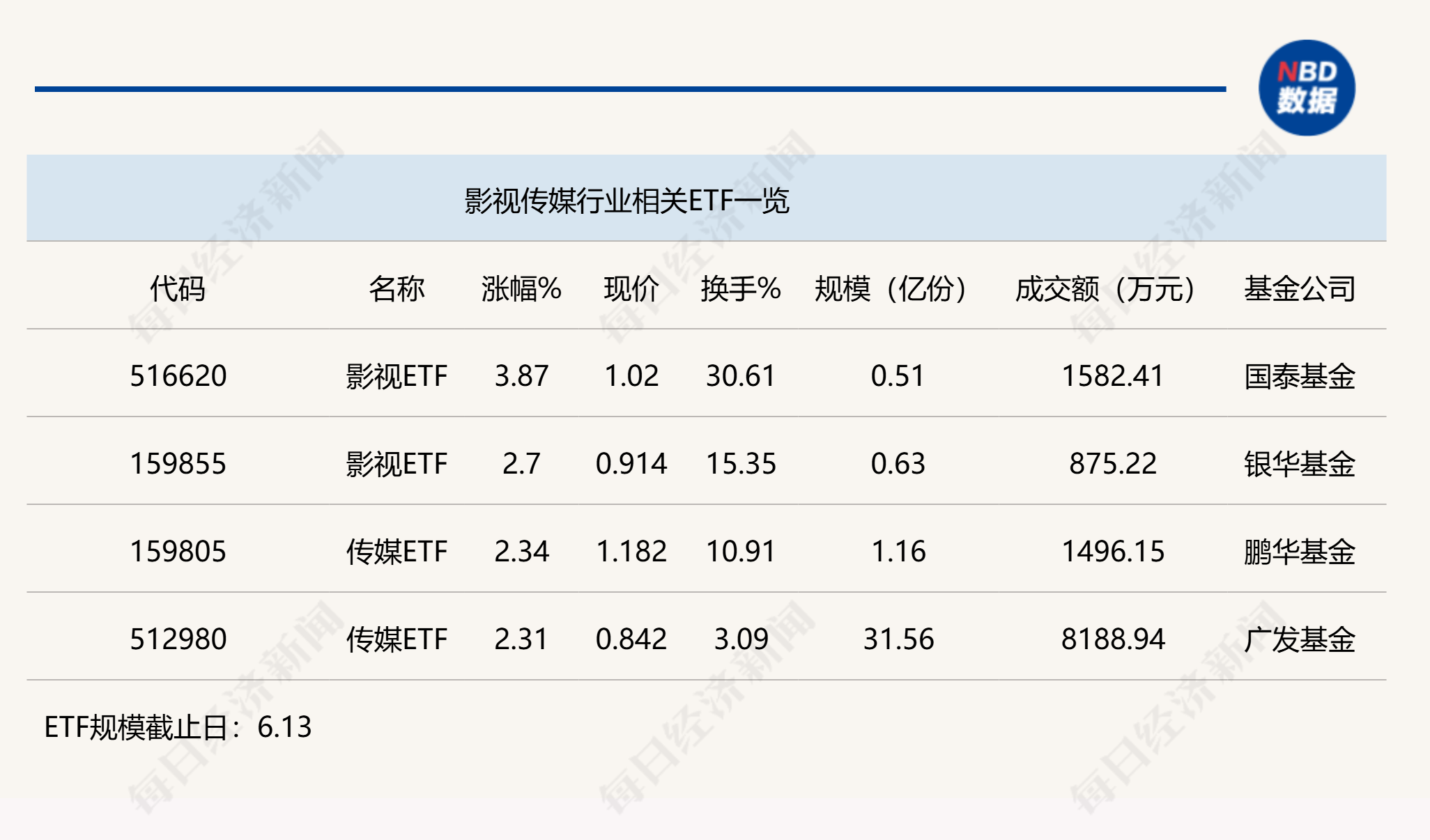
行业ETF风向标丨游戏大热传导做多情绪,4只影视传媒ETF半日涨幅超2%
Sou Hu Cai Jing· 2025-06-16 05:24
Group 1 - The gaming sector's strong performance has positively influenced the entire cultural media industry, with significant increases in related ETFs [1] - Four film and media-related ETFs saw half-day gains exceeding 2%, with the leading performers being the film ETFs [1] - The film ETF (516620) rose by 3.87%, while the film ETF (159852) increased by 2.7%, indicating robust market interest [3] Group 2 - The media ETFs (159805 and 512980) also experienced gains of 2.34% and 2.31% respectively, with the latter having a substantial scale of 31.56 million shares [5] - The overall share volume of media ETFs has decreased significantly this year, with the media ETF (512980) losing 597 million shares, reflecting a year-to-date change rate of -15.91% [2] - The media ETF (159805) saw a reduction of 8.8 million shares, with a year-to-date change rate of -43.04%, indicating a notable decline in share volume [2] Group 3 - The IP economy is gaining traction in the summer season, with positive developments expected from policy, industry, and corporate levels by Q2 2025 [3] - The card game sector's progress in the Hong Kong market has drawn attention to the card game segment within the cultural media IP sector [3] - The Zhongzheng Film Theme Index selects sample stocks from film content providers, distributors, and other beneficiaries in the A-share market [3][4]
中金研究 | 本周精选:宏观、策略、房地产
中金点睛· 2025-06-14 00:28
Real Estate Industry - The real estate market is expected to stabilize gradually, divided into three phases: housing transaction volume, housing prices, and real estate investment [3] - The core point for entering a positive cycle is the upward shift in housing price expectations due to changes in supply and demand structure, which should be a key signal for market observation [3] - Policy measures need to be more decisive to facilitate stabilization, focusing on adjusting supply and demand structures and mitigating risks from enterprises [3] - The probability of a "medium policy" scenario for the real estate fundamentals in 2025 is high, with sales performance potentially exceeding expectations due to the prolonged effects of the 926 policy [3] - A recovery in total housing sales to historically reasonable levels could lead to significant upward potential, with new housing transaction volumes likely to see greater recovery [3] Strategy - The A-share market has shown signs of improvement in early 2025, but external uncertainties are rising, impacting market dynamics [8] - The expected market rhythm for the second half of 2025 is "steady first, then rise," with upward potential dependent on comprehensive policy support [9] - Investment focus should be on certainty in uncertain environments, including opportunities from capacity cycles, high-growth sectors with low correlation to economic cycles, and dividend-paying sectors [9] Macroeconomy - The GDP growth rate has improved while prices remain weak, indicating a widening demand gap due to restrained policy measures [18] - The real estate sector's drag on the economy is expected to continue narrowing, contributing to a "quasi-balance" recovery [18] - The core CPI inflation is anticipated to improve slightly in the second half of the year, but overall inflation is expected to remain weak [18] New Consumption Trends - Despite overall consumption being insufficient, new consumption trends are emerging, characterized by a shift towards quality and rational spending [23] - The Z generation is becoming a key driver of the new consumption wave, indicating a shift in consumer behavior [23] - The potential for consumption in lower-tier cities is increasing as the drag from real estate weakens [23]

从“管高价”到“管低价”:如何提振核心
Soochow Securities· 2025-06-12 09:16
Group 1: CPI Trends and Influences - Since February 2025, CPI has experienced four consecutive months of negative growth, primarily driven by food and energy prices, while core CPI has shown a significant recovery since September 2024[1] - The average CPI year-on-year growth from February to May 2025 was -0.25%, with food contributing -0.24 percentage points and energy contributing -0.29 percentage points, while core CPI contributed +0.28 percentage points[1] - The CPI growth target was adjusted from 3% to 2% in March 2025, indicating a shift in policy focus from preventing high prices to preventing low prices[1] Group 2: Core CPI Components - Core CPI can be divided into three main components: core goods, housing services, and other services, with housing services being a significant drag on core CPI growth[1] - Housing services prices have averaged 0.07% since 2022, down from 1.74% from 2013 to 2022, contributing approximately 0.4 percentage points to the decline in core CPI growth[1] - Other services prices are closely linked to overall wage trends, with a potential for price increases driven by rising demand and improved corporate profits[1] Group 3: Policy Recommendations - To boost core CPI, service consumption subsidies are recommended, which could increase core CPI by approximately 0.3 percentage points, offsetting the negative impact from declining housing service prices[1] - The expected core CPI growth for the second half of 2025 is projected to reach around 1.0% before slightly declining, remaining within the 0.6%-1.0% range[1] - The core goods price is expected to rise initially before a slight decline, while housing service prices are anticipated to remain stable around zero[1]
陆挺:二季度GDP增速在4.8%左右,用有效的财政改革来改变市场预期
Jing Ji Guan Cha Bao· 2025-06-08 09:33
Core Viewpoint - The expected GDP growth rate for the second quarter is around 4.8%, influenced by factors such as export fluctuations, the diminishing impact of trade-in policies on consumption, and ongoing adjustments in the real estate sector [1][2]. Economic Analysis - The economic situation in China is projected to remain relatively stable in the short term, primarily due to a backlog of export orders and the positive effects of trade-in policies on retail [2]. - Export growth is expected to maintain a high level in May and June, potentially close to April's 8% growth rate, but challenges may arise in the second half of the year [2]. - The increase in tariffs on Chinese goods by the U.S. has significantly impacted exports, particularly with a 54% tariff on small packages, which may lead to a substantial decline in exports after the initial surge [3]. - The positive effects of trade-in policies for durable goods are expected to wane, with potential negative impacts on consumer demand in the latter half of the year [3][4]. - The real estate sector is experiencing a prolonged downturn, with a 10% annual decline and a 22% drop in new housing starts, complicating efforts to stabilize domestic demand [4]. Policy Recommendations - Maintaining the stability of the RMB exchange rate is crucial for economic stability, especially given the current challenges in the real estate market and capital outflow concerns [5][6]. - Accelerating fiscal spending and exploring additional stimulus measures are necessary to stabilize the economy in the second half of the year [6]. - The stability of the real estate market is critical, requiring measures such as interest rate cuts and debt resolution for developers to prevent further economic decline [7]. - Structural reforms in the social security system are needed to enhance consumer spending, particularly by increasing pension levels for rural elderly populations [8]. - Fiscal reform is essential to improve local government finances and create independent revenue sources beyond real estate, which is vital for enhancing the business environment [9].