锂电池制造

Search documents
21评论丨加强供需两侧政策协同,促进物价合理回升
2 1 Shi Ji Jing Ji Bao Dao· 2025-07-11 22:47
Group 1: Economic Indicators - In June, the CPI increased by 0.1% year-on-year, marking a shift from decline to growth, indicating positive changes in the price sector [1] - Despite the increase, both CPI and PPI remain at low levels, suggesting that the momentum for sustained recovery needs to be strengthened [1] - China's overall low inflation amidst global high inflation reflects strong supply assurance capabilities, supported by a complete industrial chain, abundant labor resources, and an efficient logistics system [1] Group 2: Supply-Side Structural Reforms - Enhancing supply quality and efficiency is essential for transforming growth momentum and achieving high-quality economic development [2] - Continued deepening of supply-side structural reforms is necessary to adjust structures, expand effective supply, and improve adaptability to demand changes [2] - Measures to address overcapacity and "involution competition" in certain sectors, such as automotive manufacturing and photovoltaic equipment, are being implemented to maintain fair competition and optimize industry ecology [2] Group 3: Demand Expansion Strategies - Stimulating effective demand and expanding new market spaces are crucial for sustainable economic development [3] - A series of policies aimed at boosting domestic demand have been introduced, including tax reductions and consumption environment optimization, showing significant effects in sectors like automotive and home appliances [3] - Investment in public welfare areas such as education, healthcare, and housing is essential to enhance residents' consumption capacity and confidence [3] Group 4: New Productive Forces - Cultivating new productive forces is vital for promoting supply-demand coordination during the economic transformation [4] - Encouraging social capital investment in smart manufacturing, digital economy, and new infrastructure is necessary to drive economic growth and structural optimization [4] - The development of new productive forces requires collaboration among government, enterprises, and society to create a supportive environment and enhance research and market expansion efforts [4]
整体物价低位运行与结构性涨价同在
2 1 Shi Ji Jing Ji Bao Dao· 2025-07-09 22:42
Economic Overview - In June, the Consumer Price Index (CPI) increased by 0.1% year-on-year, marking a shift from negative to positive growth, with food prices showing a reduced decline and non-food prices slightly rising [1] - The Producer Price Index (PPI) fell by 3.6% year-on-year, with a widening decline, indicating that living material prices performed better than production material prices [1] - The average CPI for the first half of the year was -0.1%, while the average PPI was -2.9%, reflecting a low overall price level in the domestic market [1] External Factors - International commodity prices have decreased, creating downward pressure on domestic prices, particularly affecting industries related to oil and gas, with oil and gas extraction prices down by 12.6% year-on-year and fuel prices down by 10.4% [1] - The rise of anti-globalization sentiments and "reciprocal tariffs" from the U.S. has led to increased trade barriers, impacting China's export industries and potentially leading to further price declines in related sectors [2] Internal Factors - The acceleration of energy structure transformation and the increase in green energy have contributed to lower energy prices, with coal mining and washing prices dropping by 21.8% year-on-year due to reduced demand for thermal power [2] - Intense market competition in certain industries, particularly in manufacturing, has led to price suppression, with many companies engaging in price wars due to product homogeneity [3] Structural Price Changes - Policies aimed at reducing "involution competition" have helped alleviate overcapacity in certain sectors, leading to a narrowing of price declines in industries such as automotive manufacturing and lithium battery production [3] - Consumption-boosting policies have positively impacted certain consumer goods sectors, resulting in price increases for items like arts and crafts, sports goods, and smart consumer products [4] - High-tech industries related to smart manufacturing and digital economy are experiencing rapid growth, with product prices showing a year-on-year increase, indicating a promising future for economic transformation [5]
从热风到红外,锂电极片干燥“换道提速”
高工锂电· 2025-06-22 07:00
Core Viewpoint - The article discusses the advancements in lithium battery manufacturing, particularly focusing on the transition to more efficient and environmentally friendly drying technologies, such as the new planar infrared drying system introduced by Leisuo New Materials, which aims to address energy consumption and space utilization issues in the production process [1][2][10]. Group 1: Industry Trends - Over the past five years, Chinese battery manufacturers have led the global market with a focus on speed and scale, significantly advancing the entire supply chain [1]. - As of 2024, the manufacturing landscape is shifting, with cell prices dropping to 0.3 yuan/Wh, and leading companies are accelerating their international expansion [1]. - The industry consensus emphasizes the need to overcome bottlenecks in the early stages of production, particularly in the processes of pulping, coating, and drying, under the dual constraints of energy conservation and rapid delivery [1]. Group 2: Technological Innovations - Leisuo New Materials is set to unveil its new high-efficiency coating drying technology, the planar infrared system, at the 18th High-Tech Lithium Battery Industry Summit [2]. - The new infrared drying technology is positioned as a primary process rather than a supplementary heat source, marking a significant advancement in lithium battery manufacturing [3]. - The core of this system is a graphene-coated infrared module that achieves over 80% infrared conversion efficiency at temperatures between 200°C and 300°C, allowing for more effective heating of coating materials [4]. Group 3: System Benefits - The planar infrared system offers a 30% reduction in drying oven volume, freeing up factory space and saving on construction investments [7]. - It can achieve over 50% energy savings by completely replacing traditional hot air systems, eliminating the need for thermal oil boilers and hot air ducts [14]. - The system also enhances production speed by over 40%, significantly increasing the capacity of production lines [14]. Group 4: Market Adaptation - The planar infrared system addresses challenges associated with overseas expansion, such as the need for large boiler systems and high carbon emissions from traditional hot air drying methods [10][11]. - The all-electric solution of the new system allows for flexible factory designs and aligns with global clean manufacturing trends by enabling the use of green electricity [12]. - The modular design of the system supports quick retrofitting of existing hot air ovens, facilitating a rapid transition to electric heating [12]. Group 5: Broader Implications - The integration of ultrasonic technology in the development of the infrared drying system enhances the overall efficiency and sustainability of lithium battery manufacturing [15][17]. - The current phase of transformation in lithium battery manufacturing emphasizes the importance of equipment efficiency and energy conservation as critical factors for competitiveness in the global market [18].

突发!亿纬锂能注销子公司!
鑫椤锂电· 2025-06-18 09:27
Core Viewpoint - Yihui Lithium Energy is restructuring its operations by dissolving its Beijing branch while establishing a new company in Beijing to enhance its capital strength and international competitiveness through an H-share listing in Hong Kong [4][9]. Group 1: Company Restructuring - On June 16, Yihui Lithium Energy announced the dissolution of its Beijing Technology Branch, authorizing management to handle the related matters [4]. - A new company, Beijing Yihui Lithium Energy Co., Ltd., was established on February 14, 2025, with a registered capital of 10 million RMB, fully owned by Yihui Lithium Energy [7][8]. Group 2: Financial Performance - For the year 2024, Yihui Lithium Energy reported a revenue of 48.615 billion RMB and a net profit attributable to shareholders of 4.076 billion RMB, with a year-on-year growth of 14.76% [9]. - The company achieved a net operating cash flow of 4.434 billion RMB and invested 3.060 billion RMB in R&D, marking a 6.58% increase from the previous year [9]. - The total shipment of power batteries reached 30.29 GWh, a year-on-year increase of 7.87%, while the shipment of energy storage batteries surged to 50.45 GWh, reflecting a 91.9% growth [9].


第一创业晨会纪要-20250606
First Capital Securities· 2025-06-06 08:51
Group 1: Semiconductor Industry - Broadcom reported Q2 adjusted net revenue of $15 billion, exceeding analyst expectations of $14.96 billion, and expects Q3 revenue around $15.8 billion, slightly above the forecast of $15.72 billion [2] - The company anticipates continued growth in AI chip sales into FY2026 due to increased spending from major clients on AI inference [2] - Other semiconductor companies, such as STMicroelectronics and Texas Instruments, have also indicated positive demand outlooks, suggesting a sustained recovery in the global semiconductor industry [2] Group 2: Ethylene Export Restrictions - Recent reports indicate that the U.S. government has notified energy companies to apply for licenses to export ethane to China, with one company's request being denied [2] - This move is perceived as a response to China's rare earth export controls, potentially impacting domestic ethylene cracking enterprises due to reliance on U.S. imports [2] Group 3: Lithium Battery Industry - The lithium battery industry is experiencing a significant downturn, with 108 Chinese lithium companies reporting a 11.87% decline in overall revenue in 2024, and a 67.27% drop in net profit [5] - Over 30 lithium manufacturing companies have ceased operations in the past two and a half years, with total investments exceeding 100 billion [5] - Northvolt's bankruptcy filing is seen as a landmark event in the industry's inventory reduction and capacity cut cycle, indicating a potential upcoming recovery phase [5] Group 4: Consumer Sector - Baiya Co. achieved revenue of 999.5 million yuan in Q1 2025, a significant increase of 30.10% year-on-year, with net profit rising by 27.27% [7] - The company experienced a notable growth in offline channels, with revenue from this segment reaching 650 million yuan, up 49% year-on-year [7] - Baiya's expansion into non-core provinces has resulted in a 125.1% increase in revenue, indicating a strong national growth strategy [7]
碳酸锂日评:国内碳酸锂5月供给预期偏松,国内碳酸锂社会库存量环比减少-20250529
Hong Yuan Qi Huo· 2025-05-29 03:28
Report Industry Investment Rating - Not provided in the given content. Core Viewpoints - The supply of domestic lithium carbonate in May is expected to be loose, with a decrease in the domestic social inventory of lithium carbonate compared to the previous week. The prices of lithium carbonate futures and various lithium-related products have generally declined, while the production and inventory of some lithium products may change in different directions. It is recommended that investors mainly short on price rebounds, paying attention to the support level around 53,000 - 60,000 and the resistance level around 66,000 - 70,000 [6]. Summary by Related Catalogs Lithium Carbonate Futures - On May 28, 2025, the closing prices of near - month, continuous - one, continuous - two, and continuous - three contracts of lithium carbonate futures decreased compared to the previous day. The closing price of the active contract was 60,380 yuan/ton, down 540 yuan; the trading volume was 388,140 lots, down 4,329 lots; the open interest was 283,607 lots, down 10,088 lots; and the inventory was 33,854 tons, down 300 tons [1]. Lithium Spot Prices - The average prices of various lithium - related products such as lithium ore, lithium carbonate, lithium hydroxide, etc. mostly decreased on May 28, 2025, compared to the previous day. For example, the average price of battery - grade lithium carbonate (99.5%/domestic) was 61,500 yuan/ton, down 500 yuan [1]. SMM Lithium Carbonate Inventory - As of May 22, 2025, the total SMM lithium carbonate inventory was 131,779 tons, a decrease of 141 tons compared to the previous week. The inventory of smelters, downstream, and other sources all showed different degrees of decline [1]. Company News - Dazhong Mining has made important breakthroughs in its "iron ore + lithium ore" dual - wheel drive strategy, with rapid progress in its Hunan lithium ore project. Sijie Co., Ltd. released new sulfide products at the 2025 China International Battery Technology Exchange Conference, with leading - level product performance and large - scale orders. Hainan Mining's 20,000 - ton battery - grade lithium hydroxide project achieved full - process connectivity. Rio Tinto will form a joint venture with the Chilean National Mining Company to develop the Maricunga Salt Lake lithium project [1][2][3]. Supply and Demand Analysis - Supply: The total production capacity of Tianqi Lithium's Greenbushes 652,000 - ton wet - process project may reach 240,000 tons/year after it is put into operation in October 2025, which may lead to a decline in the prices of domestic and imported lithium ore. The production of lithium carbonate in May may increase, and the inventory may decrease. The production of lithium hydroxide may also increase, but the export volume may be affected by negative export profits [4]. - Demand: The production and inventory of phosphoric acid iron and lithium iron phosphate may increase. The production, installation, and export of lithium batteries, as well as the production and sales of new energy vehicles in May, may all increase [5][6].
明泰铝业携手鹏辉能源布局新能源 产销两旺首季扣非3.79亿增41.7%
Chang Jiang Shang Bao· 2025-05-26 23:41
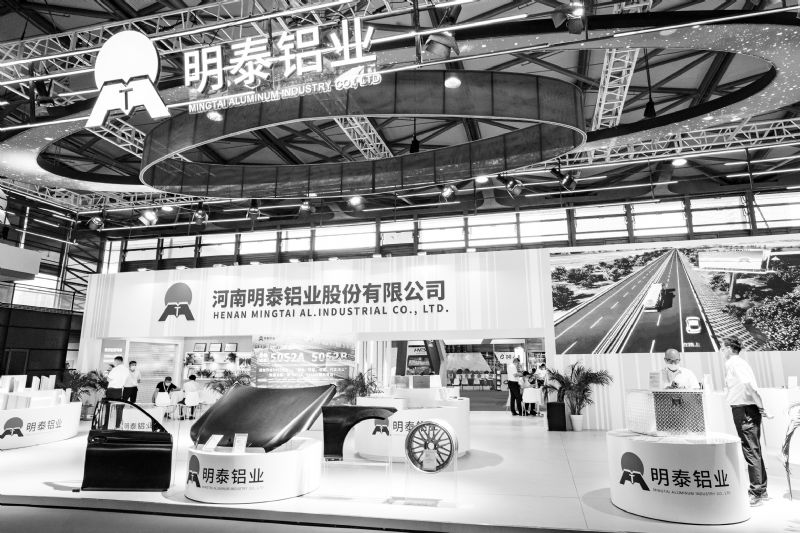
Core Viewpoint - Ming Tai Aluminum Industry (601677.SH), a leading private aluminum processing company in China, is actively expanding into the new energy sector through a strategic partnership with Guangzhou Penghui Energy Technology Co., Ltd. to develop solid-state and sodium-ion batteries, as well as aluminum recycling initiatives [2][3][5] Company Overview - Ming Tai Aluminum is the first private aluminum processing enterprise in China, focusing on aluminum plates, strips, foils, and comprehensive recycling of resources, with advanced production lines and a wide range of products [4][6] - The company has an annual waste aluminum processing capacity of over 1 million tons and a comprehensive utilization capacity of 120,000 tons of aluminum ash [6] Financial Performance - In Q1 2025, the company achieved operating revenue of 8.124 billion yuan, a year-on-year increase of 13.07%, and a net profit of 440 million yuan, up 21.46% [7] - The company reported a record quarterly sales volume of nearly 380,000 tons, marking an 11% year-on-year increase [7] - For the full year 2024, the company recorded operating revenue of 32.321 billion yuan, a 22.23% increase, and a net profit of 1.748 billion yuan, up 29.76% [6] Strategic Initiatives - The partnership with Penghui Energy aims to leverage each party's expertise and resources to enhance collaboration across the new energy supply chain, focusing on sustainable development and innovation [5] - The company is committed to optimizing its product structure, with an increasing proportion of high-value products in new energy, electronics, and transportation sectors [4][6] Shareholder Returns - Ming Tai Aluminum has consistently rewarded its shareholders, with a proposed cash dividend of 1.19 yuan per 10 shares for 2024, totaling 148 million yuan [8]


碳酸锂:矿山出现停产预期,但仍有增量弥补,震荡
Guo Tai Jun An Qi Huo· 2025-05-25 10:47
1. Report Industry Investment Rating - The report does not mention the industry investment rating 2. Core Viewpoints of the Report - The lithium carbonate market is expected to be volatile. The price of the LC2507 contract is projected to range between 55,000 - 63,000 yuan/ton [1][4][5] - The market is transitioning from trading the logic of collapsing mine - end costs to trading the trend of mine shutdowns. However, due to the lack of concentrated shutdowns of high - cost projects and relatively low costs, there is no room for price rebound [4] - For hedging, it is recommended to increase the proportion of buying hedging to 50% in the short - term, and buy spot ore and sell on the futures market to lock in processing profits. In the long - term, selling hedging should still be the main strategy, with a short - term proportion of 30% [7] 3. Summaries According to Relevant Catalogs 3.1 Price Trends This Week - The LC2507 contract of lithium carbonate declined, with positions decreasing and then stabilizing, followed by a decline with increasing positions. The LC2507 contract closed at 60,960 yuan/ton, down 840 yuan/ton week - on - week; the LC2509 contract closed at 62,300 yuan/ton, down 900 yuan/ton week - on - week. The spot price dropped 1,450 yuan/ton to 63,050 yuan/ton [1] - The SMM basis (2505 contract) weakened by 610 yuan/ton to 2,090 yuan/ton. The Fubao trader's premium/discount quotation was + 490 yuan/ton, down 40 yuan/ton week - on - week. The spread between the 2507 - 2509 contracts was - 1,340 yuan/ton, up 60 yuan/ton week - on - week [1] 3.2 Supply and Demand Fundamentals Supply - The lithium ore price dropped to $690/ton, but the decline rate slowed. Some mines started to cut or halt production. In May, the Bikita mining area's emissions nearly stopped, and concentrator work was expected to be cut or stopped. Dongpeng's production cut affected about 1,500 tons of LCE per month [2] - In April, China imported 622,900 tons of spodumene, a 16.5% increase from the previous month, and 28,300 tons of lithium carbonate, a 56.3% increase from the previous month. In the future, the shipments of spodumene and lithium salts from Mali's Kodal and Goulamina projects will gradually increase, while shipments from Zimbabwe projects are expected to decrease. Lithium salt imports are expected to decrease due to high inventories and the cancellation of the reserve price [2] - This week, the lithium carbonate output was 16,093 tons, a 3.23% decrease from the previous week. The overall smelting - end operating rate was 45.75%, a decrease in operation [2] Demand - The 90 - day tariff relaxation period in the US brought a small amount of rush - shipping demand, mainly for the export of energy - storage batteries. However, the tariff level of 40.9% is still higher than the profit of battery cell manufacturers, so the overall effect is limited [2] - This week, the passenger car sales were 382,000 vehicles, among which new energy vehicle sales were 215,000 vehicles, a 3.59% decrease from the previous week. Currently, battery manufacturers' orders to cathode material manufacturers in June are expected to increase month - on - month. However, due to profit losses, cathode material enterprises are maintaining rigid raw material inventory, reducing cathode material production, and actively reducing inventory [2] 3.3 Inventory - The lithium carbonate inventory decreased slightly. Upstream enterprises continued to accumulate inventory, while downstream enterprises actively reduced inventory. The lithium carbonate inventory was 13.2 tons, a decrease of 141 tons from last week. The number of futures warrants decreased to 35,800 tons [3] 3.4 Market Outlook - The market is expected to be volatile. The price of the 2507 contract is expected to range between 55,000 - 63,000 yuan/ton. For inter - delivery trading, no recommendation is given for now [4][5]
联盟牵线,星球石墨在长建研发中心 | 科产融合闯新路
Chang Sha Wan Bao· 2025-05-13 23:32
Core Viewpoint - The integration of technological innovation and industrial innovation in Changsha is essential for enhancing the modern industrial system, focusing on key areas and precise efforts to transform innovation potential into industrial momentum [1] Group 1: Project Implementation and Collaboration - The successful establishment of a 550 million yuan R&D center by Nantong Star Graphite Co., Ltd. in Changsha was facilitated by the Carbon-Based Materials Industry Technology Innovation Strategic Alliance, which acted as a connector [2] - The Carbon-Based Alliance provided comprehensive support throughout the project lifecycle, including site selection, business registration, and talent recruitment, ensuring the company became an integral part of Changsha's carbon-based materials industry ecosystem [3] Group 2: Industry Chain Development - The Advanced Battery Materials and Battery Industry Technology Innovation Strategic Alliance has significantly contributed to the completion of the lithium battery industry chain in Changsha, which previously lacked key components such as separators and electrolytes [4] - Over the past decade, Changsha's lithium battery industry has developed a complete supply chain, leading to the advanced energy storage materials industry cluster's output exceeding 100 billion yuan, making it the third city in China to achieve this milestone [5] Group 3: Strategic Alliances and Ecosystem Building - Various industry technology innovation strategic alliances in Changsha, including the Integrated Circuit Industry Technology Innovation Strategic Alliance and the Kunpeng Computing Industry Technology Innovation Strategic Alliance, are focused on strengthening and complementing the industry chain to attract leading enterprises [7] - The alliances operate with a professional approach, maintaining extensive industry knowledge and a large enterprise resource database to facilitate precise matching of supply and demand [7] - The establishment of an industrial chain investment map by the municipal science and technology bureau aids in decision-making for attracting high-growth technology enterprises and innovation resources, enhancing the overall industrial chain in Changsha [8]

磁悬浮技术重塑锂电模组装配新格局 烽禾升FTS输送线引领效率革命
高工锂电· 2025-05-13 10:31
Core Viewpoint - The article discusses the transition in the new energy industry from scale expansion to efficiency revolution, highlighting the importance of production efficiency and technological innovation in lithium battery manufacturing [3]. Group 1: Industry Trends - The bottleneck in the battery production process has shifted from cell manufacturing to the module PACK stage, where traditional mechanical conveying systems face challenges such as insufficient precision, lack of flexibility, and high costs [3]. - The industry is increasingly focusing on smart magnetic levitation technology to overcome efficiency bottlenecks in the module PACK stage, which offers high precision and flexibility in material handling [4]. Group 2: Company Innovations - Fenghesen Group, a leading provider of intelligent manufacturing solutions, offers comprehensive production assembly solutions for module PACK lines, covering various battery types [5]. - The FTS (Flexible Transport System) introduced by Fenghesen is designed to enhance production efficiency with high precision, flexibility, and cost-effectiveness, redefining material transport logic in smart manufacturing [5][7]. - The FTS system features a positioning accuracy of ≤ 5 μm and significantly improves production line utilization while reducing changeover costs through integrated control systems [6][7]. Group 3: Future Developments - Fenghesen Group is set to open a new R&D building in 2025, which will provide advanced research environments and equipment to support technological innovation [9]. - The company aims to strengthen its core technologies in control, execution, perception, transport, and artificial intelligence, positioning itself as a leader in intelligent manufacturing solutions [9].