水泥

Search documents
上市公司结构向好创新向优
Jing Ji Ri Bao· 2025-11-13 22:10
Core Viewpoint - The A-share market is experiencing a dual growth trend in both emerging and traditional industries, driven by favorable macro policies and technological innovation, despite facing challenges such as weak global economic growth and insufficient domestic demand [1] Emerging Industries - Emerging industries, particularly in hard technology sectors like new generation information technology, new energy, and new materials, are showing strong performance, with 588 companies on the Sci-Tech Innovation Board achieving a total revenue of 1.01 trillion yuan, a year-on-year increase of 6.6% [2] - Key technological breakthroughs are driving the performance of technology companies, with 26 new Class 1 drugs approved in the biopharmaceutical sector and significant advancements in high-end equipment and communication technologies [2] - Companies like Mingzhi Electric and Obit Zhongguang are capitalizing on opportunities in AI and robotics, with revenue growth of 11.66% and 103.5% respectively in the first three quarters [3] R&D Investment - Increased R&D investment is providing strong internal momentum for technology companies, with R&D intensity reaching 4.54% for the ChiNext, 11.22% for the Sci-Tech Innovation Board, and 4.42% for the Beijing Stock Exchange [4] - Companies are focusing on innovation and technology breakthroughs to enhance their competitive edge, as seen with Zhongrun Optical's 50.47% increase in R&D spending [4] Traditional Industries - Traditional industries are also evolving, with companies like Midea Group and Seres adapting to new technologies and applications, resulting in a 13% increase in smart home revenue and significant sales in the electric vehicle sector [5][6] - The steel and cement industries are optimizing supply-demand balances, with companies like Nanjing Steel and Anhui Conch Cement reporting improved profit margins and net profit growth due to strategic adjustments [7] Investor Return Awareness - There is a growing awareness among companies regarding investor returns, with an increase in cash dividend announcements and share buybacks, totaling 734.9 billion yuan in cash dividends announced by 1,033 companies [8] - Companies like Yili Group are actively engaging in share buybacks and dividend distributions to enhance shareholder value [8][9] Future Outlook - Despite external uncertainties, many companies maintain an optimistic outlook for future growth, supported by proactive strategies in R&D, market expansion, and operational efficiency [10]
巴西与英国共同发起工业脱碳倡议
Shang Wu Bu Wang Zhan· 2025-11-13 16:29
Core Points - Brazil and the UK have launched a two-year "Industrial Decarbonization Incubator Initiative" aimed at promoting the decarbonization process in Brazilian industries [1] - The initial investment for the initiative is 8 million Brazilian Reais (approximately 1.49 million USD), funded by the UK government [1] - The initiative will focus on high decarbonization demand sectors such as steel, aluminum, cement, and paper in Brazil [1] - The goal is to select 10 promising projects for incubation, ultimately leading to the implementation of at least 2 demonstration projects [1]
基建地产链2025年三季报综述:盈利仍然承压,经营性现金流表现改善
Soochow Securities· 2025-11-13 12:02
Investment Rating - The report maintains an "Accumulate" rating for the construction materials industry [1] Core Insights - The construction materials industry continues to face pressure on profitability, with operating cash flow showing improvement [1] - The overall revenue of the sample companies in the infrastructure real estate chain decreased by 4.5% year-on-year in Q3 2025, but the decline has narrowed compared to previous quarters [27] - The report highlights that leading companies are seeking external growth and enhancing market share despite the challenging environment [24] Summary by Sections Profit and Loss Analysis - The revenue decline for the construction materials sector has slowed, with Q3 2025 revenues for construction and materials down 4.6% and 3.4% year-on-year, respectively [27] - The revenue growth rates for various sub-sectors in Q3 2025 show significant variation, with design consulting at 38.4% and cement at 53.8% [1][15] - The overall return on equity (ROE) for the sample companies was 6.5%, with the construction and materials sectors at 7.2% and 3.8%, respectively [2][19] - The sales net profit margin for the construction materials sector was 5.5%, reflecting a year-on-year decrease of 0.3 percentage points [3][22] Cash Flow and Balance Sheet - The net cash flow from operating activities for the sample companies reached 926.9 billion, with the construction sector generating 754.8 billion and the materials sector 172.1 billion [8][5] - The overall asset-liability ratio for the sample companies was 75.2%, with the construction and materials sectors at 77.4% and 48.2%, respectively [8][5] Key Sub-sector Performance - In Q3 2025, the construction materials sector's net profit decreased by 14.4% year-on-year, while the materials sector saw a 10.9% increase [4][31] - The highest net profit growth rates were observed in the decoration and renovation sector at 289.0% and glass fiber at 84.7% [31][4] - The report indicates that the cash flow management has improved, particularly in the infrastructure and international engineering sub-sectors [8][5]
国泰海通|建材:水泥出海国别研究之赞比亚、马拉维
国泰海通证券研究· 2025-11-13 11:03
Core Insights - The article provides an in-depth analysis of the economic development, cement supply and demand situation, competitive landscape, profitability, and trend predictions for Zambia and Malawi [1] Economic Overview - Both Zambia and Malawi have low economic development levels, with Malawi facing a significant cement supply gap that necessitates imports from Zambia and other countries [2] - Zambia has a rich mineral resource base, particularly in copper and cobalt, with favorable foreign exchange conditions, while Malawi has experienced significant currency depreciation and some foreign exchange controls [2] Cement Supply and Demand - Malawi's cement production is insufficient, with an output of less than 500,000 tons against a demand of over 1.7 million tons, indicating a substantial supply gap [2] - Zambia is a dominant player in the local cement market, exporting cement clinker to Malawi and Zimbabwe to address local supply shortages [2][3] Competitive Landscape - Huaxin Cement is the largest cement producer in Zambia, with a production capacity of 1.77 million tons, accounting for approximately one-third of the market share [3] - In Malawi, only two companies are capable of producing cement, with Huaxin Cement expected to lead the market after commissioning its plant in September 2025, contributing 800,000 tons to the local capacity [3] Pricing and Profitability - Cement prices in Malawi are notably high at $200 per ton, positioning it among the highest price regions in sub-Saharan Africa [4] - Zambia's cement prices remain elevated, with Dangote's Q3 factory price nearing $110 per ton, benefiting from stable competition and regional price linkages [4] - Zambia's profitability is robust, with Chilanga expected to achieve over $20 million in net profit from a production capacity of 1.2 million tons in 2024, translating to a net profit of over $20 per ton [5] Future Outlook - The demand for cement in both Zambia and Malawi is expected to rise, while supply remains stable, suggesting that prices are likely to maintain high levels [6] - Huaxin Cement plans to expand its production capacity in both Zambia and Malawi by 2025 [6]



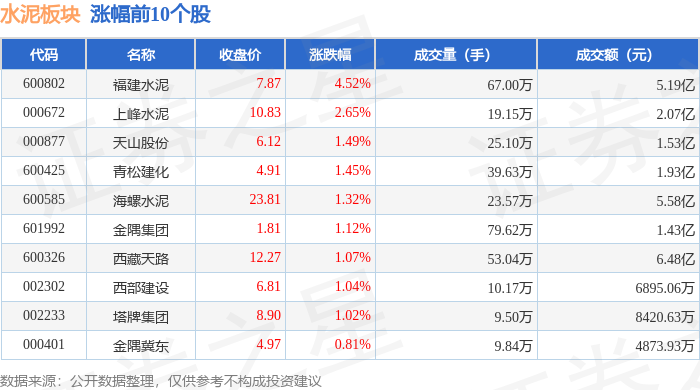
水泥板块11月13日涨1.04%,福建水泥领涨,主力资金净流出1.34亿元
Zheng Xing Xing Ye Ri Bao· 2025-11-13 08:45
Group 1 - The cement sector experienced a rise of 1.04% on November 13, with Fujian Cement leading the gains [1] - The Shanghai Composite Index closed at 4029.5, up 0.73%, while the Shenzhen Component Index closed at 13476.52, up 1.78% [1] - Fujian Cement's stock price increased by 4.52%, closing at 7.87, with a trading volume of 670,000 shares and a transaction value of 519 million yuan [1] Group 2 - The cement sector saw a net outflow of 134 million yuan from institutional investors and 121 million yuan from speculative funds, while retail investors had a net inflow of 255 million yuan [2] - The trading data for various cement stocks indicates mixed performance, with some stocks experiencing declines, such as Sichuan Jinding, which fell by 3.87% [2][3] - The net inflow and outflow of funds varied significantly among different stocks, with Fujian Cement showing a net inflow of 22.72 million yuan from institutional investors [3]




建筑建材行业2026年度策略报告:行业底部区间,反内卷加速格局重塑-20251113
Western Securities· 2025-11-13 08:30
Core Conclusions - The construction sector has seen a cumulative increase of 10.83% from the beginning of 2025 to November 11, 2025, underperforming the broader market, while the building materials sector has increased by 22.32%, outperforming the market [7][18] - The overall construction market is experiencing a decline in scale, with significant business homogenization, necessitating a transformation within the industry, particularly among large state-owned construction enterprises [7][46] - The cement industry is under pressure, with a projected 6% decline in demand for the year, while supply-side policies aimed at capacity reduction and carbon emissions are expected to be key drivers for future adjustments [8][9] Industry Review - The construction and building materials sectors have shown varied performance, with the construction sector ranking 20th out of 30 industries in terms of cumulative growth, while the building materials sector ranks 10th [18][20] - The cement sector has faced declining sales volumes for most companies in 2025, with a significant increase in inventory levels due to poor peak staggering [8][9] - International engineering projects are seeing sustained growth, particularly in regions involved in the Belt and Road Initiative, with many state-owned construction companies reporting an increase in overseas orders [8][9] Investment Recommendations - The report suggests focusing on large construction blue-chip stocks such as China Railway and China Communications Construction, while also considering companies involved in international engineering and those with cyclical elasticity in domestic demand [9] - The report emphasizes the importance of high dividend yields from undervalued state-owned construction companies as a potential investment opportunity [8][9] Financial Performance Summary - The revenue decline in the construction sector has narrowed, while profit pressures continue, with significant improvements in cash flow noted [9][57] - For the cement industry, revenue declines have expanded, and profit growth has slowed, indicating ongoing challenges [9][57] - The eight major state-owned construction enterprises reported a total revenue of 4.81 trillion yuan for the first three quarters of 2025, reflecting a year-on-year decline of 3.99% [61]
中国中材国际工程股份有限公司 关于重要参股公司对外投资(海外)的进展公告
Zhong Guo Zheng Quan Bao - Zhong Zheng Wang· 2025-11-13 05:03
Group 1 - The company has announced the establishment of a new investment entity, Central Asia SPV Company, in the United Arab Emirates to invest in Kazakhstan's QazCement Industries LLP, acquiring a 70% stake for an investment of approximately $37.85 million [2][3] - The transaction has received all necessary approvals, including registration of the Central Asia SPV Company and various certificates from Chinese regulatory bodies, as well as passing antitrust reviews in Kazakhstan [3] - The conditions for the equity transfer have been met, and the company has successfully transferred all rights and obligations under the investment framework agreement to the Central Asia SPV Company, completing the shareholder change registration [4]

中国建材(03323.HK):25Q3水泥小幅减亏 新材料提供正贡献
Ge Long Hui· 2025-11-13 04:01
Core Insights - The company reported a revenue of 133.4 billion, a year-on-year decrease of 1%, while net profit attributable to shareholders improved significantly to 2.96 billion from a loss of 0.68 billion in the same period last year [1] Cement Sector - Tianshan shares experienced a slight reduction in losses in Q3 2025, with a sales volume of 144.1 million tons, down 12.8% year-on-year, indicating a greater decline than the industry average [2] - The company's Q3 revenue was 18.96 billion, a year-on-year decrease of 12.9%, while net profit was -0.26 billion, a year-on-year increase of 22.6% [2] Engineering Sector - China National Materials International's Q3 2025 performance remained stable year-on-year, with a revenue of 32.998 billion, a 3.99% increase, and a net profit of 2.074 billion, a 0.68% increase [3] - The Q3 revenue was 11.322 billion, a year-on-year increase of 4.48%, while net profit decreased by 1.18% to 0.653 billion [3] New Materials Sector - China National Materials Technology reported a net profit of 0.48 billion in Q3 2025, a year-on-year increase of 235% [3] - The main business faced challenges due to credit impairment losses in blade business and a temporary decline in fiberglass prices, although prices began to rise in September [3] Gypsum Board Sector - BNBM's gypsum board business faced short-term pressure, with a revenue decline of 2.25% year-on-year for the first three quarters, and a Q3 revenue drop of 6.20% [4] - The company expects revenue growth in waterproof and paint businesses due to its state-owned enterprise background and resource advantages [4] - Q3 net profit was 0.657 billion, a year-on-year decline of 29.47% [4]
生态环境部:"十五五"碳排放权交易市场逐步转向总量控制
Zhong Guo Chan Ye Jing Ji Xin Xi Wang· 2025-11-13 00:19
Core Insights - The national carbon market in China is transitioning from intensity control to total control during the 14th Five-Year Plan period, with a focus on enhancing green and low-carbon transformation in key industries [1][2][3] Group 1: Mandatory Carbon Market - The mandatory carbon market has expanded to include the steel, cement, and aluminum industries, which will enhance emission reduction responsibilities for these sectors [2] - By 2027, priority will be given to implementing total quota control for industries with relatively stable carbon emissions, ensuring effective compliance with national greenhouse gas emission control targets [2][3] - The carbon market has already reduced overall emission reduction costs in the power generation sector by approximately 35 billion yuan during the first two compliance cycles [3] Group 2: Voluntary Carbon Market - The voluntary carbon market has entered a critical development phase, with 31 projects registered and a total of 1.504 million tons of CCER traded, amounting to a transaction value of 270 million yuan [4][5] - The framework for the voluntary carbon market has been established across management systems, technical methods, and infrastructure, with a focus on enhancing the integrity and regulatory compliance of voluntary reduction projects [4][5] Group 3: Carbon Footprint Management - The average carbon footprint factor for electricity in China has decreased by 6.9% from 0.6205 kg CO2 equivalent per kWh in 2023 to 0.5777 kg CO2 equivalent per kWh in 2024, reflecting improvements in energy structure and technological innovation [6][7] - The Ministry of Ecology and Environment is committed to building a product carbon footprint management system, addressing key issues related to calculation and data availability [6][7]
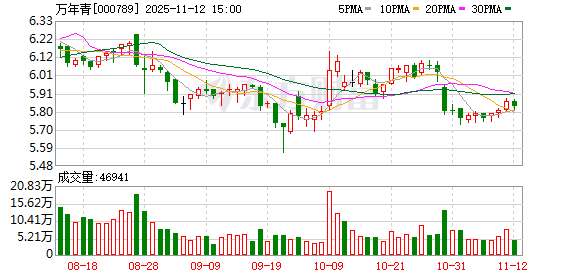
万年青:未来公司将加快绿色低碳发展步伐,积极推广应用节能降碳新技术、新装备
Zheng Quan Ri Bao· 2025-11-12 14:24
Core Viewpoint - The company is actively responding to national low-carbon transition policies and is implementing various measures for green and low-carbon transformation, which may benefit the long-term development of the cement industry [2] Group 1: Company Initiatives - The company is adopting alternative fuels, photovoltaic power generation, promoting the creation of green factories, and re-greening mines as part of its green low-carbon transformation efforts [2] - The company plans to accelerate its green low-carbon development pace by promoting the application of energy-saving and carbon-reducing new technologies and equipment [2] - The company aims to improve its carbon emission management system and optimize carbon asset management to effectively respond to carbon trading [2] Group 2: Industry Impact - The introduction of relevant policies may accelerate the elimination of inefficient production capacity and optimize the industry structure [2] - These changes are expected to be beneficial for the long-term development of the cement industry [2]