
机械

Search documents
今年以来A股再融资规模逾8000亿元 较去年全年增幅高达258.7%
Cai Jing Wang· 2025-09-12 10:54
Group 1 - The A-share refinancing market has seen significant activity in 2023, with total funds raised reaching 800.21 billion yuan, a 258.7% increase compared to last year's total of 223.12 billion yuan [1] - The surge in refinancing is attributed to a combination of policy and market factors, including the optimization of the refinancing process through the registration system reform and increased funding needs in sectors like new energy and semiconductors [1][2] - The private placement market has been particularly strong, with 108 projects completed, raising 756.43 billion yuan, marking a 337.1% increase from the previous year [1] Group 2 - Three main factors driving the refinancing market's growth include improved macro policy environment, increased internal demand from companies due to economic recovery, and ample market liquidity with institutional investors actively participating [2] - The number of disclosed private placement plans has reached 424, with an average expected fundraising of 1.10 billion yuan per project [2] - The manufacturing and high-tech industries are the primary drivers of refinancing, with significant activity in sectors such as chemicals, machinery, and semiconductors [3] Group 3 - The characteristics of the refinancing market in 2023 include a notable rebound in private placements and a targeted flow of funds towards technological innovation [3] - The active refinancing market enhances the capital market's ability to serve the real economy, supporting companies in expanding investments and upgrading technology [3] - The allocation of refinancing funds towards key areas like technological innovation and green low-carbon initiatives promotes economic structure optimization and fosters new productive forces [3]
西部唯一沿海省份,不愿放过出海生意
3 6 Ke· 2025-09-12 02:11
Group 1: Trade Relations and Economic Impact - ASEAN has become an important part of China's foreign trade, with China being ASEAN's largest trading partner for 16 consecutive years and ASEAN being China's top trading partner for five years [1][2] - In the first seven months of this year, trade between China and ASEAN reached $597 billion, a year-on-year increase of 8.2%, accounting for 16.7% of China's total foreign trade [1] - From 2004 to 2024, Guangxi's trade with ASEAN increased from 8.29 billion to 397.82 billion, a growth of approximately 48 times [6] Group 2: Challenges Faced by Guangxi - Guangxi faces geographical limitations, as its rivers flow eastward into Guangdong, leading to increased transportation costs and causing goods to be exported through the Pearl River Delta instead of Guangxi [8][9] - The industrial structure in Guangxi is relatively weak, with many industries being at the low end of the value chain, resulting in limited competitiveness [10] - Despite being a coastal province, Guangxi's trade with ASEAN is overshadowed by Guangdong, which has become ASEAN's largest trading partner since 2020, with trade expected to reach 1.5 trillion by 2024 [7] Group 3: Infrastructure and Industrial Development - Guangxi is actively working on infrastructure projects, such as the Pinglu Canal, which is expected to significantly shorten shipping routes and save logistics costs [12] - The region is also enhancing its transportation network to connect with the Guangdong-Hong Kong-Macao Greater Bay Area, aiming to establish a modern comprehensive transportation system [12] - Guangxi is focusing on strengthening its industrial chains in sectors like new energy vehicles and fine chemicals, aiming to become a key supplier for the Greater Bay Area [12][13] Group 4: Digital Economy and AI Initiatives - The upcoming China-ASEAN Expo will focus on artificial intelligence and the digital economy, marking a shift in cooperation towards a "3.0 era" [1] - Guangxi aims to establish itself as a hub for AI industries, with plans to achieve an output value of over 100 billion in AI-related industries by 2027 [14] - The region is also looking to leverage its geographical advantages to capitalize on the growing digital economy in ASEAN, which is projected to reach $263 billion in 2024 [13][14]
今年以来A股再融资规模逾8000亿元
Zheng Quan Ri Bao· 2025-09-11 16:45
Group 1 - The A-share refinancing market has seen significant activity in 2023, with total funds raised reaching 800.21 billion yuan, a 258.7% increase compared to last year's total of 223.12 billion yuan [1] - The surge in refinancing is attributed to policy and market resonance, including the optimization of the refinancing process through registration system reforms and increased funding needs in sectors like new energy and semiconductors [1][2] - The private placement market has been particularly strong, with 108 projects completed, raising 756.43 billion yuan, marking a 337.1% increase from the previous year [1][2] Group 2 - Three main factors driving the refinancing market's growth include improved macro policy environment, increased internal demand from companies, and ample market liquidity [2] - The number of disclosed private placement plans has reached 424, with an average expected fundraising of 1.10 billion yuan per project [2] - The manufacturing and high-tech industries are the primary drivers of refinancing, with significant activity in sectors such as chemicals, machinery, and semiconductors [3] Group 3 - The active refinancing market enhances the capital market's ability to serve the real economy, supporting companies in expanding investments, upgrading technology, and facilitating mergers and acquisitions [3] - The allocation of refinancing funds is increasingly directed towards technology innovation and green low-carbon initiatives, promoting economic structure optimization [3] - The refinancing market provides diverse investment tools for investors, attracting long-term capital and contributing to a multi-tiered capital market system [3]
对话菁英投顾——“多金多玉组合”主创洪金钰
申万宏源证券上海北京西路营业部· 2025-09-11 02:51
Core Viewpoint - The article emphasizes the importance of balancing value investing with trend following, highlighting that investors often lose money during bull markets due to overconfidence and neglecting risk management [2][3]. Market Overview - The A-share market is currently experiencing wide fluctuations with clear structural characteristics, indicating that quality assets often present buying opportunities during corrections [7]. - The driving forces behind this year's structural market include continuous inflows of incremental capital, the relocation of household deposits, expanded financing balances, and foreign capital returning [7]. - Growth stocks, particularly in technology sectors like AI computing and semiconductors, remain favored in the current market environment [7]. Investment Philosophy - The "Four Good Principles" for stock selection include: - Good Industry: Focus on high-ceiling industries with clear business models and avoid sunset industries [10]. - Good Company: Select leading firms with strong competitive advantages and solid financial health [10]. - Good Price: Invest when the market undervalues a company, adhering to the principle of safety margin [10]. - Good Patience: Maintain a long-term perspective and avoid reacting to short-term market noise [11]. Investment Strategy - The "Duojin Duoyu Combination" service product has achieved a relative return of 114.37% compared to the CSI 500 index over its first year [13]. - The strategy combines deep fundamental research with trend-following tactics, focusing on both long-term value and short-term growth opportunities [13]. Trend Analysis - True Trends (Fundamental Trends): Focus on industries aligned with national policies and societal changes, selecting sectors expected to thrive in the next 3-5 years [14]. - Market Trends: Identify stocks in upward price channels through technical indicators and gauge market sentiment to capture thematic investment opportunities [16]. Positioning Strategy - Core Position (50%-70%): Invest in high-quality companies for long-term growth, making adjustments only for significant fundamental changes [17]. - Swing Position (30%-50%): Target stocks with both strong fundamentals and market momentum for capturing mid-term investment opportunities [17]. Buying and Selling Strategies - Buying Strategy: - Core Position: Use a pyramid buying approach, adding to positions as prices decline [18]. - Swing Position: Enter when stocks break through key resistance levels [18]. - Selling Strategy: - Core Position: Sell if fundamental logic is broken or if valuations reach historical highs [19]. - Swing Position: Sell upon reaching target returns or if technical trends deteriorate [20]. Risk Management - Maintain strict risk control measures, including limiting exposure to any single industry and individual stock [20]. - Regularly reassess portfolio allocations based on market conditions and overall valuation levels [21]. Insights - The article concludes with the importance of maintaining rationality, adhering to established strategies, and having patience in the investment journey [23].


连德国媒体都佩服中国了!德国媒体报道:在中美关税战中,东方大国的强硬态度让全球震惊
Sou Hu Cai Jing· 2025-09-10 15:45
Core Viewpoint - The article discusses the shift in global media perception towards China, particularly in Europe, highlighting a growing respect for China's strategic use of resources, especially rare earth elements, in the context of trade tensions with the United States [1][3]. Group 1: Trade War and Rare Earth Elements - The U.S.-China trade war began in 2018, with the U.S. imposing tariffs on steel, aluminum, and semiconductors, amounting to over a hundred billion dollars [3]. - China responded to U.S. tariffs by leveraging its dominance in rare earth elements, which are crucial for high-tech and military applications, with over 70% of U.S. rare earth imports coming from China [3][6]. - In April 2025, China announced new export management rules for rare earths, prioritizing domestic needs, showcasing its strategic leverage in the supply chain [3][6]. Group 2: Germany's Perspective - Germany, as a supply chain-driven economy, recognizes the risks of resource supply disruptions, which could halt entire industries [5]. - German media noted that China's assertive stance is part of a broader strategy to upgrade its industrial capabilities rather than merely exporting raw materials [5][10]. - The respect from Germany stems from China's long-term planning in the rare earth sector, as evidenced by the 2023 "Rare Earth Industry Development Plan" aimed at achieving self-sufficiency in key technologies [6]. Group 3: Technological Advancements - China is not only rich in rare earth resources but is also making significant technological advancements, such as developing room-temperature superconductors and enhancing 5G transmission speeds [8]. - The integration of rare earths with green technologies, such as CO2 conversion into gasoline, demonstrates China's innovative approach to resource utilization [8]. - China's dominance in rare earth-related patents, accounting for 83% of global patents, indicates a shift from merely selling raw materials to selling technology [8]. Group 4: Strategic Implications - The U.S. miscalculated by believing that tariffs would force China to concede, but instead, it has led to China's self-sufficiency in the rare earth supply chain [10]. - The article suggests that the long-term implications of this trade war could result in China becoming increasingly stronger in the global market [10].

兴业证券:本轮A股和港股上涨由何贡献?
智通财经网· 2025-09-10 12:44
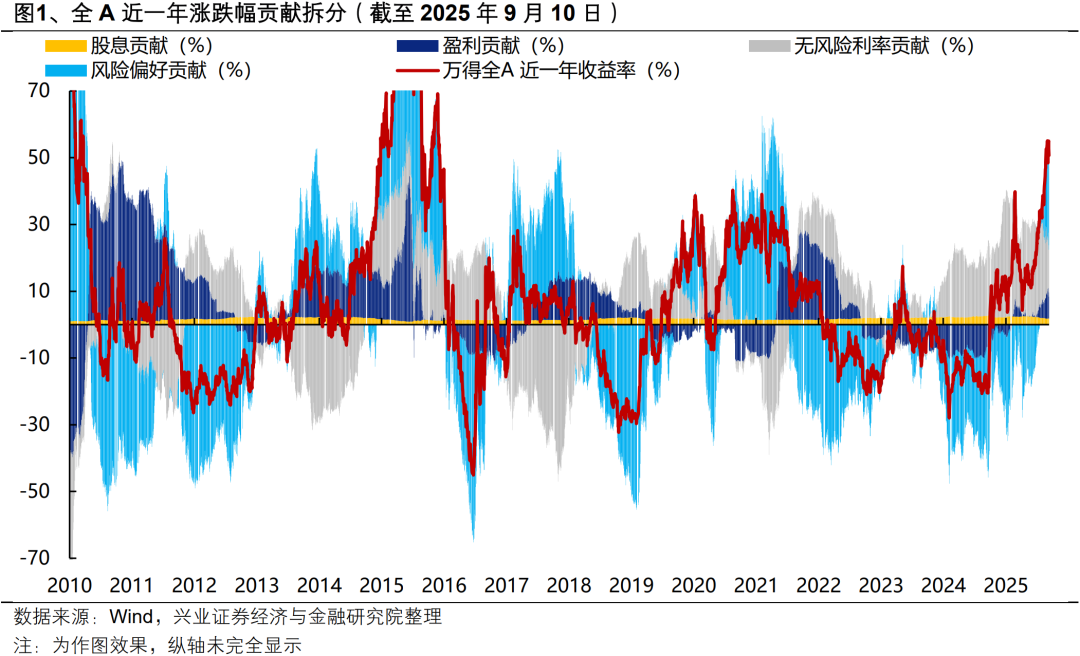
Core Viewpoint - The report from Industrial Securities analyzes the contribution of profit, valuation, and dividends to the recent performance of A-shares and Hong Kong stocks, highlighting the breakdown of valuation contributions into risk-free rate and risk preference [1]. A-shares Performance Breakdown - In the past year, the total increase of A-shares was 50.66%, with dividend contribution at 1.85%, profit contribution at 6.5%, risk-free rate contribution at 14.1%, and risk preference contribution at 28.2% [1]. Hong Kong Stocks Performance Breakdown - The Hang Seng Index increased by 55.47% over the past year, with dividend contribution at 2.99%, profit contribution at 10.56%, risk-free rate contribution at 25.34%, and risk preference contribution at 16.59% [4]. Industry Performance Analysis - A-shares - Among A-shares, sectors such as telecommunications, non-ferrous metals, media, machinery, and electronics showed positive profit contributions, while sectors like coal, petrochemicals, food and beverage, utilities, and construction faced declines due to limited valuation increases alongside profit downturns [6]. Industry Performance Analysis - A-shares (Secondary Level) - In the secondary industry analysis of A-shares, sectors with significant increases generally had positive profit contributions, while sectors like ground weaponry, glass fiber, new metal materials, automation equipment, auto parts, small appliances, and rubber had negative profit contributions driven mainly by valuation [7]. Industry Performance Analysis - Hong Kong Stocks - For Hong Kong stocks, leading sectors such as agriculture, light industry, non-ferrous metals, pharmaceuticals, steel, and electronics had positive profit contributions, while sectors like social services, construction, petrochemicals, and coal were negatively impacted by profit declines and limited valuation increases [11]. Industry Performance Analysis - Hong Kong Stocks (Secondary Level) - In the secondary industry analysis of Hong Kong stocks, leading sectors generally had positive profit contributions, while sectors like automation equipment, semiconductors, medical devices, and communication equipment faced negative profit contributions primarily due to valuation [13].

欧盟推进与南方共同市场贸易协定
Shang Wu Bu Wang Zhan· 2025-09-05 17:28
Core Points - The European Union is seeking to sign new trade agreements with countries like India, Indonesia, and Thailand amid escalating tariff tensions with the United States [1] - The EU is accelerating the push for a trade agreement with the Southern Common Market (Mercosur), which will gradually eliminate a 35% tariff on European cars and tariffs on automotive parts, machinery, chemicals, textiles, and other industrial goods [1] - The European Commission estimates that this agreement could save EU exporters over 40 billion euros annually [1] - The agreement aims to strengthen the EU's presence in a region where China has become a significant industrial supplier and raw material buyer for Mercosur [1]
如何看待A股2025年中报表现︱重阳问答
重阳投资· 2025-09-05 07:33
Core Viewpoint - A-share companies are currently experiencing a bottoming out in profitability, with a notable structural divergence in performance across sectors [2][3] Summary by Sections Overall Performance - A-share companies' total revenue growth for the first half of the year is -0.02%, while non-financial enterprises show a decline of -0.53% year-on-year, indicating a slight improvement compared to the first quarter [2] - Net profit growth for A-share companies is 2.42%, and for non-financial enterprises, it is 0.98%, both showing a decline from the first quarter [2] - The second quarter's net profit growth for non-financial enterprises reached a seasonal low since 2010, primarily driven by financial companies [2] - Return on Equity (ROE) for A-share companies is 7.76%, and for non-financial enterprises, it is 6.55%, both down from the previous quarter [2] - Cash flow analysis shows that while net cash flow remains negative, operational, investment, and financing cash flows have improved, with non-financial real estate companies maintaining high free cash flow levels, indicating strong potential for dividends [2] Structural Performance - High-tech and overseas-oriented companies are performing well, while domestic consumption sectors are still recovering [3] - The net profit growth for the Sci-Tech Innovation Board exceeded 20% in the second quarter, leading the market, with significant contributions from the AI, semiconductor, and innovative pharmaceutical sectors [3] - Companies focused on overseas markets, as indicated by the Outbound 50 Index, reported a revenue growth of 12% and a 0.6% increase in ROE, outperforming the overall market [3] - Companies with over 10% of revenue from overseas markets are seeing a recovery in profit margins and ROE, making overseas business a key growth driver [3] - In contrast, domestic consumer goods sectors have shown a significant decline in growth rates compared to the first quarter, indicating a need for recovery in domestic consumption [3] - Overall, A-share companies' profitability is gradually solidifying, with innovation and overseas expansion becoming new growth points [3]

2025苏州紧缺人才目录发布 15个专业人才需求旺盛
Su Zhou Ri Bao· 2025-09-05 00:24
Core Insights - Suzhou has released the "2025 Key Industry Talent Demand Directory," highlighting a strong demand for professionals in electronic information, machinery, and computer fields, particularly in new generation information technology, high-end equipment, and new materials [1][2] Group 1: Talent Demand and Salary Insights - The directory identifies 868 critical professional categories and 3,373 job postings, expanding coverage to include quantum computing and smart agriculture in advanced manufacturing, and data services and wellness services in the service industry [1] - High-paying positions in advanced manufacturing include roles such as intelligent research experts and AI algorithm engineers, with annual salaries exceeding 1 million yuan, while service industry roles like big data algorithm experts earn over 600,000 yuan [1][2] Group 2: Recruitment Trends - A survey indicates that 82% of companies prefer hiring candidates with over two years of work experience, with the highest demand in the new energy vehicle and information technology sectors [2] - 77.25% of companies plan to recruit R&D technical talent in the next year, while 21.57% aim to hire sales and customer service roles [2] Group 3: Impact on Companies - The directory serves as a precise recruitment guide, helping companies like ASUS Technology (Suzhou) to clarify their hiring strategies, with previous years seeing 17 recognized talents in critical fields [3] - The Suzhou Human Resources Department has launched a talent demand directory information-sharing feature, aiding job seekers and companies in talent acquisition and development [3]
市场监管总局:以标准支撑制造业高质量转型升级
Huan Qiu Wang· 2025-09-04 08:22
Group 1 - The core viewpoint of the article emphasizes the proactive measures taken by the Market Regulation Administration (National Standardization Administration) to support the high-quality development of the manufacturing industry through the establishment of national standards [1][2] - In 2023, over 600 national standards have been released, significantly aiding the transformation and upgrading of the manufacturing sector towards high-end, green, and intelligent development [1][2] - Specific standards have been introduced in key areas such as high-end basic components, electric vehicles, and special processing machine tools, which enhance the industry's value and technological content [1] Group 2 - In the green transformation aspect, national standards have been published focusing on energy consumption efficiency, pollutant emissions, green product evaluation, and resource recycling, promoting the large-scale application of green technologies [2] - The implementation of the national standard for carbon dioxide recovery and disposal in metallurgical lime kilns has facilitated the research and industrial application of carbon capture technology, enabling steel companies to reduce carbon dioxide emissions by 140 kilograms per ton of steel [2] - For the intelligent transformation, standards related to artificial intelligence and industrial internet have been developed, improving the digital and intelligent development levels of the manufacturing industry [2] Group 3 - The Market Regulation Administration plans to continue advancing related work by focusing on key areas and weak links in manufacturing transformation, aiming to revise and establish over 4,000 national standards in fields such as artificial intelligence, IoT, and new materials [3] - There will be an emphasis on monitoring the implementation of standards in key sectors and industries, ensuring that the effectiveness of these standards is fully realized through collaboration with policies in industry, finance, and taxation [3]