
软件

Search documents
国资央企推进“AI+”行动!软件方向领涨,星环科技涨超8%,科创人工智能ETF场内溢价频现,买盘强势
Xin Lang Cai Jing· 2026-01-29 06:02
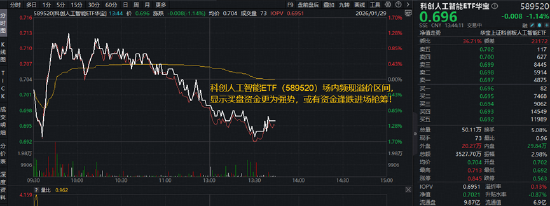
今日(1月29日)重点布局国产AI产业链的科创人工智能ETF华宝(589520)早盘活跃,场内涨幅一度 上探1.28%,后随市盘整回调,场内价格现跌1.14%,值得关注的是,该ETF场内频现溢价区间,显示买 盘资金更为强势,或有资金逢跌进场抢筹! 【国产替代之光,科创自立自强】 科技摩擦背景下,信息安全、产业安全重要性凸显。AI作为核心技术,实现自主可控至关重要。科创 人工智能ETF(589520)及其联接基金(联接A:024560,联接C:024561)重点布局国产AI产业链, 成份股囊括国产GPU龙头(如寒武纪),国产ASIC龙头(如芯原股份)、AI应用龙头(如金山办 公),前十大重仓股权重占比近七成,半导体行业权重占比近一半,具备较强进攻性;软件行业权重占 比超三成,有望受益于AI应用补涨行情。同时,该ETF是融资融券标的,是一键布局国产算力的高效工 具。 风险提示:科创人工智能ETF及其联接基金被动跟踪上证科创板人工智能指数,该指数基日为 2022.12.30,发布于2024.7.25,该指数2023年、2024年的年度涨跌幅分别为:12.68%、32.36%,指数成 份股构成根据该指数编制规则适时调 ...


恒生科技ETF易方达(513010)规模突破300亿元,关注港股科技产业链阶段性配置价值
Mei Ri Jing Ji Xin Wen· 2026-01-29 02:15
Group 1 - The core viewpoint of the news highlights the resilience of the Hong Kong technology sector, which showed a rebound after a significant drop, with the Hang Seng Technology Index down by 0.7% as of 9:47 AM on January 29 [1] - Recent data indicates a recovery in overall trading volume in the Hong Kong market, with both the amount and proportion of southbound capital increasing, suggesting a rise in market participation [1] - Foreign active funds have turned to net inflows for two consecutive weeks, indicating a positive change in the funding structure of the Hong Kong technology sector, which supports market recovery [1] Group 2 - The current earnings season for U.S. tech stocks is a focal point, with AI, cloud computing, and commercialization of applications being key areas of market interest [1] - If the performance and future guidance of overseas tech leaders exceed expectations, it could catalyze trends in related industries, positively impacting the Hong Kong technology sector through valuation and risk appetite transmission [1] - The Hang Seng Technology Index consists of the 30 largest stocks related to technology themes listed in Hong Kong, focusing on sectors such as semiconductors, robotics, software, internet, and smart driving, with major weights including Tencent Holdings, Alibaba, and SMIC [1] Group 3 - The Hang Seng Technology ETF managed by E Fund has seen a cumulative net inflow of over 1.5 billion yuan since January, with its latest scale surpassing 30 billion yuan, marking a new high since its inception [2] - The ETF offers good liquidity and supports T+0 trading, which can help investors seize opportunities in the Hong Kong technology industry chain amid the convergence of capital inflow and industry catalysts [2]



互联网行业周报:财报季已临近,AI商业化需验证
Guoyuan Securities2· 2026-01-29 00:45
Investment Rating - The report suggests a long-term investment perspective, focusing on quality companies with strong core competitiveness and long-term value, particularly in the AI integration within the internet entertainment sector [3][5]. Core Insights - The overall market sentiment is cautious due to fluctuating expectations of interest rate cuts by the Federal Reserve and short-term impacts from regulatory policies in mainland China. The Hang Seng Technology Index has been under pressure, with many internet entertainment companies experiencing a downward trend in stock prices [3][5]. - The central economic work conference has set a tone for 2026 emphasizing "stability while seeking progress," which aims to boost economic vitality and consumer confidence, benefiting the internet entertainment sector directly [3][5]. - 2026 is anticipated to be a significant year for AI application and commercialization, with the integration of AI technology being a core factor determining future competitiveness in the internet entertainment sector [3][5]. Summary by Sections Market Performance - The Hang Seng Index and the Hang Seng Technology Index experienced slight declines of -0.36% and -0.42% respectively during the week of January 19-23, 2026. The overall market sentiment is cautious, influenced by external factors and regulatory policies [4][5]. - The software and services sector's PE-TTM is at 28.9x, while the PS-TTM is at 5.3x, indicating high valuation levels compared to historical data [12][14]. Company Recommendations - The report recommends focusing on industry leaders such as: -阅文集团 (772.HK) -腾讯音乐 (TME.N) -浪潮数字企业 (596.HK) -百融云 (6608.HK) -阿里巴巴 (BABA.N) These companies are expected to have strong R&D and application capabilities in the AI wave, making them optimal choices for sharing in long-term industry growth [3][5]. Industry Data - The film industry is showing signs of mild recovery, with a box office of 3.04 billion yuan during the week of January 19-25, 2026. The new film "Return to Silent Hill" performed well, contributing significantly to the box office [25]. - The gaming market in China saw a year-on-year sales growth of 7.83% in October 2025, indicating robust potential and vitality in the gaming sector [28].
新浪财经隔夜要闻大事汇总:2026年1月29日
Xin Lang Cai Jing· 2026-01-29 00:32
一、市场: ●1月29日收盘:联储按兵不动 标普指数小幅收跌 北京时间1月29日凌晨,美股收盘涨跌不一,标普500指数小幅收跌,美国国债收益率走高。美联储结束2026年首次议息会议,维持基准利率在3.50%-3.75% 区间不变,上调经济增长评估。市场预计在鲍威尔五月任期结束前,美联储都将维持利率不变。芯片股受积极财报提振早盘上涨,英伟达等普遍走高,但涨 势未扩散至芯片股以外,标普500指数最终转跌。此外,微软等科技巨头财报即将出炉,非科技板块中,星巴克股价微涨,其首季营收超预期但盈利未达预 期。 ●1月29日美股成交额前20:Carvana被指人为虚增利润,股价重挫14% 周三美股成交额前20的公司表现各异。英伟达收高1.58%,芯片板块普涨,有报道称其和亚马逊或参与OpenAI融资轮;特斯拉收跌0.10%,盘后涨近4%,公 布第四季度多项财务数据;美光收高6.10%,存储概念股普涨,其与新加坡胜科工业扩大购电协议;苹果收跌0.71%,iPhone Air市场接受度低,周四将发布 财报;英特尔收高11.04%;闪迪收高9.60%;Carvana收跌14.17%,被指人为虚增利润;Palantir收跌5.04 ...

马云最新发声:谈AI和教育;软银拟向OpenAI追加投资300亿美元;英伟达员工晒年会最牛年终奖:黄仁勋亲笔签名皮衣丨邦早报
Sou Hu Cai Jing· 2026-01-29 00:25
Group 1: AI and Education - Jack Ma emphasizes that in the AI era, the focus should be on teaching children how to effectively use AI rather than debating its necessity. He believes curiosity, imagination, creativity, judgment, and collaboration are the key skills needed [1] - The Ma Yun Rural Teacher Program aims to enhance the quality of rural education through funding and professional training, providing support to 100 teachers annually [1] Group 2: Market Performance and IPOs - Hunan Mingming Henbang, a leading snack and beverage retailer, saw its stock surge by 88.08% upon listing on the Hong Kong Stock Exchange, closing with a market cap of 862.04 billion HKD [3] - SoftBank is reportedly negotiating to invest an additional 30 billion USD in OpenAI, which is seeking up to 100 billion USD in new funding, potentially valuing the company at 830 billion USD [9] - Tesla plans to cease production of Model S and Model X vehicles to transition towards a fully autonomous future, utilizing its "Optimus" robot factory [7] Group 3: Financial Results - Meta reported Q4 revenue of 59.89 billion USD, a 24% year-over-year increase, with advertising revenue also up by 24% [10] - Li Auto is restructuring its R&D framework, splitting the autonomous driving team into three distinct groups to enhance efficiency [9] - Oriental Selection reported a net profit of 239 million CNY for the first half of the 2026 fiscal year, reversing a loss from the previous year [11][12] Group 4: Corporate Developments - Amazon announced layoffs affecting nearly 16,000 jobs while continuing to invest in strategic areas [16] - The German automotive supplier, OMO, plans to cut up to 4,000 jobs globally due to challenging market conditions [16] - Longting Technology completed a new round of financing totaling 500 million CNY, with investments from various funds [17]






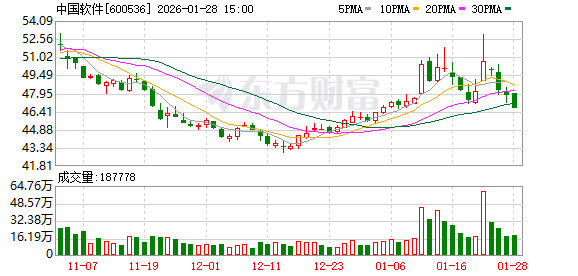
中国软件:麒麟操作系统已在党政、金融、通信等多领域有应用
Zheng Quan Ri Bao· 2026-01-28 12:45
Core Viewpoint - The company, China Software, has confirmed that its Kylin operating system is widely used across various sectors, including government, finance, and telecommunications, and has maintained the leading market share in China's Linux market for 14 consecutive years according to statistics from CCID Consulting [2] Group 1 - The Kylin operating system has applications in multiple fields such as party and government, finance, and telecommunications [2] - The product has achieved the number one market share in China's Linux market for 14 years in a row [2]

退市警报拉响!多家A股公司公告
证券时报· 2026-01-28 11:48
Core Viewpoint - The A-share market is undergoing a new wave of "delisting risk inspection" as companies disclose their 2025 annual performance forecasts, with over 20 companies already warning of potential delisting risks due to financial indicators not meeting standards, major violations, or abnormal audit opinions [1] Group 1: Financial Indicators - Several companies have announced that they may face delisting risk warnings due to failing to meet financial indicators, including Ba Yi Steel, Shuaifeng Electric, Tianjian Technology, Yijing Optoelectronics, and Huaxia Happiness [3][4][5] - Ba Yi Steel expects its net assets to be between -1.76 billion and -1.95 billion yuan by the end of 2025, triggering delisting risk warnings under the Shanghai Stock Exchange rules [3] - Yijing Optoelectronics anticipates a negative net asset of between -6.8 million and -13 million yuan for 2025, which also falls under the delisting risk warning criteria [4] - Huaxia Happiness is expected to have negative net assets by the end of 2025, leading to potential delisting risk warnings [4] - Shuaifeng Electric forecasts a total profit loss of between -57 million and -38 million yuan for 2025, with expected revenue between 21 million and 25 million yuan, below the 300 million yuan threshold [5] - Tianjian Technology predicts a total profit loss of between -170 million and -242 million yuan for 2025, with negative revenue projections [5] Group 2: Internal Control Issues - Some companies may face delisting risk warnings due to unresolved internal control issues, such as Digital People and Tianye Co., which received negative audit opinions on their internal controls for 2024 [6][8] - Digital People is at risk of delisting if it receives negative audit opinions for two consecutive years, as per the Beijing Stock Exchange rules [8] - Tianye Co. has also announced potential delisting risks due to similar internal control audit issues [8] Group 3: Audit Opinions - For companies already under the *ST designation, the audit opinion for the 2025 financial statements is critical, as non-standard opinions could lead to further delisting risks [9][10] - *ST Panda has indicated that unresolved issues may lead to non-standard audit opinions for 2025, which would trigger delisting risks [10] - *ST Zhengping has been warned of delisting due to unresolved non-standard audit opinions and internal control issues, with significant uncertainties regarding its continued operation [10]

2026年寻找AI应用的“硬支撑”:软件ETF汇添富的关键位守卫战与数据复盘
Sou Hu Cai Jing· 2026-01-28 08:12
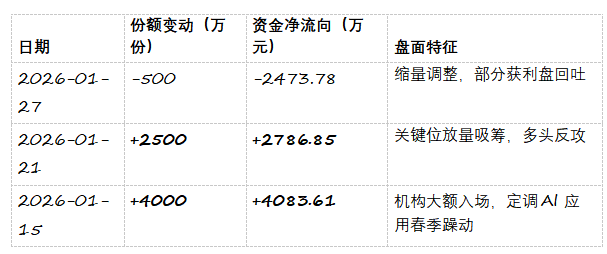
作者: 导语:截至2026年1月27日软件ETF汇添富(159590)近一个月净值涨幅高达13.89%,现出了明显的"高 弹性"。 一、 行情透视:AI应用与智能体(Agent)逻辑的超额溢价 基于Wind最新数据显示,从近5个交易日的资金净流向来看,市场情绪表现得极为复杂: | | 份额变动(万 | 资金净流向(万 | | | --- | --- | --- | --- | | 日期 | (સે) | 元) | 盘面特征 | | 2026-01- | -500 | -2473.78 | 缩量调整。 部分获利盘回吐 | | 27 | | | | | 2026-01- | +2500 | +2786.85 | 关键位放量吸筹,多头反攻 | | 21 | | | | | 2026-01 - +4000 | | +4083.61 | 机构大额入场,定调Al 应 | | 1.5 | | | 用春季躁动 | 虽然1月27日份额减少了500万份,出现了约2473.78万元的净流出,但在近一个月涨幅近14%的背景 下,这更倾向于高位获利盘的正常清洗。1月15日与21日合计超6800万元的大额净流入,构成了当前 1.27元净 ...
行业主题ETF开年吸金逾2200亿元,已超去年全年流入额三成
Sou Hu Cai Jing· 2026-01-28 05:45
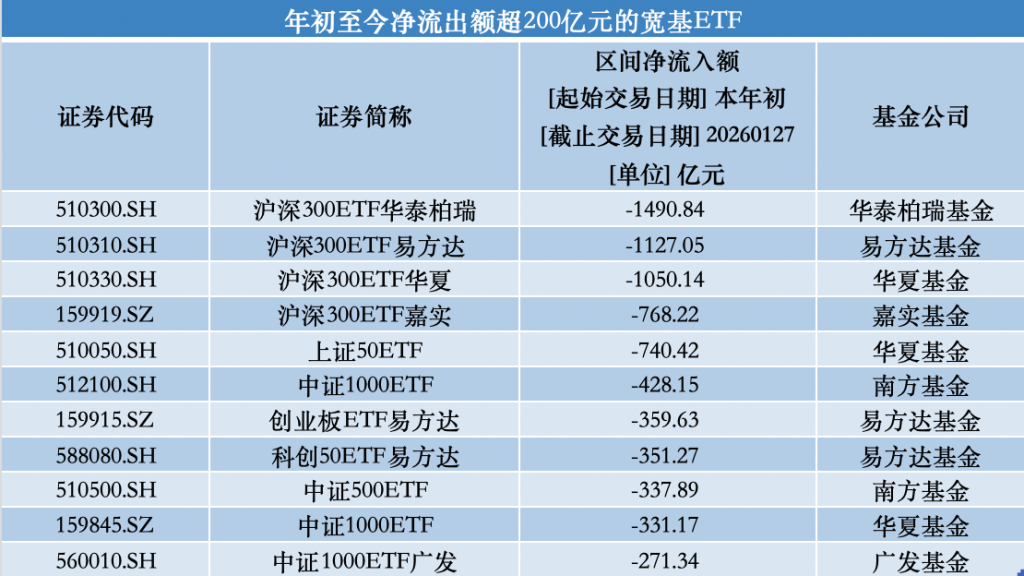
Core Insights - The A-share stock ETF market has shown a clear divergence since the beginning of 2026, with significant net outflows from core broad-based products like the CSI 300 ETF, totaling 795.76 billion yuan, while sector-specific thematic ETFs in industries such as non-ferrous metals, electric grid equipment, and chemicals have attracted substantial inflows [1][2] Market Trends - As of January 27, 2026, the total net outflow for stock ETFs (including cross-border ETFs) reached 597.45 billion yuan since the start of the year, with broad-based ETFs being the primary source of this outflow [2] - The net outflow for large-scale index ETFs (including cross-border ETFs) has reached 795.76 billion yuan as of January 27, 2026 [2] - On January 27 alone, major CSI 300 ETFs experienced significant single-day net outflows, with Huatai-PB CSI 300 ETF and E Fund CSI 300 ETF seeing outflows of 14.065 billion yuan and 11.924 billion yuan, respectively [2] Sector Performance - The thematic ETFs have seen a cumulative net inflow of 227.18 billion yuan, which is nearly one-third of the total net inflow for such products in 2025, which was 738.54 billion yuan [1][5] - The top-performing sector ETFs include the Southern Non-Ferrous Metals ETF, which led with a net inflow of 14.474 billion yuan, followed by the Huaxia Electric Grid Equipment ETF and Penghua Chemical ETF with inflows of 12.740 billion yuan and 11.980 billion yuan, respectively [7][9] Investment Insights - Analysts suggest that the current market conditions may lead to a slow bull market driven by bank wealth management and insurance funds, rather than the previous bull market led by public funds [4] - The non-ferrous metals sector is expected to perform well due to anticipated price increases driven by interest rate cuts and high exposure to new growth areas such as energy storage and AI infrastructure [6][10] - The chemical sector is viewed as undervalued, with potential for recovery as PPI is expected to turn positive in the second half of 2026, particularly in the petrochemical chain [8]
罗珀科技:政府合同需求疲软,2026年营收及利润预期低于市场估值
Xin Lang Cai Jing· 2026-01-27 16:54
Core Viewpoint - Roper Technologies has issued a disappointing earnings outlook for 2026, projecting revenues and profits to fall below Wall Street expectations, primarily due to weak demand from its government contracts subsidiary, Deltek, leading to a 14.9% drop in the company's stock price [1][6]. Revenue and Earnings Projections - The company anticipates an annual revenue growth of approximately 8%, compared to the market's previous expectation of 9% [2][7]. - Roper expects adjusted earnings per share (EPS) for 2026 to be between $21.30 and $21.55, lower than the analyst forecast of $21.65 [2][7]. Quarterly Performance - For the first quarter of the current year, Roper projects adjusted EPS to be between $4.95 and $5.00, also below the market expectation of $5.18 [8]. - In the fourth quarter ending December 31, the company reported revenues of $2.06 billion, slightly below the analyst expectation of $2.08 billion [3][8]. Business Challenges - The CEO, Neil Henn, indicated that uncertainty surrounding Deltek's business has negatively impacted the company's performance over the past few quarters, reflecting a more "reasonable and balanced" outlook [2][7]. - A decline in perpetual license revenue has slowed organic growth in the company's application software division, further dragging down overall performance [4][9].