
通信

Search documents
瑞银关于A股十问十答:估值还有空间!
Datayes· 2026-01-27 12:09
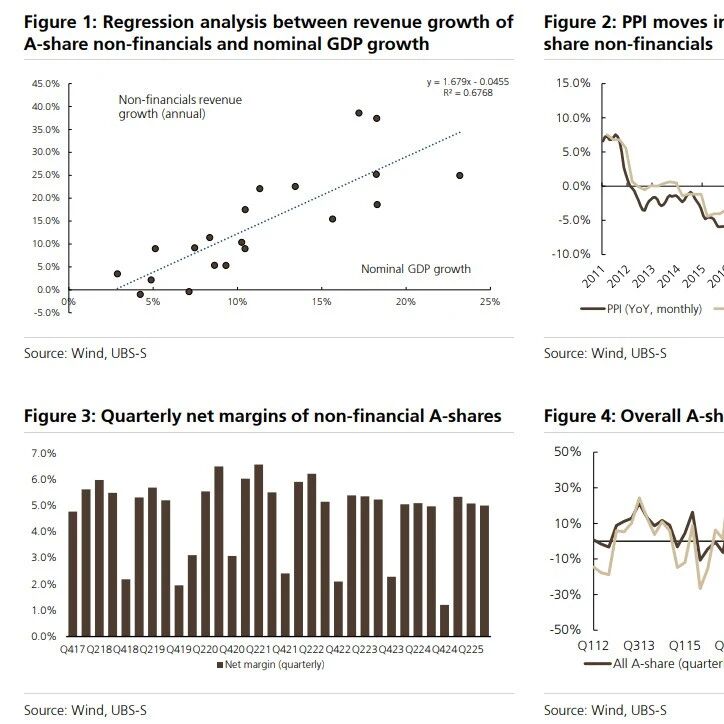
Group 1 - The overall A-share profit growth is expected to accelerate from 6% in 2025 to 8% in 2026, primarily driven by the non-financial sector [1] - The revenue growth of non-financial A-shares is closely related to China's nominal GDP growth and PPI inflation, with a projected nominal GDP growth of 4.3% in 2026 [1] - The net profit margin (NPM) of non-financial A-shares has rebounded in the first nine months of 2025, reversing a long-term downward trend since 2021 [1] Group 2 - The financial sector's profit growth is expected to remain stable, supported by solid asset quality in the banking sector and improved market sentiment [2] - The cumulative profit growth of industrial enterprises in China was only 0.1% in the first eleven months of 2025, but certain sectors like computer and electronic equipment manufacturing saw a 15% profit increase [2] - Investors should pay attention to potential revisions in profit growth expectations around April 2026, as historical data shows discrepancies in profit growth forecasts during that period [2] Group 3 - The current rolling P/E ratio of the Wind All A-share index has risen above the historical average, leading some investors to worry about overvaluation [13] - Despite concerns, the equity risk premium in the A-share market remains above historical averages, indicating potential for further revaluation [13][16] - Factors such as clearer fiscal support, accelerating profit growth, and increased household savings reallocating to stocks are expected to drive A-share growth in 2026 [16] Group 4 - The Chinese central bank plans to moderately expand the deficit and maintain stable credit pulses, which is expected to support A-share revaluation [17] - The anticipated reduction in policy rates and reserve requirement ratios by the central bank may further enhance liquidity in the market [17] - A moderate expansion in P/E ratios is expected as profit growth accelerates, with historical data showing a correlation between profit growth and P/E ratios [21] Group 5 - The ongoing market capitalization management reforms are changing investor perceptions, leading to increased focus on shareholder returns [27] - A-share cash dividends reached 2.06 trillion yuan in 2025, marking a significant increase, while stock buybacks have also risen [27] Group 6 - Daily trading volume in A-shares has significantly increased in 2026, driven by improved investor risk appetite, with average daily turnover reaching 3.03 trillion yuan [28] - Regulatory measures have been implemented to cool down excessive trading activity, with daily turnover ratios fluctuating [28][33] - The financing balance in A-shares reached a historical high of 2.7 trillion yuan, indicating increased leverage in the market [33] Group 7 - The trend of reallocating household savings towards stocks is evident, with a significant portion of household deposits still available for investment in A-shares [40] - Despite a recent uptick in the stock market, the influx of household funds into the market has not yet reached overheating levels [42][46] - The potential for further inflows into A-shares exists as investors may gradually shift from fixed-income products to equity investments [49] Group 8 - The issuance of active funds has been slow, but the performance of equity funds has improved, potentially leading to increased inflows as market conditions stabilize [53] - The ETF market has seen rapid growth, with A-share holdings in ETFs surpassing those in active equity funds for the first time [58] Group 9 - The "anti-involution" policies are expected to improve supply-demand dynamics and support price recovery, enhancing corporate profitability [64] - The narrowing and eventual recovery of PPI is crucial for the revenue growth of non-financial A-shares, which may lead to stock price revaluation [65] Group 10 - The growth style is expected to outperform the value style in the mid-term, with cyclical stocks likely to perform better than defensive stocks [66] - Tactical preferences lean towards sectors benefiting from innovation, ample liquidity, and narrowing PPI, such as electronics, telecommunications, and chemicals [66] Group 11 - Despite recent declines in financing balances and market turnover, the technology sector's fundamentals remain strong, with expectations for continued growth in 2026 [75] - Metrics for assessing trading congestion in technology stocks include the proportion of trading volume and financing balances relative to market capitalization [78]

资金动向 | 北水连续5日加仓中海油,中国移动遭持续甩卖
Ge Long Hui· 2026-01-27 11:37
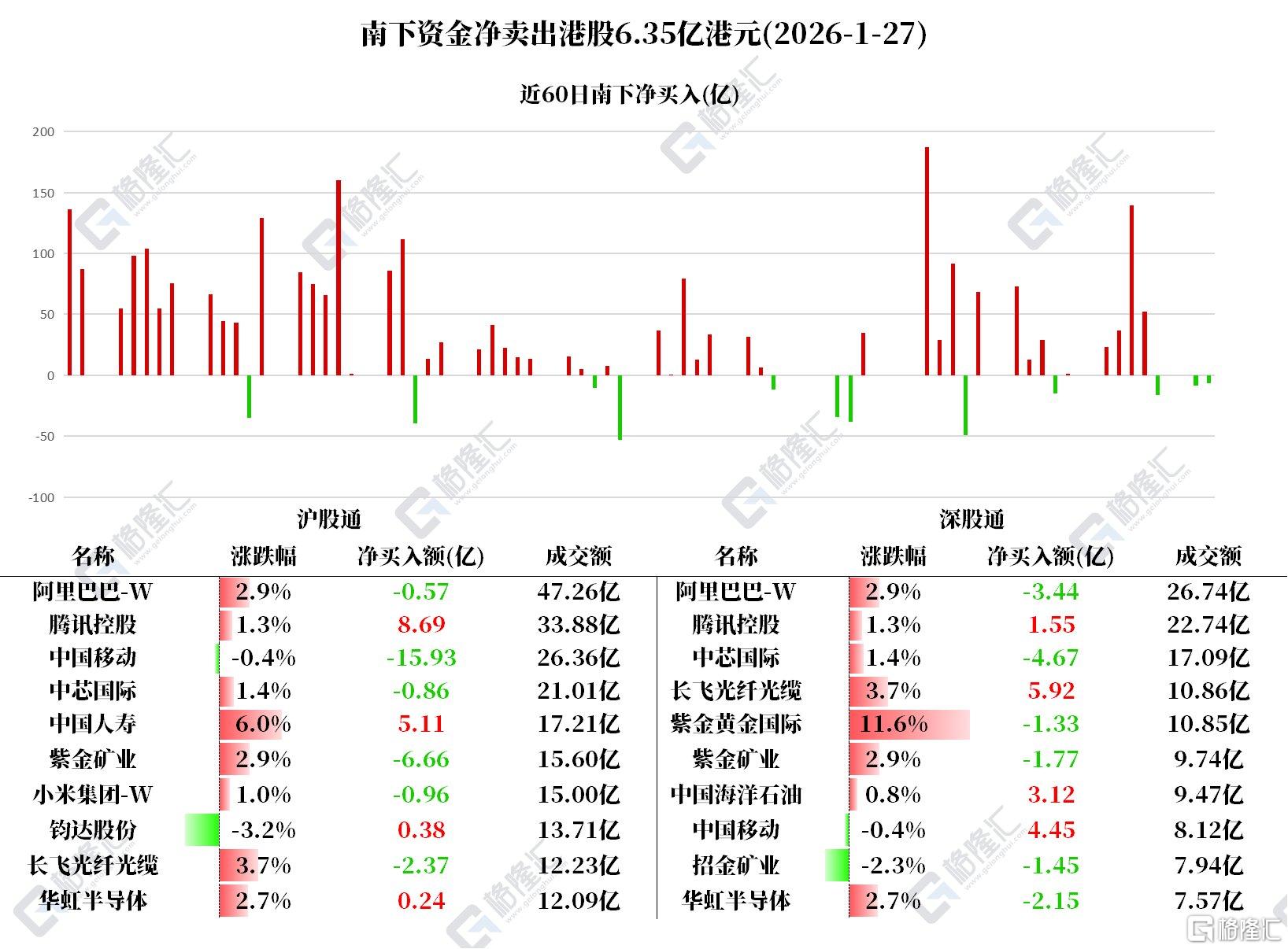
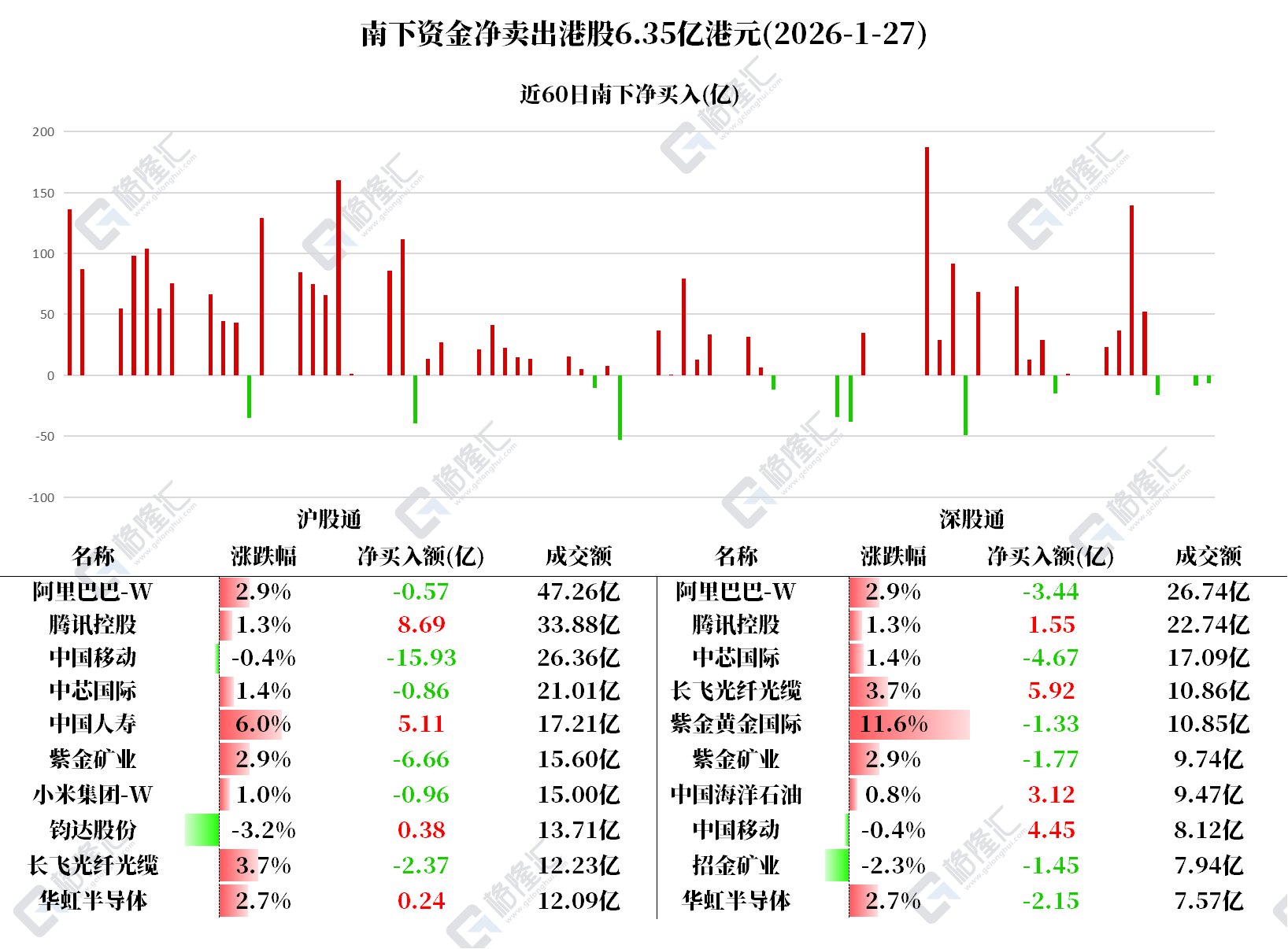
Group 1: Market Movements - Southbound funds recorded a net sell of HKD 635 million in Hong Kong stocks for the third consecutive day [1] - Notable net purchases included Tencent Holdings at HKD 1.024 billion, China Life at HKD 511 million, and Longi Green Energy at HKD 354 million [1] - Significant net sells included China Mobile at HKD 1.147 billion, Zijin Mining at HKD 842 million, and Alibaba-W at HKD 401 million [1] Group 2: Stock Performance - Tencent Holdings saw a net buy of HKD 869 million with a price increase of 1.3% [4] - China Life experienced a net buy of HKD 511 million with a price increase of 6.0% [4] - Alibaba-W had a net sell of HKD 570 million with a price increase of 2.9% [4] Group 3: Company Insights - Tencent Holdings has contributed significantly to the stock buyback trend, with 108 Hong Kong companies participating and a total buyback amount exceeding HKD 11.7 billion [5] - China Life is expected to benefit from a historical opportunity in the life insurance sector due to wealth reallocation, with a preference for leading companies amid tightening regulations [5] - Longi Green Energy is experiencing strong growth in its optical interconnect components business, benefiting from the construction of AI data centers in North America [6]

【27日资金路线图】两市主力资金净流出超410亿元 电子等行业实现净流入
证券时报· 2026-01-27 11:13
1月27日,A股市场整体上涨。 截至收盘,上证指数收报4139.9点,上涨0.18%;深证成指收报14329.91点,上涨0.09%;创业板指收报3342.6点,上涨0.71%。两市合计成交 28949.81亿元,较上一交易日减少3532.21亿元。 1. 两市主力资金净流出超410亿元 今日沪深两市主力资金开盘净流出373.34亿元,尾盘净流入41.39亿元,两市全天主力资金净流出414.34亿元。 | | | 沪深两市最近五个交易日主力资金流向情况 (亿元) | | | | --- | --- | --- | --- | --- | | 日期 | | 净流入金额 开盘净流入 | 尾盘净流入 | 超大单净买入 | | 2026- 1- 27 | - 414. 34 | -373. 34 | 41. 39 | - 173. 55 | | 2026- 1- 26 | - 757. 10 | -324. 59 | - 15. 61 | - 496. 92 | | 2026- 1-23 | - 41. 67 | - 83. 56 | 58. 37 | 119. 93 | | 2026- 1- 22 | - 104. ...

1月27日南向资金追踪:腾讯控股、中国人寿、长飞光纤光缆净买入额居前,分别为10.24亿港元、5.11亿港元、3.55亿港元
Jin Rong Jie· 2026-01-27 11:09
港股通成交数据披露(沪深合计) 恒生指数今日涨1.35%,报27126.95点,大市成交2543.73亿港元。 披露的南向资金成交股中,腾讯控股、中国人寿、长飞光纤光缆分别获净买入10.24亿港元、5.11亿港 元、3.55亿港元;中国移动、紫金矿业、中芯国际分别遭净卖出11.47亿港元、8.43亿港元、5.53亿港 元。 本文源自:市场资讯 作者:智投君 证券简称成交金额净买入额收盘价涨跌幅腾讯控股 0070056.62亿港元10.24亿港元607.00港元12.50%中国人寿 0262817.21亿港元5.11亿港元34.10港元59.70%长飞光纤光缆 0686923.09亿港元3.55亿港元65.15港元37.40%中国海洋石油 008839.47亿港元3.12亿港元23.52港元7.70%钧达股份 0286513.71亿港元0.38亿港元35.26港元-32.40%小米集团-W 0181015.00亿港元-0.96亿港元35.56港元9.70%紫金黄金国际 0225910.85亿港元-1.33亿港元233.00港元115.90%招金矿业 018187.94亿港元-1.45亿港元38.42港元-22. ...



拆解公募基金四季报:藏在数据中的七大投资线索
Sou Hu Cai Jing· 2026-01-27 10:55
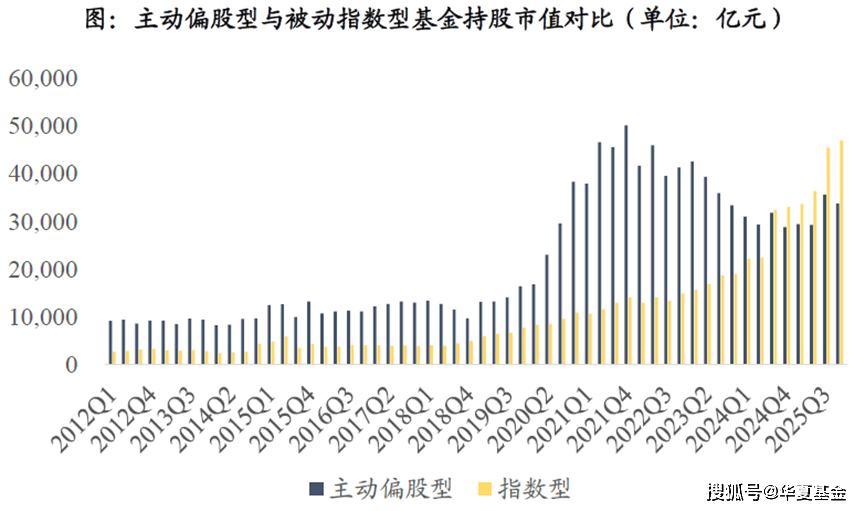
Core Insights - The article highlights the shift in investment patterns in the A-share market, emphasizing the growing dominance of passive index funds over active equity funds, which is reshaping market pricing logic [5][9][10]. Group 1: Investment Trends - Passive index funds, particularly ETFs, are becoming the mainstream choice for investors, contrasting with the previous bull market dominated by active equity funds [5]. - By Q3 2024, the market value of index funds surpassed that of active equity funds for the first time, with index funds reaching 4.70 trillion yuan, a 3.4% increase, while active funds fell to 3.37 trillion yuan, a 5.2% decrease, widening the gap from 1 trillion yuan to 1.3 trillion yuan [6]. Group 2: Fund Flows and Strategies - Fixed income plus (固收+) funds are emerging as a key vehicle for reallocating household deposits, with their scale increasing to 2.9 trillion yuan in Q4 2023, an 8.8% growth [11]. - The preference for mid-high quality fixed income products with equity allocations of 15-25% is evident, with secondary bond funds seeing a remarkable 24.5% increase in scale [11]. Group 3: Sector Focus and Performance - The article notes a significant shift in fund holdings, with technology stocks becoming the focal point of investment narratives, reflecting the changing economic landscape [18]. - By Q4 2025, the leading stocks held by public funds included technology firms, indicating a renewed focus on tech as a central theme in the market [19]. Group 4: Market Dynamics and Future Outlook - The article discusses the ongoing rebalancing in the market, with a potential shift towards a more balanced investment style as indicated by the new performance benchmark regulations for public funds [28]. - There is a growing emphasis on sectors such as semiconductors, AI, and high-end manufacturing, which are seen as core areas for future wealth generation [20][30]. Group 5: Resource Sector Revaluation - Public funds have significantly increased their allocation to resource sectors like non-ferrous metals and chemicals, reflecting a strategic reassessment of resource value amid global reindustrialization trends [23]. - The article suggests that traditional resource sectors are being re-evaluated as core assets, highlighting their importance in a context of safety and self-sufficiency [25]. Group 6: Emerging Opportunities - The focus on innovation and new production capabilities is evident, with institutions increasingly investing in sectors like AI, commercial aerospace, and new materials, which are expected to yield structural opportunities [33]. - The article emphasizes the importance of understanding and participating in these evolving sectors as a means to share in the benefits of the ongoing economic transformation [20][35].
掘金内参(1.27)|从“宁王”“茅王”撤出!主力资金集中押注这两大科技主线
和讯· 2026-01-27 10:44
Market Overview - The market showed signs of recovery with all three major indices turning positive, and the ChiNext index rising over 1% at one point. The total trading volume in the Shanghai and Shenzhen markets was 2.89 trillion, a decrease of 353.2 billion from the previous trading day. However, over 3,400 stocks in the market experienced declines [2]. Capital Flow Analysis - On January 27, the main capital inflow was directed towards high-growth technology sectors such as electronics and communications, while there was a notable outflow from previously popular sectors like electric equipment and biomedicine [3]. - The top five sectors for capital inflow were dominated by technology, with the electronics sector leading with a net inflow of 31.928 billion. Other sectors like communications and machinery also saw significant increases. Conversely, the top five sectors for capital outflow included electric equipment, non-bank financials, and biomedicine [5]. Stock Performance - The top five stocks with the highest capital inflow were primarily in the communications and electronics sectors, with Zhongji Xuchuang leading at a net inflow of 3.413 billion. Other notable stocks included Tianfu Communication and Dongxin Co., which also saw substantial inflows. The outflow was mainly from heavyweight stocks and previously popular sectors, indicating a clear trend of capital withdrawal [6]. Market Highlights - On January 27, a total of 59 stocks hit the daily limit up, with the semiconductor sector being the biggest winner, accounting for 11 of those stocks [7]. - The sectors with the most stocks hitting the limit up included chips, photovoltaic, and gold, indicating strong market interest in these areas [8]. Sector Movements - Gold stocks experienced a resurgence, with many reaching new highs. The semiconductor and AI computing supply chains showed strength, particularly in memory and CPO directions. In contrast, coal, basic metals, and retail sectors faced declines, while vaccine and lithium battery themes weakened [9][10]. - The recent statements by Tesla CEO Elon Musk regarding space photovoltaics have sparked increased activity in related concepts. Musk announced plans for SpaceX and Tesla to build a total of 200GW of photovoltaic capacity in the U.S. over the next three years, primarily for ground data centers and space AI satellites [10]. Future Outlook - According to Open Source Securities, the release of a hundred GW-level space computing market, combined with the high unit value of space photovoltaic batteries, is expected to open new growth opportunities for the photovoltaic industry [11]. - Guotai Junan Securities also noted that the upcoming dense launch period for low-orbit satellites and the clear trend of commercializing space computing will effectively drive the demand for photovoltaic expansion, with core equipment manufacturers likely to benefit first [12].





公募主动权益基金2025年四季报解析:有色金属大幅加仓,中际旭创成第一大重仓股
Huaan Securities· 2026-01-27 10:25
Investment Rating - The report indicates a strong performance of public actively managed equity funds in 2025, with a notable increase in the allocation to non-ferrous metals and non-bank financials, while reducing exposure to media and electronics sectors [1][3][40]. Core Insights - Public actively managed equity funds showed robust excess returns in 2025, with the mixed equity fund index (885001.WI) rising by 33.19%, outperforming major broad-based indices [1][14]. - The allocation to Hong Kong stocks decreased significantly, while the proportion of investments in the ChiNext board increased [2][30]. - There was a substantial increase in allocations to non-ferrous metals and non-bank financials, while reductions were seen in media and electronics sectors [3][42]. Summary by Sections Fund Performance - As of Q4 2025, the total scale of public actively managed equity funds is approximately 3.90 trillion, reflecting a quarter-on-quarter decrease of 4.10% [1][12]. - The share of public actively managed equity funds decreased by 2.53% in Q4 2025 [18]. Sector Allocation Changes - The allocation to non-ferrous metals increased to 8.03%, up by 2.14 percentage points from the previous quarter, marking a continuous rise over four quarters [42]. - The allocation to the electronics sector decreased to 23.78%, down by 1.85 percentage points [43]. - The proportion of investments in the ChiNext board rose from 23.72% in Q3 to 24.91% in Q4 2025 [2][30]. Top Holdings - The top individual stock in public fund allocations is Zhongji Xuchuang, with a holding ratio of 4.04%, primarily due to its price increase rather than new acquisitions [4][40]. - The most actively increased holdings include China Ping An (+0.43 percentage points) and Dongshan Precision (+0.41 percentage points) [4].




图解丨南下资金净买入腾讯,持续净卖出中国移动
Ge Long Hui A P P· 2026-01-27 10:18
Group 1 - Southbound funds recorded a net sell of HKD 635 million in Hong Kong stocks for the third consecutive day [1] - Notable net purchases included Tencent Holdings at HKD 1.024 billion, China Life at HKD 511 million, and Longi Green Energy at HKD 354 million [1] - Significant net sales were observed in China Mobile at HKD 1.147 billion, Zijin Mining at HKD 842 million, and Alibaba-W at HKD 401 million [1] Group 2 - Southbound funds have net bought China National Offshore Oil Corporation (CNOOC) for five consecutive days, totaling HKD 1.40858 billion [1] - Tencent has seen net purchases for three consecutive days, amounting to HKD 2.27903 billion [1] - China Mobile has experienced net sales for 17 consecutive days, totaling HKD 14.04003 billion [1]
公募基金2025年四季度持仓分析:聚焦有色与防御,减仓科技
市值风云· 2026-01-27 10:09
继续进攻有色。 作者 | 市值风云基金研究部 编辑 | 小白 2025年第四季度,A股市场呈现震荡分化格局,主要宽基指数表现不一,而港股市场则出现明显回 调。 在此背景下,主动偏股型公募基金进行了一系列显著的仓位调整和结构优化,值得各位关注。 整体仓位高位微降,港股大撤退 2025年四季度末,主动偏股型基金持有的股票总市值约为3.39万亿元,较三季度末减少0.19万亿元。 其中,投资于A股的市值为2.91万亿元,环比减少0.08万亿元。这一变化导致基金的整体股票仓位由 三季度末的85.62%下降1.4个百分点至84.22%。 尽管有所回落,但超过84%的仓位水平仍处于2005年以来的历史高位区间,表明公募基金对权益市场 的整体配置意愿依然强烈。 值得注意的是,港股市场的配置比例出现显著下滑,普通股票型基金和偏股混合型基金的港股仓位分 别下滑了1.1和2.54个百分点,为11.89%和14.56%。 (来源:国信证券研究所) 这反映出在四季度港股市场表现疲软的背景下,基金经理更倾向于将资金集中于资金面、想象力都更 好的A股市场。 A股持仓结构剧变:周期风格崛起,科技与消费承压 四季度公募基金在A股内部的调仓换股 ...

公募基金周报:从基金季报看基金季报-20260127
BOHAI SECURITIES· 2026-01-27 09:09
Report Industry Investment Rating No information provided in the report. Core Views - Scale: The growth of passive index funds has slowed down. As of the end of Q4 2025, there were 7,583 equity funds (excluding ETF-linked funds and FOF funds) in the market, an increase of 294 from Q3 2025. The total scale of all equity funds was RMB 9,457.212 billion, a decrease of RMB 27.704 billion from the previous quarter. Passive index funds had the largest increase in both quantity and scale [3]. - Position: The positions of active equity funds decreased slightly. In terms of arithmetic average and stock market value weighted average position levels, the positions of active equity funds decreased by 1.13 pct. and 0.91 pct. respectively. Specifically, the funds with the largest position decreases were partial equity hybrid funds and flexible allocation funds [3]. - Sector distribution and allocation: There was a significant reduction in the allocation to the Hong Kong Stock Exchange and an increase in the allocation to the Main Board. In Q4 2025, the total scale of all top ten heavy - held stocks decreased by RMB 67.305 billion compared with the previous quarter. Among them, the scale of the Main Board increased, while the scales of the other sectors decreased. Compared with the allocation ratio of the total A - share floating market value among sectors, active equity funds continued to under - allocate the Main Board and over - allocate the Science and Technology Innovation Board and the Growth Enterprise Market in Q4. Specifically, the under - allocation ratio of the Main Board was - 20.51%, and the over - allocation ratios of the Growth Enterprise Market and the Science and Technology Innovation Board were 13.50% and 7.00% respectively. The under - allocation ratio of the Main Board and the over - allocation ratio of the Science and Technology Innovation Board both narrowed slightly quarter - on - quarter [3]. - Industry allocation: In Q4, the top five industries with an increase in the proportion of holding market value were non - ferrous metals, communication, household appliances, environmental protection, and non - bank finance; the top five industries with a decrease in the proportion of holding market value were electronics, pharmaceutical biology, media, banking, and machinery [3]. - Heavy - held individual stocks: The total market value of active equity funds' holdings of CATL was RMB 181.5 billion, ranking first. The top five stocks in terms of holding market value were CATL, Zhongji Innolight, New Fiber Optic, Kweichow Moutai, and Zijin Mining. Compared with the previous quarter, Tencent Holdings dropped out of the top 5, and Zijin Mining entered the top 5 [3]. - Total shareholding: Stocks such as Foxconn Industrial Internet were reduced, while stocks such as Industrial Bank were increased. In Q4, Industrial Bank, Ping An of China, Meituan - W, Tuojing Technology, and Dongshan Precision had the highest increase in total shareholding. In contrast, Foxconn Industrial Internet, East Money, Alibaba - W, EVE Energy, and CATL had the highest reduction in total shareholding [3]. - Central Huijin ETF holdings: According to the holder data disclosed in the Q4 2025 public fund regular reports, as of the end of Q4 2025, the shareholdings of Central Huijin Investment Co., Ltd. and Central Huijin Asset Management Co., Ltd. in most broad - based and industry - specific ETFs remained stable. Only in some industry - themed ETFs were there small redemption actions observed: the special plan managed by Huijin Asset Management redeemed 16 million shares of the automobile ETF and 338 million shares of the electronics ETF under China Asset Management in Q4 [3]. Summary by Directory 1. Equity Fund Scale, Position, and Sector Distribution - **1.1 Passive index fund quantity and scale growth slow down, active equity fund positions decrease slightly**: As of the end of Q4 2025, there were 7,583 equity funds (excluding ETF - linked funds and FOF funds) in the market, an increase of 294 from Q3 2025. The total scale of all equity funds was RMB 9,457.212 billion, a decrease of RMB 27.704 billion from the previous quarter. Passive index funds had the largest increase in both quantity and scale. In Q4 2025, the positions of active equity funds decreased slightly. The arithmetic average and stock market value weighted average position levels decreased by 1.13 pct. and 0.91 pct. respectively. The funds with the largest position decreases were partial equity hybrid funds and flexible allocation funds [10][12]. - **1.2 Significant reduction in the allocation to the Hong Kong Stock Exchange and an increase in the allocation to the Main Board**: In Q4 2025, the total scale of all top ten heavy - held stocks decreased by RMB 67.305 billion compared with the previous quarter. Among them, the scale of the Main Board increased, while the scales of the other sectors decreased. The allocation ratio of the Main Board increased by 2.14 pct. quarter - on - quarter, and the allocation ratio of the Hong Kong Stock Exchange decreased by 1.54 pct. quarter - on - quarter. Compared with the allocation ratio of the total A - share floating market value among sectors, active equity funds continued to under - allocate the Main Board and over - allocate the Science and Technology Innovation Board and the Growth Enterprise Market in Q4. The under - allocation ratio of the Main Board was - 20.51%, and the over - allocation ratios of the Growth Enterprise Market and the Science and Technology Innovation Board were 13.50% and 7.00% respectively. The under - allocation ratio of the Main Board and the over - allocation ratio of the Science and Technology Innovation Board both narrowed slightly quarter - on - quarter [15][16]. 2. Industry Allocation - **2.1 Heavy - held A - share industry distribution**: In Q4 2025, the top ten heavy - held industries of active equity funds were electronics, non - ferrous metals, power equipment, communication, computer, machinery, automobile, non - bank finance, pharmaceutical biology, and household appliances. Compared with Q3 2025, the rankings of non - ferrous metals and other industries increased significantly, while the ranking of pharmaceutical biology decreased significantly. In Q4, the top five industries with an increase in the proportion of holding market value were non - ferrous metals, communication, household appliances, environmental protection, and non - bank finance; the top five industries with a decrease in the proportion of holding market value were electronics, pharmaceutical biology, media, banking, and machinery [22][24]. - **2.2 Heavy - held A - share active allocation**: Compared with the weights of CSI 300 constituent stocks, in Q4, active equity funds' heavy - held A - shares maintained a relatively high over - allocation ratio in industries such as electronics, non - ferrous metals, and power equipment. The over - allocation ratio of electronics was 7.31%, that of non - ferrous metals was 4.10%, and that of power equipment was 2.05%. Industries such as banking, non - bank finance, and food and beverage were still under - allocated. The under - allocation ratio of banking was - 9.62%, that of non - bank finance was - 6.44%, and that of food and beverage was - 4.12%. Compared with Q3, the over - allocation ratio of non - ferrous metals increased significantly, while the over - allocation ratio of electronics decreased significantly [28]. 3. Heavy - Held Stock Situation - **3.1 Tencent Holdings drops out of the top 5, Zijin Mining enters the top 5**: Among the top 20 heavy - held stocks by market value, the total market value of active equity funds' holdings of CATL was RMB 181.5 billion, ranking first. The top five stocks in terms of holding market value were CATL, Zhongji Innolight, New Fiber Optic, Kweichow Moutai, and Zijin Mining. Compared with the previous quarter, Tencent Holdings dropped out of the top 5, and Zijin Mining entered the top 5. In terms of the number of funds with positions, the top five stocks with the most positions in Q4 were CATL, Zhongji Innolight, Zijin Mining, New Fiber Optic, and Tencent Holdings. Among them, 2,043 active equity funds held positions in CATL. Compared with the previous quarter, Zhongji Innolight's ranking rose by 2 places, and Tencent Holdings' ranking dropped by 2 places [31][33]. - **3.2 Stocks such as Foxconn Industrial Internet are reduced, while Industrial Bank is increased**: From the perspective of the change in the total amount of heavy - held stocks held by active equity funds, in Q4, Industrial Bank, Ping An of China, Meituan - W, Tuojing Technology, and Dongshan Precision had the highest increase in total shareholding. In contrast, Foxconn Industrial Internet, East Money, Alibaba - W, EVE Energy, and CATL had the highest reduction in total shareholding [35]. 4. Central Huijin ETF Holdings As of the end of Q4 2025, the shareholdings of Central Huijin Investment Co., Ltd. and Central Huijin Asset Management Co., Ltd. in most broad - based and industry - specific ETFs remained stable. Only in some industry - themed ETFs were there small redemption actions observed: the special plan managed by Huijin Asset Management redeemed 16 million shares of the automobile ETF and 338 million shares of the electronics ETF under China Asset Management in Q4 [37].