
服务

Search documents
宏观日报:中游开工分化-20251112
Hua Tai Qi Huo· 2025-11-12 05:06
Industry Overview Upstream - Black: Iron ore and rebar prices declined [2] - Agriculture: Egg prices rebounded [2] - Energy: International oil prices declined and fluctuated recently [2] Midstream - Chemical: PTA operating rate decreased, urea operating rate increased slightly, and PX operating rate remained stable at a high level [2] - Energy: Coal consumption of power plants was at a low level [2] - Infrastructure: Asphalt operating rate was at a low level [2] Downstream - Real estate: Seasonal rebound in commercial housing sales in second - and third - tier cities [3] - Services: Domestic flight frequencies increased slightly [3] Key Events Production Industry - From November 10, 2025, to November 9, 2026, the US will suspend the implementation of the export control penetration rule [1] Service Industry - The People's Bank of China requires the implementation of a moderately loose monetary policy to maintain a relatively loose social financing environment [1] Key Price Indicators | Industry | Indicator | Price | YoY | | --- | --- | --- | --- | | Agriculture | Spot price of eggs | - | +5.69% | | | Spot price of palm oil | 8714.0 yuan/ton | +0.32% | | | Average wholesale price of pork | 18.1 yuan/kg | +0.61% | | | Spot price of zinc | 22558.0 yuan/ton | +1.03% | | Non - ferrous metals | Spot price of aluminum | 21503.3 yuan/ton | +0.25% | | | Spot price of nickel | 122233.3 yuan/ton | +0.01% | | Black metals | Spot price of rebar | 3133.0 yuan/ton | -1.42% | | | Spot price of iron ore | 789.4 yuan/ton | -3.25% | | Non - metals | Spot price of natural rubber | 14675.0 yuan/ton | +0.69% | | Energy | Spot price of WTI crude oil | 59.8 dollars/barrel | -2.02% | | | Spot price of Brent crude oil | 63.6 dollars/barrel | -2.21% | | | Spot price of liquefied natural gas | 4242.0 yuan/ton | -1.81% | | | Coal price | 826.0 yuan/ton | +1.10% | | Chemical | Spot price of PTA | 4645.7 yuan/ton | +1.91% | | | Spot price of urea | 1627.5 yuan/ton | +2.36% | | | Spot price of soda ash | 1207.9 yuan/ton | +0.30% | | Real estate | Building materials composite index | 112.0 points | -0.88% | | | Concrete price index | 90.9 points | -0.10% | [37]
理性“双11”背后的成都消费新趋势:“商品零售+服务消费”双轮驱动
Sou Hu Cai Jing· 2025-11-11 14:06
Core Insights - The 17th "Double 11" shopping festival has begun, but market enthusiasm has not increased in tandem with the extended promotional period, indicating a deep transformation in China's consumption structure rather than consumer fatigue [1][3] Consumer Behavior Changes - Consumers are becoming more rational, with decision-making shifting from impulsive purchases driven by low prices to value-based choices, emphasizing cost-effectiveness, practicality, and functionality [3][5] - The marginal impact of short-term promotions on attracting new users is diminishing, leading platforms to adapt to consumers' rational purchasing rhythms by extending the "Double 11" period [3][5] Shift to Experience-Centric Consumption - The focus of consumption is shifting from "what to buy" to "how to experience," with offline spaces that provide emotional value, social connections, and instant gratification gaining popularity [5][6] - In Chengdu, the share of experiential formats in new lease transactions reached 26.6% in the first three quarters of the year, highlighting the importance of experience-driven consumption [5][6] Integration of Goods and Services - The relationship between product sales and service consumption is evolving from being seen as separate to becoming interdependent, forming a new ecosystem that drives domestic demand [7][8] - Traditional retail categories are integrating with service experiences, such as beauty brands offering in-store trials with online ordering and sports brands collaborating with indoor venues for a comprehensive experience [7][8] Technological Advancements - Technology is shifting from supply-side efficiency to enhancing demand-side interactions, creating new touchpoints for consumer engagement [8] - The e-commerce penetration rate has stabilized at 25.0%, indicating a maturation of the consumption structure rather than stagnation in growth [8] Future Outlook - The rationalization of "Double 11" reflects a structural shift in Chinese consumption from scale expansion to quality enhancement, with a focus on retail format reconstruction and omnichannel integration [8] - Companies that can effectively combine product retail operations with service and experiential ecosystems are likely to capture more consumer traffic and achieve a "dual-wheel drive" in the market [8]


全球最大消费市场该是啥样
Sou Hu Cai Jing· 2025-11-10 22:39
Core Insights - The eighth China International Import Expo concluded in Shanghai, showcasing a record number of participating companies, highlighting the vitality and attractiveness of the Chinese market [2] - The event prompted deeper reflections on the responsibilities of the world's largest consumer market, emphasizing the need for a balance between economic strength and structural integrity [2] Market Size and Structure - In 2024, the United States is projected to have personal consumption expenditures of approximately $19.8 trillion, the largest globally; however, its consumption structure is heavily skewed towards services, which account for nearly 70% [2] - The over-reliance on certain service sectors, such as healthcare and finance, poses a burden on American consumers, suggesting that the true impact of the U.S. market may be overstated from a global trade perspective [2] - A truly influential consumer market should see a synergistic development of goods and services to meet diverse consumer needs and reflect a balanced economic operation [2] Openness and Global Integration - The largest consumer market should act as a "gathering place" for global goods rather than a "protectionist" entity, with the U.S. being a significant net importer influencing global supply chains [3] - The U.S. has leveraged its market power in trade negotiations, but unilateral protectionist policies, such as recent tariff increases, have disrupted global supply chains and economic growth [3] - In contrast, China is expanding its openness, providing opportunities for global enterprises, with a cumulative import of consumer goods amounting to 7.4 trillion yuan from 2021 to 2024 [3] - China is also enhancing its international cooperation through economic partnership agreements and tax exemptions for products from 53 African countries, with the Republic of Congo being the first beneficiary [3] Innovation and Market Dynamics - Innovation is a key driver for maintaining the leading position of the consumer market, particularly in digital consumption, with online retail sales in China expected to reach 15.5 trillion yuan in 2024 [4] - The "Guochao" phenomenon reflects cultural confidence, transforming the domestic market into a unique cultural consumption hub, enhancing market efficiency and consumer choice [4] - China's policies promoting sustainable consumption, such as the trade-in program for old products, not only stimulate consumption but also advance the adoption of green and intelligent products [5] Inclusive Growth and Market Responsibility - The growth of the consumer market should benefit a broader population, promoting inclusive growth, as evidenced by the rapid rise of rural consumption outpacing urban growth [5] - The market must also set standards for fair competition and consumer protection to ensure quality and equity in growth [5] - With a population exceeding 1.4 billion, China is poised to become the largest consumer market by total scale, but the focus should also be on the quality of development [5] - The largest consumer market must balance openness and protection, innovation and regulation, as well as growth and sustainability, to create stable expectations for global consumers [5]

邛崃“投资盖碗茶”香飘长三角 多维度推介城市价值
Sou Hu Cai Jing· 2025-11-08 07:38
Core Viewpoint - The "Yangtze River Delta" investment event in Qionglai City aims to showcase the city's resources and high-quality development achievements while facilitating communication and cooperation between government, enterprises, and talent in the region [1][2]. Group 1: Event Overview - The event was organized by the Qionglai Municipal Government and the Qionglai Investment Promotion Bureau, inviting nearly a hundred representatives from listed companies, specialized and innovative enterprises, and investment institutions from the Yangtze River Delta region [1]. - The event serves as a platform for government-enterprise talent exchange and supply-demand matching, highlighting Qionglai's advantages in location, ecology, industry development, and investment environment [2]. Group 2: Investment Opportunities - The Qionglai Economic Development Zone and state-owned enterprises released an investment opportunity list covering sectors such as new energy, new materials, cultural tourism integration, and modern services, providing clear cooperation windows for enterprises [2]. - Investment opportunities were also promoted in specific towns, such as cultural tourism and creative development in Pingle Town, and agricultural tourism and health vacation projects in Huojing Town, leveraging local ecological and agricultural resources [2]. Group 3: Talent Attraction - The Qionglai Municipal Talent Office introduced the "Phoenix Lai Qi" talent policy system and awarded "Talent Green Cards" to Qionglai natives in the Yangtze River Delta, emphasizing the city's commitment to attracting talent and investment [2]. Group 4: Cultural Showcase - The event featured a Qionglai specialty exhibition area showcasing local products such as Qionglai wine, tea, and bamboo weaving, reflecting the blend of ancient culture and modern industry, which piqued the interest of attendees to explore Qionglai further [2].

美国10月裁员飙升183%,阿里在建超大规模AI设施 | 财经日日评
吴晓波频道· 2025-11-08 00:29
Trade Data - In October, China's exports decreased by 1.1% year-on-year in USD terms, while imports increased by 1% [2] - ASEAN remains China's largest trading partner, with a trade value of 6.18 trillion yuan, up 9.1% [2] - The trade value with the EU was 4.88 trillion yuan, up 4.9%, while trade with the US fell by 15.9% to 3.38 trillion yuan [2] Economic Outlook - Recent US-China trade negotiations have led to the temporary cancellation of some tariffs, which may boost Chinese exports [3] - Domestic demand recovery is slow, putting pressure on economic growth in Q4, with more focus on the declining import side [3] US Employment Trends - In October, US companies announced 153,000 layoffs, a 183% increase month-on-month, marking the highest monthly figure since 2003 [7] - The technology sector saw significant layoffs, with 33,300 job cuts, nearly six times that of September [7] - The overall job market in the US is cooling, with rising layoffs and stagnant hiring demand [8] AI Infrastructure Development - Alibaba is building a large-scale AI infrastructure, aiming to provide leading AI services globally [9] - The development of AI is expected to progress through three stages, with the current focus on achieving AGI (Artificial General Intelligence) [9][10] Robotics Innovations - XPeng Motors plans to mass-produce humanoid robots by the end of 2026, targeting a market projected to be worth $20 trillion [11] - The humanoid robot, IRON, is designed for various applications, including service roles [12] Tesla's Compensation Plan - Tesla's CEO Elon Musk's compensation plan, valued at approximately $1.03 trillion, was approved by 75% of shareholders [13] - The plan includes ambitious targets such as achieving a market cap of $8.5 trillion and delivering 20 million vehicles [13][14] Market Performance - On November 7, the Chinese stock market experienced a slight decline, with the Shanghai Composite Index down 0.25% [17] - The market is currently characterized by a lack of clear leadership, with various sectors experiencing mixed performance [18]

呼伦贝尔市瀚宇商贸有限公司成立 注册资本10万人民币
Sou Hu Cai Jing· 2025-11-07 23:45
Core Insights - Hohhot City Hanyu Trading Co., Ltd. has been established with a registered capital of 100,000 RMB [1] Company Overview - The legal representative of the company is Zhou Yu [1] - The business scope includes general projects such as food sales (only pre-packaged food), food internet sales (only pre-packaged food), office supplies sales, daily necessities sales, labor services (excluding labor dispatch), office services, takeaway delivery services, professional design services, technical services, technical development, technical consulting, technical exchange, technical transfer, and technical promotion [1] - The company is also involved in conference and exhibition services, and information consulting services (excluding licensed information consulting services) [1] - The company is permitted to engage in liquor business, subject to approval from relevant authorities [1]
美国10月裁员环比飙升183%!AI渗透与消费疲软叠加 劳动力市场正被改写
Di Yi Cai Jing· 2025-11-07 00:36
Group 1 - The core point of the article highlights that the acceleration of AI integration, weak consumer spending, and rising costs are driving companies to cut expenditures and adjust their workforce structures, leading to significant layoffs in the U.S. job market [1][4][5] - In October, U.S. companies announced layoffs of 153,000 employees, a staggering increase of 183% month-over-month, marking the highest monthly total since 2003 and a 175% increase compared to the same month last year [1][3] - Year-to-date, approximately 1.1 million layoffs have been announced, representing a 65% increase from the previous year, making it the largest year for layoffs since the pandemic began [1][3] Group 2 - The technology sector is identified as the most affected industry, with 33,300 layoffs in October, nearly six times the number in September, primarily due to the impact of AI integration and automation [3][4] - Other sectors experiencing layoffs include consumer goods, with 3,400 layoffs, and non-profit organizations, which have seen a staggering 419% increase in layoffs this year due to government shutdowns [3] - The five industries with the highest cumulative layoffs this year are government, technology, warehousing, retail, and services, collectively accounting for over 70% of total layoffs [3] Group 3 - The report indicates that the current wave of layoffs is closely linked to the accelerated application of AI technology, which is reshaping workforce demand, particularly in the technology and media sectors [4][5] - The labor market is experiencing a longer re-employment cycle for laid-off workers, with reduced job supply and extended job search periods, indicating a weakening momentum for job growth [3][5] - Analysts suggest that the combination of AI penetration, cooling consumer demand, and fiscal uncertainties is prompting companies to adopt defensive measures, potentially delaying economic recovery [5]
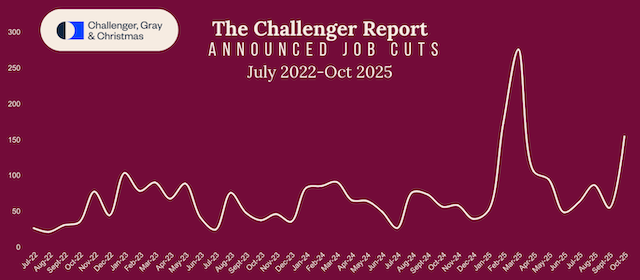
美国10月裁员环比飙升183%!AI渗透与消费疲软叠加,劳动力市场正被改写
Di Yi Cai Jing Zi Xun· 2025-11-07 00:28
Group 1 - The core point of the articles highlights that the acceleration of AI integration, weak consumer spending, and rising costs are driving companies to cut expenditures and adjust workforce structures, leading to significant layoffs in the U.S. job market [1][4][5] - In October, U.S. companies announced layoffs of 153,000 employees, a staggering increase of 183% month-over-month, marking the highest monthly total since 2003 and a 175% increase compared to the same month last year [1][3] - Year-to-date, approximately 1.1 million layoffs have been announced, representing a 65% increase from the previous year, making it the largest year for layoffs since the pandemic began [1][3] Group 2 - The technology sector is identified as the hardest hit, with 33,300 layoffs in October, nearly six times the number in September, primarily due to the impact of AI integration and automation [3][4] - The report indicates that the five industries with the highest cumulative layoffs this year are government, technology, warehousing, retail, and services, collectively accounting for over 70% of total layoffs [3] - The report suggests that the difficulty for laid-off workers to find new jobs is increasing, with longer job search cycles and reduced job supply, indicating a weakening momentum in employment growth [3][5] Group 3 - The current wave of layoffs is closely linked to the accelerated application of AI technology, which is reshaping workforce demand, particularly in the technology and media sectors [4][5] - The Federal Reserve is expected to lower interest rates in December, with a 62% probability of a 25 basis point cut, as ongoing weak employment data may prompt a more accommodative monetary policy [5] - Analysts believe that the combination of AI penetration, cooling consumer demand, and fiscal uncertainties is leading companies to adopt defensive measures, which may delay economic recovery [5]
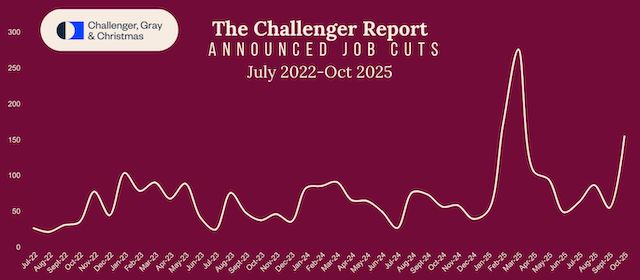
美国10月挑战者企业裁员报告全文:同比激增175%!
Jin Shi Shu Ju· 2025-11-06 09:37
Core Insights - In October, U.S. employers announced layoffs of 153,074, a 175% increase from the same month in 2024 and an 183% increase from the previous month [1][3] - Cumulatively, layoffs for the year reached 1,099,500, a 65% increase compared to the same period in 2024, marking the highest level since 2020 [1][3] Layoff Trends - Nearly 450 independent layoff plans were tracked in October, up from just below 400 in September [3] - October's layoffs were the highest for the month since 2003, with a record of 171,874 layoffs at that time [3] - The trend of announcing layoffs in the fourth quarter has changed, with companies now more willing to disclose layoffs in October, contrary to past practices [3] Industry-Specific Layoffs - The technology sector led private sector layoffs with 33,281 announced in October, a significant increase from 5,639 in September [4] - The retail sector announced 2,431 layoffs in October, a slight decrease from 2,577 in September, but still facing significant challenges [4] - The warehousing industry saw the highest number of layoffs in October, with 47,878, reflecting ongoing restructuring due to overcapacity and automation [4] Reasons for Layoffs - Cost-cutting was the primary reason for layoffs in October, affecting 50,437 individuals, followed by layoffs due to artificial intelligence integration, impacting 31,039 individuals [9] - Market and economic conditions led to 21,104 layoffs in October, with cumulative layoffs for the year reaching 229,331 [9] Recruitment Plans - Employers announced plans to hire 488,077 individuals by October, a 35% decrease from the same period in 2024, marking the lowest level since 2011 [10] - The average monthly recruitment announcement was 48,808, also the lowest since 2011 [10]
万业企业:股东三林万业解除质押300万股
Mei Ri Jing Ji Xin Wen· 2025-10-31 09:48
Group 1 - The company Wan Ye Enterprise (SH 600641) announced that its second largest shareholder, Sanlin Wan Ye, will release the pledge on 3 million shares [1] - As of October 30, 2025, Sanlin Wan Ye holds approximately 63.8 million shares, accounting for 6.86% of the company's total equity [1] - Currently, Sanlin Wan Ye has pledged a total of 60.36 million shares, which represents 94.61% of its holdings and 6.49% of the company's total equity [1] Group 2 - For the fiscal year 2024, the revenue composition of Wan Ye Enterprise is as follows: real estate accounts for 48.34%, manufacturing for 41.44%, services for 8.72%, and other businesses for 1.49% [1] - The current market capitalization of Wan Ye Enterprise is 17.3 billion yuan [2]
