投资银行

Search documents
高盛客户调查发现,人工智能_FOMO_在年底业绩恐慌中表现超乎寻常_ZeroHedge
Goldman Sachs· 2025-10-09 02:00
Investment Rating - The report indicates a bullish sentiment among investors, with over half of respondents optimistic about the S&P 500 index, marking the highest level of optimism since December 2024 [3]. Core Insights - The "fear of missing out" (FOMO) related to artificial intelligence (AI) is significantly influencing market sentiment, overshadowing concerns about economic slowdown and potential market bubbles [3][12]. - Investors are increasingly focused on AI-related stocks, particularly in infrastructure, while other sub-themes like robotics and quantum computing have not garnered much attention yet [9]. - The momentum index is expected to outperform the S&P 500 by year-end, reflecting the growing integration of AI trading strategies [10]. - Despite a mixed economic outlook, with excitement around AI and a soft labor market, investors are content with the prospect of only one more rate cut this year [12]. - The expectation of a large-scale rate cut cycle has diminished, leading to a shift in focus towards AI-driven market rebounds [14]. - Discussions around high valuations and potential market bubbles are emerging as investors prepare to re-enter the stock market, driven by FOMO sentiment [16]. Summary by Sections - **Investor Sentiment**: Optimism among investors has reached a peak, with a significant portion expecting strong performance from the S&P 500 [3]. - **AI Focus**: The report highlights a strong interest in AI stocks, particularly in infrastructure, while other areas remain less prioritized [9]. - **Momentum Trading**: There is a consensus that momentum trading will outperform traditional indices, indicating a shift towards AI-related strategies [10]. - **Economic Outlook**: Investors are satisfied with the current economic conditions, anticipating only minor adjustments in interest rates [12]. - **Market Dynamics**: The report notes a shift away from expectations of aggressive rate cuts, favoring AI-driven market movements instead [14]. - **Valuation Concerns**: As the market heats up, discussions about high valuations and potential bubbles are becoming more prevalent among investors [16].

投资圈又迎来女掌门,41岁哈佛金融女,接管7100亿基金公司
3 6 Ke· 2025-10-09 01:00
Core Insights - The article highlights the increasing prominence of women in Wall Street, showcasing their capabilities and achievements in a traditionally male-dominated industry [1][25]. Group 1: Leadership Changes - Blackstone Group appointed Katie Keenan as the new CEO of BREIT, overseeing a flagship real estate fund with assets exceeding $100 billion (approximately 710 billion RMB) [2][4]. - The previous CEO, Wesley LePatner, tragically passed away due to a shooting incident, marking a significant and shocking event in the industry [2][9]. - Katie Keenan has been with Blackstone for 13 years and has made notable contributions, including initiating a $2 billion mortgage loan project and leading an $1.8 billion loan for a landmark building in Manhattan [4][6][7]. Group 2: Rising Female Leaders - Li Wei, a 35-year-old Chinese-American, has become a prominent global chief investment strategist at BlackRock, recognized for her market insights and analysis [10][16]. - Jessica Wu, a 22-year-old entrepreneur and former MIT student, has successfully raised $21 million (approximately 149 million RMB) for her AI company, Sola, while also being the youngest quantitative researcher at a major hedge fund [18][21][22]. Group 3: Industry Trends - The article notes a significant shift in gender representation within Wall Street firms, with an increasing number of women rising to leadership positions, challenging the historical male dominance [25][26]. - Companies like Citigroup are seeing a gradual increase in female executives, indicating a potential future where women may hold more leadership roles in finance [26].



现货黄金历史性突破4000美元大关,年内涨幅超50%
Sou Hu Cai Jing· 2025-10-08 02:33
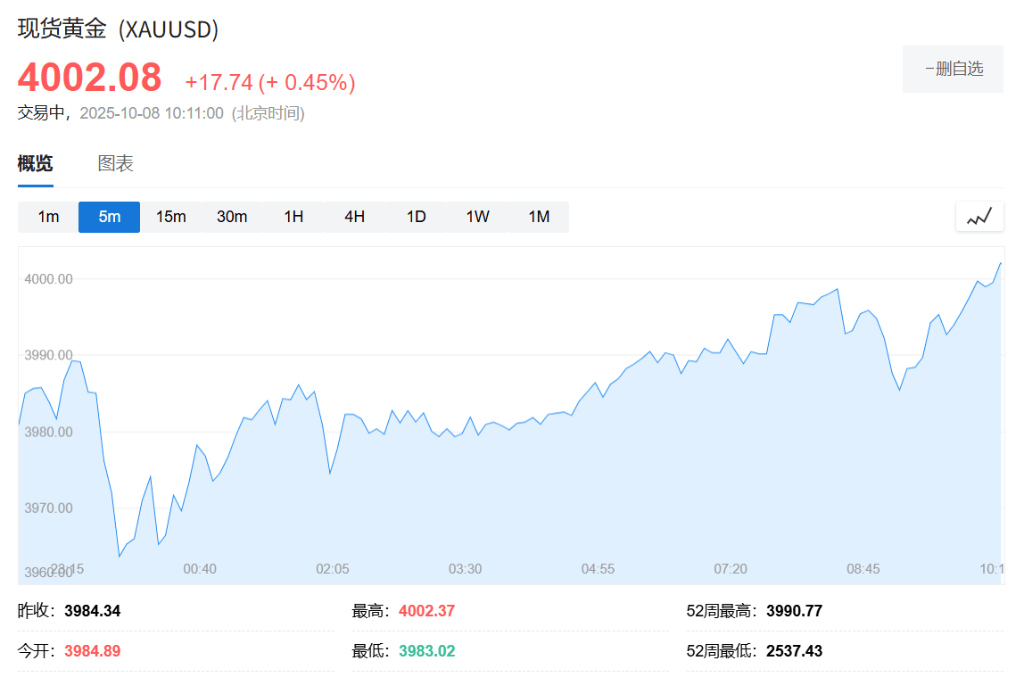
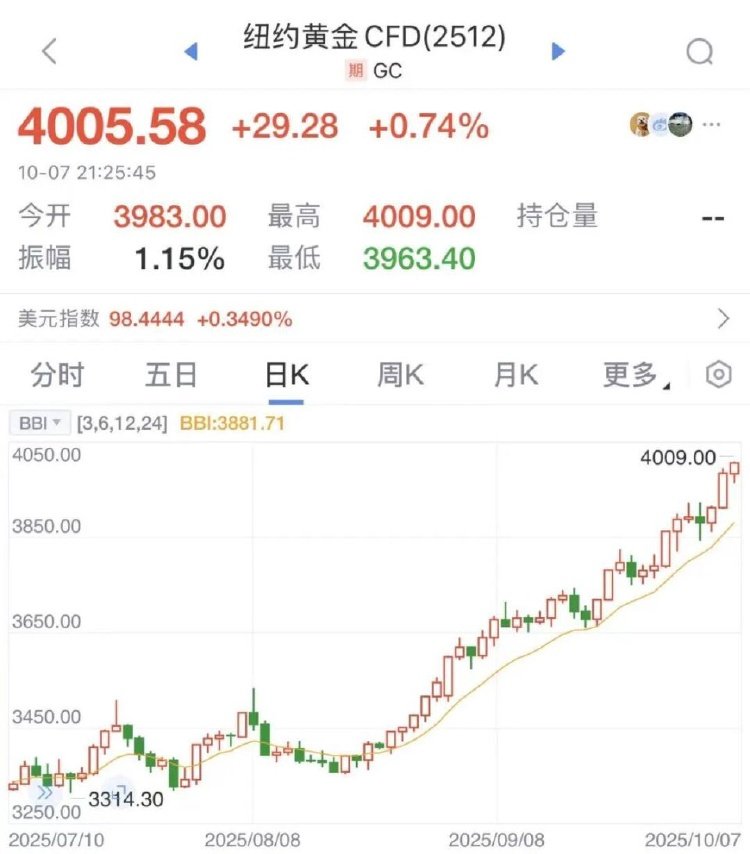
Core Viewpoint - Spot gold has historically surpassed the $4000 per ounce mark, driven by factors such as the U.S. government shutdown, a pullback in tech stocks, and global political uncertainties [1][4]. Group 1: Market Dynamics - Investors are flocking to the gold market seeking refuge amid escalating global economic and geopolitical risks, with gold prices soaring over 50% this year [4]. - The recent surge in gold prices is primarily catalyzed by the ongoing U.S. government shutdown, which has delayed key economic data and increased uncertainty regarding the Federal Reserve's interest rate decisions [4][5]. - Market expectations suggest a 25 basis point rate cut by the Federal Reserve this month, which typically enhances the appeal of non-yielding assets like gold [5]. Group 2: Global Political Factors - Political turmoil in various regions, including France and Japan, has intensified concerns over fiscal risks, further boosting demand for gold as a safe haven [5][6]. - The resignation of French Prime Minister Le Maire and the potential leadership change in Japan have contributed to market uncertainty, prompting increased investment in gold [5][6]. Group 3: Long-term Trends - The narratives of "de-dollarization" and "de-globalization" are providing structural support for the long-term rise in gold prices, as global investors shift from the dollar to safe-haven assets [7]. - Strong institutional demand is a significant characteristic of the current bull market, with central banks, including the People's Bank of China, actively increasing their gold reserves [8]. Group 4: Investor Sentiment - Despite the bullish outlook, some analysts caution about potential short-term pullbacks due to the rapid pace of price increases, suggesting that profit-taking may occur [9]. - More strategists recommend that investors increase their gold allocation to hedge against dollar risks and prepare for future market shocks, with a suggested allocation of around 5% [9].
机构靠比特币赚翻了!华尔街加码:万亿资金拟配2%–4%加密货币?
Sou Hu Cai Jing· 2025-10-08 02:14
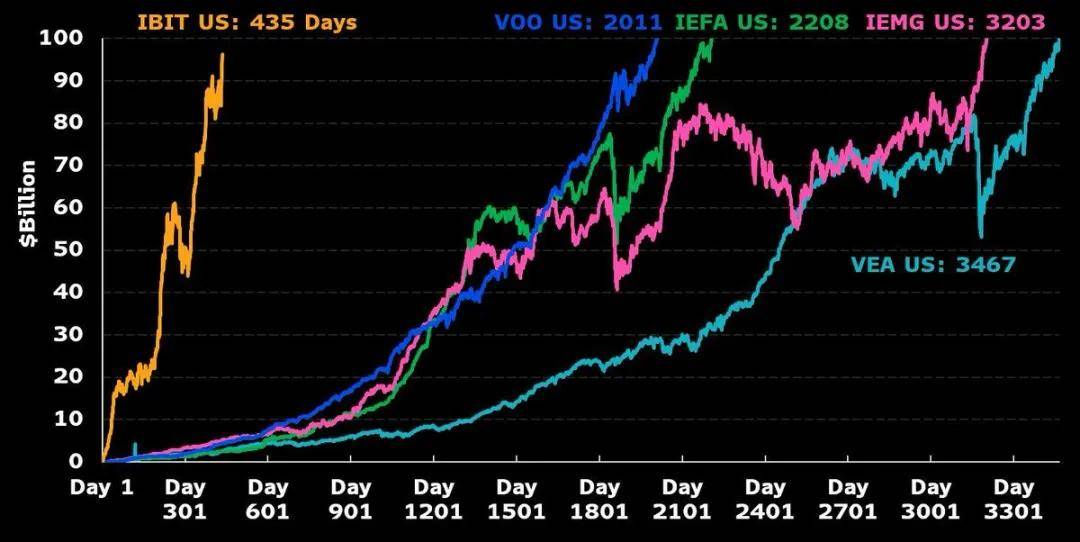
Core Insights - The approval of Bitcoin spot ETFs by the SEC in 2024 is seen as a watershed moment in cryptocurrency history, significantly altering market dynamics and providing substantial returns for financial giants on Wall Street [1] - The success of Bitcoin ETFs, particularly BlackRock's iShares Bitcoin Trust (IBIT), has led to a massive capital migration towards the cryptocurrency market, with major investment banks like Morgan Stanley opening doors to crypto investments [1][4] Group 1: Bitcoin ETF Success - BlackRock's IBIT has approached nearly $100 billion in assets under management (AUM) since its launch in January 2024, generating over $244 million in annual management fees, making it the most profitable ETF in BlackRock's portfolio [4] - In the first week of October 2025, Bitcoin spot ETFs saw a record net inflow of $3.2 billion, with IBIT alone attracting $1.78 billion, pushing Bitcoin prices above $125,000 [4] Group 2: Wall Street's Shift - Morgan Stanley's Global Investment Committee (GIC) has recommended incorporating cryptocurrencies into client asset allocations, marking a significant shift in perspective towards Bitcoin as a "scarce asset" akin to digital gold [7] - The potential influx of $40 billion to $80 billion into the crypto market is anticipated if only a small percentage of Morgan Stanley's $2 trillion in managed assets adopt the 2% to 4% allocation recommendation [7] Group 3: Macro Economic Factors - The growing trend of "debasement trade" and concerns over the long-term credibility of the US dollar have led investors to seek refuge in scarce assets like Bitcoin and gold, with Bitcoin being viewed as "digital gold" [10] - Prominent investors, such as Paul Tudor Jones, have publicly endorsed Bitcoin, reinforcing institutional confidence in the cryptocurrency as a hedge against inflation and currency devaluation [10][11] Group 4: Investment Strategies - Various investment firms suggest different allocation strategies for cryptocurrencies, with BlackRock recommending 1% to 2% and Fidelity suggesting 2% to 5% for optimal returns during bull markets [12] - The overall trend indicates that cryptocurrencies, particularly Bitcoin, are transitioning from high-risk fringe assets to essential components of modern investment portfolios [14]


高盛谈铜价:10000美元已成“新底线”,未来两年11000美元是上限
美股IPO· 2025-10-08 01:24
Core Viewpoint - The demand for copper is undergoing a profound transformation from a cyclical indicator ("Dr. Copper") to a strategic asset ("Colonel Copper") that serves national security and strategic industries [1][9]. Group 1: Price Forecast and Market Dynamics - Goldman Sachs analysts predict that copper prices are resetting to a new range, with a solid bottom at $10,000 per ton due to structural supply constraints and strong demand in key sectors [3][5]. - The new trading range for copper prices is expected to be between $10,000 and $11,000 per ton starting in 2026, driven by limited supply, structural demand growth, and strategic reserves [5][6]. - Despite a slight oversupply in the market, a significant supply gap is not anticipated until the end of the decade (2029) [5][6]. Group 2: Supply Constraints - The $10,000 price floor is primarily supported by structural challenges in the supply side, including increased mining difficulty and rising capital expenditures [6][7]. - Global copper supply is projected to grow at an average annual rate of only 1.5% from 2025 to 2030 [6]. Group 3: Demand Dynamics - The core drivers of demand growth will be the electric grid and power infrastructure, contributing over 60% of the increase, fueled by the urgent needs of AI, defense, and energy security [11]. - Although strategic demand is strong, the overall growth rate of refined copper demand is expected to slow from 2.8% in 2025 to an average of 2.1% from 2026 to 2030 due to structural declines in the Chinese construction industry and substitution effects from aluminum [11]. Group 4: Strategic Reserves and Market Impact - Strategic reserves may play a crucial role in absorbing excess capacity in the current slightly oversupplied market, making copper an attractive reserve commodity [8][10]. - Potential strategic purchases by countries like China and the U.S. could absorb much of the anticipated excess, providing downward protection for prices [10].

金价爆了!史上首次
Sou Hu Cai Jing· 2025-10-07 18:14
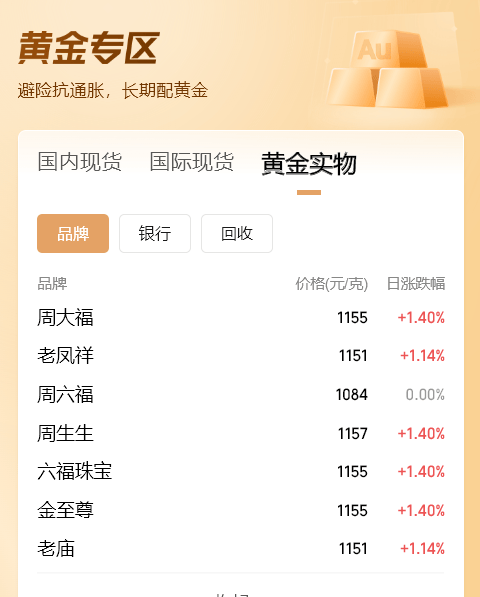
Group 1 - International gold prices continued to rise, reaching an all-time high of $4000.1 per ounce on October 7, driven by factors such as the ongoing U.S. government shutdown crisis, increased expectations for multiple interest rate cuts by the Federal Reserve, and persistent geopolitical conflicts globally [1] - As of October 7, the December gold futures price on the New York Mercantile Exchange was reported at $3999.9 per ounce, reflecting a 0.59% increase [1] - Domestic gold jewelry prices also increased, with brands such as Chow Sang Sang reaching 1157 RMB per gram, Chow Tai Fook at 1155 RMB per gram, and Lao Miao Gold at 1151 RMB per gram [1] Group 2 - Goldman Sachs raised its forecast for gold prices in December 2026 to $4900 per ounce, up from a previous estimate of $4300 [3] - It is anticipated that central banks will have average net purchases of gold of 80 tons and 70 tons in 2025 and 2026, respectively, as emerging market central banks may continue to diversify their foreign exchange reserves by increasing gold holdings [3]
国际期金价格突破每盎司4000美元
Sou Hu Cai Jing· 2025-10-07 18:14
2月11日,在浙江省湖州市德清县乾元镇一家金店,店员展示黄金首饰。新华社发(倪立芳摄) 新华社北京10月7日电 美国纽约商品交易所12月交割的黄金期货价格7日盘中一度涨至每盎司4000.05美元,创历史新高。这是国际黄金期货价格首次突破 这一关口。另一方面,国际现货黄金交易7日盘中一度上涨至每盎司3977.45美元,再创新高。 俄罗斯新闻社此前预测,因美国政府"停摆"可能导致数千个联邦岗位遭永久裁撤,市场对避险资产的支撑显著增强,金价预计在7日触及每盎司4000美元甚 至更高。 美国总统特朗普与其共和党阁僚一直警告国会民主党人,若因资金分歧导致的政府"停摆"无法尽快结束,数千名联邦雇员将面临永久性失业风险。联邦政府 1日"停摆"后,美国国会参议院3日未能通过新的临时拨款法案。 高盛预计,2025年全球央行平均购金量将达80吨,2026年将达70吨;新兴市场央行可能会继续推进外汇储备结构多元化,增加黄金在储备中的占比。 高盛分析师称,市场预期美国联邦储备委员会将在2026年中期前降息100个基点,这意味着西方市场ETF持仓量有望进一步上升。 由于联邦政府"停摆",美国劳工统计局未能按计划于3日公布月度就业数据统 ...

金价爆了,今年已涨超50%!有人后悔:观望2个月,一克涨了140元
Mei Ri Jing Ji Xin Wen· 2025-10-07 15:24
Group 1 - Gold prices have surged, with spot gold reaching a historic high of $3980 per ounce and New York gold futures surpassing $4000, both up over 50% year-to-date [1][8] - Domestic gold jewelry prices are also hitting record highs, with major brands like Chow Tai Fook and Chow Sang Sang seeing prices exceed 1150 RMB per gram [3][4] - The increase in gold prices has not dampened consumer enthusiasm; instead, it has led to a surge in demand, particularly during the recent holiday period [5][6] Group 2 - High foot traffic was reported in major shopping districts, with consumers showing strong purchasing power, spending from thousands to tens of thousands of RMB on gold jewelry [5][6] - The market for traditional wedding gold items remains strong, with new trends emerging such as 5D gold crafts gaining popularity among younger consumers [6][7] - Goldman Sachs has raised its gold price forecast for December 2026 to $4900 per ounce, citing increased demand from central banks and individual investors as key drivers [7][8]

高盛交易员给投资者的忠告:别跟人工智能股热对着干
Xin Lang Cai Jing· 2025-10-07 12:43
投资的一条金科玉律是"不要跟美联储对着干"。高盛集团宏观交易员Bobby Molavi指出,这似乎同样适 用于气势如虹的人工智能股票交易。大型科技股乘着人工智能投资热的东风一骑绝尘,纳斯达克100指 数今年已30次创出新高。Molavi在一份研报中写道,押注这轮行情过头的观点不会有什么赚头。"如果 太早或者看错,眼下很难对抗资本支出并生存下来," 在高盛担任欧洲、中东和非洲执行服务主管的 Molavi说,"无论人工智能最终结果如何以及何时会发生,目前的势头和轨迹都是清晰的。" 来源:滚动播报 ...
悲观者聪明而乐观者赚钱!高盛交易员:AI争论还要好几个季度才能出结果,别跟资本开支对着干
Hua Er Jie Jian Wen· 2025-10-07 11:57
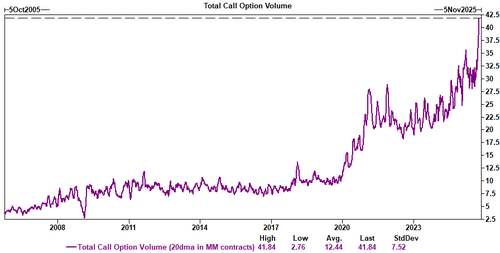
Core Viewpoint - The article emphasizes the importance of maintaining optimism in the market despite signs of bubbles, particularly driven by significant capital expenditures related to AI. It suggests that understanding the long-term narrative of AI and ignoring short-term noise is crucial for investors [1]. Group 1: Market Trends - The U.S. stock market has shown remarkable resilience, with the S&P 500 and Nasdaq indices trading above their 50-day moving averages for over 100 consecutive days, reaching new historical highs [1]. - Retail investors have been net buyers for 21 out of the last 24 weeks, and ETFs have seen net inflows for 183 out of the last 185 trading days, indicating strong market enthusiasm [1]. - The "most shorted" and "unprofitable tech stocks" have experienced rapid gains, alongside sectors like nuclear energy, quantum computing, drones, and artificial intelligence [3]. Group 2: Capital Expenditure and AI - A report predicts that capital expenditures by "hyperscale computing companies" will reach $2.8 trillion by 2029, with total global related capital expenditures amounting to $5.5 trillion during the same period [7]. - The article argues that the substantial capital inflow related to AI is a powerful trend that cannot be easily countered, suggesting that premature bearishness could be detrimental for investors [7]. Group 3: Key Market Drivers - Three main drivers supporting the market are identified: declining interest rates, corporate profits, and employment dynamics [8]. - The expectation of lower U.S. interest rates is seen as a likely scenario, which would provide additional support to capital markets [8]. - AI is expected to enhance corporate profit margins either by directly reducing costs through efficiency or by compelling companies to improve productivity to showcase their AI investments [8]. Group 4: Market Sentiment and Indicators - Current market sentiment indicators are at extreme levels, with daily trading volumes of call options reaching an average of 40 million contracts, double the volume from three years ago [9]. - Despite the S&P 500 and Nasdaq reaching historical highs, a significant percentage of their constituent stocks have declined, indicating a divergence in market performance [9]. - Technology and tech-related stocks now account for 56% of the total market capitalization in the U.S., while defensive stocks have dropped to 16%, the lowest recorded level [10]. Group 5: Currency Valuation and Asset Performance - The current bull market reflects a "devaluation trade" of fiat currency, with the Nasdaq index rising 165% and the S&P 500 index rising 102% when measured in U.S. dollars since the pandemic [11]. - However, when measured in gold, the Nasdaq index has only increased by 7%, and the S&P 500 has decreased by 18%, highlighting the importance of the currency used for asset valuation [11]. - This suggests that non-dollar-denominated assets, such as Bitcoin and gold, have seen faster appreciation, emphasizing the need for investors to consider the currency in which they evaluate asset returns [11].