化工

Search documents
27国要对我们加税30%?法国打响第一枪,美财长一句话定义中美关系
Sou Hu Cai Jing· 2026-02-14 04:41
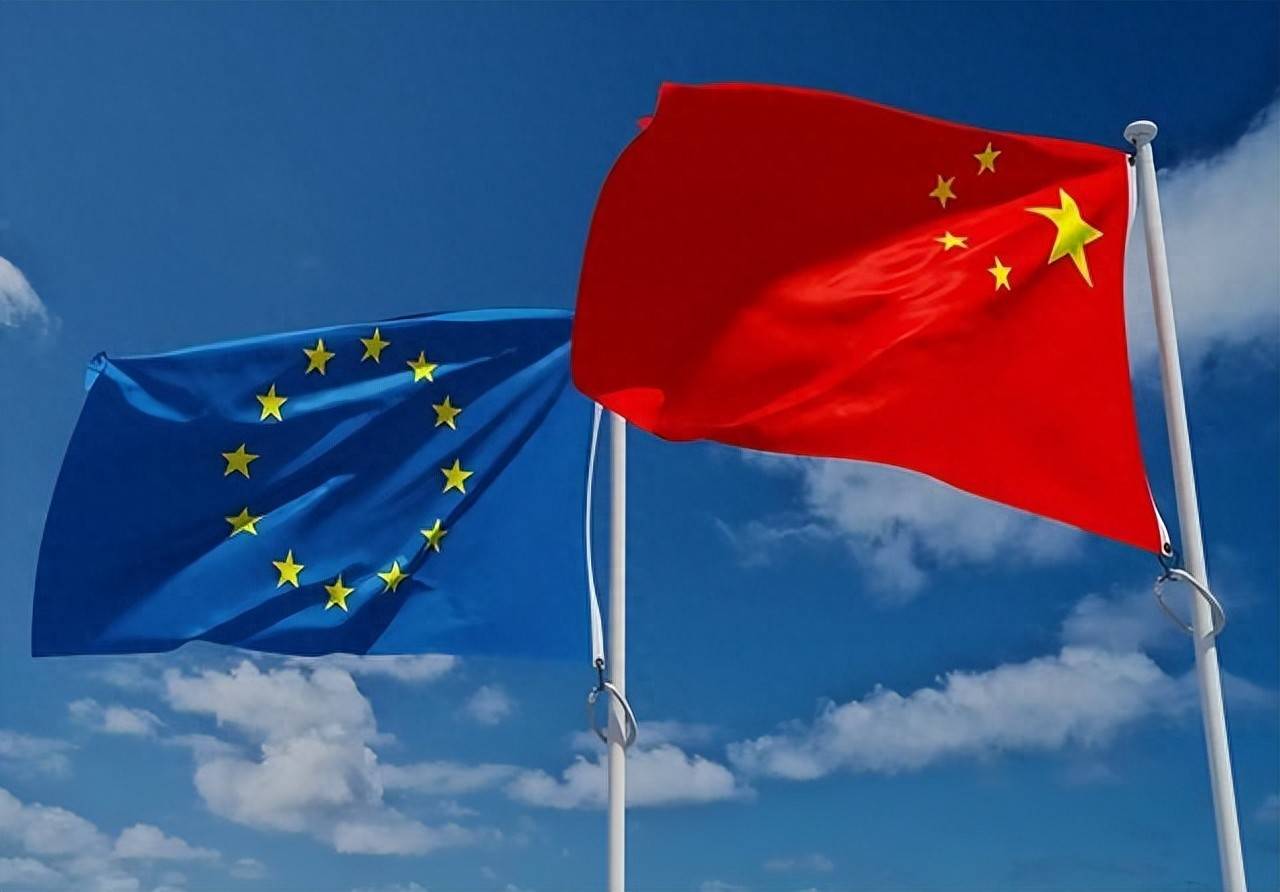
Group 1 - France has proposed a significant government report suggesting that EU member states impose a 30% tariff on Chinese goods to address the trade deficit with China [2][10] - The report indicates that 55% of manufacturing output in the EU faces direct competition from China, with Germany at 70% and France at 36% [10][12] - The proposed tariffs are seen as a desperate measure to level the playing field, as Chinese products have a cost advantage of approximately 30% [12][14] Group 2 - The report reflects France's panic over its industrial decline, as it attempts to unify EU member states against China, despite differing interests among countries like Germany [15][18] - The U.S. Treasury Secretary's comments about being in a "comfortable position" regarding U.S.-China relations suggest a shift in strategy, moving from aggressive confrontation to a more pragmatic approach [20][22] - The U.S. has recognized that a hardline approach against China has not yielded the desired results, leading to a focus on "de-risking" rather than complete decoupling [24][26] Group 3 - France's proposal to manipulate the euro's value against the yuan is reminiscent of the 1985 Plaza Accord, which aimed to address trade imbalances through currency intervention [30][31] - The differences between China and Japan during the Plaza Accord era highlight China's current economic independence and robust domestic market, making such proposals less feasible [33][35] - The report indicates that France's protectionist measures may not effectively address the underlying issues of industrial competitiveness and could lead to further economic challenges [35][37]

六国化工机构调整与股价波动,化工行业周期引关注
Jing Ji Guan Cha Wang· 2026-02-14 04:18
Group 1 - The core viewpoint of the news indicates that the Chinese chemical industry may enter a new upward cycle between 2026 and 2028, with expectations for profit recovery and valuation rebound, although Morgan Stanley suggests that the recovery is more likely to be "long-tail" driven by liquidity rather than fundamental improvements [1] - Zhao Ximing, Vice Dean of Hengli Industrial Chemical Academy, points out that the current cycle is more supply-side driven, with domestic coastal petrochemical bases gradually gaining global pricing power, leading to a rotational characteristic in the valuation recovery of the chemical sector [1] Group 2 - Recent events include the organizational restructuring of Six Nations Chemical (600470) on February 10, 2026, which involves the cancellation of the original phosphate fertilizer workshop and the establishment of five core operational systems to enhance management efficiency and cost accounting accuracy [2] - The chemical sector has recently strengthened, supported by price adjustments in disperse dye varieties (e.g., Zhejiang Longsheng (600352) saw a cumulative increase of 5000 yuan/ton for disperse dye black on February 8) and the implementation of export tax rebates for 94 pesticide varieties starting April 1 [2] Group 3 - In the past 7 days (as of February 13, 2026), Six Nations Chemical's stock price has shown significant volatility: it rose by 0.90% to 6.74 yuan on February 11, with a trading volume of 124 million yuan, but fell by 2.26% to 6.48 yuan on February 13, with the highest price during the period being 6.88 yuan (February 11) and the lowest being 6.46 yuan (February 13), resulting in a fluctuation of 6.37% [3] - Capital flow data indicates a net outflow of 5.19 million yuan from the main funds on February 13, with a turnover rate of 2.85%, and the stock price is approaching a resistance level of 6.88 yuan [3]

冠军产品扩容:从67项到82项的滨州好品新答卷
Qi Lu Wan Bao· 2026-02-14 04:16
Core Insights - The number of champion products in Binzhou has increased from 67 to 82, with 19 of them being global champions, reflecting the city's industrial upgrade and the vitality of its market entities [1][13][14] Group 1: Champion Products and Market Position - Binzhou has achieved the top market share in various sectors, including electronic-grade hydrofluoric acid for advanced process logic chips, high-toughness lightweight aluminum alloy wheels, and wide-width cellulose fiber dyeing cloth [1][3] - The champion products are seen as a crucial benchmark for industrial competitiveness and a solid support for high-quality regional economic development [3][4] Group 2: Industrial Structure and Development - The 82 champion products span across 8 industries, with 51 from traditional sectors and 31 from emerging industries, enhancing the resilience and growth potential of Binzhou's modern industrial system [4][6] - Traditional industries like aluminum, high-end textiles, and chemicals continue to lead, while emerging sectors such as new energy and new materials are rapidly growing, indicating a robust industrial upgrade [6][10] Group 3: Innovation and Ecosystem - Binzhou has established a comprehensive innovation ecosystem that supports the entire chain of production, research, and development, facilitating the transformation of innovative results [7][9] - The city promotes a "Five Institutes, Ten Schools, N Bases" innovation consortium to address the challenges of isolated innovation efforts, ensuring seamless integration of research and industrial needs [7][12] Group 4: Future Growth and Strategy - By 2025, Binzhou aims to cultivate 240 provincial-level champion and specialized enterprises, maintaining the highest R&D investment intensity in the province for five consecutive years [9][14] - The city is transitioning from attracting resources based on cost advantages to leveraging value and ecological advantages, enhancing its industrial development dynamics [12][14]
2026年2月上旬流通领域重要生产资料市场价格变动情况
Guo Jia Tong Ji Ju· 2026-02-14 01:33
Core Viewpoint - The monitoring of market prices for 50 important production materials in China shows a mixed trend, with 28 products experiencing price increases, 20 seeing declines, and 2 remaining stable in early February 2026 compared to late January 2026 [2]. Group 1: Price Changes in Major Categories - In the black metal category, prices for rebar, wire rod, and ordinary medium plates decreased by 0.3%, 0.4%, and 0.2% respectively, while seamless steel pipes remained unchanged [4]. - In the non-ferrous metal category, electrolytic copper saw a price increase of 0.3%, while aluminum ingots and lead ingots decreased by 2.8% and 2.4% respectively [4]. - Chemical products like sulfuric acid and ethanol experienced price increases of 3.3% and 2.7%, while caustic soda and acetic acid saw declines of 2.4% and 4.4% respectively [4]. Group 2: Energy and Coal Prices - In the petroleum and natural gas sector, liquefied natural gas prices fell by 0.8%, while liquefied petroleum gas and gasoline prices increased by 0.3% and 0.9% respectively [4]. - Coal prices showed mixed results, with anthracite coal increasing by 0.7% and coking coal decreasing by 1.0% [4]. Group 3: Agricultural Products and Fertilizers - Among agricultural products, prices for rice and wheat increased by 0.1% and 0.3%, while cotton prices decreased by 0.6% [5]. - Fertilizer prices also varied, with urea increasing by 1.2% and potassium fertilizer rising by 0.5% [5]. Group 4: Monitoring Methodology - The price monitoring includes a comprehensive range of 50 products across 9 categories, covering over 300 markets and nearly 2000 businesses nationwide [7][8]. - The methodology involves various data collection techniques, including on-site price collection and electronic inquiries [8].
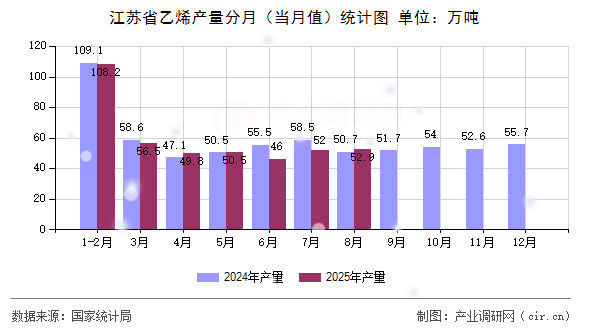
【图】2025年1-8月江苏省乙烯产量数据分析
Chan Ye Diao Yan Wang· 2026-02-14 00:45
Group 1 - The core viewpoint of the article highlights the production statistics of ethylene in Jiangsu Province for the year 2025, indicating a mixed performance with a notable increase in August but an overall decline from January to August [1][4]. Group 2 - In August 2025, the ethylene production reached 52.9 thousand tons, representing a year-on-year growth of 4.3%, which is an increase of 15.0 percentage points compared to the same month last year [1]. - The growth rate in August is 6.1 percentage points lower than the national average, with Jiangsu's production accounting for 16.8% of the national total of 314.08 thousand tons [1]. Group 3 - From January to August 2025, the total ethylene production was 415.9 million tons, showing a year-on-year decline of 3.3%, which is 5.2 percentage points lower than the previous year's growth rate [4]. - The decline in production is 13.9 percentage points lower than the national average, with Jiangsu's output representing 17.0% of the national total of 2,440.69 million tons [4].
“一生磨一剑!”独家对话黄燕铭,A股下一站,重点关注这两个方向!
券商中国· 2026-02-13 23:49
Core Viewpoints - The current A-share market is characterized as a "confidence bull," driven by improved expectations of national governance and enhanced expectations of technology leading the economy, with the movement of residents' deposits being a result rather than a cause [2][5] - The outlook for A-shares in 2026 is expected to be a "sideways fluctuation with slight strengthening," emphasizing the pursuit of a long-term, slow, and healthy bull market while being cautious of rapid bull markets that may lead to sharp declines [2][6] - The previous "dumbbell" market trend has ended, shifting investment opportunities from "high-growth technology + low-volatility high-dividend" extremes to a focus on mid-cap blue chips, particularly in the cyclical and manufacturing sectors [2][6] Investment Opportunities - Opportunities in cyclical industries are not in the real estate chain but are related to national strategies in three sectors: chemicals, metals, and agriculture [3][7] - AI remains a core focus in technology, with long-term potential, but is currently in a phase of expectation verification, requiring careful stock selection [3][9] - The investment focus for the next 3 to 6 months should be on cyclical and manufacturing sectors, as these align with national strategies and economic transformation [7][8] Market Dynamics - The core drivers of the current market uptrend are improvements in national governance and stronger expectations for technology-led economic growth, with significant achievements in diplomacy, defense, and trade contributing to economic resilience [4][5] - The market is currently at a critical juncture around the 4100-point level, with the need for new drivers to support further upward movement, as previous gains have largely reflected the core drivers [6][12] - The transition from a "dumbbell" market structure to a focus on mid-cap blue chips indicates a shift in risk appetite, with low-volatility, high-dividend stocks losing their appeal [11][12] Future Outlook - The AI sector is expected to experience a period of consolidation and differentiation, with the potential for long-term growth remaining intact despite short-term fluctuations [9][10] - The public fund commission rate reform is prompting a strategic shift in brokerage research departments, moving towards comprehensive service for institutional clients beyond just public funds [17] - The securities research industry is seen as a field of continuous learning and growth, with a call for new talent to join and contribute to the evolving landscape [18]

“一生磨一剑!”对话黄燕铭,A股下一站,重点关注这两个方向!
Xin Lang Cai Jing· 2026-02-13 23:47
Core Insights - The current A-share market is characterized as a "confidence bull," driven primarily by improved expectations of national governance and enhanced technological leadership in the economy, with the movement of residents' deposits being a result rather than a cause [2][5][23] - The outlook for 2026 indicates a market pattern of "sideways fluctuations with slight strengthening," emphasizing the pursuit of a long-term, slow, and healthy bull market while cautioning against overly high index targets [2][6][24] - The previous "dumbbell" market trend has ended, shifting investment opportunities from "high-growth technology and low-volatility high-dividend" extremes to a focus on mid-cap blue chips, particularly in the cyclical and manufacturing sectors [2][19][25] Investment Opportunities - Opportunities in cyclical industries are not found in the real estate chain but are linked to national strategies in three key sectors: chemicals, metals, and agriculture [3][20][25] - The AI sector remains a core focus for technology, with long-term potential, but is currently in a phase of expectation verification, requiring careful stock selection [5][28][29] - The manufacturing sector is highlighted as a key area, with China being a manufacturing powerhouse, focusing on equipment across various fields such as machinery, new energy, robotics, military, and semiconductor manufacturing [25][26] Market Dynamics - The market is transitioning from a "two ends" structure to a focus on mid-cap blue chips, with a shift in risk appetite towards more stable investments [30][31] - The core drivers of the market's performance are rooted in changes in expectations rather than liquidity factors, emphasizing the importance of political, economic, and technological developments [31][32] - The upcoming period is expected to see a verification and correction phase for the AI sector, with overall market volatility likely to decrease [28][29] Industry Evolution - The public fund commission rate reform is significantly impacting the securities research industry, prompting a strategic shift towards providing comprehensive services across investment banking, institutional business, and wealth management [35][36] - The future of securities research will involve deeper integration with the core business areas of securities firms, expanding the client base to include enterprises, institutions, and individual clients [35][36]
化工行业2026年投资策略:周期破晓,材料乘风
Southwest Securities· 2026-02-13 23:30
Core Insights - The chemical industry is at the beginning of a new prosperity cycle globally, with Chinese chemical companies showing stronger profit foundations and elasticity due to past expansions and capital expenditures [5][11][29] - Focus on cyclical chemical products, particularly those with resource attributes and potential in the real estate chain [4][5] - The demand from major economies like China and the US is expected to improve, with China's GDP projected to exceed 140 trillion yuan, growing at 5.0% year-on-year [5][22] Group 1: Global and Domestic Chemical Landscape - The global chemical landscape is improving, with China's chemical sector becoming more resilient [9][12] - China's share of the global chemical market has significantly increased from 13% in 2004 to 47% in 2024, indicating its growing importance in the global chemical industry [14][29] - The capital expenditure in the global chemical sector has paused, with many overseas chemical companies reducing production, which may benefit Chinese companies [14][16] Group 2: Resource Attributes in Chemical Products - Three main resource directions are emphasized: mineral resources (like phosphate and potash), indicator resources (such as pesticides and refrigerants), and channel resources (like compound fertilizers) [5][33] - China's phosphate reserves rank second globally, with a steady increase in demand driven by both traditional fertilizer needs and emerging sectors like lithium iron phosphate for batteries [33][36] - The supply of fertilizers is expected to contract in 2025, with production of monoammonium phosphate and diammonium phosphate projected to decrease by 6.73% and 6.86% respectively [39] Group 3: Real Estate Chain Chemical Products - The market currently has low expectations for the recovery of demand in the real estate chain, but there is potential for significant improvement due to government stimulus policies [5][22] - The supply concentration of chemical products related to the real estate chain is gradually increasing, which may lead to faster and easier supply-demand improvements [5] Group 4: New Materials and Domestic Substitution - The report highlights the importance of domestic substitution and the development of new materials in line with China's strategic plans for emerging industries [7][8] - Key areas of focus include lubricating oil additives, semiconductor materials, and bio-based materials [7] Group 5: Investment Recommendations - Suggested companies for investment include Hualu Chemical, Xin Fengming, Yuntianhua, and others, focusing on those with strong market positions and innovative capabilities [7][8]





壳牌股价创新高后回调,化工业务连续亏损拖累业绩
Jing Ji Guan Cha Wang· 2026-02-13 22:45
经济观察网 壳牌股价在近7天内表现强劲,盘中触及历史峰值,随后有所回调。交易活跃度较高。股价 上涨主要受能源主业稳健、成本削减及股东回报计划支撑。 以上内容基于公开资料整理,不构成投资建议。 财报分析壳牌2025年第四季度调整后利润为32.6亿美元,同比下降11%,创近五年单季新低,低于市场 预期;全年调整后利润185.3亿美元,同比下滑22%。化工业务持续拖累业绩,已连续6个季度亏损, 2025年全年亏损11.2亿美元,四季度单季亏损5.89亿美元。尽管上游油气和综合天然气业务收益稳健, 但化工业务利润率低迷对整体盈利形成压力。财务方面,2025年全年归母净利润178.8亿美元,同比增 长11.05%,但四季度盈利疲软凸显结构性挑战。 机构观点经济观察网分析指出,壳牌股价创新高主要受益于液化天然气业务增长、成本控制及股东回 报,但化工业务连续亏损仍是核心隐忧,若重组不及预期可能压制估值。格隆汇报告显示,欧洲油企在 低油价环境下集体转向防御策略,壳牌虽未暂停回购,但需平衡化工业务整改与能源转型投入,行业利 润率低迷或加剧财务压力。 近期事件2026年2月12日,安永因违反壳牌审计独立性规则,四名合伙人离职,包 ...
2026年全国碳市场重点工作来了!从存证到清缴,一步都不能少
2 1 Shi Ji Jing Ji Bao Dao· 2026-02-13 14:01
Core Viewpoint - The Ministry of Ecology and Environment has issued a notification detailing the responsibilities and obligations of key emission units in the carbon emission trading market, which will include the power generation, steel, cement, and aluminum smelting industries by 2026, as part of China's dual carbon goals [1][2]. Group 1: Key Emission Units and Coverage - By 2026, the carbon market will include approximately 3,700 key emission units, covering around 8 billion tons of carbon emissions, which accounts for over 60% of the national carbon emissions [2]. - The eight key industries, including power generation, steel, construction materials, non-ferrous metals, petrochemicals, chemicals, paper, and aviation, contribute to about 75% of China's carbon dioxide emissions [2][5]. Group 2: Compliance Requirements - The four core industries (power generation, steel, cement, aluminum smelting) must complete a full compliance process, including listing, monthly verification, annual reporting, and quota management [2][4]. - The notification outlines specific deadlines for key emission units, such as the publication of the 2027 key emission unit list by October 31, 2026, and the submission of greenhouse gas emission reports by March 31, 2026 [3][4]. Group 3: Additional Industry Management - Industries like petrochemicals and chemicals are required to submit annual emission reports but are not yet involved in quota trading and compliance [5]. - Companies in these sectors with annual emissions of 26,000 tons of CO2 equivalent must participate in the annual reporting process, with the same reporting deadline of March 31, 2026 [5][6]. Group 4: Future Preparedness - Industries not yet included in the carbon market should focus on preparing for future compliance by enhancing their reporting and verification capabilities [6]. - It is recommended that these companies establish carbon asset management departments and develop carbon reduction plans to ensure readiness for future inclusion in the carbon market [6].