
建筑业

Search documents
4月PMI数据点评:季节性因素叠加外部环境变化,制造业PMI降至收缩区间
Tai Ping Yang Zheng Quan· 2025-04-30 12:42
Group 1: Manufacturing PMI Insights - China's April manufacturing PMI dropped to 49.0%, down 1.5 percentage points from the previous month, indicating a return to contraction territory[4] - The production index fell to 49.8%, a decrease of 2.8 percentage points, while the new orders index declined to 49.2%, down 2.6 percentage points[10] - New export orders plummeted to 44.7%, a significant drop of 4.3 percentage points, reflecting weakened external demand[10] Group 2: Economic Factors and Trends - Seasonal factors and external environment changes contributed to the decline in manufacturing PMI, with April historically showing negative month-on-month growth since 2016[6] - Price indices for major raw materials and factory output remained below the critical level, with the former at 47.0% and the latter at 44.8%, indicating ongoing supply-demand imbalances[15] - High-tech manufacturing PMI stood at 51.5%, showing resilience compared to other sectors, which experienced declines[17] Group 3: Non-Manufacturing Sector Performance - The non-manufacturing PMI for April was 50.4%, down 0.4 percentage points but still indicating expansion[18] - The service sector's business activity index was 50.1%, supported by increased consumer spending during the Qingming Festival[22] - The construction sector's business activity index remained robust at 51.9%, driven by infrastructure projects and government initiatives[26]
整理:ADP报告重要行业薪资增速一览
news flash· 2025-04-30 12:22
Core Insights - The ADP report indicates that the median year-on-year wage growth for employment in various sectors shows slight variations from March to April 2023, with most sectors experiencing stable growth rates [1] Group 1: Wage Growth by Industry - In April, the median year-on-year wage growth for employment in the construction industry was 4.7%, unchanged from March [1] - The manufacturing sector saw a decrease in median year-on-year wage growth to 4.6% in April, down from 4.8% in March [1] - The trade, transportation, and utilities sector maintained a stable median year-on-year wage growth of 4.3% in both March and April [1] - The financial services sector experienced a slight decrease in median year-on-year wage growth to 5.1% in April, compared to 5.3% in March [1] - The professional and business services sector's median year-on-year wage growth decreased slightly to 4.3% in April from 4.4% in March [1]
整理:ADP报告重要行业就业人数变化一览
news flash· 2025-04-30 12:18
Core Insights - The ADP report indicates a mixed employment landscape across various sectors, with some industries experiencing growth while others face declines. Employment Changes by Industry - In April, the construction industry saw an increase of 16,000 jobs, following a rise of 6,000 jobs in March [1] - The manufacturing sector added 4,000 jobs in April, a decrease from the 21,000 jobs added in March [1] - The trade, transportation, and utilities sector experienced a gain of 21,000 jobs in April, contrasting with a loss of 6,000 jobs in March [1] - The financial services industry added 20,000 jobs in April, down from an increase of 38,000 jobs in March [1] - Professional and business services saw a decrease of 2,000 jobs in April, following a significant increase of 57,000 jobs in March [1]
中采PMI点评:4月PMI:内外开始分化
Shenwan Hongyuan Securities· 2025-04-30 11:14
Group 1: PMI Overview - In April, the manufacturing PMI decreased by 1.5 percentage points to 49%, down from 50.5% in March[7] - The non-manufacturing PMI fell by 0.4 percentage points to 50.4%, compared to 50.8% in the previous month[7] - The new export orders index dropped significantly by 4.3 percentage points to 44.7%, indicating potential pressure on future exports[2] Group 2: Demand and Production Insights - The new orders index declined to 49.2%, while the production index remained near the threshold at 49.8%, suggesting weak demand but relatively high production levels[2] - Internal demand showed resilience, with the domestic orders index only down 2.3 percentage points to 49.9%[2] - Despite a decline in new export orders, foreign trade cargo volume increased by 0.7 percentage points year-on-year to 1.3%, attributed to prior "export rush" orders[2] Group 3: Sector Performance - Key sectors like high-tech manufacturing and equipment manufacturing saw significant PMI declines of 0.8 and 2.4 percentage points, respectively, while the consumer goods sector's PMI fell only 0.6 percentage points to 49.4%[3] - The construction PMI decreased by 1.5 percentage points to 51.9%, primarily due to a slowdown in real estate, although infrastructure construction accelerated[3] - The service sector PMI experienced a minor decline of 0.2 percentage points to 50.1%, supported by strong performance in productive service industries[4] Group 4: Future Outlook - The report highlights increased uncertainty in external demand due to tariff hikes, while emphasizing the need to monitor changes in domestic demand[4] - The central political bureau meeting in April stressed the importance of stabilizing employment, businesses, and market expectations, indicating potential support for domestic demand in manufacturing[4]
4月PMI:内外开始分化
申万宏源宏观· 2025-04-30 11:04
屠 强 资深高级宏观分析师 联系人: 屠强、耿佩璇 摘要 事件: 4月30日,国家统计局公布4月PMI指数,制造业PMI为49%、前值50.5%;非制造业PMI为50.4%、 前值50.8%。 核心观点:4月新出口订单已明显下滑,但内需如基建与消费品行业PMI仍维持韧性。 4月PMI整体与分项读数均有走弱,但相对来看新订单指数更弱,生产仍维持较高水平。 4月制造业PMI 边际下行1.5pct至49%;剔除供应商配货指数的PMI也回落1.5pct。结构上生产、新订单指数均有回落,边 际分别下行2.8、2.6pct。由于PMI为环比指标,反映本月制造业景气度较上月的边际变化;产需对比看, 新订单指数下行至49.2%,而生产指数仍在荣枯线附近(49.8%),反映本月需求偏弱,生产景气水平相 对较高。 需求内部呈现分化特征,其中新出口订单指数降幅较大,但内需订单更具韧性。 生产景气相对较高的情 况下,4月外贸货运量同比上行0.7pct至1.3%,主因前期订单在"抢出口";而4月新出口订单指数大幅回落 4.3pct至44.7%,或意味着后续出口有较大压力。对比之下,内需订单指数本月下滑2.3pct,但绝对水平仍 在荣枯 ...
4月制造业PMI为49%,但这一产业延续高景气
券商中国· 2025-04-30 09:55
重要数据披露! 4月30日,国家统计局服务业调查中心和中国物流与采购联合会发布了4月份中国采购经理指数。其中,制造业采购 经理指数(制造业PMI)为49.0%,比上月下降1.5个百分点。 分析认为,4月份外贸环境的变化给我国制造业带来一定的扰动,市场需求和企业生产短期有所放缓,原材料采购、 市场价格等方面也有所波动,但国内需求稳定释放,缓解了出口订单下行的压力,新动能和消费品生产继续稳中有 增。 新出口订单指数环比走低 4月份,制造业PMI比上月下降1.5个百分点,至49.0%,降至临界点以下。 国家统计局服务业调查中心高级统计师赵庆河表示,这是受前期制造业较快增长形成较高基数叠加外部环境急剧变 化等因素影响。 从13个分项指数来看,同上月相比,生产指数、新订单指数、新出口订单指数积压订单指数、产成品库存指数、采 购量指数、进口指数、购进价格指数、出厂价格指数、原材料库存指数、从业人员指数、供应商配送时间指数和生 产经营活动预期指数均下降,指数降幅在0.1至5.5个百分点之间。 中国人民大学统计学院教授、中国调查与数据中心副主任吴翌琳对记者表示,4月中国制造业PMI景气度环比走低主 要是受外需收缩和政策效应递 ...
重磅数据出炉!
证券时报· 2025-04-30 09:32
4月30日,国家统计局服务业调查中心和中国物流与采购联合会发布了4月份中国采购经理指数。 其中,制造业采购经理指数(制造业PMI)为49.0%,比上月下降1.5个百分点。分析认为,4月份外贸环境的变化给我国制造业带来一定的扰动,市场需求和企业 生产短期有所放缓,原材料采购、市场价格等方面也有所波动,但国内需求稳定释放,缓解了出口订单下行的压力,新动能和消费品生产继续稳中有增。 新出口订单指数环比走低 4月份,制造业PMI比上月下降1.5个百分点,至49.0%,降至临界点以下。 国家统计局服务业调查中心高级统计师赵庆河表示,这是受前期制造业较快增长形成较高基数叠加外部环境急剧变化等因素影响。 从13个分项指数来看,同上月相比,生产指数、新订单指数、新出口订单指数、积压订单指数、产成品库存指数、采购量指数、进口指数、购进价格指数、出厂价 格指数、原材料库存指数、从业人员指数、供应商配送时间指数和生产经营活动预期指数均下降,指数降幅在0.1至5.5个百分点之间。 中国人民大学统计学院教授,中国调查与数据中心副主任吴翌琳对记者表示,4月中国制造业PMI景气度环比走低主要是受外需收缩和政策效应递减以及大宗商品价 格波动 ...
消费品制造业国内市场需求释放 投资、消费表现积极
Yang Shi Wang· 2025-04-30 09:11
Group 1: Manufacturing Sector - In April, the Manufacturing Purchasing Managers' Index (PMI) was reported at 49%, a decrease of 1.5 percentage points from the previous month, indicating a slight contraction in the manufacturing sector [3] - High-tech manufacturing PMI stood at 51.5%, significantly above the overall manufacturing level, indicating continued expansion in this sector [5] - The new orders index for consumer goods manufacturing was at the critical point of 50%, suggesting a good release of domestic market demand [5] Group 2: Business Confidence and Expectations - The production and business activity expectation index for April was 52.1%, remaining in the expansion zone, reflecting strong confidence among enterprises regarding market development [5] - Industries such as food and beverage, automotive, and aerospace showed high expectation indices of 58% and above, indicating robust business activity [7] Group 3: Non-Manufacturing Sector - The non-manufacturing business activity index was at 50.1%, a slight decrease of 0.2 percentage points from the previous month, but still above the critical point, indicating continued expansion [8] - The service sector, particularly tourism and information services, showed positive performance, contributing to the overall growth in non-manufacturing activities [8][9] Group 4: Construction Sector - The construction business activity index was reported at 51.9%, a decrease of 1.5 percentage points from the previous month, yet still indicating expansion [9] - With the arrival of the construction peak season, civil engineering investment is accelerating, highlighting the role of investment in driving economic growth [10]

如何更全面评估4月PMI数据?五个维度盘点外部冲击的影响
Sou Hu Cai Jing· 2025-04-30 06:25
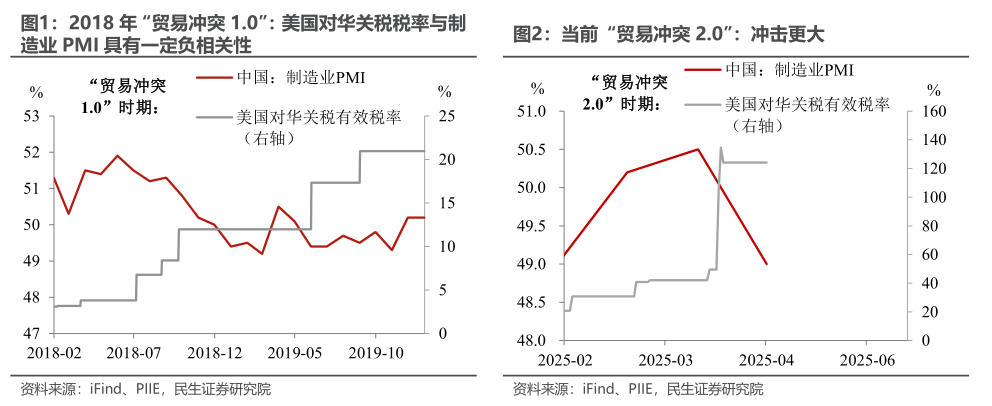
Core Viewpoint - The April PMI data reflects the impact of tariff shocks, indicating that the previous "export rush" has come to an end, with significant declines in both manufacturing PMI and new export orders, surpassing the declines seen in 2018 [1] Dimension 1: Direct Impact - The new export orders index for April PMI dropped by 4.3 percentage points to 44.7%, marking a decline much steeper than the -2.7 percentage points seen during the lowest growth rates between 2018-2019 [5] - High-frequency data also shows a clear decline in export container freight rates to regions such as the U.S. West Coast, East Coast, and South America in April, signaling the end of the "export rush" [5] Dimension 2: Indirect Impact - The PMI new orders index, representing domestic demand, fell to 49.2% (down 2.6 percentage points), while the PMI production index dropped to 49.8% (down 2.8 percentage points), both falling below the growth threshold and contributing to the overall decline in manufacturing PMI [11] Dimension 3: Corporate Behavior Impact - As demand weakens, companies are more inclined to reduce prices to clear inventory, with the PMI finished goods inventory index decreasing by 0.7 percentage points to 47.3% and the PMI production expectations index falling by 1.7 percentage points [13] - The PMI ex-factory price index also declined by 3.1 percentage points to 44.8%, indicating ongoing downward pressure on inflation [13] Dimension 4: Employment and Expectations Impact - The negative impact of U.S. tariffs on the PMI employment index and production expectations index may be more significant and longer-lasting than the direct effects on exports [16] - The PMI employment index fell by 0.3 percentage points to 47.9%, aligning with the political bureau's emphasis on "stabilizing employment," "stabilizing enterprises," and "stabilizing expectations" [16] Dimension 5: Impact by Enterprise Type - In April, the PMIs for large, medium, and small enterprises were 49.2%, 48.8%, and 48.7% respectively, with declines of 2.0 percentage points, 1.1 percentage points, and 0.9 percentage points, indicating a downturn in business sentiment across all sizes, particularly among small enterprises [17] Non-Manufacturing Sector - The non-manufacturing sector also experienced a decline, with the construction PMI at 51.9% (down 1.5 percentage points) and the services PMI at 50.1% (down 0.2 percentage points), both at historically low levels [20] Policy Implications - The tariff shocks reflected in the PMI data suggest that policy measures may need to prioritize "stabilizing livelihoods" over "total countermeasures," with a focus on targeted structural policies for affected enterprises expected to be accelerated [22]
4月PMI数据超预期回落,经济景气有所下降
Dong Hai Qi Huo· 2025-04-30 06:09
Report Industry Investment Rating - Not provided in the given content Core Viewpoints - In April, due to the US tariff policy, business production and operation activities slowed down significantly. Although the three major indices (manufacturing PMI, non - manufacturing business activity index, and composite PMI output index) slowed down, China's economy generally remained in an expansionary phase [3]. - On the demand side, external demand slowed down rapidly in the short term, while domestic demand rebounded. Policy support increased, but overall demand was still slowing. In production, industrial production decreased due to the slowdown in domestic and foreign demand, but it was expected to continue growing at a relatively high speed with the support of domestic demand policies. In terms of prices, domestic - demand - type commodity prices were weak, and external - demand - type commodity prices fluctuated [3]. Summary by Relevant Content Overall Economic Situation - In April, the manufacturing PMI was 49% (expected 49.8%, previous value 50.5%), the non - manufacturing business activity index was 50.4% (expected 50.6%, previous value 50.8%), and the composite PMI was 50.2% (previous value 51.4%). All three indices decreased compared to the previous month, but the economy remained in an expansionary range [1][3][4]. - In domestic investment, real - estate sales improved, but investment recovery was slow; infrastructure investment accelerated due to the rapid issuance of special bonds; manufacturing investment maintained high - speed growth, but short - term restocking motivation weakened [3]. - Consumption growth accelerated significantly, strongly driving the economy. Exports decreased significantly due to tariff impacts on overseas demand, and future export growth was expected to slow further [3]. Manufacturing Sector - The manufacturing PMI fell to the contraction range and was lower than market expectations. The new order index was 49.2%, down 2.6 percentage points from the previous month, indicating a decline in market demand. The production index was 49.8%, down 2.8 percentage points, showing a slight slowdown in production [3]. - The new export order index and import index were 44.7% and 43.4% respectively, down 4.3% and 4.1% from the previous month, indicating a significant decline in external demand due to tariffs and a decrease in import demand due to external shocks [3]. - The price index continued to decline. The main raw material purchase price index and the ex - factory price index were 47% and 44.8% respectively, down 2.8 and 3.1 percentage points from the previous month, mainly due to the US tariff policy and global economic uncertainties [3][4]. - Both the finished - product inventory index and the raw - material inventory index decreased. The finished - product inventory index dropped 0.7 percentage points to 47.3%, and the raw - material inventory index decreased 0.2 percentage points to 47% [4]. Non - manufacturing Sector - The non - manufacturing business activity index was 50.4%, down 0.4 percentage points from the previous month, remaining above the critical point. The service industry business activity index was 50.1%, down 0.2 percentage points, and the construction industry business activity index was 51.9%, down 1.5 percentage points [4]. - In the service industry, sectors such as air transportation, telecommunications, and IT services were in a high - prosperity range, while sectors like water transportation and capital market services were below the critical point. In the construction industry, the civil engineering construction business activity index was 60.9%, up 6.4 percentage points [4]. - The service industry business activity expectation index was 56.4%, and the construction industry business activity expectation index was 53.8%, indicating that most enterprises in these two industries were confident about market development [4]. Composite PMI - The composite PMI output index was 50.2%, down 1.2 percentage points from the previous month, remaining above the critical point, indicating that overall business production and operation activities remained in an expansionary phase, although at a slower pace [4].