
租赁商务

Search documents
2025年山东服务业增加值同比增长6.1%,增速好于全国0.7个百分点
Qi Lu Wan Bao· 2026-01-23 15:14
Group 1 - The core viewpoint of the articles emphasizes the significant growth and strategic development of the service industry in Shandong Province, with a focus on modern service sectors and supportive policies [1][2][3] Group 2 - In 2025, the added value of the service industry in Shandong is projected to grow by 6.1% year-on-year, surpassing the national growth rate by 0.7 percentage points, with the service sector's contribution to economic growth reaching 3.2 percentage points [1] - The service industry's added value is expected to account for 54.1% of the province's economy, with a contribution rate of 59.1% [1] - From January to November, revenue from large-scale service enterprises increased by 6%, with nine out of ten major industry categories experiencing growth [1] Group 3 - Shandong is prioritizing the development of modern service industries, with significant revenue growth in leasing and business services (16.2%) and cultural and entertainment sectors (13.5%) from January to November [2] - The province has implemented a policy framework to support the high-end development of productive services and has recognized 31 leading enterprises in this sector, bringing the total to 100 [2] Group 4 - The province aims to increase the number of large-scale service enterprises by over 1,000 by 2025, reaching a total of 16,700 [2] - Efforts are being made to attract and cultivate leading enterprises, with 100 key service enterprises identified for targeted support [2] Group 5 - Shandong is promoting the deep integration of modern service industries with advanced manufacturing, having recognized 17 pilot enterprises for this integration [3] - The province has established 16 new provincial-level modern service industry clusters and 19 service innovation centers, totaling 120 and 200 respectively [3] Group 6 - Future plans include enhancing the service industry policy framework, increasing support for wholesale, transportation, and finance sectors, and expanding the scale of service development guidance funds [3] - The goal is to stabilize the growth of large-scale service enterprises and to complete the construction of approximately 300 key projects this year [3]
上海去年增速超预期:工业投资为何激增20%?高出口能否延续?
2 1 Shi Ji Jing Ji Bao Dao· 2026-01-21 14:44
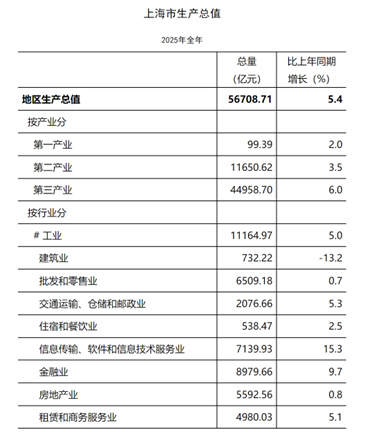
Economic Overview - In 2025, Shanghai's GDP reached 5.67 trillion yuan, growing by 5.4% year-on-year, surpassing the initial target of 5% and the national average growth rate of 5.0% [1][2] - The primary industry added value was 99.39 billion yuan (2.0% growth), the secondary industry was 11,650.62 billion yuan (3.5% growth), and the tertiary industry was 44,958.70 billion yuan (6.0% growth) [1][3] Income and Employment - The per capita disposable income in Shanghai was 91,987 yuan, a 4.1% increase from the previous year, which is lower than the GDP growth rate [1] - The average urban unemployment rate was 4.2%, better than the national average of 5.2% [1] Key Economic Drivers - Shanghai's economic growth is primarily supported by advanced manufacturing, new foreign trade products, and modern service industries [1][2] - The three leading manufacturing sectors (integrated circuits, biomedicine, and artificial intelligence) saw a 9.6% increase in output, while the new energy sector grew by 12.9% [6] Investment Trends - Fixed asset investment in Shanghai grew by 4.6%, which is below the GDP growth rate [7] - Industrial investment surged by 20.0%, the highest in over a decade, while real estate investment declined by 3.1% [10] - Urban infrastructure investment increased by 11.2%, indicating a structural optimization in investment [10] Consumption Patterns - The total retail sales of consumer goods reached 1.66 trillion yuan, growing by 4.6% year-on-year, reversing a decline from the previous year [11] - The increase in inbound tourism, with 9.36 million visitors, contributed significantly to the consumption market [12] Trade Performance - Shanghai's total import and export volume reached 4.51 trillion yuan, a 5.6% increase, with exports growing by 10.8% [13] - The export of "new three samples" products increased by 17.4%, with electric vehicle exports rising by 13.8% [6][13] Future Outlook - For 2026, Shanghai aims for a GDP growth target of around 5%, considering external uncertainties and internal structural adjustments [16] - Key factors influencing future economic performance include exports, investments, and consumption [17] - The "14th Five-Year Plan" emphasizes synchronized growth of resident income and economic growth, along with improving labor remuneration and productivity [20]

甘肃2025年经济运行“成绩单”出炉:GDP突破1.36万亿元,增长5.8%,增速领跑彰显强劲韧性
Zhong Guo Fa Zhan Wang· 2026-01-21 07:24
Core Viewpoint - Gansu Province has achieved significant economic growth in 2025, with key indicators surpassing expectations, reflecting a stable and improving economic environment. Economic Performance - The GDP of Gansu Province reached 1,369.75 billion yuan in 2025, growing by 5.8% year-on-year, consistently outperforming the national average for 16 consecutive quarters since 2022 [2] - The primary industry added value was 177.3 billion yuan (5.5% growth), the secondary industry 455.82 billion yuan (6.7% growth), and the tertiary industry 736.63 billion yuan (5.3% growth), indicating collaborative growth across all sectors [2] Industrial Growth - Industrial production remains a key driver of economic growth, with a 9.5% increase in the added value of industrial enterprises above designated size [3] - The mining industry grew by 5.4%, manufacturing by 9.3%, and the electricity, heat, gas, and water production and supply industry by 17.6%, showcasing enhanced power supply capabilities [3] - Key industries such as non-ferrous metal smelting and rolling processing, and electricity and heat production saw added value growth of 19.5% and 18.5%, respectively [3] Foreign Trade - Gansu's total import and export value reached 71.17 billion yuan, a 16.2% increase year-on-year, with exports surging by 44.5% to 18.38 billion yuan, indicating improved international competitiveness [4] - Imports totaled 52.79 billion yuan, growing by 8.7%, with trade with Belt and Road countries accounting for 70.5% of total trade [4] Agricultural Production - Grain production reached a historical high of 13.0925 million tons, a 1.01% increase from the previous year, with autumn grain production growing by 1.97% [5] - Livestock production also increased, with pork, beef, mutton, and poultry meat output reaching 1.803 million tons, a 6.3% growth [5] Consumer Market and Investment - The service sector showed strong recovery, with new service industries like information technology and leasing services growing by 19.2% and 15.6%, respectively [6] - Retail sales of consumer goods increased by 2.5%, driven by policies promoting consumption upgrades, with significant growth in categories such as communication equipment and new energy vehicles [6] - Fixed asset investment saw a slight decline overall, but excluding real estate, it grew by 2.7%, with manufacturing investment up by 4.5% and infrastructure investment up by 14.5% [6]
浙江民营企业在册总量超370万户,平均每千人拥有56.5户
Sou Hu Cai Jing· 2026-01-20 02:40
Core Insights - Zhejiang's private enterprises are showing steady and positive development, with a total of 3.7689 million registered private enterprises expected by the end of 2025, equating to 56.5 private enterprises per 1,000 people in the province [1][3]. Group 1: Overall Development - The private enterprises in Zhejiang have made breakthroughs in new productive forces, global value chain layout, and cultural innovation, transitioning from "Zhejiang manufacturing" to "Zhejiang creation" [3]. - Private enterprises are a core engine for high-quality development and play a significant supporting role in the national new development pattern [3]. Group 2: Regional Distribution - The cities of Hangzhou, Ningbo, Wenzhou, and Jinhua host 70% of the province's private enterprises, with Hangzhou leading at 1.0096 million enterprises, accounting for 26.8% of the total [3][4]. - Other cities like Jinhua, Ningbo, and Wenzhou have 623,800, 569,100, and 442,100 registered enterprises, respectively [3]. Group 3: Industry Distribution - By the end of 2025, the registered private enterprises in Zhejiang will be distributed across three industries: 42,800 in primary, 905,400 in secondary, and 2,820,600 in tertiary, with nearly 75% operating in the tertiary sector [3][4]. - The main industries include wholesale and retail (1.2629 million), manufacturing (686,400), and rental and business services (448,500), collectively accounting for 92% of the total enterprises [4]. Group 4: Sectoral Characteristics - The private enterprises in Zhejiang exhibit distinctive characteristics in industry distribution, creating significant industrial clustering effects and competitive advantages [4]. - Hangzhou, recognized as the "digital economy capital," has seen strong development in private tech enterprises in AI, big data, and cloud computing, forming a complete industrial chain in the AI sector [4].
上海“十五五”:增强内需主动力、壮大服贸优势
Di Yi Cai Jing· 2026-01-19 12:45
Core Viewpoint - Shanghai aims to strengthen its role as a "key node in the global city network" during a period of globalization headwinds by enhancing domestic consumption and service engines while improving its discourse power in trade and shipping rules [1][2] Economic Development Goals - The "15th Five-Year Plan" outlines major goals for Shanghai's economic and social development, emphasizing high-quality development, new leaps in urban core functions, breakthroughs in high-level reform and opening up, and significant improvements in social civilization [3] - The plan highlights the importance of building an international consumption center and enhancing domestic demand as the main driver of economic growth [3] Service Sector Expansion - Shanghai plans to expand service consumption, focusing on cultural, tourism, sports, and health services, while promoting green and smart consumption [4] - The city encourages innovation in consumption models and formats, integrating online and offline consumption, and enhancing the international influence of large consumption events [4] Policy Measures - Recent policies include the "Measures to Promote the Quality Improvement and Consumption Expansion of the Service Industry," which proposes 28 initiatives aimed at optimizing supply and expanding consumption [5] - The focus is on quality competition in the service sector, shifting from scale expansion to value enhancement [5][6] Trade and Shipping Enhancements - Shanghai's "15th Five-Year Plan" emphasizes the enhancement of trade hub functions and the optimization of trade structures, aiming to strengthen global supply chain management [7][8] - The city plans to promote high-value product exports and develop knowledge-intensive service trade, including cultural and technical trade [7] Foreign Trade Performance - In 2025, Shanghai's foreign trade is projected to reach 4.51 trillion yuan, with exports growing by 10.8% and imports by 1.8%, outperforming national averages [8] - The export of high-end manufacturing products, particularly electric vehicles and industrial robots, has shown significant growth, indicating a shift towards "Shanghai Intelligent Manufacturing" [9] Maritime and Shipping Development - Shanghai aims to solidify its position as a global maritime hub by developing modern shipping services and promoting digital and green transformations in the shipping industry [9] - Plans include establishing a world-class shipping exchange and enhancing the global service network of shipping insurance institutions [9]
宏观专题报告:设备投资,能否“持续高增”?
Shenwan Hongyuan Securities· 2026-01-06 03:41
Group 1: Misconceptions about Equipment Investment Growth - Equipment investment growth is not primarily driven by the "Juga Cycle" but rather by strong infrastructure and service sector investments, with construction industry growth at 65.5% and narrow infrastructure at 46.1% in 2024, contributing an additional 8.2 percentage points to overall equipment investment[2] - The notion that equipment investment strength is influenced by the "Two New" policies is misleading; significant increases in manufacturing investment and equipment purchases occurred as early as February 2024, with equipment purchase investment growth reaching 17%[2] - Manufacturing equipment purchase investment growth was only 6.5% in 2024, significantly lower than the overall equipment investment growth of 15.7%[3] Group 2: Drivers of Equipment Investment Growth - The establishment of a modern industrial system has driven strong digital infrastructure investments, with software industry growth at 53% and computer services at 35%, contributing to overall equipment investment[4] - Public utility equipment investment has surged since the "dual carbon" policy was intensified in 2021, with electricity and heat equipment investment growth at 17.6%[4] - Service sector equipment investment has outpaced construction investment since 2023, with growth rates of 13.9% compared to 2.8% for construction investment in 2024[5] Group 3: Sustainability of Equipment Investment Growth - Equipment investment is expected to continue high growth in 2026, supported by a rebound in narrow infrastructure, particularly in digital infrastructure and hub-related investments[6] - The "dual carbon" policy is anticipated to further enhance investment in carbon reduction technologies, including high-energy-consuming industry upgrades and renewable energy investments[6] - Policies focused on "investing in people" are likely to increase service sector equipment investment, with a projected growth rate of around 6% in 2026, surpassing the overall fixed asset investment growth of 3%[7]
普路通停牌前5日股价大涨30%包含两个涨停 重组公告日6名交易对手突击入股标的公司
Xin Lang Cai Jing· 2025-12-19 10:13
Core Viewpoint - Pulu Tong announced a plan to acquire 100% of Leqi Cayman and 8.26% of Hangzhou Lemai, raising questions about potential insider trading due to a significant stock price increase prior to the announcement [1][9][10] Stock Performance - Pulu Tong's stock price rose from 9.83 CNY to 12.94 CNY over five trading days before the suspension, marking a 31.64% increase [2][17] - The stock experienced two trading halts during this period, with the last trading day also being a halt day [3][17] - Excluding market factors, the stock's cumulative increase was 32.16% over the last 20 trading days [19] Acquisition Details - The acquisition primarily targets Hangzhou Lemai, as Leqi Cayman holds 91.74% of its shares [1][9] - The acquisition involves multiple parties, including CMC and six other investors who acquired stakes in Hangzhou Lemai just before the announcement [5][20] Financial Performance of Target Companies - Leqi Cayman reported a revenue of 4.995 billion CNY in 2024, a decrease of 3.9%, and a net profit of 204 million CNY, down 32.7% [12][25] - Hangzhou Lemai's revenue for 2024 was 4.2808241 billion CNY, reflecting a 1.41% decline, with a net profit of 147.1086 million CNY, a 51.68% drop [11][26] Company Financials - Pulu Tong has reported negative net profits for three consecutive years from 2022 to 2024, with a slight recovery in the first three quarters of 2025 [14][27] - The company has only 310 million CNY in cash as of the end of the third quarter of 2025, raising concerns about financial pressure if leverage is used for the acquisition [14][27]


黄金疯涨37%,股市破4000点!普通人该跟风还是躺平?
Sou Hu Cai Jing· 2025-11-17 14:14
Group 1: Consumer Trends - The jewelry sector, particularly gold, saw a significant year-on-year increase of 37.6% in October, marking it as a standout performer in consumer spending [2] - The surge in gold purchases is attributed to a more than 50% increase in international gold prices this year, currently stabilizing above $4,100 per ounce, leading consumers to invest in gold as a safe asset [4] - Overall retail sales in October increased by 2.9% year-on-year, with rural consumption growing at a faster rate of 4.1% compared to urban areas, indicating a shift in spending patterns [9] Group 2: Industrial and Manufacturing Insights - The industrial output for October rose by 4.9% year-on-year, with notable growth in equipment manufacturing and high-tech manufacturing at 8% and 7.2% respectively, outpacing overall industrial growth [11] - The manufacturing sector is transitioning towards high-tech production, as evidenced by increased investments in smart equipment and advanced production lines [12] Group 3: Investment and Economic Challenges - Fixed asset investment decreased by 1.7% year-on-year, primarily due to a 14.7% drop in real estate development investment, highlighting ongoing challenges in the property market [14] - Excluding the real estate sector, national investment actually increased by 1.7%, with manufacturing investments continuing to grow [17] Group 4: Trade and Export Dynamics - In October, the total value of imports and exports rose by 0.1% year-on-year, with imports increasing by 1.4%, indicating a rise in domestic demand [20] - The Producer Price Index (PPI) fell by 2.1% year-on-year, but the rate of decline has slowed, suggesting a potential easing of deflationary pressures in the industrial sector [21] Group 5: Market Performance - The stock market has recently surpassed the 4,000-point mark, reflecting increased investor confidence and a shift of funds from savings to equity investments [23]

(活力中国调研行)从“持久战”到“当天办” 海南营商“软环境”提升外企获得感
Zhong Guo Xin Wen Wang· 2025-09-24 05:11
Core Insights - The article highlights the significant improvements in the business environment for foreign enterprises in Hainan, emphasizing the rapid processing of business registrations and the reduction of bureaucratic hurdles [1][2]. Group 1: Business Environment Improvements - Hainan has implemented measures that allow foreign companies to obtain business licenses on the same day, significantly reducing the time and costs associated with registration [1][3]. - As of August 2025, Hainan has 10,690 foreign enterprises, marking a year-on-year increase of 13.61%, with diverse sources of foreign investment [2][3]. Group 2: Policy Innovations - Hainan has introduced innovative reforms in foreign enterprise registration, including the use of recommendation letters to replace notarized documents, which has streamlined the process [2][3]. - The province has reduced the required notarized documentation for Hong Kong, Macau, and Taiwan investors from over 50 pages to as few as 6 pages, facilitating electronic processing [2][3]. Group 3: Future Developments - Hainan plans to enhance its foreign enterprise services by upgrading the "Hainan e-registration" platform, incorporating AI for automated responses, and expanding electronic processing capabilities [3][4]. - The province aims to strengthen its talent pool by providing foreign language training for registration specialists and developing bilingual service guides [4].
“十四五”期间 长宁积极抢抓大虹桥战略机遇 经济总量实现跨步跃升
Jie Fang Ri Bao· 2025-09-24 02:04
Core Insights - The Longjing District has achieved an average GDP growth rate of 7.8% during the first four years of the 14th Five-Year Plan, ranking first in the city, driven by the strategic opportunities of the Greater Hongqiao initiative [1] - By 2024, the GDP of Longjing District is projected to reach 278.9 billion yuan, which is 1.8 times that of 2020, with a net increase of 12.28 billion yuan [1] - The district has established four trillion-level industrial clusters, with the software information service industry growing at an annual rate of 24.8%, the highest in the city [1][2] Economic Development - Longjing District has seen a cumulative increase of over 5 billion yuan in general public budget revenue during the 14th Five-Year Plan, with an average annual increase of over 1 billion yuan [1] - The East Hongqiao area has achieved an average annual tax revenue growth of 13.6%, accounting for over 40% of the tax revenue in the Hongqiao International Central Business District [2] - The district has attracted 22 new multinational company regional headquarters and a total of 153 various headquarters and R&D centers [2] Urban Renewal and Infrastructure - Longjing District has implemented 169 urban renewal projects since the beginning of the 14th Five-Year Plan, focusing on historical preservation and the renovation of old neighborhoods [3] - The district has completed the construction of over 4.72 million square meters of premium residential areas and has provided over 10,000 units of affordable rental housing [3] - 27 ecological gardens have been established, enhancing the green environment of the district [3] Social Services and Community Engagement - The district has achieved a total of 7,411 elderly care beds, leading in bed availability per 10,000 elderly residents among central urban areas [3] - Longjing District has actively engaged in grassroots democracy, establishing platforms for public opinion collection and legislative contact points [4]