
液冷技术

Search documents
2026年,AI投资要靠超预期了
虎嗅APP· 2026-01-05 10:14
Core Viewpoint - The article emphasizes that AI computing power remains a key investment theme in 2026, driven by strong growth in infrastructure and technology advancements, particularly in GPU, liquid cooling, optical modules, and PCB sectors [2][5][44]. AI Computing Power - The AI computing power index has seen a significant increase of 46.67% since 2025, outperforming other AI-related indices [3]. - The article identifies that the excess returns in AI computing power stem from its certainty and continuous outperformance, supported by capital investments from major tech companies and policy-driven domestic GPU replacements [4][5]. Market Growth Projections - The article outlines the market size and compound annual growth rates (CAGR) for various AI computing segments from 2024 to 2029, highlighting that the Chinese intelligent computing GPU market is expected to grow at a CAGR of 56.47% [6][7]. - Liquid cooling technology is projected to see a penetration rate increase from 14% in 2024 to 31% in 2026, indicating a strong growth trajectory [19]. Investment Opportunities - The article suggests that liquid cooling is one of the highest growth segments in AI computing, transitioning from an optional to a necessary technology due to the limitations of traditional air cooling [18]. - Companies involved in liquid cooling that secure contracts with major clients like Google and NVIDIA are expected to see valuation increases [20][24]. GPU Market Dynamics - NVIDIA continues to dominate the GPU market, but domestic manufacturers are rising due to policies favoring local replacements [8][10]. - The profitability of domestic GPU companies like Cambricon is anticipated to improve significantly, with projected net profits of 48.72 billion and 79.91 billion yuan for 2026 and 2027, respectively [12]. Optical Modules and PCB - The optical module sector has experienced substantial growth, with companies like NewEase and Zhongji Xuchuang seeing stock price increases of 450% and 422% since 2025 [27]. - The article notes that the PCB market is also expected to grow significantly, with AI-related PCBs projected to have a CAGR of 20.6% from 2024 to 2029 [34]. Investment Ranking - The article ranks various AI segments based on investment certainty: liquid cooling is rated highest, followed by optical chips, GPUs, PCBs, and optical modules, while AI applications and end products are considered less certain [42][43]. Macro Environment - The anticipated loosening of macroeconomic conditions, including potential interest rate cuts by the Federal Reserve, is expected to enhance liquidity in the market, benefiting high-growth sectors like AI computing power [44].


2026-AI之光引领成长-反内卷周期反转
2026-02-02 02:22
Summary of Key Points from the Conference Call Industry Overview - The main trend in the A-share market for 2026 is a technology-driven bull market, with AI leading the growth sectors. Other growth sectors are expected to have relatively lower elasticity. The emphasis on cyclical reversal and growth emergence will continue into 2026, particularly in commercial aerospace and humanoid robotics, which are anticipated to see sustained growth and market attention [2][3]. Sector Performance and Reversal - Industries that performed poorly in 2025, such as shipbuilding and rail transit, are expected to experience a reversal in 2026. These sectors had strong performances in 2024 but underwent an adjustment period in 2025. The commercial aerospace and humanoid robotics sectors are projected to continue their growth trends in 2026 [3][4]. - The engineering machinery sector's leading companies are expected to achieve a compound annual growth rate (CAGR) of 20%-30% over the next three years, with companies like XCMG Machinery showing significant growth potential [3][5]. AI Industry Chain - The AI industry chain is currently driven by capital expenditure, with significant demand for upstream infrastructure such as optical modules and optical equipment. The transition of computing power from data centers (DC) to internet data centers (IDC) is increasing the demand for infrastructure like liquid cooling technology, providing development opportunities for related companies. By 2026, applications of embodied intelligent agents, including humanoid robots, autonomous driving, and drones, are expected to see more opportunities [6]. Commercial Aerospace - Commercial aerospace is viewed as a critical field combining high technology and future industries. The expectations include reduced costs for reusable rockets and satellite manufacturing, which will facilitate commercialization and open up larger market spaces. Opportunities in space computing, space energy, and lunar commercial activities present significant growth potential [7]. Lithium Battery Equipment Sector - The lithium battery equipment sector is recovering after an adjustment period from 2022 to 2024, with a new capacity cycle starting in 2025. Revenue and net profit growth turned positive in 2025, with a stock price increase of 103%. The demand for power lithium batteries and energy storage lithium batteries is fully recovering, and the expansion cycle of leading domestic battery manufacturers is expected to continue into 2026 [12]. - The solid-state battery industry is anticipated to reach a turning point in industrialization between 2026 and 2027, driven by technological improvements, demand growth, and policy support. The market size for solid-state batteries is projected to grow over 15 times from 2025 to 2030 [13]. Investment Recommendations - Key sectors and stocks to focus on include: - Engineering machinery, with XCMG Machinery recommended as a key stock due to its significant growth over the past three years and future potential [5][9]. - Humanoid robotics and commercial aerospace as emerging fields with vast industrial space [5]. - Specific companies in the lithium battery equipment sector, including leading equipment manufacturers and those involved in solid-state battery production, are recommended for their strong cash flow and technological advantages [14]. Solar Industry Insights - The solar industry has seen a significant increase in component prices, with prices for Trina Solar components rising from approximately 0.7 to over 0.82, and some exceeding 1. This price increase indicates a gradual reversal in the solar industry. If these price increases can be accepted by the power station end, the overall market may no longer incur losses, leading to a reversal [11]. This summary encapsulates the key insights and recommendations from the conference call, highlighting the anticipated trends and investment opportunities across various sectors.
谷歌光模块和液冷需求或提升
2025-12-31 16:02
Summary of Google TPU and Liquid Cooling Demand Insights Industry and Company Involved - The discussion revolves around Google and its upcoming changes in the TPU (Tensor Processing Unit) architecture and the associated demand for optical modules and liquid cooling technology [1][2]. Core Insights and Arguments - Google is expected to significantly increase the shipment of V7+8 TPUs by 2026, primarily featuring 1.6T optical modules and liquid cooling technology, indicating substantial changes in the related supply chain [1][3]. - The introduction of 3D Taurus or Cloth architecture at the cabinet level is anticipated, which will increase the demand for scale-up optical modules and Active Optical Cables (AOC) [1][4]. - The 3D Taurus architecture aims to reduce latency through direct interconnection, with each Cube containing 64 TPUs, while the Cloth architecture employs a traditional fat-tree multi-layer network to alleviate OCS (Optical Circuit Switching) port pressure [5][6]. - The structural changes are projected to significantly boost the demand for 1.6T optical modules, benefiting suppliers like Zhongji Xuchuang and Yuanjie Technology; increased chip counts will raise power consumption, leading to a higher demand for liquid cooling, favoring suppliers like Invec [7]. Additional Important Content - Liquid cooling technology is critical to the entire data center solution, requiring stringent supplier selection. Once a supplier enters Google's supply chain, their market share tends to grow steadily, provided their product quality remains high [8]. - Companies expected to benefit from these changes include Zhongji Xuchuang, NewEase, Yuanjie Technology, and others in the optical module sector, as well as Invec in the liquid cooling sector. Additionally, companies linked to the AIGC (Artificial Intelligence Generated Content) supply chain, such as Yangtze Optical Fibre and Cable, Tengjing Technology, and Oulu Tong, are also likely to gain from these developments [9].

当前时点如何看2026年AIDC电气设备投资机会
2025-12-29 01:04
Summary of AIDC Electrical Equipment Market Conference Call Industry Overview - The conference call focused on the AIDC (Artificial Intelligence Data Center) electrical equipment market, particularly in North America, highlighting the impact of energy shortages and the increasing demand for electrical equipment such as transformers and power supplies [1][2][3]. Key Points and Arguments 1. Energy Supply and Pricing - North American terminal electricity prices have risen by over 5% due to energy shortages, particularly in the PJM region, indicating a tight electricity supply that may worsen with AI development [1][2]. - The construction of data centers in the PJM region has significantly increased spot electricity prices, suggesting a growing demand for electrical equipment [2]. 2. Transformer Demand - There is a surge in demand for high-voltage transformers, with orders from companies like ABB, Siemens, and General Electric reaching 3-4 times their annual revenue, leading to long delivery cycles [1][3]. - Chinese companies, leveraging production capacity and cost advantages, are expected to expand exports to the U.S., with firms like Siyuan, Jinpan, and Igor already achieving exports [1][3]. 3. AIDC Power Supply Trends - The trend towards high-voltage direct current (HVDC) power supplies is expected to gain momentum, with significant applications anticipated in 2026, particularly with Meta's new product launches [1][4]. - Domestic companies such as Oulitong and New Energy are making marginal breakthroughs in power supply technology, indicating a competitive edge in customization speed [4]. 4. Growth in Gas Turbine Orders - Gas turbine orders have seen a significant increase, with a growth rate of approximately 50%-60% as of September 2025, and hydrogen turbine orders growing even faster [1][8]. - Major manufacturers like Baker Hughes, Ansaldo, and Kawasaki are experiencing increased demand, with light gas turbine production ramping up while heavy gas turbine delivery cycles remain long [8]. 5. PCB Industry Developments - The PCB (Printed Circuit Board) industry is witnessing an increase in the usage and value of drilling needles due to material upgrades, with leading manufacturers like Dingtai and Zhongtung exceeding 50% production capacity [2][15]. - The P4B technology is nearing maturity, leading to increased equipment performance requirements and a strong growth outlook for equipment demand and value [15]. 6. Competitive Landscape for Chinese Companies - Chinese companies are positioned to play a crucial role in the global AIDC electrical equipment market, particularly in traditional components like transformers and emerging technologies such as HVDC and SST products [5][6]. - The ability to respond quickly and provide customized services is expected to give Chinese firms a competitive advantage [5]. 7. Infrastructure and Modular Data Centers - The construction cycle for modular data centers is shortening due to AI infrastructure demands, with companies like Schneider and CIMC participating in total or partial contracting [1][14]. - Significant growth is anticipated in this sector by 2026, driven by increased penetration rates [14]. 8. Liquid Cooling Technology - Liquid cooling technology is expected to see substantial growth, supported by changes in demand and the introduction of new products into the overseas supply chain [11][13]. - Companies are actively preparing talent to support the development of this technology, indicating its importance in the AI industry [11]. Additional Important Insights - The overall sentiment for the AIDC electrical equipment market is optimistic, with expectations of price elasticity and valuation expansion across various sectors, including power, infrastructure, and PCB [16]. - Companies like Yingliu, Hangyu Technology, and Jereh are highlighted as having strong growth potential in the AI power sector due to solid customer relationships and strategic partnerships [9][10].
注意,明年大趋势!
Xin Lang Cai Jing· 2025-12-28 15:33
Group 1 - In 2026, humanity will witness the "year of origin" for fifteen top technology fields, including autonomous driving, liquid cooling, domestic HBM, edge AI, solid-state batteries, AI applications, quantum computing, integrated storage and computing chips, brain-like computing, low-altitude economy, commercial aerospace, humanoid robots, silicon photonics, controllable nuclear fusion, and deep-sea technology [2][3][4][5][6] - The current market sentiment is characterized by a defensive cynicism, with many dismissing innovation due to economic challenges, which is a dangerous mindset [4][5] - Historically, significant technological revolutions emerge during crises, not in prosperous times, indicating that the current economic climate may be a precursor to a technological explosion [5][6] Group 2 - The convergence of these fifteen fields is not coincidental; they are interconnected, creating a "technological resonance" that will reshape the world [10][28] - The first core theme is "brain," focusing on making computing power as accessible as water and electricity, with advancements in edge AI, integrated storage, domestic HBM, and silicon photonics [12][15] - The second theme is "body," where advancements in autonomous driving, humanoid robots, and low-altitude economy will enable AI to interact with the physical world, transforming productivity [18][21] - The third theme is "heart," emphasizing the need for energy solutions like liquid cooling, solid-state batteries, and controllable nuclear fusion to support the demands of advanced technologies [23][24][27] Group 3 - The current economic difficulties mirror those of the 1920s in the United States, where technological advancements led to a significant economic boom despite widespread despair [29][32] - The technological resonance of the past was driven by electricity and internal combustion engines, similar to how the current technological advancements will drive economic growth [35][36] - The ongoing economic "clearing" in China is necessary for new technologies to flourish, as old systems must be dismantled to make way for innovation [37][39] Group 4 - The emergence of these fifteen fields represents a complete industrial chain, where computing power acts as the brain, embodied intelligence as the body, and new energy sources as the heart [28] - The "year of origin" signifies the beginning of commercialization for these technologies, which may face challenges such as high costs and low production rates [40][42] - Investors and entrepreneurs are encouraged to focus on these emerging fields for future opportunities, as they represent the next wave of innovation and economic growth [47][48]

20年10次增资:一家丹麦工业巨头与中国的“绿色共振”
Xin Lang Cai Jing· 2025-12-27 23:52
Core Viewpoint - The article highlights the significant growth and strategic positioning of Danfoss in China, particularly in the context of the increasing demand for energy-efficient solutions and the country's commitment to carbon neutrality. Group 1: Market Opportunities - Danfoss has established a strong market presence in China, with an expected annual output value exceeding 5 billion yuan in its Haiyan facility, reflecting a nearly 25% year-on-year growth due to the surge in computing power demand [1] - The company has invested over 5 billion yuan in Haiyan since its establishment in 2005, demonstrating a long-term commitment to the region [2] - The demand for AI chips has led to a $20 billion technology collaboration between major AI chip companies and startups, creating a favorable environment for Danfoss's cooling solutions [1] Group 2: Innovation and Development - Danfoss's application development center in Haiyan serves as a global testing ground for hydraulic applications, attracting over 300 domestic and international companies annually for testing and technology collaboration [4][5] - The company has developed a unique competitive advantage through its focus on product and performance solutions, which are difficult for competitors to replicate [4] Group 3: Sustainability Initiatives - The new Haiyan facility, with a total investment of 2.7 billion yuan, is Danfoss's largest global manufacturing base and showcases low-carbon technology, achieving 100% green electricity supply [7] - The facility incorporates advanced technologies such as photovoltaic panels and rainwater recycling, aiming for zero carbon emissions throughout its operations [8] - Danfoss's commitment to sustainability has resulted in a significant increase in monthly output value from 20 million yuan to 110 million yuan, with an expected annual reduction of over 40,000 tons of carbon emissions [8] Group 4: Strategic Alignment with National Goals - Danfoss's operations align with China's green transformation goals, positioning the company as a key player in the energy-efficient solutions market [6][9] - The company's growth trajectory in China is attributed to its ability to adapt to the country's evolving energy policies and infrastructure needs, particularly in high-end construction and renewable energy sectors [9][10] - Danfoss's innovative solutions, such as electric drive systems for ships, have led to a dramatic increase in revenue from 18 million yuan in 2017 to nearly 400 million yuan last year, reflecting a 20-fold growth [10] Group 5: Long-term Commitment and Trust - The relationship between Danfoss and Haiyan has evolved into a mutually beneficial partnership, characterized by ten rounds of investment over 20 years, emphasizing a shared vision for sustainable development [11] - The collaboration reflects a broader trend of international companies investing in China, driven by the country's commitment to green growth and innovation [11]
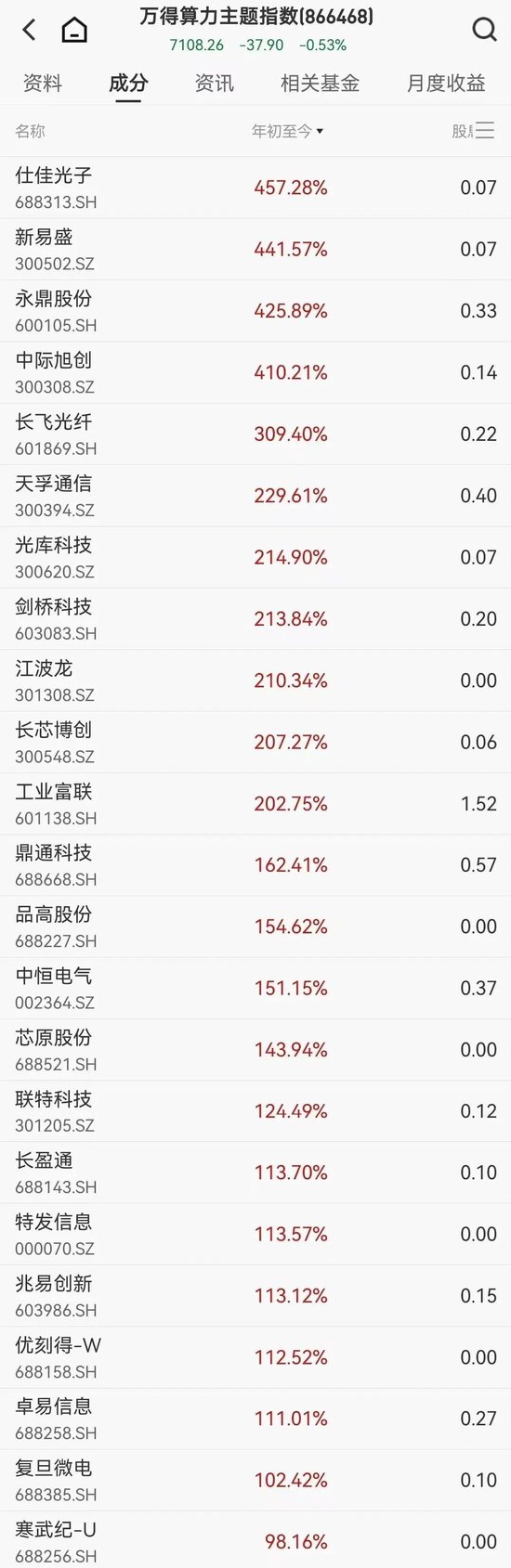
4只大牛股飙涨超400%,A股算力22股年内翻倍
Xin Lang Cai Jing· 2025-12-26 14:59
Core Viewpoint - The A-share computing power sector underwent a significant value reshaping in 2025, transitioning from policy-driven expectations at the beginning of the year to performance verification by year-end, with the index showing an impressive annual increase of 80% [1][15]. Performance Summary - As of December 25, 2025, the Wind Computing Power Theme Index (399363.SZ) closed at 7108 points, reflecting a substantial rise [1][15]. - A total of 22 stocks in the A-share computing power sector doubled in value, with four stocks exceeding a 400% increase: Shijia Photon (457.28%), Xinyi Sheng (441.57%), Yongding Co. (425.89%), and Zhongji Xuchuang (410.21%) [2][16]. Market Dynamics - The capital market's perception of the computing power industry shifted from "concept speculation" to "value anchoring," indicating a necessary evolution of the Chinese computing power industry chain amid intensified global competition and domestic upgrade demands [3][18]. - The computing power sector exhibited a "ice-fire duality" structural differentiation, where the market focus transitioned from short-term policy benefits to long-term performance realization and technological barriers [4][18]. Key Sector Highlights - AI chips and semiconductor equipment emerged as the core areas of capital pursuit, with leading companies like Haiguang Information reporting a 54.65% year-on-year revenue increase to 9.49 billion yuan and a net profit of 1.96 billion yuan, up 28.56% [6][19]. - Another AI chip representative, Cambricon, reported a staggering 2386.38% year-on-year revenue growth to 4.607 billion yuan, marking a significant turnaround to profitability [7][19]. - The global AI server leader, Industrial Fulian, achieved record revenue of 603.931 billion yuan, a 38.4% increase, with net profit rising by 48.52% [7][19]. Technological Advancements - The data center sector is prioritizing quality over quantity, with national regulations mandating that new large data centers must achieve a PUE (Power Usage Effectiveness) of ≤1.2. Domestic liquid cooling technology has achieved a PUE of 1.03-1.08, becoming essential for energy efficiency [8][20]. - Companies like Yingwei Ke have reported a 40.19% revenue increase to 4.026 billion yuan, driven by their liquid cooling solutions that meet stringent energy efficiency requirements [8][20]. Domestic Substitution Progress - The domestic substitution process in the A-share computing power sector has transitioned from "policy-driven" to "market-driven," with a comprehensive ecosystem emerging that includes chips, servers, and foundational software [9][21]. - Leading companies like Huawei have established a vertically integrated capability from Ascend AI chips to the Euler operating system, playing a crucial role in the construction of AI computing centers [9][21]. Future Outlook - The computing power sector is expected to continue its value reshaping into 2026, with a focus on high-performance AI chips and the widespread adoption of liquid cooling technology [12][25]. - The competition will shift from individual products or technologies to ecosystem collaboration, with companies that can provide comprehensive solutions from hardware to software gaining a competitive edge [12][25].
新华指数丨新华出海指数全线上扬,AI液冷行情再起
Xin Hua Cai Jing· 2025-12-26 10:01
Core Viewpoint - The AI industry chain is experiencing significant growth, particularly in the liquid cooling sector, with companies like Kuaike Intelligent (快克智能) showing strong stock performance due to their advancements in this area [1][2]. Company Performance - Kuaike Intelligent's stock price reached 37.48 yuan, marking a 22.89% increase over the week, significantly outperforming the industrial control equipment index [1]. - The company's success is attributed to its liquid cooling business, which has seen substantial demand as AI server markets expand [1]. Industry Trends - Liquid cooling technology is transitioning from an optional to a necessary solution for AI servers, driven by increasing power density and cooling efficiency requirements [2][3]. - Analysts predict that the liquid cooling sector will continue to grow, with annual market expansions expected as AI demand rises [2]. Competitive Landscape - The liquid cooling industry is currently dominated by Taiwanese manufacturers, but Chinese companies are poised to benefit from increasing demand for AI-driven liquid cooling solutions [3][4]. - Chinese firms have competitive advantages in technology iteration speed, cost control, and customer responsiveness, allowing them to capture market share [4]. Market Dynamics - The global AI computing power demand is growing exponentially, with traditional air cooling methods nearing their thermal limits, making liquid cooling the standard for high-power AI servers [2][3]. - Major tech companies like Meta, Google, and Amazon are accelerating their liquid cooling initiatives, indicating a shift in industry standards [3]. Stock Market Performance - The Xinhua Outbound Manufacturing Index saw a 2.91% increase, with significant contributions from communication equipment and passenger vehicles [6]. - Other indices, such as the Xinhua Electric New Outbound Index, rose by 7.90%, reflecting strong investor interest in technology sectors driven by AI demand [6].


AIDC电源及液冷板块观点更新
2025-12-26 02:12
Summary of AIDC Power and Liquid Cooling Sector Conference Call Industry Overview - The AIDC industry is expected to see significant opportunities in 800V HVDC and liquid cooling technologies by 2026, driven by factors such as Google's TPU V7 chip power consumption exceeding expectations, the spread of power shortages in North America, and high capital expenditure expectations from leading domestic manufacturers [1][2][6]. Key Insights and Arguments - The liquid cooling market is projected to reach 20-30 billion yuan by 2025 and is expected to explode to over 100 billion yuan in 2026, primarily driven by demand from NV GB300 cabinets, Google ASIC cabinets, and other cloud providers [1][5][7]. - The 800V HVDC technology is anticipated to become mainstream in 2026, offering higher efficiency and lower costs compared to traditional UPS systems. Delta and Vitec have already received orders from Google and Meta [1][19]. - Domestic manufacturers are expected to transition from OEM to system solution providers in the long term, with companies like Invec and Siquan New Materials showing leading advantages [1][9][10]. Market Dynamics - The North American power market is facing challenges due to power shortages, which is driving data centers to adopt off-grid and co-location models. Gas turbines and energy storage systems are emerging as solutions, with companies like Jerry and Doosan Energy receiving orders from North American data centers [4][28]. - The tightening of NV Code is expected to increase the scarcity of manufacturers already connected with NV, enhancing their competitiveness [11]. Investment Opportunities - High-potential investment directions in the AIDC sector include: 1. In-cabinet server power supplies, driven by inflation logic and capacity shortages among leading manufacturers [3]. 2. Changes in power supply architecture from traditional UPS to HVDC, driven by systemic power shortages in North America [5]. 3. Increased overseas spending on computing power and upgrades in chip liquid cooling solutions [5]. Challenges and Opportunities for Chinese Manufacturers - The Chinese liquid cooling industry faces short-term challenges due to dominance by Taiwanese companies, but mergers and acquisitions may enhance competitiveness. In the long term, the industry is expected to evolve towards providing comprehensive system solutions [9][10]. - Invec and Siquan New Materials are positioned to capitalize on these trends, with Invec's market value potential estimated to exceed 100 billion yuan and Siquan New Materials aiming to become a "small Invec" [12]. Future Trends in Liquid Cooling Technology - Liquid cooling technology is expected to continuously evolve, with innovations such as microchannel technology and gold plating to enhance heat dissipation efficiency. New entrants like Red Sea Teda and Quanta are expected to provide more opportunities for domestic supply chains [8]. Magnetic Components Industry - The demand for magnetic components in AI power supply equipment is increasing, with companies like Jincaihua and Keli benefiting from the recovery in new energy vehicles and energy storage [25]. Conclusion - The AIDC power and liquid cooling sectors are poised for significant growth driven by technological advancements and market demands. Key players in the industry are expected to leverage their positions to capture emerging opportunities while navigating challenges posed by competition and market dynamics [1][2][4][5][19].
招商证券:AIDC加速投建 重点关注设备产业链投资方向
智通财经网· 2025-12-23 06:01
Core Insights - The report from China Merchants Securities highlights a surge in data center construction driven by computing power, with North America and China identified as the key growth regions for global data center expansion [1][2] - North American AI giants and Chinese internet companies are the primary drivers of this expansion, with capital expenditures expected to rise significantly [1] - The report anticipates a rebound in domestic demand in China after a temporary slowdown due to restrictions on the import of computing power cards [1] Demand Side - The construction boom in data centers is primarily fueled by the demand for computing power, leading to a significant increase in orders for companies within the industry [1] - Capital expenditures for North American leading companies are projected to increase from $24.1 billion in Q2 2023 to $76 billion by Q3 2025, while Chinese major firms are expected to reach a peak of 77.2 billion yuan in Q4 2024 [1] - The electricity demand from data centers in the U.S. is expected to account for 6.7%-12% of total electricity demand by 2028 [1] Supply Side - North America faces challenges such as aging power grids and outdated generation equipment, which are exacerbated by energy transition issues, leading to increased electricity prices [2] - In China, the main constraints are the reduction in imports of computing power cards and overseas equipment, making domestic substitution crucial [2] - The supply-demand dynamics in China are expected to shift towards demand-driven by 2026, while energy constraints in North America are likely to persist [2] Key Investment Directions - In the gas turbine segment, focus on upstream components (e.g., Yingli Co., Ltd.), HRSG component companies, domestic substitution targets (e.g., Shanghai Electric), and terminal service providers (e.g., Jereh Group) [3] - In the diesel generator segment, domestic companies are expected to benefit from delivery speed advantages, with attention on domestic substitution (e.g., Weichai Heavy Machinery) and overseas expansion (e.g., KOTAI Power) [3] - In the cooling segment, the increase in single rack power is driving the shift of liquid cooling from "optional" to "essential," leading to a significant rise in mechanical equipment spending [3]
