
即食

Search documents
2025年中国餐饮食品连锁加盟行业白皮书
艾瑞咨询· 2026-01-02 00:03
Core Insights - The Chinese restaurant food chain franchise industry is undergoing significant transformation, driven by macroeconomic recovery and increasing consumer spending power, leading to market expansion and digital transformation [1][4][12] - The rise of home dining and heightened consumer demand for health, efficiency, and social value are reshaping industry structures, prompting chain brands to accelerate their digital transformation and omnichannel marketing strategies [1][10] - The relationship between brands and franchisees is shifting from extensive expansion to refined operations and mutual selection, with a growing group of experienced "professional franchisees" [1][47] Market Overview - The Chinese restaurant food market reached 12.6 trillion yuan, with a compound annual growth rate (CAGR) of approximately 7.2% from 2020 to 2024, driven by both service and retail sectors [9] - The restaurant service sector is recovering strongly post-pandemic, with an annual growth rate nearing 9%, while food retail is experiencing structural upgrades with high-value subcategories [9][10] - The home dining market is growing rapidly at an annual rate of 18.4%, expected to account for 13.5% of the overall food retail market by 2029, indicating a significant shift towards retailization in the industry [10][36] Consumer Spending Trends - From 2020 to 2024, urban and rural residents' per capita consumption expenditure is showing a recovery trend, with urban growth at 6.4% and rural at 8.9%, reflecting the ongoing vitality of the lower-tier market [6] - Food and beverage spending remains stable and resilient, providing a solid demand foundation for the restaurant food industry [6] Franchise Market Dynamics - The franchise market is dominated by the restaurant sector, which accounts for nearly 50% of the market, indicating its high-frequency consumption and standardization advantages [20] - The chain rate in the restaurant service sector is expected to rise from 15% to 24% between 2020 and 2025, although it still lags behind developed markets like Japan and the U.S. [12] - The competitive environment is shifting towards refined operations, with franchisees focusing on quality site selection and cost structures as market saturation increases [24][48] Investment Considerations - Franchisees are increasingly favoring low-investment, high-profit margin segments, with the home dining sector being particularly attractive due to its lower entry barriers and shorter investment return periods [34][36] - The home dining segment is characterized by a high degree of standardization and flexibility in product offerings, making it appealing for franchisees [32][34] Brand Selection Criteria - Franchisees prioritize brands with clear profit models, operational support, and a proven track record, leading to a dual selection mechanism between brands and franchisees [48] - The leading brand in the home dining sector, Guoquan Shihui, is recognized for its low investment threshold, mature replicable model, and diverse product matrix, making it a preferred choice for franchisees [39][40] Digital Transformation - The industry is witnessing a pressing need for digital transformation to support scale expansion and profitability, with brands leveraging data-driven site selection and standardized operational systems [44] - Digital management of supply chains is enhancing control, reducing waste, and improving efficiency, which is crucial for increasing single-store profitability [44] Conclusion - The Chinese restaurant food chain franchise industry is poised for growth, driven by changing consumer behaviors, digital transformation, and evolving franchisee dynamics, presenting numerous opportunities for investment and expansion [1][9][12]


2025年中国餐饮食品连锁加盟行业白皮书
艾瑞咨询· 2025-12-06 00:06
Core Insights - The Chinese restaurant food chain franchise industry is undergoing significant transformation, driven by macroeconomic recovery and increasing consumer spending power, leading to market expansion and digital transformation [1][4][9] Market Overview - The Chinese restaurant food market reached a scale of 12.6 trillion yuan, with a compound annual growth rate (CAGR) of approximately 7.2% from 2020 to 2024, driven by both service and retail sectors [9] - The restaurant service sector is recovering strongly post-pandemic, with an annual growth rate close to 9%, while food retail is experiencing structural upgrades with high-value subcategories [9][10] Consumer Behavior - Urban and rural residents' per capita consumption expenditure is showing a recovery trend, with urban and rural growth rates of 6.4% and 8.9% respectively, indicating strong demand stability in food spending [6] - The at-home dining market is rapidly growing at an annual rate of 18.4%, reflecting changing consumer preferences towards convenience and health [10][36] Industry Trends - The chain rate in the restaurant service sector is expected to rise from 15% in 2020 to 24% by 2025, indicating a shift towards more standardized and digital operations [12] - The differentiation in chain categories is evident, with ready-to-drink beverages leading in chain rates, while traditional Chinese cuisine remains lower due to reliance on local tastes and chef skills [15] Investment Opportunities - The at-home dining segment is favored by franchisees due to its lower investment threshold and shorter return on investment periods, with monthly sales per store ranging from 80,000 to 200,000 yuan and gross margins of 30-40% [34][35] - Brands like Guoquan Shihui are emerging as leaders in the at-home dining space, offering a diverse product matrix and strong operational support, making them attractive for franchisees [39][40] Digital Transformation - The industry is moving towards digitalization to support scale expansion and operational efficiency, with data-driven site selection and standardized operational systems becoming essential [44] - Digital management of supply chains is crucial for enhancing profitability and reducing risks for franchisees [44] Franchisee Dynamics - The franchisee landscape is shifting towards more experienced investors, with a growing number of professional franchisees who prioritize brands with clear profit models and operational support [47][48] - Successful franchise experiences are leading to repeat investments, fostering a mutually beneficial relationship between strong brands and capable franchisees [48]

国金证券:首予锅圈(02517)“买入”评级 在家吃饭餐食龙头重启增长
Zhi Tong Cai Jing· 2025-12-01 02:44
Core Viewpoint - Guoquan is recognized as a leading brand in China's at-home meal market, leveraging an efficient supply chain, continuous product innovation, an extensive channel network covering over 10,000 stores, and a strong brand image to demonstrate robust competitiveness in an increasingly concentrated industry [1][2]. Company Overview - Guoquan offers a one-stop solution for at-home meal products, providing ready-to-eat, ready-to-heat, ready-to-cook, and ingredient delivery services to meet diverse consumer dining scenarios [2]. - The company has established a wide community store network and possesses strong digital supply chain capabilities, aiming to deliver "variety, speed, quality, and cost-effectiveness" in its meal products [2]. Industry Insights - The at-home meal market in China is experiencing steady growth, with market concentration expected to increase. In 2022, the market size reached 367.3 billion yuan, projected to grow to 940 billion yuan by 2027, reflecting a CAGR of 20.7% from 2022 to 2027 [3]. - The market concentration is relatively low, with the top five players holding only about 11.1% of the market share in 2022. Guoquan ranked first among all retailers in China with a market share of 3.0% [3]. Competitive Advantages - The company benefits from a strong supply chain, continuous product innovation, an extensive channel network, and deep brand recognition. 1. **Supply Chain**: The company has established seven self-owned factories, efficiently integrating production and logistics [4]. 2. **Product Innovation**: Guoquan has introduced a significant number of new SKUs annually, enhancing its product matrix to adapt to changing consumer preferences [4]. 3. **Channel Expansion**: The company has achieved a store count of 10,761 as of Q3 2025, supported by a multi-store model and a mature franchise system [4]. 4. **Brand Development**: Continuous investment in brand building has established Guoquan as a national hot pot brand, with prepaid card value reaching 590 million yuan, a year-on-year increase of 37.2% [4]. Growth Potential - The community central kitchen strategy is focused on penetrating lower-tier markets, which present significant growth opportunities. The company aims to enhance efficiency compared to traditional local stores, driving growth through an expanded product matrix and diverse store formats [5].

国金证券:首予锅圈“买入”评级 在家吃饭餐食龙头重启增长
Zhi Tong Cai Jing· 2025-12-01 02:29
Core Viewpoint - Company is rated as a "buy" by Guojin Securities, highlighting its strong competitive position in China's home meal market due to efficient supply chain, continuous product innovation, extensive store network, and strong brand image [1] Industry Overview - The home meal market in China is experiencing steady growth, with a market size of CNY 367.3 billion in 2022, projected to reach CNY 940 billion by 2027, reflecting a CAGR of 20.7% from 2022 to 2027 [2] - The market concentration is relatively low, with the top five players holding only 11.1% of the market share in 2022, while the company holds the leading position with a 3.0% market share among all retailers [2] Core Competitiveness - Strong supply chain support, continuous product innovation, extensive channel network, and deep brand recognition are key competitive advantages [3] - Supply Chain: The company has established seven self-owned factories, enhancing efficiency in production and logistics [3] - Product Innovation: The company introduced a significant number of new SKUs annually, with 412 new products launched in 2025H1, catering to diverse consumer preferences [3] - Channel Network: The company has expanded to 10,761 stores by 2025Q3, utilizing a multi-store model and mature franchise system [3] - Brand Development: Continuous investment in brand building has resulted in a prepaid card value of CNY 590 million in 2025H1, a year-on-year increase of 37.2% [3] Growth Potential - The community central kitchen strategy is focused on penetrating lower-tier markets, which presents significant growth opportunities as traditional local stores lack efficiency compared to the company's township stores [4] - The expansion of product offerings and store types is expected to drive rapid growth in same-store performance and the number of new openings [4]
2025年中国餐饮食品连锁加盟行业白皮书
艾瑞咨询· 2025-11-23 00:05
Core Insights - The Chinese catering and food chain franchise industry is undergoing significant transformation, driven by macroeconomic recovery and increasing consumer spending power, leading to market expansion and digital transformation [1][4][9] Market Overview - The Chinese catering food market reached a scale of 12.6 trillion yuan, with a compound annual growth rate (CAGR) of approximately 7.2% from 2020 to 2024, driven by both catering services and retail [9] - The average annual growth rate of GDP is projected at 6.9%, while the retail sales of consumer goods are expected to grow at about 5.5%, indicating a resilient domestic demand [4] Consumer Behavior - Urban and rural residents' per capita consumption expenditure is showing a recovery trend, with urban residents growing at 6.4% and rural residents at 8.9% annually, reflecting the ongoing vitality of the lower-tier markets [6] - The demand for food and beverages remains stable, with food and alcohol expenditures showing strong resilience, providing a solid demand foundation for the catering industry [6] Industry Trends - The chain rate in the catering service sector is expected to rise from 15% in 2020 to 24% by 2025, indicating a shift towards more standardized and digitalized operations [12] - The rise of "at-home dining" is reshaping the industry, with this market segment growing at an annual rate of 18.4%, significantly outpacing overall food retail growth [10][36] Competitive Landscape - The franchise market is dominated by the catering sector, which accounts for nearly 50% of the market, but most franchise businesses are still in early expansion stages, with nearly 80% of franchise companies having fewer than 10 stores [20][22] - Major brands like Mixue Ice City and Zhengxin Chicken are rapidly expanding their networks, joining the "10,000 stores" club through franchise models [22] Investment Considerations - Franchisees are increasingly focused on competition and financial returns, with a shift from broad expansion to refined operations and careful site selection [24] - The "at-home dining" segment is favored by franchisees due to its lower investment threshold and shorter return on investment period, making it an attractive option for new investors [34][36] Digital Transformation - The industry is moving towards digitalization to support scale expansion and profitability, with brands leveraging data-driven site selection and standardized operational systems to reduce risks for franchisees [44] Franchisee Dynamics - A growing number of professional franchisees are emerging, leading to a two-way selection process between brands and franchisees, emphasizing the importance of operational support and clear profit models [47][48]

线上仅占1.4%,却实现三连增,日本超市为何坚守线下?
3 6 Ke· 2025-11-06 10:58
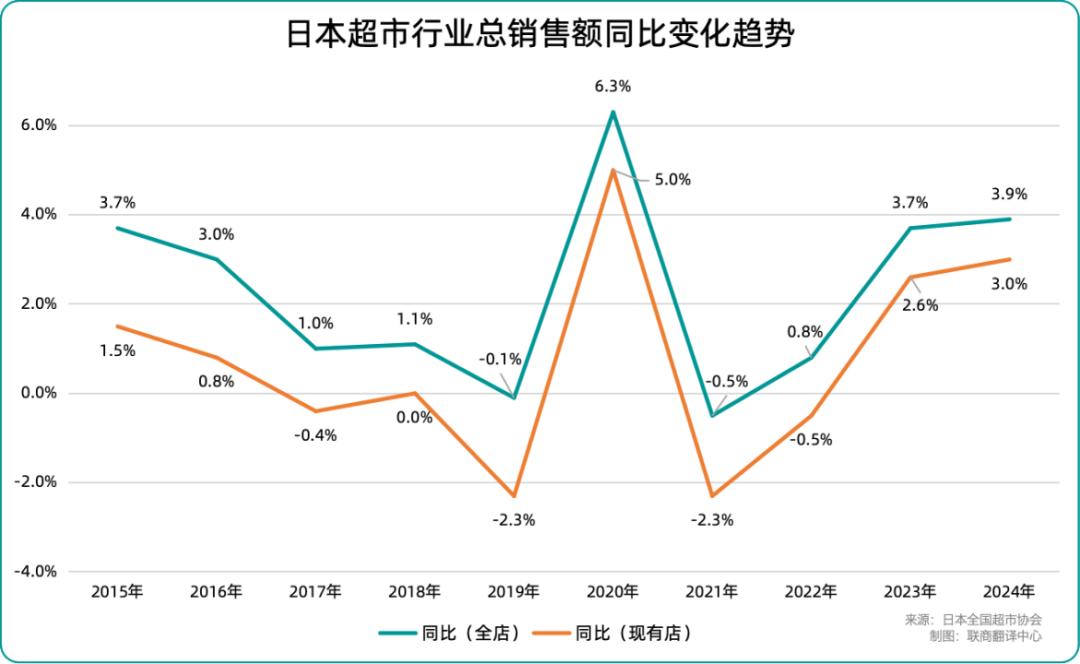
Core Insights - The Japanese supermarket industry is experiencing a transformation with a focus on efficiency and customer experience, despite the low online sales penetration of only 1.4% [1][7][8] Group 1: Sales Performance - The total sales of the Japanese supermarket industry reached approximately 1.2 trillion RMB by the end of 2024, marking a year-on-year growth of 3.9% and achieving three consecutive years of growth [2] - The number of supermarkets in Japan stands at 23,039, with a net decrease of 35 stores compared to the previous year [4] Group 2: Workforce and Labor Trends - The workforce in the supermarket sector has shown stability, with an increase in the proportion of female employees from 24.4% to 26.2% over the past four years [6] - The average salary for full-time employees has seen a moderate increase, with starting salaries for university graduates rising by 896 RMB over five years [6] Group 3: Digitalization and Service Trends - The adoption of digital services is accelerating, with self-checkout usage rising from 15.8% to 37.9% [6] - Non-core service functions in stores are being reduced, indicating a shift towards a more efficient and digital-focused supermarket model [6] Group 4: Consumer Behavior and Product Trends - There is a noticeable shift in consumer preferences towards ready-to-eat and prepared food items, with the share of prepared foods increasing from 10.0% to 10.9% [8] - The penetration of private label (PB) products has increased significantly, with the introduction rate rising from 70.6% to 81.9% [9][10] Group 5: Financial Challenges for Small and Medium Enterprises - Approximately 54.5% of surveyed companies reported increased revenue and profit, while 21.7% of medium-sized enterprises faced a "revenue increase but profit decrease" situation [14] - Rising operational costs, particularly in labor, rent, and utilities, are impacting profitability, leading to a "high-cost elimination race" in the industry [14] Group 6: Strategic Adjustments and Market Dynamics - Consumer shopping behavior is evolving, with weekday shopping focusing on convenience and efficiency, while weekends are more family-oriented and purpose-driven [15][17] - The emergence of food-focused drugstores is creating new competition for supermarkets, emphasizing the need for supermarkets to leverage their strengths in quality and trust [15][17] Group 7: Future Directions - Supermarkets must adapt to changing consumer needs and preferences, focusing on enhancing the in-store experience and building customer relationships [18] - The key to survival in the face of demographic changes and diverse consumer demands lies in understanding consumer behavior and innovating business models accordingly [18]
锅圈(02517.HK):连锁化过万店 探索全供应链新模式
Ge Long Hui· 2025-10-27 21:00
Core Viewpoint - Guoquan is a leading brand in China's home dining food products, providing a wide range of ready-to-eat and ready-to-cook ingredients through a nationwide franchise network, with a target of 10,150 stores by 2024 [1] Industry Overview - The home dining market in China has grown from 3.25 trillion yuan in 2018 to 5.62 trillion yuan in 2022, with a CAGR of approximately 14.7%. The food product segment has seen even faster growth, with a CAGR of 25.5%, reaching 367.3 billion yuan [1] - The industry is highly fragmented, with the top five companies holding only 11.1% market share in 2022, while Guoquan leads with a 3.0% share [1] Business Model and Supply Chain - Guoquan employs a "single product, single factory" model, operating seven factories with a total capacity of 25,000 tons in 2022. The acquisition of Huading Cold Chain in 2024 will enhance its cold chain network across 290 cities [2] - The company focuses on refined operations and rapid product iteration based on consumer feedback, with a payback period for stores in provincial, prefectural, and county-level cities estimated at 12.2, 17.9, and 20.1 months, respectively [2] - The expansion plan aims for 20,000 stores, primarily targeting lower-tier markets, with single-store revenue recovering through popular products [2] Financial Projections and Valuation - Guoquan is projected to achieve total revenue of 73.3 billion yuan, 84.4 billion yuan, and 95.9 billion yuan from 2025 to 2027, with year-on-year growth rates of 13.3%, 15.1%, and 13.6% [3] - The company is expected to realize net profits of 4.1 billion yuan, 4.9 billion yuan, and 5.6 billion yuan during the same period, with corresponding year-on-year growth rates of 78.9%, 19.4%, and 13.7% [3] - The current stock price corresponds to a PE ratio of 22.6, 18.9, and 16.6 for the years 2025 to 2027, with a potential market value of 111 to 124 billion HKD, indicating a premium of 11% to 24% compared to the current valuation [3]
锅圈(02517):连锁化过万店,探索全供应链新模式
Guoxin Securities· 2025-10-27 07:27
Investment Rating - The report maintains an "Outperform" rating for the company [5]. Core Insights - The company, Guoquan, is a leading brand in the home dining food product sector in China, with over 10,150 stores as of 2024, and a revenue forecast of 6.47 billion yuan for the same year, with 84% of revenue coming from franchisees [1][4]. - The home dining market in China has grown significantly, with a CAGR of approximately 14.7% from 2018 to 2022, and the segment for food products has seen even faster growth at 25.5% [1][34]. - Guoquan's business model includes a deep integration of the supply chain and a focus on optimizing its commercial model, which is expected to enhance profitability [2][55]. Summary by Sections Company Overview - Guoquan is positioned as a leading brand in home dining food products, offering a variety of ready-to-eat and ready-to-cook ingredients across eight categories [12][14]. - The company has established a nationwide franchise network, achieving a store count of 10,150 by the end of 2024 [1][26]. Industry Analysis - The home dining market in China has expanded from 32.48 trillion yuan in 2018 to 56.16 trillion yuan in 2022, with projections to reach 71.09 trillion yuan by 2027 [34]. - The competitive landscape is highly fragmented, with Guoquan holding a market share of approximately 3.0%, leading the industry [39]. Core Advantages - Guoquan employs a "single product, single factory" model, operating seven factories to cover various product categories, which enhances its supply chain efficiency [2][55]. - The company has established a robust network of over 300 suppliers, ensuring a comprehensive supply chain and optimizing production costs [55][56]. Future Outlook - The company aims to expand its store count to 20,000, primarily targeting lower-tier cities, with a projected revenue growth of 13.3% to 95.9 billion yuan by 2027 [2][3]. - Profitability is expected to improve, with net profit margins projected to rise as operational efficiencies are realized [3][27].
从“卖猪肉”到“卖品牌”,媒体+赋能广东生猪产业谋变
2 1 Shi Ji Jing Ji Bao Dao· 2025-10-26 00:22
Core Insights - The Guangdong pig industry is facing a "quantity increase and price drop" dilemma, necessitating urgent transformation due to a supply-demand imbalance and changing consumer preferences [2][6]. Group 1: Industry Challenges - The current market is characterized by oversupply, leading to declining breeding profits and exacerbating structural issues where primary production is strong, but secondary and tertiary sectors are weak [2]. - Consumer trends are shifting towards ready-to-eat and snack foods, with traditional pork products lagging behind, creating a widening gap between new consumer demands and industry supply [2]. Group 2: Strategic Solutions - Seven strategies have been proposed to facilitate a breakthrough in the industry: 1. Strengthening key players by cultivating top pig enterprises to enhance industry connectivity and competitiveness [2]. 2. Fostering innovation in product forms, exploring new consumption scenarios, and enhancing marketing strategies [2][3]. 3. Promoting collaboration through a "four sharing" mechanism to achieve coordinated development across the entire industry chain [3]. 4. Establishing platforms for innovation, including a deep processing research center and supporting the development of high-quality breeding and livestock industries [3][4]. 5. Advancing "media+" initiatives to enhance brand empowerment and promote new product lines [3]. 6. Improving quality standards with guidance from regulatory bodies to ensure safety and quality [4]. 7. Training new talent equipped with technical skills and business acumen to support industry growth [5]. Group 3: Collaborative Ecosystem - The transformation of the industry is being accelerated by the collaboration of various stakeholders, including research institutions focusing on new product development and leading enterprises advocating for a "problem-solving" approach [6]. - The "media+" concept is emerging as a crucial factor in the industry's evolution, facilitating a shift from merely selling pork to selling brands through effective marketing and cultural initiatives [6].