
小鹏图灵芯片

Search documents
鲜猪肉竟是数个月前屠宰?山姆:是失误!网友称品质「不如菜市场」;马斯克宣布:进军2nm芯片制造!挑战台积电三星;OpenAI扩招至8000人
雷峰网· 2026-03-23 00:30
Group 1 - Sam's Club faced controversy over selling fresh pork that was allegedly slaughtered months prior, leading to consumer distrust and claims of "fraudulent sales" [4][5] - Despite the food safety issues, Sam's Club is rapidly expanding in China, with Walmart reporting a 21.67% increase in net sales in the region [5] - OpenAI plans to significantly expand its workforce, aiming to hire 3,500 new employees by the end of 2026, nearly doubling its current staff [36][37] Group 2 - Yu Minhong emphasized that Dongfang Zhenxuan is a product company rather than a live-streaming company, focusing on providing valuable products and services [8][9] - MiniMax is set to welcome Hu Weiqi, former general manager of Huawei Cloud Singapore, to enhance its B2B operations and market presence [20] - Xiaopeng Motors reported a revenue of 22.25 billion yuan for Q4 2025, with a significant focus on its Turing chip, which has already shipped over 200,000 units [26][27] Group 3 - Tesla announced plans to build a massive chip manufacturing facility, TeraFab, aiming to produce 100 to 200 billion chips annually, reducing reliance on external suppliers [38][39] - Huawei's Mate 80 series has achieved sales of over 4.53 million units, with improved supply chain capabilities for its Kirin 9030 chip [23][24] - Alibaba's chairman, Cai Chongxin, highlighted the importance of AI application in various sectors, aiming to leverage its Qwen model for market opportunities [33][34] Group 4 - Lightelligence, a Shanghai-based AI optical computing unicorn, plans to go public in Hong Kong, seeking to raise $300 to $400 million [56] - Yushu Technology's IPO application has been accepted, aiming to raise over 4.2 billion yuan, focusing on humanoid robot development [53][54] - OpenAI's recruitment strategy includes introducing "technical ambassadors" to help clients effectively deploy AI tools, enhancing commercial conversion [36][37]


智能涌现-VLA智驾技术解读
2026-03-11 08:11
Summary of Key Points from the Conference Call Company and Industry Overview - The conference call discusses the advancements in autonomous driving technology, specifically focusing on Xiaopeng Motors' VLA 2.0 system and its competitive positioning against Tesla and other industry players [1][2][3]. Core Insights and Arguments VLA 2.0 Technology Advancements - Xiaopeng's VLA 2.0 has transitioned from a "Vision-Language-Action" model to a "Vision-Action" model, eliminating intermediate conversion losses and achieving continuous control signal output, marking a leap from L2+ to L4 preliminary form [1]. - The vehicle's large model utilizes token compression (from 3,200 to 800), model distillation, and low-precision storage (4/8 bits), combined with the Turing chip's 2000+ TOPS computing power for real-time inference [1][2]. - The Turing chip features a dual NPU architecture and a self-developed compiler, optimizing over 90% of autonomous driving algorithms, increasing computing efficiency from 20% to over 80% [1][7]. Competitive Landscape - The competitive landscape is diversifying, with Tesla and Xiaopeng adhering to a pure vision approach, while Huawei and Li Auto adopt a hybrid architecture with LiDAR [1][11]. - Xiaopeng's VLA 2.0 shows advantages over Tesla's FSD V12.4 in terms of end-to-end latency, computing efficiency, and adaptability to complex domestic scenarios, achieving a safe takeover mileage of 5,000 km compared to Tesla's 1,000 km [1][10]. Challenges and Areas for Improvement - Despite significant advancements, VLA 2.0 faces challenges in generalization in non-navigation areas, handling extreme long-tail scenarios, maturity of safety redundancy systems, and compliance with local regulations as it expands into international markets [3][4]. Additional Important Insights Technical Architecture and Optimization - The VLA 1.0 architecture involved serial processing of visual and language inputs, while VLA 2.0 allows for parallel processing, enhancing efficiency and reducing latency [4][5]. - The vehicle's model can efficiently run large parameter models due to systematic optimization strategies, including data compression, model pruning, and low-precision storage, supported by powerful hardware [5][6]. Comparison with Tesla - Tesla's FSD V12.4 is recognized as a benchmark for end-to-end intelligent driving, with a significant parameter increase to potentially over 1 trillion, relying on extensive data accumulation [8][9]. - Key advantages for Tesla include a vast data collection network and a fully AI-driven, pure vision system, while Xiaopeng excels in hardware configuration, computing efficiency, and adaptability to local driving conditions [10][11]. Future Outlook - The industry is currently at L3.5, with a projected timeline of 1.5 to 2 years to reach L4 capabilities, facing challenges such as reliability, all-weather perception, decision-making transparency, safety redundancy, and data scale [15][16]. Regulatory and Commercialization Challenges - Legal frameworks for L4 autonomous driving are still developing, with significant challenges in insurance liability and commercial deployment limited to specific trial areas [16]. This summary encapsulates the critical points discussed in the conference call, highlighting the advancements, competitive dynamics, challenges, and future outlook for Xiaopeng Motors and the autonomous driving industry.


2026年智驾平权之车企智驾方案梳理
Soochow Securities· 2026-03-04 12:24
Investment Rating - The report maintains a positive outlook on the smart automotive sector, particularly emphasizing the L4 RoboX theme for 2026 [4] Core Insights - The report suggests a preference for B-end software companies over C-end hardware companies, recommending specific stocks in both H-shares and A-shares [4] - It highlights various downstream application perspectives, including Robotaxi and Robovan, and identifies key players and their business models [4] - The report also discusses upstream supply chain opportunities, including core suppliers and manufacturing partners [4] Summary by Sections Mainstream Automotive Companies' Smart Driving Technology Solutions - The report provides a comprehensive overview of the smart driving strategies of major automotive companies, detailing their partnerships and technology approaches [5][6][7][15][22][24][30][33] - Companies like BYD, Geely, Chery, and Great Wall are noted for their mixed strategies of self-research and external collaboration, with specific technology and supplier partnerships outlined [7][15][22][24][30][33] BYD's Smart Driving Strategy - BYD has shifted its smart driving approach from standard configuration to a pay-per-use model, emphasizing self-research while maintaining partnerships with algorithm companies [7][8] - The company has launched the "Tianshen Eye 5.0" system, which features advanced capabilities such as emergency steering and obstacle avoidance [12][13] Geely's Smart Driving Team Integration - Geely has completed the integration of its smart driving team under the "Qianli Zhijia" brand, focusing on enhancing its autonomous driving capabilities [15][17][19] - The company has established a structured approach to its smart driving solutions, offering multiple versions with varying hardware and software capabilities [19] Chery's Smart Driving Development - Chery has introduced the "Falcon Smart Driving" strategy, which includes multiple versions of its smart driving system, aiming for comprehensive coverage across various scenarios [22][23] - The company has also consolidated its smart driving R&D teams to enhance efficiency and innovation [22][23] Great Wall's Smart Driving Solutions - Great Wall has adopted a dual approach of self-research and external collaboration, with a focus on enhancing its computing power and algorithm capabilities [26][29] - The company has developed a tiered computing platform to support various levels of autonomous driving features [26][29] Changan's Smart Driving Framework - Changan has implemented a strategy that combines procurement from Huawei with its own smart driving research, aiming for a comprehensive autonomous driving solution [32][33] Other Companies' Strategies - The report also covers the smart driving strategies of other companies such as SAIC, GAC, and Leap Motor, highlighting their partnerships and technological advancements [33][36][38]



神玑“单挑”英伟达:蔚来要赌AI时代算力话语权
2 1 Shi Ji Jing Ji Bao Dao· 2026-03-02 23:04
Core Insights - The automotive industry's shift towards "intelligentization" is accelerating, particularly in the chip sector, as evidenced by NIO's announcement of a successful financing round for its chip subsidiary, Anhui Shenji Technology Co., Ltd, raising over 2.2 billion RMB with a post-investment valuation nearing 10 billion RMB [1][11] - The financing round attracted a mix of local state-owned enterprises and industry capital, indicating strong confidence in the semiconductor sector and NIO's strategic direction in autonomous driving and embodied intelligence [1][2] - NIO retains a 62.7% stake in Anhui Shenji, while external investors hold 27.3%, with 10% allocated for management incentives, allowing NIO to maintain control over core technologies while alleviating financial pressure [1][3] Company Developments - Anhui Shenji's financing comes at a pivotal moment as the global supply chain is being reshaped and AI technology is rapidly advancing, positioning car-mounted chips as strategic assets for automakers [2][6] - The "Shenji NX9031" chip, the world's first mass-produced 5nm automotive-grade high-performance driving chip, exemplifies NIO's commitment to self-research and development, avoiding reliance on ARM's public licenses [3][4] - The NX9031 chip features over 50 billion transistors, a 32-core CPU architecture, and a self-developed ISP capable of processing 6.5G pixels per second, providing significant cost advantages and performance improvements for NIO vehicles [4][5] Industry Trends - The automotive industry is undergoing a transformation where AI capabilities and chip performance are becoming the core competitive advantages, moving beyond traditional vehicle components [8][9] - Major players in the automotive sector, including Xpeng and Li Auto, are also investing heavily in chip development, indicating a broader industry trend towards self-reliance in AI technology [7][10] - The successful financing of Anhui Shenji reflects a revaluation of technology investments in the automotive sector, highlighting the strong market demand for advanced semiconductor capabilities [11]

2026智驾芯片市场格局
傅里叶的猫· 2026-01-11 12:43
Core Viewpoint - The competition in the intelligent driving chip market has shifted from algorithm functionality to core hardware chips, with significant developments from domestic chip manufacturers like Horizon and Momenta [3]. Group 1: Domestic Intelligent Driving Chips - Horizon's J6P chip has completed hardware design and is in performance testing, with plans to achieve vehicle readiness by Q2 2026, targeting mid-to-high-end models [5]. - Horizon plans to reduce the price of the J6P chip by approximately 15% by 2026, with potential discounts of up to 20% for major clients like BYD, impacting the mid-to-high-end chip market [5]. - Momenta's BMC chip has entered the testing phase, focusing on cost advantages and targeting the market for vehicles priced below 200,000 yuan, with expected mass production in 2026 [6][7]. - Momenta anticipates a significant increase in output, projecting around 1 million units in 2026, driven by partnerships with SAIC, GAC, and Chery [7]. Group 2: Algorithm and Performance Comparison - In standard driving scenarios, both Momenta and Horizon perform similarly, but Momenta excels in complex scenarios, benefiting from its extensive urban experience [8]. - Momenta's software-driven hardware model allows for better adaptation to market needs, enhancing user experience and providing tailored tools for automakers [8]. Group 3: Self-Development vs. Collaboration - Different automakers are adopting varied strategies, with companies like NIO and Li Auto focusing on self-developed chips, while others like Chery and Geely are opting for a mixed approach [9][12]. - High-end models are more likely to utilize self-developed chips to enhance profit margins and adapt to specific driving algorithms, while mid-to-low-end models prioritize cost-effectiveness [13]. Group 4: Market Dynamics and Future Outlook - The market is expected to see a coexistence of self-developed chips and third-party suppliers, with domestic chip market share projected to reach around 10% by 2026 [15]. - NVIDIA is expected to maintain a significant market share in high-end models, while domestic suppliers like Horizon and Momenta are anticipated to capture substantial portions of the mid-to-low-end market [15]. - The price trends indicate that while low-end chips are stabilizing, high-end chips from NVIDIA may see price increases, while domestic chips like those from Momenta are expected to drop significantly [21]. Group 5: Challenges and Opportunities for Domestic Chips - Domestic chips still face challenges in performance and algorithm ecosystem compared to NVIDIA, with a technology gap of about 1-1.5 generations [17]. - The Robotaxi sector presents an opportunity for domestic chips, although current limitations in performance and ecosystem integration hinder broader adoption [18][19]. Group 6: Price Trends and Market Projections - The pricing landscape for intelligent driving chips varies significantly based on performance, with low-end chips around 1,000 yuan and high-end chips from NVIDIA priced between 8,000-9,000 yuan [21]. - The competitive landscape in 2026 will be crucial, with domestic chips pushing for wider adoption and price reductions, enhancing the overall driving experience for consumers [22].

小鹏IRON“脱皮证非人”、字节豪掷800多亿,人形机器人竞争太激烈啦!
AI前线· 2025-11-07 06:41
Core Insights - The humanoid robot industry is experiencing rapid advancements and increased competition, with major players like Xiaopeng, ByteDance, and others making significant investments and developments in this field [2][3][28]. Group 1: Industry Developments - Xiaopeng's humanoid robot IRON has gained attention for its realistic walking capabilities, supported by advanced AI technology including three Turing chips, achieving a total computing power of 2250 TOPS [11]. - ByteDance is aggressively entering the humanoid robot market, offering high salaries for experts and planning to invest $12 billion (approximately 85.45 billion RMB) in AI chip development [3][32]. - By mid-2025, global funding in the humanoid robot sector is expected to exceed 14 billion RMB, with Chinese companies accounting for 60% of this funding, totaling 8.4 billion RMB [6]. Group 2: Technological Innovations - The latest humanoid robots are showcasing new skills, such as Unitree H2, which can walk, dance, and perform martial arts, featuring a bionic face and 31 degrees of freedom [12][14]. - Galbot, a humanoid robot working in a smart convenience store, demonstrates strong generalization capabilities with its end-to-end embodied intelligence model, allowing it to adapt to various retail environments [19]. - The G2 robot from Zhiyuan is being utilized in industrial settings, capable of performing precise tasks and navigating factory environments effectively [20][21]. Group 3: Major Players and Investments - Major companies like Tencent, Alibaba, and JD are heavily investing in the humanoid robot space, with Tencent's Robotics X lab focusing on foundational research and practical applications [41][43]. - Xiaomi is building a comprehensive ecosystem for humanoid robots, investing over 20 billion RMB in research and development, and collaborating with various partners to enhance its capabilities [50]. - Baidu is partnering with UBTECH to integrate its large model capabilities into humanoid robots, enhancing their decision-making and task execution abilities [38][40]. Group 4: Future Outlook - The humanoid robot industry is at a pivotal moment, with increased capital investment, pilot projects in factories, and ongoing algorithm improvements, indicating a shift towards a future where robots and humans work collaboratively [55]. - Industry leaders express optimism about the rapid adoption of humanoid robots, with NVIDIA's CEO suggesting that widespread use could occur within a few years [56].

智能驾驶:奇点已至
2025-09-02 14:41
Summary of Key Points from the Conference Call on Intelligent Driving Industry Overview - The conference focuses on the intelligent driving industry, highlighting the commercialization challenges and the competitive landscape among automotive companies [1][2][3]. Core Insights and Arguments - **Commercialization Challenges**: Intelligent driving faces hurdles in commercialization, particularly with a pure charging model being limited. However, as an emerging technology, it shows feasibility [1]. - **Key Competitive Factors**: Advanced intelligent driving capabilities will be crucial for automotive companies, with those unable to achieve this potentially facing obsolescence [1][3]. - **Core Components**: The development of intelligent driving hinges on algorithms, computing power, and data. Companies are focusing on algorithms, with major models like VRA being adopted by firms such as Xiaopeng and Li Auto, while Huawei and NIO are pursuing world models [1][4]. - **Hardware Requirements**: Next-generation intelligent driving systems will require computing power of at least 1,000 TOPS to support algorithm iterations [1][4]. - **Commercialization Directions**: Future commercialization paths include intelligent driving rights and Robotaxi services, with significant market potential. Tesla plans to initiate small-scale operations by 2026, and Xiaopeng has similar plans [1][6]. Additional Important Content - **VRA Technology**: VRA technology enhances intelligent driving by utilizing video sensors to gather information and generate language descriptions for decision-making. This technology is expected to be launched by Li Auto in September 2025 and by Xiaopeng in November 2025 [1][9]. - **Chip Development**: Currently, automotive companies rely heavily on overseas chip manufacturers, but domestic firms like Huawei and Xiaopeng are advancing in self-developed chips, with Li Auto's self-developed chip expected to be on vehicles by 2026 [1][11]. - **Data Closed Loop**: Establishing a data closed loop is critical for intelligent driving, enabling a complete process from data collection to model optimization. Domestic companies are working towards this but face challenges with cloud computing power [12][13]. - **Regulatory Support**: The Chinese government supports intelligent driving development, with cities like Beijing implementing regulations for L3 level autonomous driving [21]. - **Investment Opportunities**: Investors should focus on companies with full-stack self-research capabilities like Li Auto and Xiaopeng, traditional automakers adopting self-research and third-party collaboration like BYD and Geely, and companies empowered by Huawei in intelligent driving technology [24].
小鹏汽车高管解读Q2财报:汽车颜值也将成为目标
Xin Lang Ke Ji· 2025-08-19 15:08
Core Insights - Xiaopeng Motors reported Q2 2025 total revenue of 18.27 billion yuan, a year-on-year increase of 125.3% and a quarter-on-quarter increase of 15.6% [1] - The net loss for the quarter was 480 million yuan, compared to a net loss of 1.28 billion yuan in the same period last year and a net loss of 660 million yuan in the previous quarter [1] - Adjusted net loss, not in accordance with US GAAP, was 390 million yuan, down from 1.22 billion yuan year-on-year and 430 million yuan quarter-on-quarter [1] Financial Performance - Total revenue for Q2 2025 reached 18.27 billion yuan, reflecting significant growth both year-on-year and quarter-on-quarter [1] - The company experienced a reduced net loss compared to previous periods, indicating improved financial health [1] Product Strategy - The company aims to enhance brand positioning and increase the average selling price of its vehicles by launching new models priced above 200,000 yuan [3] - Upcoming models include the P7 at the 300,000 yuan price range and the X9 super electric version at 400,000 yuan, which are expected to elevate the average selling price [3] - The company plans to release multiple new models priced above 300,000 yuan in 2026 and 2027 [3] Technological Advancements - Xiaopeng's Ultra model boasts an effective computing power of 2250 TOPS, significantly higher than competitors' flagship models, which range from 100 to 700 TOPS [5] - The company is focused on enhancing its autonomous driving technology and plans to roll out the initial version of its VLA model this month, with rapid iterations expected [5] - The Ultra version's capabilities are anticipated to surpass those of market competitors by a substantial margin, particularly in the context of RoboTaxi operations [6] Strategic Partnerships - The company has expanded its collaboration with Volkswagen, integrating electronic and electrical architecture across various vehicle types, including fuel and hybrid models [6] - Revenue from this partnership is expected to grow in the latter half of the year, with new income streams anticipated from the expanded collaboration [7] Future Outlook - Xiaopeng plans to pilot its RoboTaxi service in select regions starting next year, pending regulatory approvals [8] - The company differentiates itself in the RoboTaxi market by utilizing pre-installed vehicles and a unique operational model that does not rely on extensive mapping [8]
中国车载芯片自主化进程提速,从“25%”到“100%”
Xin Lang Cai Jing· 2025-06-24 07:02
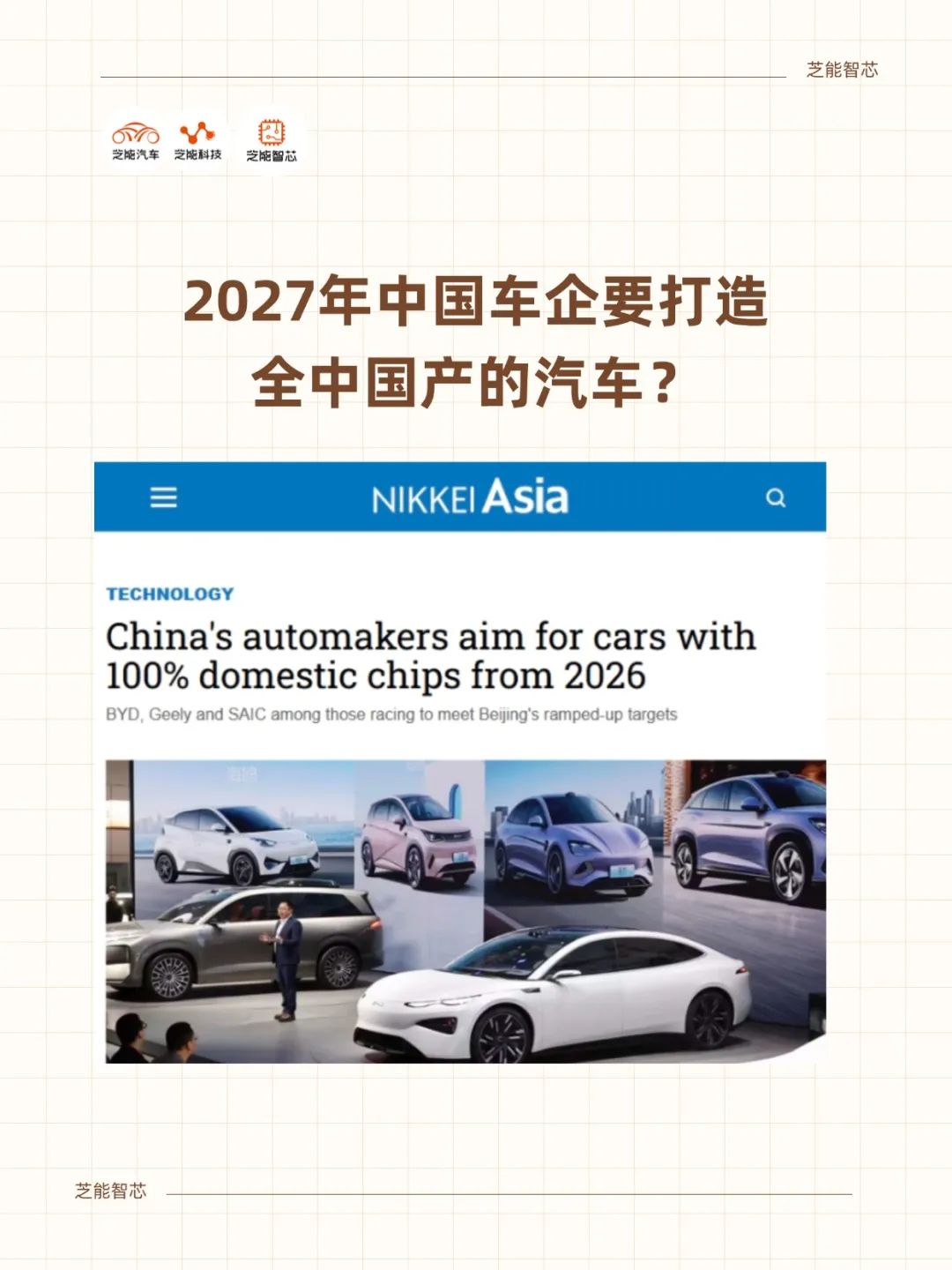
Core Viewpoint - Chinese automotive companies are accelerating the localization of automotive chips, aiming for 100% domestic production by 2027, driven by policy guidance and market awareness, significantly impacting the global chip landscape [1]. Group 1: Chip Classification and Current Status - Automotive chips are essential for the "soft and hard integration" architecture of modern vehicles, with a single vehicle typically requiring hundreds of chips across various functions [5]. - Chips can be categorized into five types: main control (e.g., MCU, SoC), communication (e.g., CAN/LIN/Ethernet transceivers), power (e.g., IGBT drivers), sensor (e.g., millimeter-wave radar front-end), and functional safety chips (e.g., TPM) [6]. - Chinese chip manufacturers have made breakthroughs primarily in main control and communication chip products [6][8]. Group 2: Current Developments in Domestic Chip Production - Companies like Neusoft Carrier, Jiefa Technology, and Huada Semiconductor have launched automotive-grade MCU products that meet AEC-Q100 certification, supporting ISO 26262 safety standards [8]. - In the communication chip sector, companies such as Xingyu Technology and Xinyi Information have achieved small-scale production of domestic CAN and Ethernet PHY chips, with some products entering the vehicle development cycle [8]. - High-performance intelligent driving SoC chips are still dominated by a few companies, with examples like Horizon's Journey series and Huawei's Kirin series, which are being deployed in various vehicle models [9]. Group 3: Trends in Chip Research and Development - Chinese automotive companies are transitioning from being "chip purchasers" to "chip architecture participants" and even "definers," with firms like XPeng leading the way in self-developed AI chip strategies [10]. - The evolution of hardware architecture is moving towards SoC integration platforms that emphasize multi-domain collaboration, requiring chip companies to possess both hardware design capabilities and a complete software SDK stack [12]. - Collaborations between automotive and chip companies are increasing, with examples including Geely's partnership with Hezhima for intelligent driving platforms and BYD's full-stack self-research model for core modules [13][15].
小鹏汽车-W(09868.HK):新车销量强劲 毛利率略超预期
Ge Long Hui· 2025-05-25 01:45
Core Viewpoint - The company reported a strong performance in Q1 2025, with significant sales growth driven by new model launches, despite a challenging industry environment [1][2][3]. Sales Performance - In Q1 2025, the company achieved sales of 94,000 vehicles, representing a year-on-year increase of 330.8% and a quarter-on-quarter increase of 2.7% [1]. - The new models, Mona M03 and P7+, contributed significantly to sales, with 47,000 and 24,000 units sold respectively, accounting for 75.5% of total sales in the quarter [2]. Financial Metrics - Total revenue for Q1 2025 was 15.81 billion yuan, showing a year-on-year increase of 141.5% but a quarter-on-quarter decrease of 1.8% [1]. - The average revenue per vehicle was 153,000 yuan, down 39.8% year-on-year and 4.7% quarter-on-quarter [1]. - The gross margin improved to 15.6%, with a year-on-year increase of 2.7 percentage points and a quarter-on-quarter increase of 1.2 percentage points [1]. Future Outlook - The company has set a delivery guidance of 102,000 to 108,000 vehicles for Q2 2025, which would be a record high [2]. - The introduction of new models such as G6 and G9, along with the upcoming M03 Max version, is expected to further enhance sales and profitability [3]. - The company anticipates total sales of 550,000 vehicles in 2025, representing a year-on-year increase of 190% [3]. Technological Advancements - The company is set to deploy its self-developed Turing chip in Q2, which is designed to optimize cost control and enhance the capabilities of its vehicles [3]. - The Turing chip boasts processing power 3-7 times that of current mainstream AI chips, specifically designed for L4 autonomous driving [3]. Profitability Forecast - The company has revised its revenue projections for 2025-2027 upwards, with expected revenues of 95.9 billion, 117.2 billion, and 135.5 billion yuan respectively [4]. - The forecast for net profit attributable to the parent company has also been increased, with estimates of 400 million, 2.8 billion, and 4.7 billion yuan for the same period [4].