
布伦特油

Search documents
2026年2月CPI和PPI数据解读:2月通胀:春节效应显著,关注备战主线
ZHESHANG SECURITIES· 2026-03-09 14:41
Inflation Data - February CPI increased by 1.3% year-on-year, significantly higher than the previous value of 0.2% and market expectations of 0.9%[1] - February PPI recorded a year-on-year decline of -0.9%, an improvement from -1.4% in January, exceeding market expectations of -1.2%[1] Consumer Price Index (CPI) Insights - The CPI's year-on-year increase is the highest in nearly three years, driven by the Spring Festival effect and recovering consumer demand[2] - Food prices rose by 1.7% in February, contributing approximately 0.30 percentage points to the CPI increase, with fresh vegetables and meats seeing price hikes between 5.9% and 10.9%[3] Core CPI Analysis - Core CPI, excluding food and energy, rose by 1.8% year-on-year, a significant increase from 0.8% in January, indicating a strong recovery in consumer spending[4] - Service prices increased by 1.6%, contributing about 0.75 percentage points to the CPI, with notable rises in travel and accommodation costs[5] Producer Price Index (PPI) Trends - The PPI has shown a continuous month-on-month increase for five consecutive months, indicating positive changes in certain industries[6] - Prices in the AI and high-end manufacturing sectors have increased, with aerospace manufacturing prices rising by 7.7%[7] Market Outlook - The report suggests that the A-share market is expected to strengthen in 2026, driven by liquidity and structural trends in low-volatility dividends and technology growth[1] - The 10-year government bond yield is anticipated to fluctuate between 1.5% and 2%[1]
格林大华期货早盘提示-20260303
Ge Lin Qi Huo· 2026-03-02 23:30
Report Summary 1. Report Industry Investment Rating - Not provided in the given content 2. Core Viewpoints - The geopolitical conflict between the US, Israel and Iran has severely disrupted the energy market, pushing the Brent oil price to contain a risk premium of $9 - $10, and the energy market is approaching the critical point of physical supply disruption. The conflict may also force the Fed to maintain high - interest rates in a declining growth environment, putting pressure on the US stock market [1]. - The global economic situation is facing high uncertainty due to US policies, geopolitical conflicts, and the Fed's expected policy changes. The global economy has started to decline since the end of 2025, and investors need to be vigilant about market fluctuations [2]. 3. Summary by Related Catalogs 【Important Information】 - Trump said a military operation against Iran might take about four weeks or less, and leaders of the UK, France, and Germany may take "necessary defensive actions" against Iran [1]. - The Iranian Revolutionary Guard hit 3 "violating" US - UK oil tankers in the Persian Gulf and the Strait of Hormuz, and an oil tanker "MKD VYOM" was hit [1]. - Morgan Stanley estimates that if the Strait is fully blocked, the storage capacity of the seven major Middle - Eastern oil - producing countries can only support 25 days, and then they will be forced to stop production. The daily oil export volume has dropped to a quarter of the normal level [1]. - War - risk insurers have canceled policies for ships in the Persian Gulf and the Strait of Hormuz, and some insurance premiums may rise by up to 50% in the next few days [1]. - Goldman Sachs warns that if the conflict turns into a "protracted war" like in 2022, high fiscal spending and energy inflation will force the Fed to maintain high - interest rates, flattening the US Treasury yield curve and pressuring the US stock market [1]. - The actual duration of the US - Iran conflict is limited by the "inventory of air - defense interceptor missiles", and the inventory of the US, Israel and other countries may be depleted in a few days [1]. - Bank of America strategist Hartnett warns that the private - credit market is sending a risk alert, and credit risks are starting to spread to the financial system [1]. - Japanese experts say that if the Strait of Hormuz is blocked for a long time, Japan's GDP is expected to decrease by 3% [1]. - The AI competition in Silicon Valley has created an extreme over - work culture, and AI is reducing entry - level jobs and increasing lay - off anxiety [2]. 【Global Economic Logic】 - The US and Israel's attacks on Iran, Iran's counter - attacks, and the interruption of transportation in the Strait of Hormuz have led to hedge funds selling US stocks at the fastest pace since March last year [2]. - JPMorgan Chase CEO warns that the current high asset prices and blind profit - seeking are similar to the situation before the 2008 financial crisis, and a credit - cycle reversal may cause an unexpected default wave [2]. - Bridgewater Associates founder Dalio warns that the world is on the verge of a "capital war" due to geopolitical tensions and capital - market volatility [2]. - The expected balance - sheet reduction policy of the Fed's incoming chairman Wash has a strong negative impact on global equity and commodity assets [2]. - The US's actions such as arresting the Venezuelan president and trying to control Venezuelan oil and Greenland have brought great uncertainty to the global economy [2]. - Nomura says that the Fed's uncertainty is expected to peak from July to November 2026, and there may be a trend of "fleeing from US assets" [2]. - Goldman Sachs analysts warn that the decline in Las Vegas gambling revenue is similar to the early warning signal before the 2008 financial crisis [2]. - The US is adjusting its economic relations with China and trying to revive its economic autonomy [2]. - The Fed's Beige Book shows that consumer K - type differentiation is intensifying, and funds are flowing from technology stocks to defensive sectors [2]. - The US's return to the Monroe Doctrine will have a profound impact on major asset classes [2]. - Wash's combination of interest - rate cuts and balance - sheet reduction indicates a major shift in the Fed's monetary policy, which will lead to a strong expectation of liquidity contraction for equity assets [2]. - The Nasdaq has broken through the six - month moving average again, and AI's disruptive substitution may trigger a new round of large - scale selling, and the decline in US stocks may have a negative impact on US consumption [2]. - Due to the US's wrong policies, the global economy has passed its peak at the end of 2025 and started to decline [2].

假期风云激荡,银价油价飙升!国内期市开盘在即,贵金属稳了?谁将成为“黑马”?
Qi Huo Ri Bao· 2026-02-24 00:34
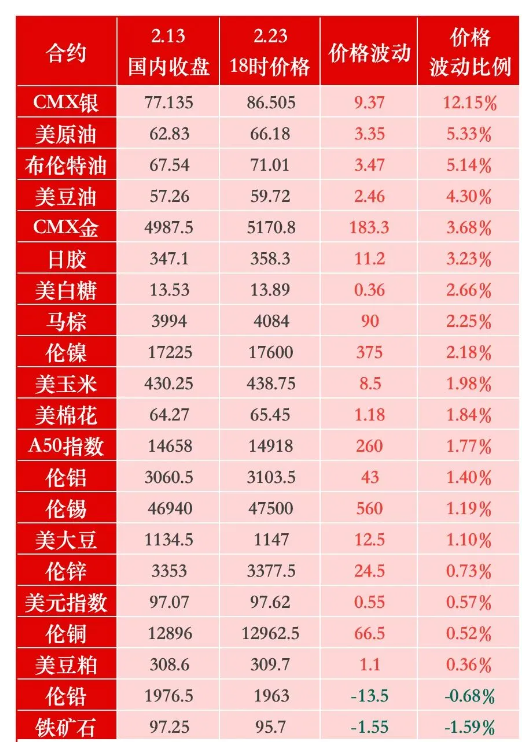
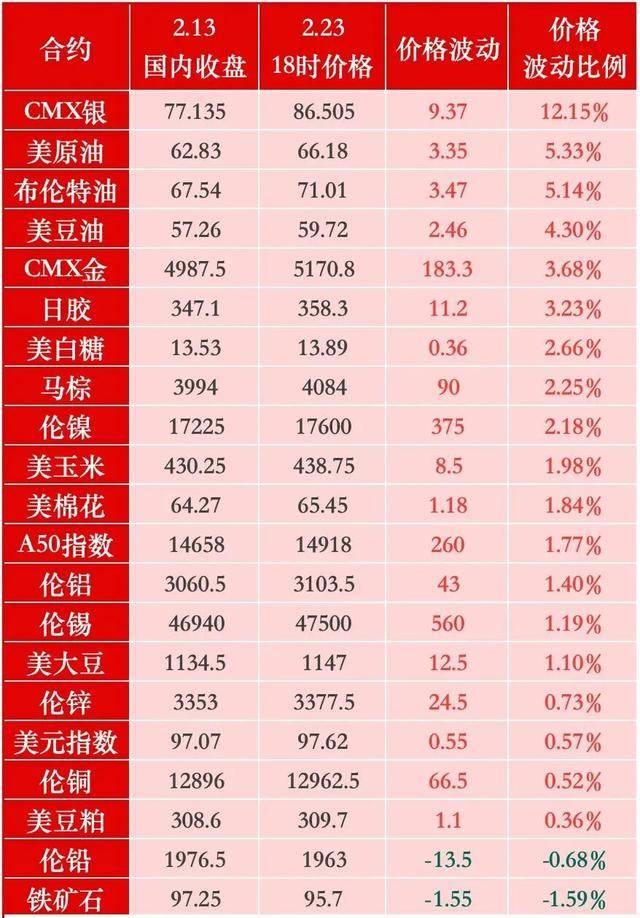
Core Viewpoint - The global macro environment remains turbulent during the Spring Festival holiday, with significant events such as changes in U.S. tariff policies and escalating geopolitical conflicts leading to sharp fluctuations in major asset prices, adding uncertainty to the domestic market's opening after the holiday [1] Market Reactions - During the Spring Festival, international markets experienced notable price movements, with commodities like silver, crude oil, and agricultural products showing significant changes [2] - The price of CMX silver increased by 12.15%, while Brent oil rose by 5.14% and U.S. soybean oil by 4.30% [2] Federal Reserve Policy Insights - The Federal Reserve is experiencing increased internal divisions regarding future monetary policy, with discussions around rate cuts, pauses, and hikes being mentioned [4][5] - Recent data indicates a 3.0% year-over-year increase in the core PCE price index, leading to a reduction in expectations for rate cuts [5][7] Stock Market and Precious Metals Outlook - Despite short-term volatility, the U.S. stock market is still in an economic expansion phase, with AI contributing positively to productivity [9] - Precious metals, particularly gold and silver, are expected to continue their upward trend, driven by both financial and industrial demand [11] Oil Market Dynamics - Geopolitical risks are identified as a primary driver of recent fluctuations in global oil prices, with potential military actions against Iran posing risks to oil supply routes [12][13] - The International Energy Agency reports a significant increase in global oil inventories, indicating a potential oversupply situation [13] Commodity Market Predictions - The precious metals sector is anticipated to see substantial increases post-holiday, with silver showing strong potential for recovery due to both financial and industrial factors [15] - The energy sector is expected to respond directly to international crude oil price movements, while the chemical sector may face challenges due to supply-demand mismatches [15] Risk Factors for Market Opening - The market is expected to open broadly higher with structural differentiation, focusing on potential rebound opportunities in precious metals and oil-related products [16] - Key risks include jump gap risks, position changes, and liquidity risks, necessitating cautious trading strategies [16]

假期风云激荡 银价油价飙升!国内期市贵金属稳了?哪些品种将成为“黑马”?
Sou Hu Cai Jing· 2026-02-24 00:08
Group 1: Global Market Overview - During the Spring Festival holiday, significant global macro events occurred, including sudden changes in U.S. tariff policies and escalating geopolitical conflicts, leading to substantial price volatility in major assets, which adds uncertainty to the domestic market opening after the holiday [1] - The international market saw notable price fluctuations in various commodities, with silver prices increasing by 12.15%, crude oil prices rising by 5.33%, and gold prices up by 3.68% during the holiday period [2] Group 2: U.S. Federal Reserve and Economic Indicators - The Federal Reserve's internal divisions have intensified, with discussions around interest rate changes indicating possibilities of rate cuts, pauses, or increases, reflecting a complex monetary policy outlook [4] - The latest data from the U.S. Bureau of Economic Analysis shows that the core PCE price index increased by 3.0% year-on-year, which is higher than expected, leading to a reduction in market expectations for rate cuts [4][6] Group 3: Precious Metals and Investment Strategies - The precious metals sector is expected to experience significant price increases, supported by overseas market trends, although high volatility is anticipated due to potential regulatory measures from exchanges [15] - Silver prices have rebounded during the holiday, driven by both financial and commodity attributes, with a notable reduction in short positions in the silver market [11] Group 4: Oil Market Dynamics - Geopolitical risks are identified as the primary driver of global oil price fluctuations, with potential military actions against Iran posing risks to oil supply routes, particularly through the Strait of Hormuz [12][13] - The International Energy Agency's latest report indicates that global oil inventories are increasing at the fastest rate since 2020, suggesting a potential oversupply in the market [14] Group 5: Agricultural Products Outlook - The agricultural sector, particularly commodities like soybean oil and palm oil, has shown significant price increases, with wheat inventories declining for four consecutive years, indicating a potential rebound in wheat prices [15]
苯乙烯:多空博弈,价格先下跌后小幅反弹
Sou Hu Cai Jing· 2026-02-12 06:18
Core Viewpoint - Styrene prices experienced a decline followed by a slight rebound, with the average closing price in Jiangsu at 7620 yuan/ton as of February 11, down 310 yuan/ton or 3.91% from February 4 [1] Cost Analysis - International oil prices fluctuated, primarily influenced by negotiations between the U.S. and a Middle Eastern country, with Brent crude oil closing at a decrease of $0.06 per barrel as of February 11 [1] - Pure benzene prices initially fell due to the end of downstream stocking, but later rebounded slightly as market expectations shifted towards tighter supply post-Spring Festival, with the average price in East China down 1.54% from the previous Wednesday [1] Supply and Demand Dynamics - Domestic production increased more than expected due to the restart of facilities by companies such as Xinyang Technology, Sinochem Quanzhou, and Tianjin Bohua; however, production of key downstream products like PS and EPS decreased, while ABS saw a slight increase, indicating continued weak consumption [1] - Main port arrivals were insufficient to meet demand, leading to a decrease in inventory levels [1] Market Forecast - As the Spring Festival approaches, the fundamental supply-demand balance is expected to weaken, putting pressure on prices; however, actual trading in the East China spot market remains limited, with prices primarily driven by expectations [1] - Current market sentiment leans towards a lower accumulation of inventory at main ports post-Spring Festival and a favorable macroeconomic outlook, providing support for prices [1] - In the context of the ongoing tug-of-war between bullish and bearish sentiments, short-term styrene prices may exhibit a strong consolidation trend [1]
9月29日国际晨讯丨俄称普京愿与特朗普在莫斯科会晤 摩根大通提醒美股五大潜在风险
Sou Hu Cai Jing· 2025-09-29 00:56
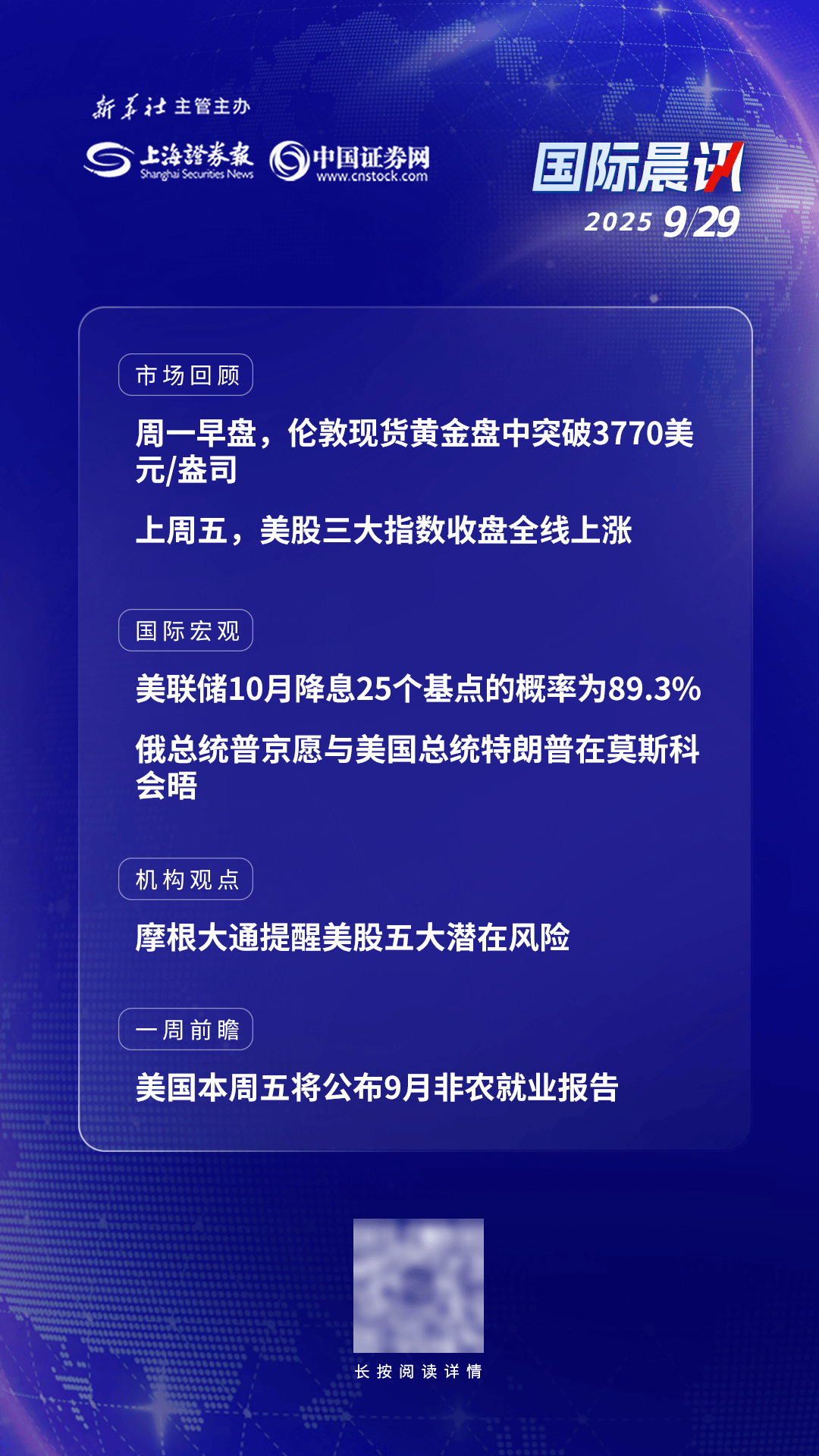
Market Overview - On Monday, the Japanese stock market opened lower, with the Nikkei 225 index down by 0.53% [4] - London spot gold prices broke through $3770 per ounce, while COMEX gold futures fell below $3800 per ounce. Last week, London spot gold saw a cumulative increase of over 2%, and COMEX gold futures rose nearly 1.9% [4] - International oil prices declined on Monday, with WTI crude oil opening down over 1%. Last week, WTI crude oil had a cumulative increase of over 4.5%, while Brent crude oil rose more than 4% [4] - On Friday, all three major U.S. stock indices closed higher, with the Dow Jones up 0.65% to 46247.29 points, the Nasdaq up 0.44% to 22484.07 points, and the S&P 500 up 0.59% to 6643.70 points. However, for the week, all three indices experienced a pullback, with the Dow down 0.15%, the Nasdaq down 0.65%, and the S&P 500 down 0.31% [4] International Macro - As of September 29, the probability of the Federal Reserve maintaining interest rates in October is 10.7%, while the probability of a 25 basis point rate cut is 89.3%. For December, the probability of maintaining rates is 2.9%, with a cumulative 25 basis point cut probability of 32.2% and a 50 basis point cut probability of 64.9% [5] Institutional Insights - JPMorgan's latest report indicates that while the S&P 500 index may aim for the 7000-point mark by year-end, investors should be cautious of several potential risks that could lead to market volatility. These risks include seasonal factors, excessive rebound magnitude, prolonged lack of correction, overheated retail investor sentiment, and macro events materializing [7] Weekly Outlook - The U.S. will release the September non-farm payroll report this Friday. Prior to this, key data to watch includes the August JOLTS job openings on Tuesday, the September ADP private employment data on Wednesday, and the weekly initial jobless claims on Thursday [8]
苯乙烯:本周涨1.05%,后市或易跌难涨
Sou Hu Cai Jing· 2025-09-18 05:03
Core Viewpoint - Styrene prices have shown a fluctuating yet strong trend this week, with expectations of potential declines in the future due to weak demand and supply adjustments [1] Price Trends - As of September 17, the average closing price of styrene in the Jiangsu market was 7185 yuan/ton, an increase of 75 yuan/ton or 1.05% compared to the previous Wednesday [1] Cost Factors - International oil prices experienced a decline followed by an increase, with Brent crude oil rising by $0.46 per barrel or 0.68% as of September 17 [1] - The price of pure benzene also showed strength, with the average closing price in the East China market increasing by 1.05% compared to the previous Wednesday [1] Supply and Demand Dynamics - The restart of production at Zibo Junchen and Tangshan Xuyang facilities has stabilized operations, while Zhejiang Petrochemical has planned outages and reduced load, leading to a shift from increased to decreased weekly output [1] - The main port in East China has transitioned from inventory depletion to a slight accumulation, with limited changes in production and consumption from major downstream sectors [1] Market Predictions - Predictions indicate that the Federal Reserve's interest rate cuts will have a limited impact on the commodity market, suggesting that the styrene market will revert to its fundamentals [1] - Despite planned supply reductions, demand remains tepid, and northern factories may resort to low-price inventory clearance before the upcoming double festival, making the market more prone to declines than increases [1]
利率量化择时系列三:跨资产维度下的利率交易择时策略
ZHESHANG SECURITIES· 2025-08-29 05:07
Core Insights - The report focuses on cross-asset timing strategies for interest rates, systematically backtesting various assets (including stock indices, commodities, and bonds) to identify performance under different market conditions [1]. Group 1: Cross-Asset Rotation Effects - The "stock-bond seesaw" effect arises from shifts in risk appetite, where strong economic expectations lead to capital flowing into equity markets, putting pressure on bond prices and raising yields [2][14]. - The relationship between commodities and bonds is closely tied to inflation expectations, with rising commodity prices typically leading to higher inflation and interest rates, which suppress bond valuations [2][14]. Group 2: Timing Strategies in Commodity and Equity Markets - In equity markets, strategies focused on volatility structures yield higher excess returns compared to trend-based moving average strategies, particularly in high-volatility environments [3]. - For commodities, timing strategies exhibit high odds and low win rates, aligning with the trend-driven nature of commodity trading. Multi-signal strategies outperform in various market conditions due to their adaptability [3][51]. Group 3: Cross-Asset Timing Strategies - The report employs a "cross-validation signal triggering method" for each asset, enhancing the robustness of cross-asset timing strategies. The "look at stocks, trade bonds" and "look at commodities, trade bonds" approaches aim to mitigate drawdowns while maintaining excess returns [4][86]. Group 4: Future Optimization Outlook - A dynamic weighting mechanism is proposed to adjust the importance of different market signals based on macroeconomic conditions, enhancing the adaptability of strategies over time [5]. - The report suggests exploring pair trading strategies in the foreign exchange market to provide additional support for cross-asset trading logic [5].

苯乙烯:新装置投产或施压价格延续弱势
Sou Hu Cai Jing· 2025-08-08 10:58
Core Viewpoint - Styrene prices experienced a slight rebound after a decline, with the average closing price in Jiangsu market at 7325 yuan/ton as of August 6, reflecting a decrease of 75 yuan/ton or 1.01% from the previous week [1] Cost Analysis - The oil market has been under pressure with continuous negative news, leading to a decline in international oil prices, which fell by 8.67% as of August 6 compared to the previous Wednesday [1] - Pure benzene prices initially dropped but later increased, influenced by weak crude oil and futures market conditions, while a tightening supply in the north contributed to the price rise, with the average price in East China down by 20 yuan/ton as of August 6 [1] - The raw material sector lacks a unilateral driving force [1] Supply and Demand - Throughout the week, except for CNOOC Shell which faced production losses due to equipment issues, other facilities maintained stable production [1] - The main port in East China experienced reduced arrivals due to typhoon impacts, leading to a decrease in inventory, although market supply remains sufficient [1] - The output of the main downstream product, three S, is expected to see a slight increase, but the purchasing intentions at the beginning of the month remain low [1] - The supply and demand fundamentals continue to show weakness [1] Forecast - Styrene prices are expected to follow fluctuations in the bulk commodity market in the short term, with the raw material sector unlikely to show a clear direction [1] - The ongoing weak supply and demand fundamentals may be exacerbated by the commissioning of the Jingbo Sida Rui facility, which could further intensify supply-demand conflicts and pressure prices to remain weak [1]
高盛:预计布伦特油价和WTI原油价格将在2025年剩余时间内小幅下跌,均价分别为63美元和59美元,并将在2026年达到58美元和55美元。
news flash· 2025-04-14 00:22
Core Viewpoint - Goldman Sachs expects Brent crude oil prices and WTI crude oil prices to experience a slight decline for the remainder of 2025, with average prices projected at $63 and $59 respectively, and further decreasing to $58 and $55 in 2026 [1] Price Projections - Brent crude oil price is anticipated to average $63 in 2025 and $58 in 2026 [1] - WTI crude oil price is projected to average $59 in 2025 and $55 in 2026 [1]