
玻璃现货

Search documents
大越期货玻璃周报-20260323
Da Yue Qi Huo· 2026-03-23 02:08
1. Report Industry Investment Rating - No relevant information provided 2. Core View of the Report - Last week, the glass futures fluctuated downward, with the main contract FG2605 closing at 1054 yuan/ton, a 7.14% decline from the previous week; the spot price of 5mm white glass大板 in Hebei Shahe was 968 yuan/ton, a 0.82% decline from the previous week [3] - In terms of supply, raw material prices have rebounded, glass production profits have declined, and there is an expectation that individual production lines will be shut down next week, with weekly output likely to continue to shrink; the number of operating float glass production lines and daily melting volume are at low levels in the same period [3] - In terms of demand, although downstream processing plants have gradually resumed work, the resumption is restricted by weak orders; some plants replenished inventory moderately after continuous price increases by original glass enterprises; the overall sales-to-production ratio of the float glass industry exceeded 100 last week, and inventory decreased, but the shipment situation slowed down slightly compared to the previous week [3] - As of March 19, the inventory of national float glass enterprises was 74.436 million weight boxes, a 1.86% decline from the previous week, and the inventory is at a historically high level in the same period; overall, the glass market has been more affected by macro sentiment recently, and it is expected to maintain a wide - range volatile trend in the short term [3] 3. Summary by Relevant Catalogs Glass Futures and Spot Weekly Market - The closing price of the main contract decreased from 1135 yuan/ton to 1054 yuan/ton, a decline of 7.14%; the spot benchmark price decreased from 976 yuan/ton to 968 yuan/ton, a decline of 0.82%; the main basis decreased from -159 yuan/ton to -86 yuan/ton, a decline of 45.91% [6] Glass Spot Market - The market price of 5mm white glass大板 in Hebei Shahe, the spot benchmark location, was 968 yuan/ton, a 0.82% decline from the previous week [11] Fundamentals - Cost and Profit - No specific content provided other than the topic of glass production profit Fundamentals - Supply - The number of operating float glass production lines was 207, with an operating rate of 70.41%, and the number of operating production lines is at a low level in the same period [17] - The daily melting volume of national float glass was 145,800 tons, and the production capacity is at a low level in the same period [19] Fundamentals - Demand - In November 2025, the apparent consumption of float glass was 4.6944 million tons [23] - Other topics such as housing sales, new construction, construction, and completion areas, and downstream processing plant operation and order situations are listed, but no specific content is provided Fundamentals - Inventory - The inventory of national float glass enterprises was 74.436 million weight boxes, a 1.86% decline from the previous week, and the inventory is running above the five - year average [37] Fundamentals - Supply - Demand Balance Sheet - The supply - demand balance sheet from 2017 to 2024E is presented, including data on production, consumption, production growth rate, consumption growth rate, and net import ratio; for example, in 2024E, production is expected to be 55.1 million tons, with a production growth rate of 3.94%, and consumption is expected to be 53.1 million tons, with a consumption growth rate of -1.15% [38]
玻璃期货周报-20260311
Guo Jin Qi Huo· 2026-03-11 02:26
1. Report Industry Investment Rating - Not mentioned in the report 2. Core Viewpoint of the Report - The glass futures main contract FG2605 showed a "first decline then rise" trend this week. The spot price remained stable, and the basis narrowed from 84 yuan/ton at the beginning of the week to 47 yuan/ton at the weekend, indicating the repair of the futures discount to the spot. There is still a contradiction between high inventory and slow demand recovery in the industrial end, but the policy expectation and technical analysis jointly drive a short - term rebound. It is expected to continue the volatile and strong pattern next week [8] 3. Summary According to Relevant Catalogs 3.1 Futures Market - This week, the glass main contract FG2605 opened at 1067 yuan/ton, with the lowest reaching 1027 yuan/ton. Driven by macro - policy expectations and the sentiment of demand recovery on Friday, it reached a maximum of 1093 yuan/ton and closed at 1087 yuan/ton, with a weekly increase of 1.87%. The average daily trading volume was 1.287 million lots, a 15% increase from last week, and the position increased slightly by 2% [2] 3.2 Spot Market 3.2.1 Basis Data - This week, the basis fluctuated in the range of 47 - 91 yuan/ton. At the beginning of the week, affected by the futures correction, the basis expanded to 91 yuan/ton. On Friday, as the futures rose sharply, the basis narrowed to 47 yuan/ton, and the basis rate dropped from 8.7% to 4.4%, with an obvious repair of the futures - spot discount [3] 3.2.2 Spot Data - The national average glass spot price remained stable at 1070.4 yuan/ton, with regional price differentiation. The large - plate price in North China was 1050 yuan/ton, in Central China was 1090 yuan/ton, and in East China was 1080 - 1100 yuan/ton. The operating rate of downstream deep - processing enterprises rebounded to 45% (a 10 - percentage - point increase from the previous period), but the order days were still only 6.5 days, and the procurement was mainly for small - order replenishment, with light trading [4] 3.3 Influencing Factors 3.3.1 Industry Information - As of March 6, the total inventory of national sample enterprises was 53.56 million heavy boxes (a 0.5 - million - heavy - box increase from the previous period), and the inventory days were 23.5 days, at a high level in the same period of the past three years. Inventory accumulation was obvious in North China and East China [6] 3.3.2 Technical Analysis - The weekly K - line closed with a long lower shadow positive line. The green column of the MACD indicator shortened, and the DIFF and DEA formed a golden cross below the zero axis. The RSI rebounded to 55, getting out of the oversold range. The K - line of the KDJ indicator broke through the D - line, forming a golden cross. The short - term technical side is strong [7]
大越期货玻璃早报-20260306
Da Yue Qi Huo· 2026-03-06 02:38
Report Industry Investment Rating No relevant content provided. Core Viewpoints - The glass market is currently bearish. The production profit of glass has been slightly restored, but cold repairs are less than expected, resulting in low supply. The downstream deep - processing orders are weak due to the real estate downturn, and the inventory is at a historically high level. The futures price is at a premium to the spot price, and the inventory is increasing. The price is below the 20 - day line, and the main positions are net short. In the short term, the glass market is expected to be in a weak and volatile state [2]. Summary by Directory Glass Futures Market - The closing price of the main glass futures contract increased from 1038 yuan/ton to 1055 yuan/ton, a rise of 1.64%. The spot price of Shahe safety large - plate glass remained unchanged at 956 yuan/ton. The main basis changed from - 82 yuan/ton to - 99 yuan/ton, a change of 20.73% [6]. Glass Spot Market - The market price of 5mm white glass large - plate in Hebei Shahe, the spot benchmark, was 956 yuan/ton, unchanged from the previous day [11]. Cost - side of Fundamentals - The production profit of glass has been slightly restored, and the production volume is decreasing due to low profit [2][4]. Production Line and Output of Glass - The number of operating national float glass production lines is 209, with an operating rate of 70.61%, at a historically low level in the same period. The daily melting volume of national float glass is 148,600 tons, and the production capacity is at a historically low level in the same period [18][20]. Demand of Fundamentals - In November 2025, the apparent consumption of float glass was 4.6944 million tons [24]. Inventory of Fundamentals - The inventory of national float glass enterprises is 79.637 million weight boxes, an increase of 4.77% from the previous week, and the inventory is above the 5 - year average [2][39]. Supply - demand Balance Sheet - The supply - demand balance sheet shows the production, consumption, and other data of float glass from 2017 to 2024E, including production growth rate, consumption growth rate, and net import ratio. For example, in 2024E, the production is 55.1 million tons, the consumption is 53.1 million tons, and the production growth rate is 3.94% [40].
国金期货玻璃周报-20251231
Guo Jin Qi Huo· 2025-12-31 08:27
Group 1: Investment Rating - There is no information about the industry investment rating in the report. Group 2: Core View - The glass futures market is likely to continue oscillating in a relatively low - level range due to insufficient long - and short - term drivers. The core contradiction in the market is the game between "rising cold - repair expectations" and "the reality of high inventory." In the short term, prices may continue to oscillate within a range, and in the medium term, they are still restricted by weak terminal demand and slow inventory depletion [2][8]. Group 3: Summary by Relevant Catalogs 1. Futures Market - Glass futures prices fell near the previous low. With the expectation of production cuts, short - position main players actively reduced their positions last week. From December 24th (Wednesday) to Friday, prices rebounded slightly, rising from a minimum of 1017 yuan/ton on Tuesday to 1057 yuan/ton at Friday's close [2]. 2. Weekly Position Changes - As of December 26th (last Friday), the long - position of the 2605 contract was 609,514 lots, an increase of 6,210 lots compared to the previous week; the short - position was 792,345 lots, an increase of 466 lots compared to the previous week [5]. 3. Spot Market - In the traditional off - season, terminal demand is weak, and recent enterprise shipments are sluggish. As of December 25th, the total inventory of float glass sample enterprises was 58.623 million heavy boxes, a week - on - week increase of 65,000 heavy boxes. South China and East China had better inventory reduction, while North China and Central China had a slight inventory increase. A production line in Dongguan, Guangdong with a daily output of 900 tons was shut down for cold repair on December 24th. The glass supply has decreased, and the previous centralized cold - repair of production lines has improved the supply - demand situation to some extent, but the weak demand remains the current keynote [6]. 4. Production Profit Changes - From December 19th to December 25th, the weekly average profit of natural - gas glass was - 186.4 yuan/ton, with a loss increase of 5 yuan/ton compared to the previous week; the weekly average profit of coal - gas float glass was - 21.88 yuan/ton, with a loss increase of 14.26 yuan/ton compared to the previous week; the weekly average profit of petroleum - coke float glass was - 7.21 yuan/ton, with a loss increase of 7.14 yuan/ton compared to the previous week [7]. 5. Market Outlook - From December 22nd to December 26th, the main contract of glass futures rebounded moderately in oscillation, but the spot market was under continuous pressure, and the divergence between futures and spot prices intensified. The short - term price may continue to oscillate within a range, and the medium - term is still restricted by weak terminal demand and slow inventory depletion [8].
光大期货煤化工商品日报-20251218
Guang Da Qi Huo· 2025-12-18 05:15
Group 1: Report Investment Ratings - Urea: Bullish and volatile [2] - Soda Ash: Bullish operation [2] - Glass: Bullish [2] Group 2: Core Views - Urea futures prices showed a volatile upward trend on Wednesday. The 01 contract closed at 1646 yuan/ton, up 1.29%, and the 05 contract closed at 1683 yuan/ton, up 0.66%. The spot market was mostly stable, with prices in some regions fluctuating between -10 and +20 yuan/ton. The supply level of urea fluctuated slightly, with the daily output of the industry at 195,000 tons, unchanged from the previous day. The demand sentiment increased significantly, with the sales-to-production ratio in the mainstream regions rising to the range of 145% - 200%, and exceeding 300% in some regions. The short-term strengthening of market sentiment was boosted by India's new tender, but whether there will be new export quotas and policy relaxation in China remains to be verified. It is expected that the overall urea futures price will maintain a range-bound trend, with short-term sentiment being bullish. Attention should be paid to the spot trading atmosphere, Indian tender dynamics, and China's export policy dynamics [2]. - Soda ash futures prices showed a firm and volatile trend on Wednesday. The 01 contract closed at 1127 yuan/ton, down 0.27%, and the main 05 contract closed at 1170 yuan/ton, up 0.78%. The spot market quotes were mostly stable, and the quotes in the trader segment fluctuated with the market sentiment. The supply level of soda ash was stable, with the industry's operating rate at 82.05% the previous day. Some regions reduced production loads, and there were still enterprises planning maintenance, so the supply of soda ash may fluctuate. The demand side was average, with downstream buyers purchasing at low prices and mainly following up on rigid demand. The expectation of cold repair of glass production lines was strengthened, and the rigid demand for soda ash was also expected to decline further. The fundamentals of soda ash fluctuated slightly. The overall strengthening of related chemical and black series varieties in the futures market provided a linkage effect, and the market still had expectations for external factors such as macro, anti-involution, environmental protection, and real estate policies. It is expected that the short-term soda ash futures price will continue to rebound at a high level, but the current trend momentum is insufficient, and excessive chasing of gains is not recommended. Attention should be paid to the overall trend of the macro and commodity markets, changes in soda ash production capacity, changes in downstream production lines, and this week's inventory data [2]. - The glass futures price rebounded strongly on Wednesday, with the 05 contract rising more than 3%. The spot price was still weak, with the average price of the domestic float glass market at 1089 yuan/ton, down 1 yuan/ton from the previous day. There were no obvious changes in the glass production lines recently, and the daily melting volume of the industry continued to remain at 155,000 tons. The cold repair plans of some production lines gradually became clear, and the market's concern about the continued decline in supply increased again. The overall strengthening of black and building materials varieties in the futures market also had a linkage effect on the glass futures price. In addition, the market still had expectations for external factors such as macro, anti-involution, environmental protection, and real estate policies, providing strong support for the bottom of the glass futures price. Currently, the demand for glass remained weak, with the sales-to-production ratios in the Shahe and Hubei regions both falling below 80%. Glass enterprises still had the intention to actively reduce inventory. Overall, driven by factors such as the macroeconomic recovery, the overall strengthening of commodities, and the expected decline in glass supply, the short-term trend of the futures market was bullish, but the sustainability of demand remained to be verified, and excessive chasing of gains was not recommended. Attention should be paid to the trend of the macro and commodity markets, changes in glass production lines, and spot trading conditions [2]. Group 3: Market Information Summary Urea - On December 17, the number of urea futures warehouse receipts was 11,202, a decrease of 12 from the previous day, and the valid forecast was 271 [5]. - On December 17, the daily output of the urea industry was 195,000 tons, unchanged from the previous working day, and an increase of 159,000 tons compared with the same period last year. The operating rate was 80.62%, a decrease of 1.38 percentage points compared with 79.24% in the same period last year [5]. - On December 17, the spot prices of small-grain urea in various regions of China were as follows: Shandong 1690 yuan/ton, down 10 yuan/ton; Henan 1670 yuan/ton, unchanged; Hebei 1710 yuan/ton, unchanged; Anhui 1670 yuan/ton, up 10 yuan/ton; Jiangsu 1680 yuan/ton, unchanged; Shanxi 1540 yuan/ton, up 20 yuan/ton [5]. - On December 17, the inventory of urea enterprises was 1.1797 million tons, a decrease of 54,500 tons from the previous week, a decrease of 4.42% [5]. Soda Ash & Glass - On December 17, the number of soda ash futures warehouse receipts was 4332, a decrease of 292 from the previous day, and the valid forecast was 856. The number of glass futures warehouse receipts was 189, a decrease of 149 from the previous day [7]. - On December 17, the spot prices of soda ash were as follows: in North China, light soda ash was 1250 yuan/ton, and heavy soda ash was 1300 yuan/ton; in Central China, light soda ash was 1180 yuan/ton, and heavy soda ash was 1250 yuan/ton; in East China, light soda ash was 1200 yuan/ton, and heavy soda ash was 1250 yuan/ton; in South China, light soda ash was 1350 yuan/ton, and heavy soda ash was 1400 yuan/ton; in Southwest China, light soda ash was 1250 yuan/ton, and heavy soda ash was 1300 yuan/ton; in Northwest China, light soda ash was 930 yuan/ton, and heavy soda ash was 930 yuan/ton [7]. - On December 17, the daily operating rate of the soda ash industry was 82.05%, the same as the previous working day [8]. - On December 17, the average price of the float glass market was 1089 yuan/ton, a decrease of 1 yuan/ton from the previous day. The daily output of the industry was 155,000 tons, unchanged from the previous day [8]. Group 4: Chart Analysis - The report includes charts of the closing prices, basis, trading volume, and positions of the main contracts of urea and soda ash, as well as the price spreads between different contracts, and the price spreads between urea and methanol, and glass and soda ash. All chart data sources are iFind and the Research Institute of Everbright Futures [10][18][19]
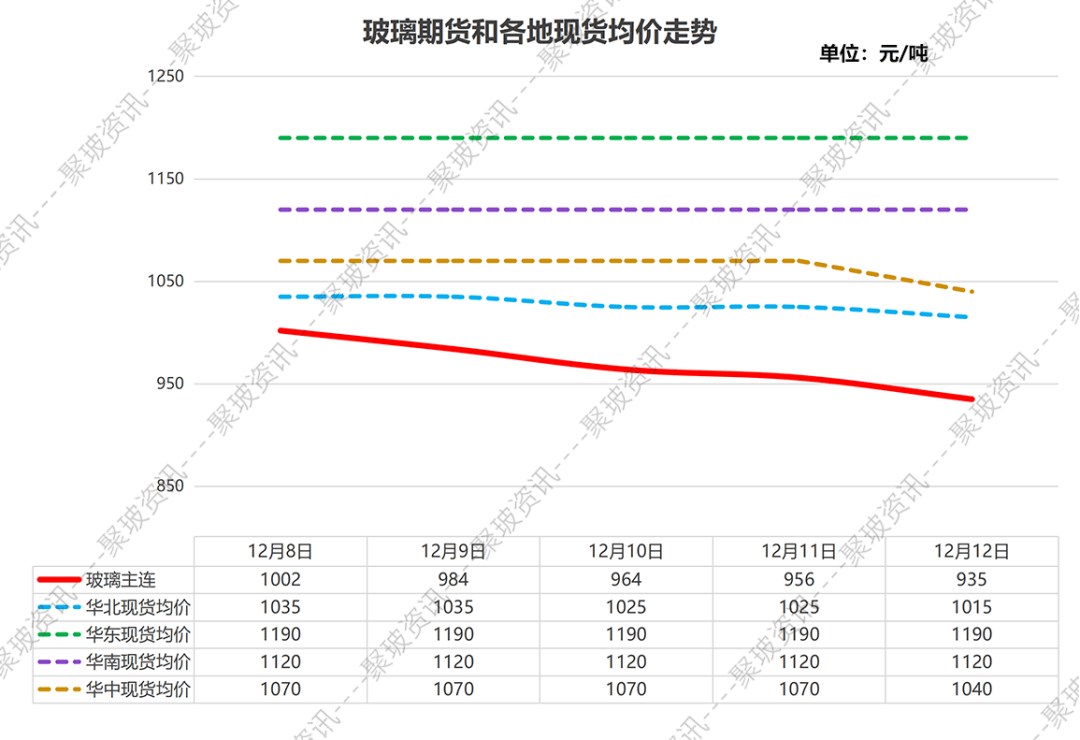
12月14日丨聚玻玻璃期现周评(第41期):期货持续走跌,现货稳中盘整,行业维持去库。
Sou Hu Cai Jing· 2025-12-14 12:12
Core Viewpoint - The glass futures prices have continued to decline, with the main contract price dropping by 67 yuan/ton this week, while the spot market prices have also seen a slight decrease of 9 yuan/ton [2]. Fundamental Analysis - Supply Side: This week, there was a slight fluctuation in the overall operating rate due to the ignition of production lines and changes in production. Overall transaction performance has weakened compared to previous periods, with inventory decreasing in many regions, although some areas still experienced inventory accumulation, resulting in a 2.05% decrease in industry inventory [2]. - Demand Side: The reduction in supply has boosted market sentiment, coupled with price adjustments from manufacturers, leading to a phase of replenishment by enterprises, with improved transaction performance in many regions [2]. Technical Analysis - The main glass contract has shown a continuous decline this week, with a highest price of 1015 and a lowest price of 934 [3]. - The volume-price relationship this week exhibited characteristics of "declining volume with rising prices, and rebounding with reduced volume," indicating a weakening of short-selling momentum and potential for a technical rebound in the short term [4]. - Technically, a "five consecutive down days" pattern has formed on the daily chart, with a long bearish candle on the weekly chart. The MACD green bars continue to expand, and the DIFF and DEA have crossed, indicating strong bearish momentum and a continuation of the downtrend [5]. Market Outlook - From a fundamental perspective, supply-demand contradictions still exist, with downstream demand unlikely to improve. Manufacturers are primarily focused on sales, and the glass spot market is expected to maintain a weak consolidation [5]. - Although related indicators suggest overselling, the weak fundamentals are difficult to change, limiting the rebound potential. A short-term technical correction may occur, but the mid-term outlook remains within the 900-1000 yuan range for bottoming out [6].

多地产销率突破100%!玻璃市场显著回暖
Qi Huo Ri Bao· 2025-10-29 23:24
Core Viewpoint - The glass futures market has experienced a "first decline then rise" trend since October, with ongoing battles between "weak reality" and "strong expectations" impacting market sentiment [1] Group 1: Market Performance - After the National Day holiday, the main glass futures contract (2601) fell from a high of 1233 yuan/ton to 1072 yuan/ton by October 22, a decline of 15.02%, reflecting strong pessimism in the market [1] - Following the low point on October 22, the glass futures market entered a phase of bottom consolidation, with the contract closing at 1127 yuan/ton on October 29, a 5.13% increase from the previous low [1] Group 2: Supply and Demand Dynamics - Post-holiday, glass production and sales data remained weak, with inventory accumulation exceeding market expectations, leading to pressure on the spot market [1] - Recent improvements in glass production and sales data, with sales rates exceeding 100% on October 28, have provided fundamental support for the futures market rebound [2] Group 3: Influencing Factors - The rebound in glass prices is driven by a combination of real market factors, policy expectations, and cost support, with recent price reductions stimulating demand and improving sales rates [2] - The upcoming glass industry symposium has heightened expectations for policy support, while the "14th Five-Year Plan" aims to enhance the competitiveness of traditional industries, further boosting market confidence [2] Group 4: Price Outlook - Analysts express differing views on whether glass prices have bottomed out, with some suggesting that the current market dynamics are still characterized by "weak reality" and "strong expectations" [3] - The potential for a year-end rush in demand and the effectiveness of capacity exit driven by policy or market forces are critical factors to monitor for future price movements [4]

行业比较周跟踪:A股估值及行业中观景气跟踪周报-20251019
Shenwan Hongyuan Securities· 2025-10-19 12:18
Investment Rating - The report does not explicitly provide an overall investment rating for the industry but highlights various sectors with their respective valuation metrics [1][2]. Core Insights - The report tracks A-share valuations and industry sentiment, indicating that the overall market is experiencing varied valuation levels across different indices and sectors [1][2]. - Key sectors such as real estate, steel, and IT services are noted for their high PE ratios, suggesting potential overvaluation, while white goods are highlighted as undervalued [1][2]. Valuation Comparisons - The report provides a detailed comparison of PE and PB ratios across major indices, with the CSI All Share (excluding ST) PE at 21.3x and PB at 1.8x, indicating historical percentiles of 79% and 39% respectively [1][4][5]. - The report identifies industries with PE ratios above the historical 85th percentile, including real estate, steel, and IT services, while white goods are noted for being below the 15th percentile [1][7]. Industry Sentiment Tracking - **New Energy**: The report notes a slight decline in downstream prices for photovoltaic products, while upstream polysilicon prices have increased by 6.3%. The demand for lithium materials remains strong due to stable orders in the traditional peak season [1][2]. - **Real Estate Chain**: Steel prices have decreased, with rebar prices down by 1.7% and iron ore prices down by 1.4%. Cement prices are also under pressure due to insufficient demand [2]. - **Consumer Goods**: Pork prices have seen a slight decline, while liquor prices have stabilized. Agricultural products like corn and wheat have mixed price movements [2]. - **Midstream Manufacturing**: Excavator sales have increased by 25.4% year-on-year, driven by infrastructure projects and equipment upgrades. Heavy truck sales have surged by 82.9% year-on-year, reflecting strong demand [2]. - **Cyclical Industries**: The report highlights fluctuations in metal prices due to geopolitical tensions and economic concerns, with precious metals seeing significant price increases [2]. Key Industry Valuations - The report lists specific industry valuations, with real estate at a PE of 120.0 and a PB of 16.6, indicating a high valuation relative to historical norms. In contrast, the white goods sector has a PE of 10.4, suggesting it is undervalued [1][7].
薛鹤翔解读:玻璃市场小幅反弹,纯碱供需修复进程加速
Sou Hu Cai Jing· 2025-09-05 03:16
Group 1: Glass Market Dynamics - The glass market is currently facing challenges with a slowdown in supply-demand recovery, despite the typical demand-driven period in summer and autumn and the effectiveness of domestic consumption support policies [1] - Short-term inventory rebound is putting pressure on supply-demand digestion, making market trends more complex due to intertwining policy expectations and short-term consumption drivers [1] - In July and August, domestic glass prices showed a trend of rising first and then falling, with July's rapid price rebound driven by policy expectations not translating into significant improvements in the actual fundamentals [5] Group 2: Soda Ash Market Dynamics - The soda ash market is showing positive signs with a trend towards recovery after short-term adjustments from both supply and demand sides, as indicated by a two-week decline in inventory [3] - In August, the market shifted focus from expectations to reality, with spot prices falling leading to a contraction in supply, increased factory maintenance, and a decrease in industry operating rates [3][5] - As of last week, soda ash production enterprise inventory decreased by approximately 150,000 tons compared to peak levels, laying a good foundation for the consumption season in September [3]

玻璃期货日报-20250815
Guo Jin Qi Huo· 2025-08-15 12:01
1. Report's Industry Investment Rating - Not provided in the given content 2. Core View of the Report - The glass futures market is expected to maintain a volatile pattern in the short - term, with a tug - of - war between weak reality and policy expectations. Mid - term directional breakthroughs depend on the actual implementation of capacity - clearing policies and the substantial recovery of demand during the traditional peak seasons of "Golden September and Silver October". The market's kinetic energy conversion depends on inventory reduction rates and the pace of macro - level positive news realization [14] 3. Summary by Relevant Catalogs 3.1 Futures Market 3.1.1 Contract Quotes - On August 13, 2025, the FG2601 glass futures contract oscillated around the moving average during the night and early sessions. In the afternoon, short - sellers gained the upper hand, pushing the price down to the daily low and closing with a negative line. The price dropped by 19 yuan/ton, a 1.54% decline, and closed at 1214 yuan/ton. The trading volume was 2.2177 million lots, and the open interest was 1.0237 million lots [2] 3.1.2 Variety Prices - All 12 glass futures contracts closed lower. The total open interest of the variety was 1.8795 million lots, a decrease of 59,402 lots from the previous trading day. The open interest of the active contract FG2601 increased by 88,800 lots [5] 3.1.3 Related Quotes - On the day, put options on glass outperformed call options [8] 3.2 Spot Market - The spot price of glass continued to be weak. Prices in Northeast China remained stable, while prices in other regions were under pressure and declined [10] 3.3 Influencing Factors 3.3.1 Supply - Demand Factors - Supply side: The daily melting volume of float glass in production reached 159,600 tons, a 0.38% increase month - on - month. The operating rate was 75.34%, and the capacity utilization rate was 79.78%. The weekly output increased by 0.16% to 1.117 million tons. In August, there were 2 cold - repaired and 2 restarted production lines, with capacity remaining basically unchanged. Demand side: The demand for real - estate completion did not improve. Deep - processing enterprises faced difficulties in collecting funds, and new orders decreased year - on - year. They mainly focused on consuming raw - sheet inventories [11] 3.3.2 Inventory Analysis - The overall inventory of glass enterprises increased from a downward trend. It rose by 2.348 million weight boxes, a 3.95% increase, reaching a total of 61.847 million weight boxes. Inventories of glass enterprises in all regions increased [13]