蚂蚁灵光

Search documents
蚂蚁集团加入春招人才争夺战,超70%为AI相关的岗位
新华网财经· 2026-03-10 06:02
Core Viewpoint - Ant Group has officially launched its 2026 Spring Campus Recruitment, focusing heavily on AI-related positions, which constitute 85% of the total openings, with over 70% directly related to artificial intelligence technologies [1][4]. Group 1: Recruitment Details - The recruitment emphasizes various AI fields, including large model algorithms, multimodal generation, data intelligence, embodied intelligence, and AI safety [1]. - Specific AI talent needs include roles in AI payment systems, algorithm evaluation, natural language processing, AI engineering, and RL infrastructure across different departments like Alipay, Ant Fortune, and Ant Group's other initiatives [4]. - The recruitment targets graduates from the 2026 and 2027 classes, with specific requirements for degree certifications based on the region [8]. Group 2: Industry Trends - Other major companies like Tencent and ByteDance have also initiated their spring recruitment, with a significant increase in AI-related positions, indicating a growing demand for AI talent across the tech industry [10]. - A report from a job platform indicates that AI roles have seen explosive growth in both quantity and salary, with AI job postings increasing approximately 12 times year-on-year, and the average monthly salary for AI positions reaching 60,738 yuan, which is about 26% higher than the overall average in the new economy sector [11].


结构分化,重点关注AI及盈利兑现度:2026年港股互联网&科技策略前瞻
Guohai Securities· 2026-02-06 01:43
Core Insights - The report emphasizes a structural differentiation in the Hong Kong internet and technology sector, highlighting a focus on AI and profitability realization as key investment themes for 2026 [4][5][6]. Valuation Perspective - Since early 2025, the valuation of the Hang Seng Technology sector has been on the rise, with the Hang Seng Technology PE-TTM at 20.05 times as of December 31, 2025, which is 0.77 standard deviations below the historical average [4][9]. - The Hang Seng AH premium index stood at 123.46 as of December 31, 2025, below the historical average of 193.92, indicating a low valuation environment [9]. Funding Perspective - There has been a significant acceleration in southbound capital inflows since 2025, with notable increases in allocations to consumer, technology, and pharmaceutical sectors [5][13]. - The proportion of Hong Kong Stock Connect holdings in internet companies has increased, with Tencent's share rising from 10.1% to 11%, Kuaishou from 11.61% to 16.64%, Meituan from 10.4% to 20.76%, and Kingdee from 24.22% to 28.22% by December 31, 2025 [5][18]. - The anticipated interest rate cuts by the Federal Reserve are expected to provide a liquidity floor for Hong Kong stocks, leading to a market characterized by strong indices, structural differentiation, and increased concentration among leading firms [5][19][21]. Internet Sector Dynamics - User traffic in the internet sector is stabilizing, with a strategic shift towards high-quality growth, driven by generative AI technologies that are penetrating high-frequency demand scenarios [22][28]. - The user base for AI applications is growing robustly, with significant increases in monthly active users (MAU) for various AI apps and platforms [28][30]. - Major internet companies are focusing on AI as a strategic direction, with substantial capital expenditures planned for AI development, including Alibaba's projected capex of 1,252 billion RMB, ByteDance's 1,600 billion RMB, and Tencent's 863 billion RMB for FY2026 [6][35]. AI and Advertising Integration - AI is becoming a critical driver for revenue generation, with domestic companies like Tencent and Alibaba leveraging AI in advertising to enhance efficiency and effectiveness [41][43]. - The report highlights the positive feedback loop between capital expenditure on AI and revenue generation, as seen in global leaders like Google, which is expected to invest between 910 to 930 billion USD in AI-related capital expenditures in 2025 [37][38]. Recommendations - The report maintains a "recommended" rating for the technology sector, focusing on companies such as Tencent, Alibaba, Bilibili, NetEase, Kuaishou, JD Health, and XPeng Motors as key investment targets [7].
西南证券:AI应用全面开花 游戏电影持续复苏
智通财经网· 2026-01-26 07:13
Group 1: AI Applications - The AI application ecosystem is thriving, with continuous upgrades in AI+ gaming, comics, companionship, advertising, education, and healthcare [2] - Major companies are accelerating their layouts, with advancements in multi-modal interaction and video generation technologies [2] - Key products like Ant Lingguang, Tencent's Mixed Yuan Game 2.0, Kuaishou Keling, and Yidian Tianxia AdsGo.ai are driving AI penetration in content creation, gaming, video production, and marketing [2] Group 2: Gaming - The gaming market is expected to show steady growth in 2025, driven by quality content and IP [3] - A clear policy encouragement is evident, with a record issuance of 1,772 game licenses in the year, injecting vitality into the industry [3] - Innovative gameplay, such as the "search, hit, withdraw" model and SLG fusion gameplay, is expanding the user base [3] Group 3: Film and Television - Short dramas and AI comics are gaining popularity, while long videos are expected to recover [4] - The comic drama market is projected to explode in 2025, with nearly 47,000 new releases and a market size of approximately 53.3 billion yuan, reflecting a 113% year-on-year growth [4] - The film market is set for a comprehensive recovery, supported by both top-tier and mid-tier films, with significant box office returns [4] - The television industry is experiencing a supply rebound driven by new policies, indicating a potential turning point for the drama market [4]

浙江走出AI“内卷”:靠“落地密度”炼成第一省?
2 1 Shi Ji Jing Ji Bao Dao· 2026-01-15 12:07
Core Insights - Zhejiang is becoming a leading province in AI application scenarios, focusing on practical implementations rather than just computational power [1][8] - The provincial government aims for a 20% growth in AI core industry revenue by 2026, leveraging its unique private economy advantages [1][3] - The establishment of a national AI application pilot base is a key innovation to reduce trial and error costs for SMEs [3][9] Group 1: AI Development Strategy - The 2026 Zhejiang government work report emphasizes the importance of AI in fostering new productive forces and aims to create a world-class open-source community [1][3] - The province is adopting a "government platform, data as medium, scenario-driven" model to empower various industries with AI [2][3] - Zhejiang's strategy includes promoting AI in traditional sectors like textiles and hardware through initiatives like "computing power vouchers" [3][11] Group 2: Application and Innovation - AI applications are rapidly expanding in sectors such as healthcare, with models like AntAngelMed being utilized in hospitals for patient monitoring [9] - The integration of AI into consumer sectors is being prioritized, with potential applications in tourism and elder care [4][9] - Local companies, including Alibaba and Ant Group, are actively developing AI products for both B2B and B2C markets, enhancing the province's competitive edge [6][7] Group 3: Infrastructure and Ecosystem - Zhejiang is addressing the structural shortfalls in computational resources by focusing on application scenarios and building a supportive infrastructure [8][10] - The province is implementing a public service model for data and computational resources, allowing SMEs to access these tools more easily [11][12] - The establishment of a "trusted data space" aims to convert dormant data into valuable assets, facilitating better data flow and utilization [11]

2026十大AI技术趋势报告
Sou Hu Cai Jing· 2026-01-12 08:10
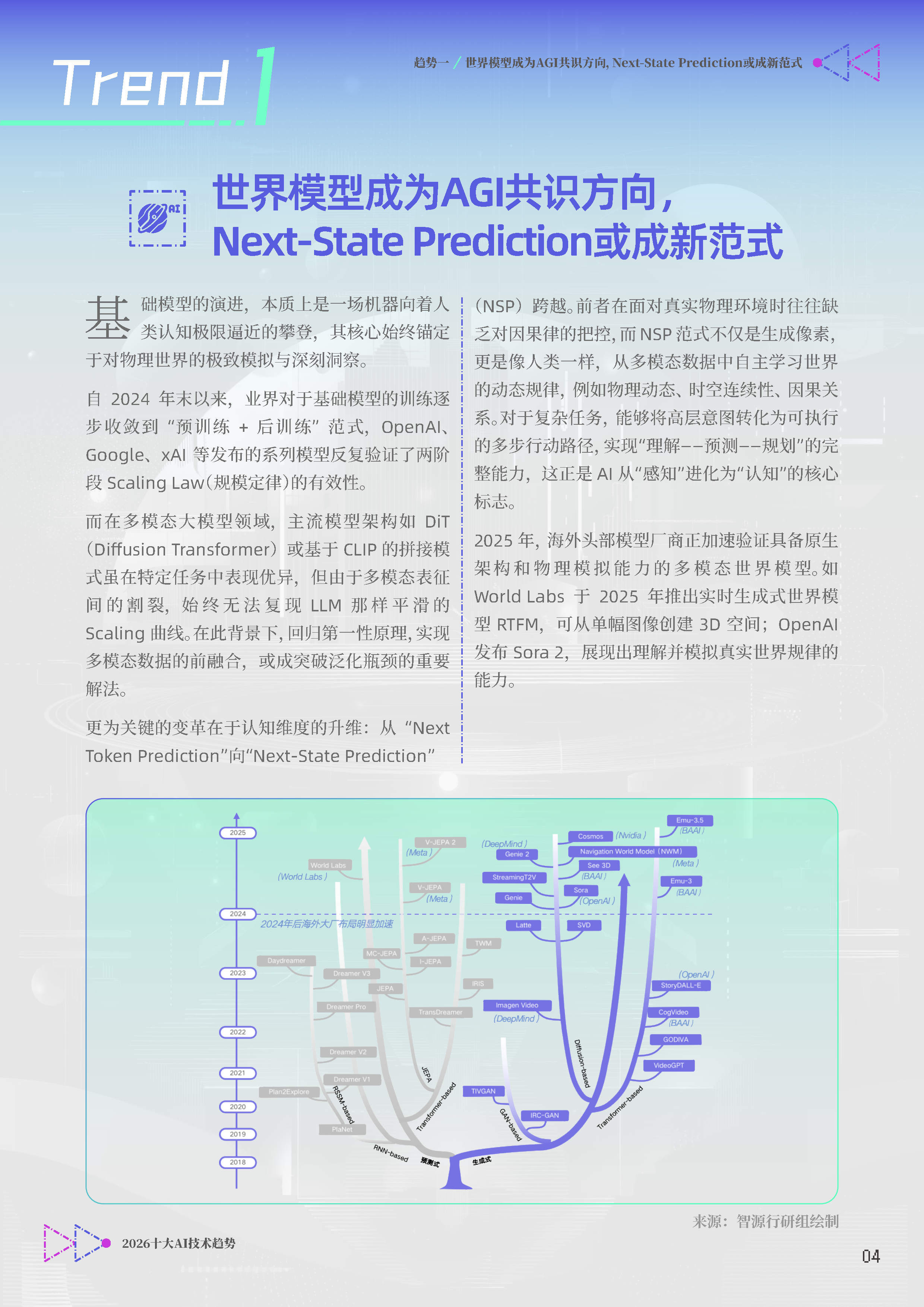
Core Insights - The article discusses the evolution of artificial intelligence (AI) from a rapid initial phase to a more mature stage characterized by cognitive enhancement, collaborative clusters, and deep industry integration, outlining ten core trends that shape the new blueprint of the intelligent era [1]. Group 1: AI Model Evolution - The evolution of foundational models is described as machines approaching human cognitive limits, with the "pre-training + post-training" paradigm validated by the industry since late 2024 [1]. - Breakthroughs in the multimodal field hinge on the transition from "Next Token Prediction" to "Next-State Prediction (NSP)," enabling AI to learn physical dynamics, temporal continuity, and causal relationships like humans [1]. Group 2: Industry Trends and Developments - By 2025, the industry is expected to enter a "clearing" phase, with over 230 embodied intelligence companies in China, including more than 100 humanoid robot firms, facing significant technical challenges and funding requirements [2]. - The commercial focus has shifted from laboratory validation to mass production, with humanoid robot sales surpassing 10,000 units and large-scale orders becoming common [2]. Group 3: Multi-Agent Systems (MAS) - AI applications are evolving from single-agent systems (SAS) to multi-agent systems (MAS), with SAS applications currently accounting for 63% in areas like customer service and code generation [3]. - A report indicates that 57% of organizations have deployed agents to handle multi-stage workflows, with this figure projected to rise to 81% by 2026 [3]. Group 4: Communication Protocols and AI for Science - The core breakthrough in MAS is the unification of communication protocols, with MCP and A2A protocols being integrated into the Linux Foundation, supporting complex applications [4]. - AI for Science (AI4S) has evolved from a supportive tool to an AI Scientist capable of executing a complete research workflow, marking a significant shift in scientific research methodologies [4]. Group 5: Global Competition and Infrastructure - The international competition is intensifying, with the U.S. launching the "Genesis Project" in November 2025 to accelerate the large-scale implementation of AI4S [5]. - China exhibits strengths in application but lacks in foundational infrastructure such as computing power, data, and models, with the national data center holding 4.6PB of data as of 2025 [5]. Group 6: Consumer AI and Vertical Markets - Consumer AI competition is focusing on "Super Apps," which integrate various functionalities into a single platform, with apps like ChatGPT and Gemini achieving over 100 million daily active users [5]. - Vertical markets show significant potential, with multimodal models demonstrating high value despite low usage frequency, as seen in the success of health management apps like Ant Financial's Aifeng [6]. Group 7: Challenges and Future Outlook - Many ToB AI applications remain in the proof of concept (PoC) stage, with 95% of GenAI pilot projects failing to produce measurable impacts due to data quality and integration challenges [6]. - The second half of 2026 is anticipated to be a critical period for the MVP rollout of ToB applications, with a clear implementation path for data governance and API connections [7]. Group 8: Synthetic Data and Cost Reduction - Synthetic data is emerging as a crucial resource for the AI 2.0 era, addressing the shortage of real data, with companies like NVIDIA optimizing 3D detection using synthetic datasets [8]. - The cost of inference has significantly decreased, with the cost per million tokens dropping from $20 to $0.07 between November 2022 and October 2024, reflecting a 280-fold reduction in 18 months [8].
2026展望:资本加速AI应用落地,科技巨头不再“炫技”
3 6 Ke· 2026-01-04 05:13
Core Insights - The AI industry is experiencing rapid evolution in 2025, driven by technological breakthroughs, application deployment, and capital influx, shifting the competitive focus from parameter scale to the ability of companies like Alibaba, Ant Group, ByteDance, Tencent, and Baidu to implement AI in real-life scenarios [1][2][3] - The emergence of significant applications and humanoid robots marks a pivotal year for AI, transitioning from experimental phases to widespread industrial applications [2][3] - The competition has evolved from a focus on computational power to value creation capabilities, particularly in high-demand sectors like finance and healthcare [4] Industry Trends - AI applications are expanding across various sectors, with notable advancements in language models, video generation, and humanoid robots, indicating a shift towards comprehensive scene penetration [2][3] - Companies are increasingly collaborating to enhance their AI capabilities, with open-source and ecosystem building becoming essential strategies for leading firms [1][4][9] Capital Market Dynamics - The AI sector is witnessing a surge in IPOs, with approximately 215 new companies listed by the end of 2025, and those with AI business increasing from 21 to 51, a growth of 143% [6][7] - Major companies are investing heavily in AI infrastructure, with Alibaba planning to invest 380 billion yuan and ByteDance considering 160 billion yuan for AI development [7][8] Challenges and Opportunities - Despite the influx of capital, the AI industry faces challenges in achieving reliable, compliant, and profitable applications, with issues related to computational power, ecosystem maturity, and model capabilities [8][9] - Companies are exploring differentiated ecological strategies to overcome these challenges, focusing on integrating AI into existing services and creating a seamless user experience [9][10] Future Outlook - The evolution of AI is expected to deepen in 2026, with a focus on ecosystem collaboration and the integration of generative capabilities across various sectors [10][11] - The AI industry is anticipated to transition towards a model where large models become the next generation of operating systems, with open ecosystems driving industry collaboration [10]


AI决战春晚!张一鸣拿下2026独家合作,字节撬动万亿AI生态入口
Sou Hu Cai Jing· 2025-12-26 19:13
Core Insights - ByteDance's Volcano Engine has secured exclusive AI cloud partnership for the 2026 Spring Festival Gala, marking a strategic shift from traffic competition to AI ecosystem development [1][8] - The competition landscape has evolved through three key phases: traffic acquisition (2015-2020), short video rise (2021), and now the AI ecosystem battle (2025-2026) [3][8] Group 1: Evolution of Spring Festival Gala Competition - The traffic acquisition era saw WeChat and Alipay dominate with massive user engagement through cash incentives [3] - The rise of short videos in 2021 was marked by Douyin's significant interaction and ecosystem closure through payment services [3] - The upcoming AI ecosystem battle is characterized by technological integration and user experience enhancement, with AI becoming a core component [3][8] Group 2: ByteDance's AI Strategy - ByteDance's collaboration showcases a dual-core AI strategy: Volcano Engine as the technical backbone and Doubao as the user interface, creating a comprehensive "technology-product-ecosystem" chain [4][6] - Volcano Engine will utilize AI cloud-native infrastructure and advanced computational capabilities to handle the Spring Gala's high concurrency demands, demonstrating its technical strength [6] - Doubao, with over 100 million daily active users and 170 million monthly active users, aims to solidify its position as a national AI assistant during the Spring Gala [6][8] Group 3: Industry Implications - The partnership signals a shift in AI competition from model comparison to a full-stack ecosystem battle, emphasizing the importance of integrated cloud services, applications, and hardware [8] - The 2026 Spring Gala is anticipated to be a pivotal moment for AI smartphones, with predictions of 147 million units shipped in China, potentially influencing industry trends [8] - The collaboration represents a broader transformation in the Chinese tech industry, moving from a traffic-driven model to one focused on technological empowerment [9]

“千问”AI梗图引阿里、腾讯下场 岁末流量大战一触即发
Nan Fang Du Shi Bao· 2025-12-20 00:02
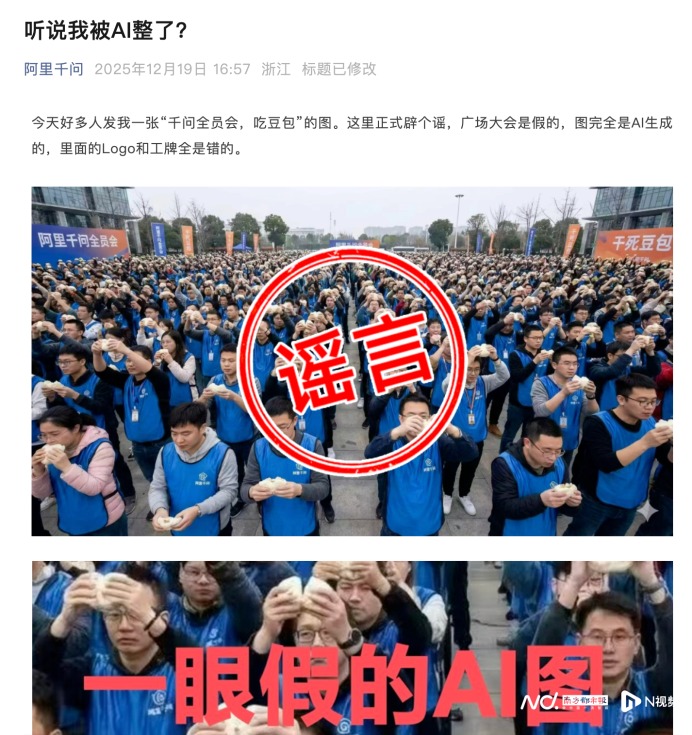
Core Viewpoint - The article discusses a recent incident involving AI-generated images that sparked a "traffic war" between major Chinese tech companies Alibaba and Tencent, highlighting their competitive strategies in the AI sector [1][4][10]. Group 1: Incident Overview - A viral AI-generated image led to speculation about a meeting involving Alibaba's "Qianwen" app and ByteDance's "Doubao" app, prompting both companies to engage in a public exchange [1][4]. - Alibaba's Qianwen app officially denied the authenticity of the image, stating it was AI-generated and encouraged users to explore its features [5][7]. - Tencent's "Yuanbao" app also joined the conversation, humorously responding to inquiries about the image and promoting its own AI capabilities [10]. Group 2: Competitive Landscape - Alibaba is intensifying its focus on consumer-facing applications, with its AI health product "Ant Aifu" achieving over 15 million monthly active users within six months [8]. - The launch of Alibaba's Qianwen app aims to integrate AI capabilities across various services, enhancing user experience and operational efficiency [8]. - ByteDance's "Doubao" model has seen significant growth, with daily token usage surpassing 50 trillion, indicating a robust demand for its AI services [9]. Group 3: Market Dynamics - The competition between Alibaba and ByteDance is characterized by a strategy where C-end applications drive B-end growth, with both companies aiming to expand the overall market rather than engage in zero-sum competition [9]. - Tencent has recently upgraded its AI model development structure to enhance its capabilities, indicating a strategic shift to strengthen its position in the AI landscape [14]. - The upcoming Spring Festival is expected to trigger a new round of competition among Alibaba, Tencent, and ByteDance, as they vie for user engagement and market share [14][15].
腾讯AI战略再提速 ,姚顺雨领衔大语言模型研发
2 1 Shi Ji Jing Ji Bao Dao· 2025-12-17 12:27
Core Viewpoint - Tencent has made significant adjustments to its AI model organization structure, focusing on enhancing foundational research and engineering capabilities in the AI era [1][2]. Group 1: Organizational Changes - Tencent has established new departments: AI Infra, AI Data, and Data Computing Platform, to strengthen its AI model research and engineering capabilities [1]. - Yao Shunyu has been appointed as the Chief AI Scientist, overseeing both the AI Infra department and the large language model department, reporting to the company's president [1][2]. - The restructuring emphasizes the integration of data capabilities, with the new AI Data and Data Computing Platform departments prioritizing data cleaning, evaluation systems, and big data platform integration [1]. Group 2: Strategic Focus - The recent adjustments mark a shift from algorithm development to a stronger emphasis on computing power and data, reinforcing Tencent's engineering advantages while enhancing AI model research capabilities [2]. - Tencent aims to improve the efficiency of AI model development and align with its broader AI strategic layout [2]. Group 3: Market Position and Competition - Tencent's mixed Yuan model has been implemented in over 900 internal business scenarios, including Tencent Meeting and WeChat [3]. - Over 90% of Tencent engineers are utilizing the internal code assistant CodeBuddy, with an AI code adoption rate of 50% [3]. - Tencent is actively upgrading its mixed Yuan model and expanding its top-tier R&D talent, while also integrating AI capabilities into major platforms like WeChat and QQ to increase user engagement [3]. - Competitors like Alibaba and ByteDance are also intensifying their investments in AI infrastructure and user engagement strategies, indicating a competitive landscape in the AI sector [3].
努比亚CEO谈豆包手机助手:发展势不可逆/华为成立基础大模型部/英伟达H200芯片获批对华出口,中外方回应
Sou Hu Cai Jing· 2025-12-10 03:13
Group 1: AI and Mobile Technology - Nubia CEO Ni Fei emphasized that the development of AI smartphones is an irreversible trend, with a focus on open collaboration to enhance user experience [12][13][14] - The first foldable iPhone is projected to have a production target of approximately 10 million units, exceeding initial industry expectations by about 30% [3] - The foldable iPhone is expected to drive a significant increase in global foldable smartphone shipments, with IDC forecasting a 30% growth in the market by 2026 due to Apple's entry [4] Group 2: Xiaomi's Organizational Changes - Xiaomi has initiated a series of personnel adjustments in its China operations, with Wang Xiaoyan taking charge of performance [5][7] - The company is experiencing a slowdown in orders across its mobile, automotive, and home appliance sectors, prompting a shift in retail strategy towards optimizing existing stores rather than expanding [8][10] - Xiaomi anticipates a one-time loss of approximately 27.26 million yuan to assist partners in reducing their annual losses by over 72.46 million yuan [9] Group 3: AI Developments and Strategic Moves - Huawei has established a new department focused on foundational large models, marking a significant upgrade in its AI strategy [24][26] - Alibaba has formed a new C-end business group, aiming to develop its "Qianwen" app into a super app that serves as a gateway to AI [35] Group 4: Market Reactions and Future Projections - Nvidia's H200 chip has been approved for export to China, with the U.S. government set to take a 25% cut from sales, highlighting the competitive landscape in AI technology [20][21][22] - The anticipated price of the foldable iPhone is expected to start at $2400, capturing over 22% of the foldable smartphone market share in its first year [3]