黄金股票

Search documents
Top 6 Ways to Invest in Gold
Yahoo Finance· 2026-03-27 15:24
Core Insights - The price of gold reached $5,000 per ounce in March 2026, leading to increased interest in gold as a long-term investment, with 23% of Americans considering it the best option according to a 2025 Gallup poll, an increase of five percentage points from the previous year [1][2]. Investment Options - There are various ways to invest in gold, including physical gold, gold ETFs, gold mutual funds, gold stocks, gold futures and options, and gold IRAs. The best option depends on the investor's financial goals and upfront investment [4][23]. Physical Gold - Minimum investment starts at $250, with low liquidity and fees including dealer premiums and storage costs. It is subject to collectibles tax rates [5]. - Pros include direct ownership and no reliance on brokerages, while cons involve added storage and insurance costs [6][7]. Gold ETFs - Minimum investment is $5, offering high liquidity with expense ratios as fees. Capital gains taxes apply [5]. - Pros include ease of buying and selling shares, while cons involve ETF fees and potential price variations from the gold spot price [10][14]. Gold Mutual Funds - Minimum investment is $1,000, with moderate liquidity and management fees. Capital gains taxes apply [5]. - Pros include easy diversification and incorporation into retirement accounts, while cons involve higher fees and less liquidity compared to ETFs [15]. Gold Stocks - Minimum investment is $5, with high liquidity and brokerage fees. Capital gains taxes apply [5]. - Pros include potential for higher returns, while cons involve higher risk and less liquidity compared to ETFs [16]. Gold Futures and Options - Minimum investment varies, often starting at $1,000, with high liquidity and complex tax rules. These are best suited for experienced investors [5][17]. - Pros include the ability to speculate on future prices, while cons involve high risk and the potential for significant losses [19][20]. Gold IRAs - Minimum investment is $5,000, with low liquidity and custodian/storage fees. These accounts are tax-advantaged but subject to strict IRS rules [5][21][26]. - Pros include tax-deductible contributions and potential for higher returns, while cons involve high custodian fees and less liquidity compared to other investment types [22][26]. Market Trends - Between December 31, 2015, and December 31, 2025, gold's price increased by 308%, from $1,062.25 to $4,339.64 [8]. - As of March 22, 2026, gold was approximately $4,500 per ounce, indicating that a $1,000 investment would buy about 0.22 ounces of gold [24]. - Historical data shows that a $10,000 investment in gold in 2006 would be worth approximately $74,570 by March 2026, reflecting the asset's strong performance over the years [25].
6 ways to invest in gold from simple buys to more complex bets
Yahoo Finance· 2026-03-27 15:24
Core Insights - The price of gold reached $5,000 per ounce in March 2026, leading to increased interest in gold as a long-term investment, with 23% of Americans considering it the best option according to a 2025 Gallup poll, an increase of five percentage points from the previous year [1][2]. Investment Options - There are multiple ways to invest in gold, including physical gold, gold ETFs, gold mutual funds, gold stocks, gold futures and options, and gold IRAs, with the best choice depending on individual financial goals and upfront investment [4][23]. Physical Gold - Minimum investment starts at $250, with low liquidity and fees including dealer premiums and storage costs, taxed at the collectibles tax rate [5]. - It is favored by long-term investors seeking a tangible asset and a hedge against inflation, but it incurs added storage and insurance costs [6][7]. Gold ETFs - Minimum investment is $5, offering high liquidity with expense ratios as fees and capital gains taxes applicable [5]. - ETFs are suitable for hands-off investors, allowing for easy buying and selling of shares, including fractional shares [10][14]. Gold Mutual Funds - Minimum investment is $1,000, with moderate liquidity and management fees, also subject to capital gains taxes [5]. - These funds provide diversification by investing in a range of gold-related companies and can be included in retirement accounts [15]. Gold Stocks - Minimum investment is $5, with high liquidity but higher risk due to reliance on individual company performance [5][16]. - Stocks are suitable for investors comfortable with higher risk levels, as they can invest in companies within the gold industry [16]. Gold Futures and Options - Investment amounts vary, often starting at $1,000, with high liquidity but complex tax rules and contract fees [5][18]. - These are best for experienced investors who can manage high risk and leverage investments [19]. Gold IRAs - Minimum investment is $5,000, with low liquidity and fees for custodians and storage, benefiting from tax-advantaged retirement account features [5][21]. - Gold IRAs allow for investment in physical gold while adhering to traditional IRA rules, but they require active management and incur higher costs [22][26]. Historical Performance - Between December 31, 2015, and December 31, 2025, gold's price increased from $1,062.25 to $4,339.64, representing a 308% rise [8]. Future Outlook - Analysts expect gold prices to remain strong in 2026 due to economic uncertainty, geopolitical tensions, and increased retail demand, despite potential fluctuations [25].
金价从涨到跌仅1天!2月7日每克新价抄底者动了?
Sou Hu Cai Jing· 2026-02-07 17:24
Group 1 - The market for gold has experienced extreme volatility, with prices recently peaking at $5,600 per ounce before a dramatic drop of over 9% in a single day, reflecting divided market sentiment [1][3] - The forces driving gold prices upward remain intact, overshadowed temporarily by profit-taking waves, with central bank gold purchases and the ongoing de-dollarization process supporting long-term value [3][5] - Current market dynamics involve a struggle between speculative fund withdrawals and long-term capital positioning, with domestic gold-themed ETFs seeing a reduction of approximately 42.7 billion yuan, although net redemptions were relatively moderate [3][4] Group 2 - The silver market has shown even more volatility, the most significant since 1980, with its industrial and speculative attributes making it more sensitive to monetary policy and market sentiment changes [4] - Investors are advised to adopt a cautious approach to silver investments, waiting for speculative sentiment to fully release before making decisions based on fundamentals [4] - For asset allocation, it is generally recommended that gold constitutes 5-10% of total household assets, which can be increased to 15% in uncertain market conditions to serve as a hedge against inflation [4] Group 3 - Future gold price movements will depend on multiple factors, with UBS providing scenario-based forecasts of $7,200 per ounce in a bullish scenario and $4,600 per ounce in a bearish scenario, reflecting current market uncertainty [5] - The essence of the gold market is a confidence game, where gold's appeal as a hard currency increases when fiat currency credibility wanes, positioning gold as a strategic asset against currency devaluation risks [5] - The market's volatility presents opportunities for prepared investors, with each pullback potentially serving as a long-term investment window, emphasizing the importance of patience and discipline over chasing short-term price differences [5]


2026年黄金长期看涨逻辑解析——多机构视角下的投资价值与决策指南
Sou Hu Cai Jing· 2026-02-05 13:26
Core Insights - The article emphasizes that the long-term bullish outlook for gold in 2026 is supported by multiple converging factors rather than a single driver, including continued global liquidity easing, geopolitical risks, central bank gold purchases, and supply-demand imbalances [2][5]. Group 1: Long-term Bullish Outlook for Gold - The core basis for the bullish outlook on gold in 2026 is identified as a combination of four main dimensions: ongoing global liquidity easing, rising geopolitical risks, normalization of central bank gold purchases, and increasing supply-demand structural imbalances [2]. - Multiple institutions agree that the monetary, safe-haven, and commodity attributes of gold will simultaneously support its long-term price increase [2]. Group 2: Factors Influencing Gold Prices - Gold prices are primarily driven by five key factors, all of which are expected to favor upward price movements in 2026: monetary policy easing, a weakening dollar, geopolitical tensions, supply-demand dynamics, and market sentiment [3]. - The Federal Reserve is projected to lower interest rates by 50-75 basis points in 2026, which will reduce the opportunity cost of holding gold [3]. - The U.S. national debt is expected to exceed $38 trillion, contributing to a weakened dollar and accelerating the "de-dollarization" process, which is beneficial for gold [3]. Group 3: Institutional Perspectives - Domestic and international institutions have differing price forecasts for gold in 2026, with estimates ranging from $5,400 to $8,500 per ounce, reflecting variations in their core supporting logic [5]. - Citic Securities predicts gold could reach $6,000 per ounce, while UBS has raised its quarterly target to $6,200, emphasizing stronger-than-expected investment demand [5]. Group 4: Investment Strategies and Risk Management - Ordinary investors are advised to focus on consensus-driven logic, such as the Fed's rate cuts and the weakening dollar, while being aware of differing institutional views on price movements [7]. - Investors should maintain a balanced approach, with gold assets recommended to constitute 5-15% of total household assets to mitigate risks associated with price volatility [15]. Group 5: Practical Investment Channels - Mainstream investment channels for gold include gold ETFs, bank gold bars, paper gold, and gold stocks, each with distinct advantages and disadvantages [12][13]. - Gold ETFs are recommended for beginners due to their low cost and strong liquidity, while gold stocks offer potential dual returns but come with higher risks [12][13].
中国投资者去年买走全球近十分之一黄金
36氪· 2026-01-30 13:35
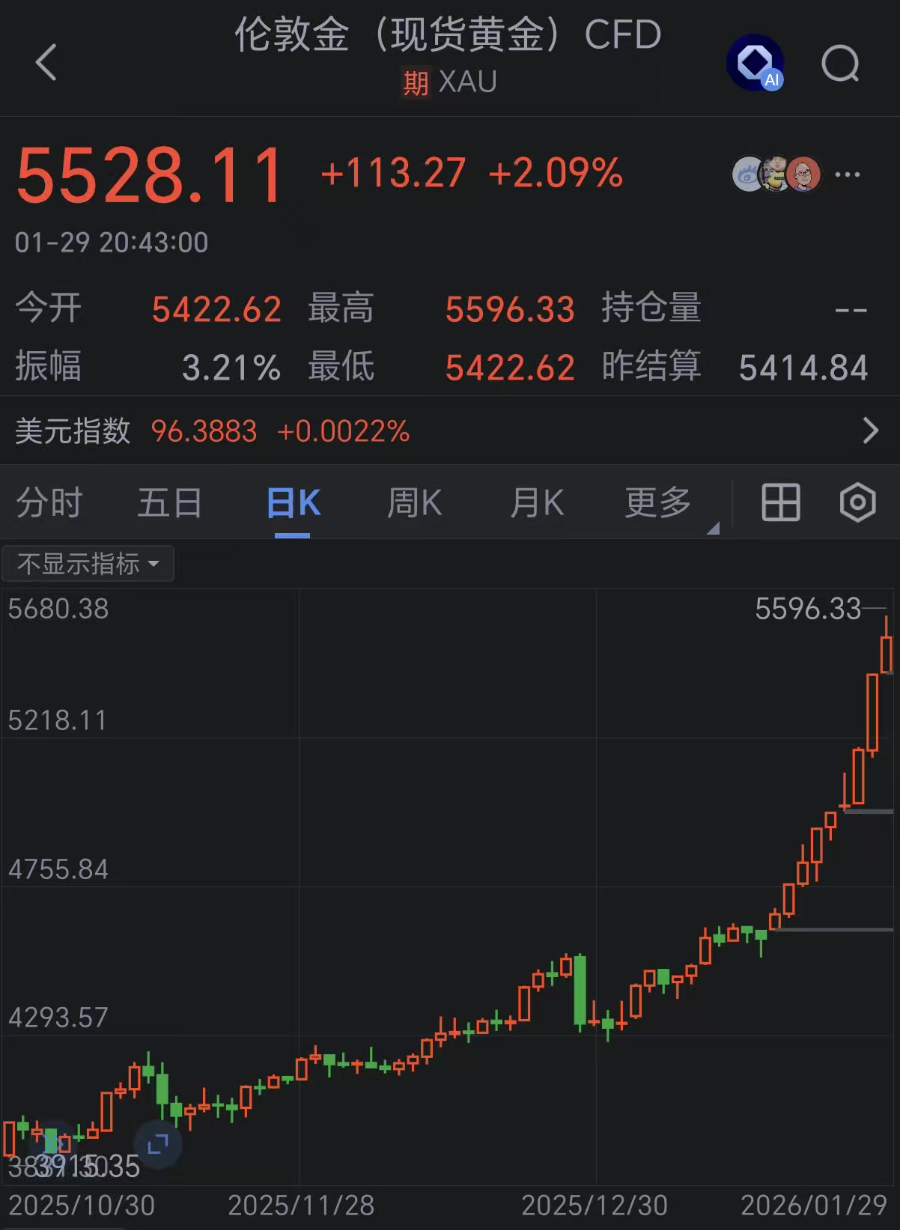
Core Viewpoint - The article discusses the recent surge in gold prices, which have reached historical highs, and highlights the diverging sentiments among investors regarding gold as an investment asset [4][5]. Investor Sentiment - As of January 29, the spot gold price surpassed $5,500 per ounce, breaking multiple resistance levels within a short period. This rapid increase has led to mixed feelings among investors, with some expressing hesitation about entering the market despite the rising prices [5]. - Professional investors also show differing opinions, exemplified by well-known fund manager Li Bei, who recently liquidated her entire gold position, citing high opportunity costs and the potential for a bull market in cyclical blue-chip stocks in China [5][6]. Market Analysis - Bank of America has raised its short-term gold price target to $6,000 per ounce, predicting a potential price increase based on historical trends of gold bull markets [6]. - The World Gold Council's CEO for China, Wang Lixin, emphasized the diversity of investor perspectives and the importance of understanding gold's role in an investment portfolio, particularly its attributes as an inflation hedge and risk diversifier [6][7]. Global Gold Demand - The World Gold Council's report projects global gold demand to reach 5,002 tons in 2025, driven primarily by investment demand, which is expected to hit 2,175 tons [9]. - Geopolitical risks, a weakening dollar, and high stock valuations are identified as key factors supporting gold investment demand [9]. Gold ETF and Physical Gold Investment - Global gold ETF holdings increased significantly, with a net addition of 801 tons in 2025, and China's gold ETF holdings doubled, reaching a historic high [9][11]. - China's physical gold investment also saw a notable increase, with 432 tons of gold bars and coins purchased in 2025, marking a 28% rise from the previous year [12]. Investment Strategies - The article advises investors to choose reliable channels for gold investment, such as through licensed financial institutions or the Shanghai Gold Exchange, to mitigate risks associated with unregulated platforms [14]. - Various investment methods are discussed, including physical gold, gold stocks, and gold ETFs, with recommendations for ordinary investors to avoid leveraged investments and consider a gradual approach to gold allocation [15][16].
432吨!中国投资者去年买走全球近十分之一黄金
2 1 Shi Ji Jing Ji Bao Dao· 2026-01-29 23:08
Group 1 - The core viewpoint of the articles highlights the recent surge in gold prices, with spot gold prices surpassing $5,500 per ounce, leading to a divided sentiment among investors regarding the future of gold investments [1][2] - Professional investors exhibit differing opinions, with notable figures like Li Bei liquidating all gold positions due to high opportunity costs, suggesting a potential bull market for cyclical blue-chip stocks in China [1][2] - The World Gold Council's report indicates that global gold demand is projected to reach a record high of 5,002 tons in 2025, driven primarily by investment demand, which is expected to hit 2,175 tons [5][6] Group 2 - The report emphasizes that geopolitical risks, a weakening dollar, and high stock valuations are key factors supporting gold investment demand, alongside expectations of interest rate cuts by the Federal Reserve [6][10] - In 2025, global gold ETF holdings saw a significant increase, with a net addition of 801 tons, and China's gold ETF holdings doubled, reaching a historic high [6][9] - The demand for physical gold in China also rose, with investors purchasing 432 tons of gold bars and coins in 2025, marking a 28% increase from the previous year [10][11] Group 3 - The report advises investors to engage in gold investments through reputable channels, such as the Shanghai Gold Exchange, to mitigate risks associated with unregulated platforms [11][12] - Various investment methods are discussed, including physical gold, gold stocks, and ETFs, with recommendations for ordinary investors to avoid leveraged investments and consider long-term strategies [12][13] - The outlook for gold investment remains positive, with expectations of continued demand driven by geopolitical uncertainties and potential regulatory changes in China [10][13]
中国投资者去年买走全球近十分之一黄金
2 1 Shi Ji Jing Ji Bao Dao· 2026-01-29 15:17
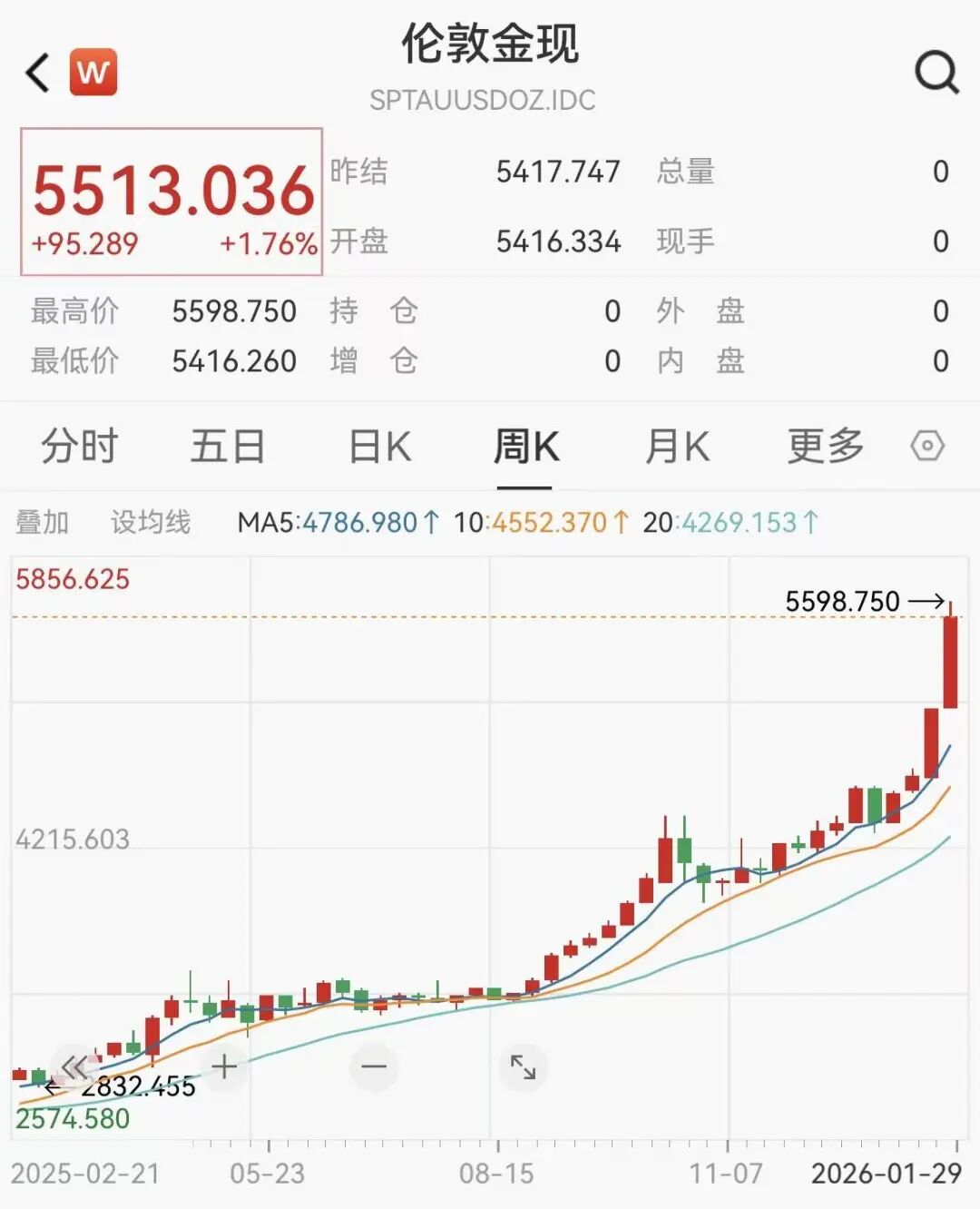
Core Viewpoint - International gold prices have surged again after two consecutive years of increase, with spot gold prices surpassing $5,500 per ounce for the first time on January 29, 2025, raising concerns about investor sentiment and market dynamics [1][3]. Price Movement - As of January 29, 2025, spot gold was quoted at $5,513 per ounce, having increased by $95.289 or 1.76% from the previous close [2]. - The highest price reached was $5,598.750, while the lowest was $5,416.260 during this period [2]. Investor Sentiment - There is a divergence in investor sentiment, with some expressing hesitation about entering the market despite the rising prices. For instance, one investor felt conflicted about buying gold after previously considering $4,000 per ounce too high [3]. - Professional investors also show differing opinions, with notable figures like Li Bei liquidating her gold positions due to high opportunity costs, suggesting a potential shift towards cyclical blue-chip stocks instead [4]. Market Analysis - Bank of America has raised its short-term gold price target to $6,000 per ounce, citing historical trends where gold prices have surged significantly during bull markets [4]. - The World Gold Council's report indicates that global gold demand is expected to reach a record high of 5,002 tons in 2025, driven by investment demand and geopolitical uncertainties [6]. Investment Demand - The report highlights that global investment demand for gold has reached a milestone of 2,175 tons, significantly contributing to the overall demand increase [6]. - Gold ETFs and physical gold are the two main segments of investment demand, with gold ETFs seeing a net increase of 801 tons globally [6]. Regional Insights - North American funds contributed significantly to the increase in gold ETF demand, with 446 tons added, while Asian gold ETFs saw a growth of 215 tons [7]. - China's gold ETF holdings doubled to 133 tons, with total assets under management increasing by 243%, marking a historic high [7][10]. Physical Gold Investment - In 2025, Chinese investors purchased 432 tons of gold bars and coins, a 28% increase from 2024, driven by geopolitical tensions and supportive policies from the People's Bank of China [11]. - The report anticipates that China's gold investment demand will remain robust in 2026, supported by ongoing geopolitical risks and potential regulatory changes [11]. Investment Strategies - Investors are advised to engage in gold investments through reputable channels, such as licensed financial institutions, to mitigate risks associated with unregulated platforms [12]. - Various investment methods are available, including physical gold, gold stocks, and ETFs, each with its advantages and disadvantages [13]. Future Outlook - The outlook for gold investment remains positive, with expectations of continued demand driven by geopolitical uncertainties and low-interest rates [11][14]. - Analysts suggest that investors should adopt a gradual investment approach, such as dollar-cost averaging, to manage risks associated with high price volatility [14].
个别机构看多黄金到6600美元,多方提示超买风险
Di Yi Cai Jing· 2026-01-26 23:20
Core Viewpoint - The surge in gold and silver prices is driven by a combination of factors including monetary credit reconstruction, escalating geopolitical risks, and liquidity expectations, with gold prices potentially reaching $6,000 per ounce by 2026 [1][3]. Group 1: Gold and Silver Price Movements - On January 26, London spot gold broke through the $5,000 and $5,100 per ounce thresholds, reaching a historical high of $5,111 per ounce, while silver also hit a new record, surpassing $110 per ounce before settling at $108 [1]. - In the domestic futures market, the main contract for gold rose by 3.67%, reaching a new high of 1,151 yuan per gram, while silver surged nearly 13%, peaking at 28,226 yuan per kilogram [1]. Group 2: Institutional and Investor Sentiment - Various institutions maintain bullish outlooks on gold, with UBS setting a target price of $5,000 per ounce, while Goldman Sachs raised its year-end target from $4,900 to $5,400, citing increased demand from private investors and central banks [3]. - Bank of America has set a target of $6,000 per ounce for gold, predicting a significant price increase based on historical trends [3]. Group 3: Investment Trends and Demand - There is a notable increase in investor interest in gold, with many seeking to diversify their portfolios through various investment vehicles such as gold ETFs and stocks [5]. - The largest gold ETF in China surpassed 100 billion yuan in assets for the first time, reflecting a significant inflow of capital into gold investments [6]. Group 4: Central Bank Activities - Central banks globally continue to increase their gold reserves, with China's central bank reporting a rise in gold holdings, and emerging market central banks actively converting foreign reserves into gold [7]. - The World Gold Council reported that global official gold reserves reached approximately $3.69 trillion, with central banks purchasing gold at a rate significantly higher than in previous years [7]. Group 5: Market Risks and Regulatory Actions - Regulatory bodies have begun to implement measures to cool down the overheated gold market, including adjusting trading limits and increasing risk assessment requirements for gold investment products [8]. - Analysts caution that the current market is driven by emotional factors, and while the long-term outlook for gold remains positive, short-term corrections may be necessary due to overbought conditions [9].
刹不住!金银迎“史诗级”大涨
Guo Ji Jin Rong Bao· 2026-01-26 14:10
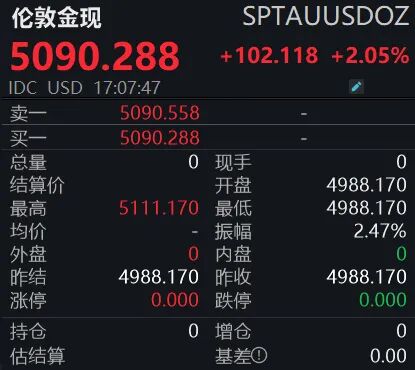
Core Viewpoint - The prices of gold and silver have surged to historic highs, with spot gold breaking the $5000 per ounce mark, driven by factors such as weakened dollar credibility, strong central bank demand for gold, and geopolitical premiums [1][11]. Market Performance - As of the report, spot gold rose by 2.05% to $5090.288 per ounce, reaching a peak of $5111.17, while spot silver surged by 6.06% to $109.6 per ounce, surpassing the $110 mark [3][5]. - In the futures market, COMEX gold futures increased by 2.02% to $5080.4 per ounce, with a peak of $5107.9, and COMEX silver futures rose by 7.54% to $108.97 per ounce, hitting a high of $110.065 [6][7]. Influencing Factors - The current gold price rally, which began in early 2025 at around $3000 per ounce, reflects significant changes in the macroeconomic environment [9]. - Short-term factors include ongoing geopolitical risks, such as tensions over Greenland's sovereignty and escalating US-Iran relations, which have heightened demand for safe-haven assets like gold [9]. - Mid-term factors involve the interplay between the Federal Reserve's policy path and its independence, with expectations of weakened monetary policy independence supporting gold prices [9][10]. - Long-term drivers include the structural weakening of the dollar credit system, with global central banks increasing gold reserves and a steady de-dollarization process [10]. Future Outlook - The long-term upward trend for gold remains intact, influenced by factors such as weakened dollar credibility, strong central bank demand, and geopolitical premiums [11]. - Analysts predict that gold prices could potentially reach $6000 per ounce by 2026, driven by ongoing geopolitical uncertainties and expectations of continued monetary easing [11]. - Investment strategies suggested include a diversified approach based on individual financial capacity and risk tolerance, with recommendations for different investment vehicles such as gold futures, ETFs, and physical gold [11].
黄金价格突破5100美元创历史新高,投资者如何配置黄金资产?
Sou Hu Cai Jing· 2026-01-26 09:14
Core Viewpoint - The recent surge in international spot gold prices, breaking through key levels of $5000 and $5100, reflects profound changes in the global economic landscape influenced by monetary policy adjustments, geopolitical conflicts, and the evolution of global reserve asset structures [1]. Group 1: Market Dynamics - Gold prices reached a peak of $5111.11 per ounce during Asian trading, indicating strong market momentum following a breakthrough of the $5000 mark [1][2]. - The increase in gold prices has sparked widespread discussions about the allocation of gold assets, with experts suggesting that the focus should be on "how" and "why" to invest rather than "whether" to invest [4]. Group 2: Influencing Factors - Geopolitical risks, particularly U.S. trade policy statements and military deployments in the Middle East, have heightened market risk aversion, driving funds towards traditional safe-haven assets like gold [4]. - Central banks globally are increasing their gold reserves, with China's gold reserves reaching 74.15 million ounces by the end of December 2025, reflecting a strategic adjustment in the international monetary system [4]. Group 3: Monetary Policy Impact - Expectations of continued interest rate cuts by the Federal Reserve are lowering the opportunity cost of holding gold, enhancing its appeal as a non-yielding asset [5]. - Goldman Sachs has raised its gold price forecast for the end of 2026 to $5400, citing sustained demand from private investors and central banks [5]. Group 4: Investment Strategies - Investors are advised to base their decisions on asset allocation principles rather than short-term price predictions, with a recommended allocation of 5% to 10% of their portfolio to gold [5]. - Suitable investment tools for gold allocation include gold ETFs for their liquidity and cost transparency, while physical gold bars are recommended for long-term holding despite storage costs [6]. Group 5: Risk Management - Investors should adopt a disciplined approach to buying gold, considering strategies like phased purchases or dollar-cost averaging to manage costs effectively [6]. - It is crucial to define the role of gold in an investment portfolio, primarily as a hedge against systemic risks rather than for short-term profit [6][7].