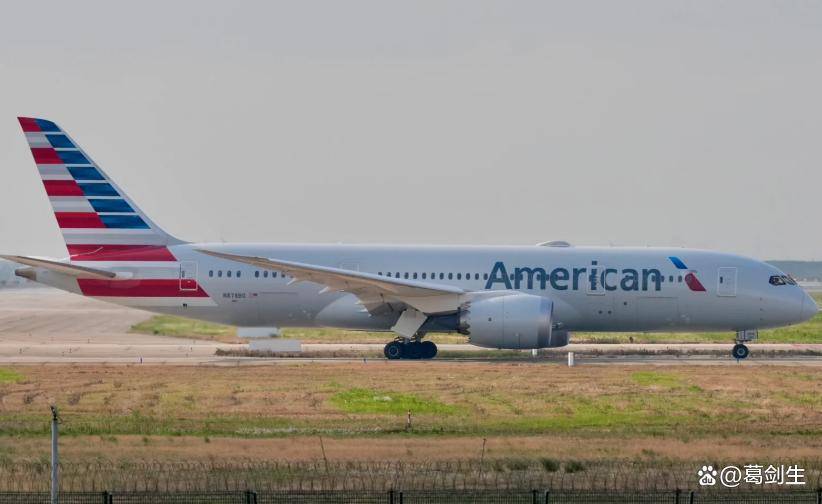
ARJ21

Search documents
第十届新加坡航展今日开幕 中国商用飞机将进行静态展示
Yang Shi Xin Wen· 2026-02-03 00:42
Group 1 - The 10th Singapore Airshow officially commenced on February 3, running until February 6 for industry professionals and open to the public on February 7-8 [1] - The Chinese Air Force's August 1st Aerobatic Team will perform multiple flight displays, showcasing their J-10C aircraft for the first time in Singapore [1] - A verification flight was conducted by the August 1st Aerobatic Team on February 1, alongside aircraft from Singapore, Australia, and Indonesia [1] Group 2 - Chinese commercial aircraft, including the C909 and C919, will be showcased in a static display at the Singapore Airshow [2] - The 2024 Singapore Airshow will feature the debut of two C919 aircraft and three ARJ21 aircraft, highlighting the progress of Chinese commercial aviation [2]
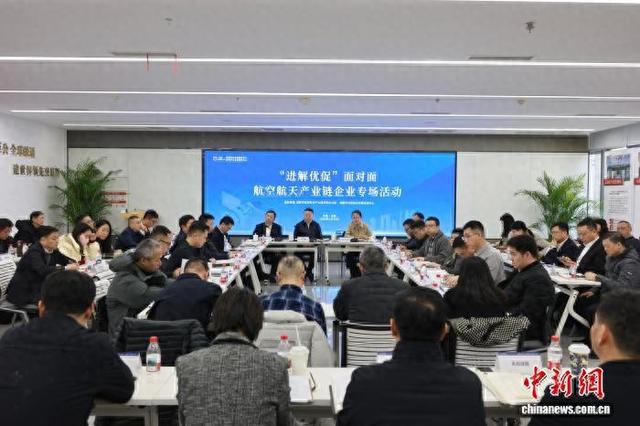
政企同心“面对面” 成都为航空航天产业注入新动能
Xin Lang Cai Jing· 2026-01-15 12:12
Core Viewpoint - The event "Jin Jie You Cu" focused on addressing the development challenges faced by the aerospace industry in Chengdu, facilitating direct communication between government departments and over 60 key enterprises in the sector [1] Group 1: Event Overview - The event collected over 30 enterprise demands, with 28 receiving immediate responses and guidance, while the remaining demands were recorded in a service ledger with assigned responsibilities and deadlines [2] - Chengdu's aerospace industry has established over 30 specialized parks and initiated a special fund exceeding 10 billion yuan to support the sector [6] Group 2: Industry Development - Chengdu has developed comprehensive capabilities in aircraft manufacturing, including autonomous research and development of complete aircraft, engines, and space vehicles, achieving over 90% self-controllable core technology [4] - The city aims to establish a globally influential aerospace technology innovation center and a national drone industry cluster by 2030, focusing on integrating large, medium, and small enterprises [6] Group 3: Talent and Market Expansion - Companies expressed a need for high-tech talent in areas such as aircraft design and composite materials, prompting the government to introduce talent attraction policies, including housing subsidies [2] - Chengdu plans to regularly host supply-demand matching events and has launched a public platform for industrial sales and demand matching, with several aerospace companies already participating [3]

“绿色航油”新巨头来了!详解中国石化、中国航油重组
Sou Hu Cai Jing· 2026-01-10 14:31
Core Viewpoint - The restructuring between Sinopec and China Aviation Oil represents a strategic integration aimed at creating a "super refinery" and supply system, enhancing collaboration across the entire supply chain rather than merely combining resources [1]. Group 1: Reasons for Restructuring - The aviation industry is experiencing a strong recovery, with global jet fuel demand projected to reach 389 million tons by 2025, reflecting a year-on-year growth of 3.9%. Domestic jet fuel demand is expected to exceed 40 million tons, indicating significant growth potential in this sector [2]. - Sinopec seeks more direct sales channels, while China Aviation Oil aims to secure more stable upstream resources and reduce intermediary costs through this restructuring [2]. Group 2: Strategic Significance of the Restructuring - Sinopec's sustainable aviation fuel (SAF) has been successfully tested on domestic large aircraft such as the C919 and ARJ21, with the potential to reduce carbon emissions by over 50% compared to traditional jet fuel. China Aviation Oil plays a leading role in the promotion and application of SAF, serving 585 global airline customers [3]. - This restructuring is expected to facilitate the transition of "green jet fuel" from demonstration flights to large-scale commercial use [3]. Group 3: Impact on Consumers and Investors - As the demand for overseas travel among Chinese citizens increases, a robust Chinese aviation fuel service provider can offer more reliable and unified refueling services for international flights, benefiting industry development [6]. - Jet fuel typically accounts for one-third of an airline's total costs. The restructuring is anticipated to eliminate intermediary costs, potentially lowering jet fuel prices and alleviating profit pressures on airlines, thereby enhancing route stability and service quality [6].

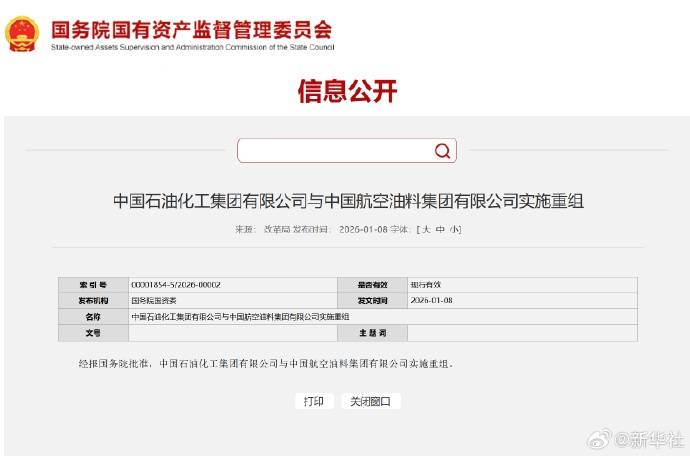
两大能源央企重组 专家看好协同效应
Shang Hai Zheng Quan Bao· 2026-01-08 15:22
Core Viewpoint - The merger between China Petroleum & Chemical Corporation (Sinopec) and China Aviation Oil Group aims to create a comprehensive aviation fuel supply system, enhancing energy security, international competitiveness, and green transformation capabilities while optimizing state-owned capital allocation [1][4]. Group 1: Company Overview - Sinopec is the world's largest refining company and China's largest aviation fuel producer, while China Aviation Oil Group is Asia's largest aviation fuel service provider [1][3]. - Sinopec is a major integrated energy and chemical group, being the largest supplier of refined oil and petrochemical products in China, with the second-largest number of gas stations globally [3]. - China Aviation Oil Group provides fuel supply services to 258 transport airports and 454 general airports in China, serving 585 global airline customers [3]. Group 2: Strategic Significance of the Merger - The merger is seen as a significant step in advancing strategic restructuring and professional integration among central enterprises, enhancing national aviation energy supply security and promoting green low-carbon transformation [4][5]. - The integration is expected to create synergies that will enhance the overall competitiveness of both companies [4]. Group 3: Sustainable Aviation Fuel (SAF) Development - SAF is recognized as a mainstream route for decarbonizing the aviation industry, with the International Air Transport Association (IATA) estimating that SAF will contribute 65% of carbon reductions needed for the aviation sector to achieve carbon neutrality by 2050 [7]. - Sinopec has developed its own bio-jet fuel technology and has established a production facility with an annual capacity of 100,000 tons, which can utilize waste cooking oil, significantly reducing carbon emissions [8][9]. - The merger is expected to enhance the research and development, industrialization capabilities, and international trade advantages in the SAF sector, promoting high-quality development of the industry chain [9].
航空2026年展望 - 步步为营,峰回路转
2025-12-29 01:04
Summary of Airline Industry Conference Call Industry Overview - The airline industry is expected to experience a supply-demand reversal in 2026, with ASK (Available Seat Kilometers) growth projected at approximately 2.7%, lower than RPK (Revenue Passenger Kilometers) growth of 5% due to aircraft capacity and engine issues leading to tight effective supply [1][2][3] - Boeing and Airbus are facing capacity bottlenecks, with delivery volumes below pre-pandemic levels and slow production increases, while COMAC's delivery volumes are insufficient to significantly fill the gap, exacerbating supply tightness [1][5][6] - A significant number of in-service aircraft are grounded due to issues with Pratt & Whitney engines, with maintenance cycles extending over two years, further intensifying the effective supply crunch [1][7][8] Demand and Capacity Insights - In 2025, aircraft utilization rates are expected to improve primarily due to rapid growth in international route capacity, but ASK growth is anticipated to slow to 2.7% in 2026, with an average growth rate below 3% over the next three years [1][10] - The demand for air travel in 2025 is projected to grow over 5% domestically, driven by strong private travel demand, while international demand is expected to maintain a high growth rate of around 20% [11] - The competitive landscape shows that high-speed rail is beginning to substitute for air travel, narrowing the growth gap between the two modes of transport, although air travel demand growth remains higher overall [12][13] Pricing and Revenue Projections - Despite a record high passenger load factor exceeding 85% in 2025, ticket prices are expected to decline by approximately 6% year-on-year, with a modest increase of 3-4% anticipated in 2026 [15][18] - The current valuation of airline stocks reflects historical average profit levels, but cyclical nature of the industry suggests that valuations should consider profit peaks, indicating potential for further upside in stock prices [4][21] Aircraft Manufacturing and Supply Chain Challenges - Boeing and Airbus are struggling with production capacity, with Boeing's monthly delivery targets significantly lower than pre-pandemic levels, and Airbus also facing delays in meeting its production goals [5] - COMAC's delivery numbers are insufficient to alleviate the production shortfall, with a notable decline in deliveries of its ARJ21 and C919 aircraft [6] - The global supply chain issues are severely impacting the production capabilities of major aircraft manufacturers, leading to a prolonged recovery period [5][8] Future Outlook and Investment Recommendations - The airline industry is expected to enter a moderate growth cycle over the next few years, contrasting with previous sharp cycles, due to reduced aircraft orders and slow production increases [19] - Investment recommendations focus on large airline stocks, particularly those listed in H-shares, which are currently undervalued compared to their A-share counterparts. Specific recommendations include Huaxia Airlines, with a projected profit of approximately 900 million yuan in 2026, indicating a potential upside of 30-40% [25]
日本专家:中国制造业被低估了!爆发持久韧性,印度根本不是对手
Sou Hu Cai Jing· 2025-12-18 17:13
Core Insights - China's manufacturing strength is underestimated globally, showcasing remarkable adaptability in the face of global supply chain adjustments [2][22] - India struggles to compete with China due to infrastructure issues and policy execution challenges, despite its large population [2][12] Manufacturing Sector - In 2024, China's manufacturing sector is projected to maintain a significant global share, with a robust export growth rate [2][12] - China's manufacturing PMI remains above the neutral line of 50, indicating a stable growth trajectory, while India's PMI is below 50, reflecting ongoing struggles [8][18] Supply Chain and Infrastructure - China's supply chain integrity is highlighted by its dominance in global events like the 2022 FIFA World Cup, where it provided a majority of the infrastructure and merchandise [4][12] - India's attempts to attract manufacturing investments are hampered by logistical inefficiencies and frequent policy changes, leading to a lack of competitiveness [14][16] Technological Advancements - China's advancements in the aviation sector, such as the C919 aircraft, demonstrate its ability to overcome technological barriers and achieve high domestic production rates [6][10] - In the electric vehicle sector, China is expected to export 5 million units in 2024, showcasing its leadership in core battery technologies [10][12] Economic Policies - China's manufacturing policies have created a solid foundation for sustained growth, while India's "Make in India" initiative has seen limited success due to bureaucratic hurdles [12][20] - Japan's analysis indicates that India's manufacturing sector is more suited for service exports rather than competing directly with China's established manufacturing base [20][22] Global Positioning - China's manufacturing resilience has been evident during global trade tensions, with a significant investment of $1.4 trillion in technology and industrial upgrades, contrasting with India's $700 billion foreign investment primarily in services [14][20] - The gap between China and India in manufacturing capabilities is widening, as China's integrated supply chain and competitive pricing continue to outperform India's efforts [18][22]
中航西飞20251216
2025-12-17 02:27
Summary of Conference Call for 中航西飞 Company Overview - 中航西飞 is a key player in the aviation industry, particularly in the field of large and medium-sized transport aircraft, with a focus on models such as 运 20, 运 8, and 运 9 [2][3] Key Points and Arguments Competitive Advantages - 运 20, a new large transport aircraft, has a maximum payload of 66 tons, positioning it between the US C17 (77 tons) and the Russian Il-76 (50 tons). The C17 has been out of production since 2015, and the Il-76 is aging, giving 运 20 a competitive edge [3] - Historical data shows that smaller countries have also purchased large transport aircraft, indicating a broader market potential for 运 20 beyond just large nations [3][5] Market Demand and Expansion - 运 20 can be modified for various roles, such as aerial refueling and early warning, which increases its demand and potential for scale effects. Current modifications include 运油 20 and 空警 3,000, with future developments possibly including maritime patrol and electronic warfare aircraft [5] - In the medium transport aircraft sector, 中航西飞 competes with the US C130, which has seen global deliveries of 2,700 units, with over 1,100 military trade orders. 中航西飞 has already secured military trade orders for 运 8 and 运 9 from countries like Myanmar and Namibia [6] Contributions to Civil Aviation - 中航西飞 is a significant supplier for domestic large commercial aircraft, including the C919, where it handles about 50% of the structural workload, and ARJ21, accounting for approximately 60% [7][8] - The 新舟 700 regional aircraft is designed to operate economically in the 6,000-8,000 meter range, providing a viable alternative to high-speed rail for connecting cities [8] Management Changes and Market Transparency - A significant management overhaul occurred in December 2023, with a new leadership team primarily composed of younger executives. This change is expected to enhance market transparency and improve the company's market value management [9] Industry Insights Commercial Aerospace Developments - SpaceX is preparing for an IPO in 2026, potentially valued at $800 billion, which could set a record for the largest IPO. Additionally, the successful launch of the Zhuque-3 rocket marks a significant technological breakthrough in commercial aerospace [10] - The domestic satellite constellation plan has exceeded 39,000 satellites, with a target to complete launches between 2030 and 2035. This includes various projects from state-owned and private companies [13] Cost Reduction in Satellite Launches - The introduction of reusable rockets is expected to significantly lower satellite launch costs, aided by the deployment of the Long March series rockets [14] Investment Strategies - The focus for the end of the 14th Five-Year Plan should be on upstream component changes, with recommendations for stocks in missile segments and satellite manufacturing. Key companies to watch include 航天电器 and 中国卫星 [16][17] Additional Noteworthy Content - The management's proactive communication and transparency are anticipated to positively influence investor confidence and company growth [9] - The potential for military AI and unmanned equipment in the defense sector is highlighted as an area of interest for future investments [17]

这家GE、罗罗的供货商,造出了“无人航空母机”
Xin Lang Cai Jing· 2025-12-11 14:24
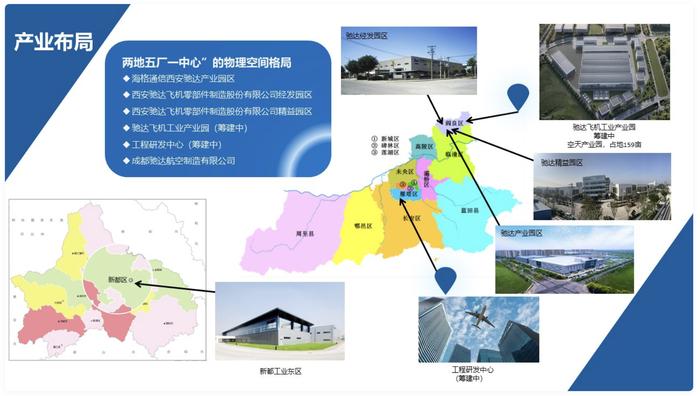
Group 1 - The "Jiutian" drone successfully completed its maiden flight on December 11, 2023, and is recognized as a new generation model that fills the market gap for heavy dual-use drones in China [1] - The drone has a length of 16.35 meters, a wingspan of 25 meters, a maximum takeoff weight of 16 tons, and a payload capacity of 6 tons, capable of carrying various types of munitions and has a unique "heterogeneous hive mission cabin" [1] - The drone is produced by Xi'an Chida, a subsidiary of Haige Communication, which has transitioned from a focus on military applications to include civil products [1][2] Group 2 - Xi'an Chida has established a complete industrial chain and has capabilities in the production of large drones and general aviation aircraft [3] - The company has developed a "two locations, five factories, and one center" industrial layout, including several established parks and a planned industrial park and engineering research center [3] - In 2024, Xi'an Chida is expected to hold a 16.1% market share in the core precision structural components for large civil aviation transport aircraft [5] Group 3 - Xi'an Chida's revenue reached 250 million yuan in the previous year, reflecting a year-on-year increase of 38.1%, with a total profit of 69.1025 million yuan, up 23.5% [5] - The company has undergone multiple changes in its shareholding structure and has faced a complex listing process, with Haige Communication becoming the controlling shareholder in 2017 [9][10] - Xi'an Chida was delisted from the New Third Board in 2019 to reduce operational costs and focus on enhancing competitive advantages [12]

露出獠牙,欧洲终于对C919下“逐客令”,外媒:不怕断供发动机?
Sou Hu Cai Jing· 2025-11-29 16:12
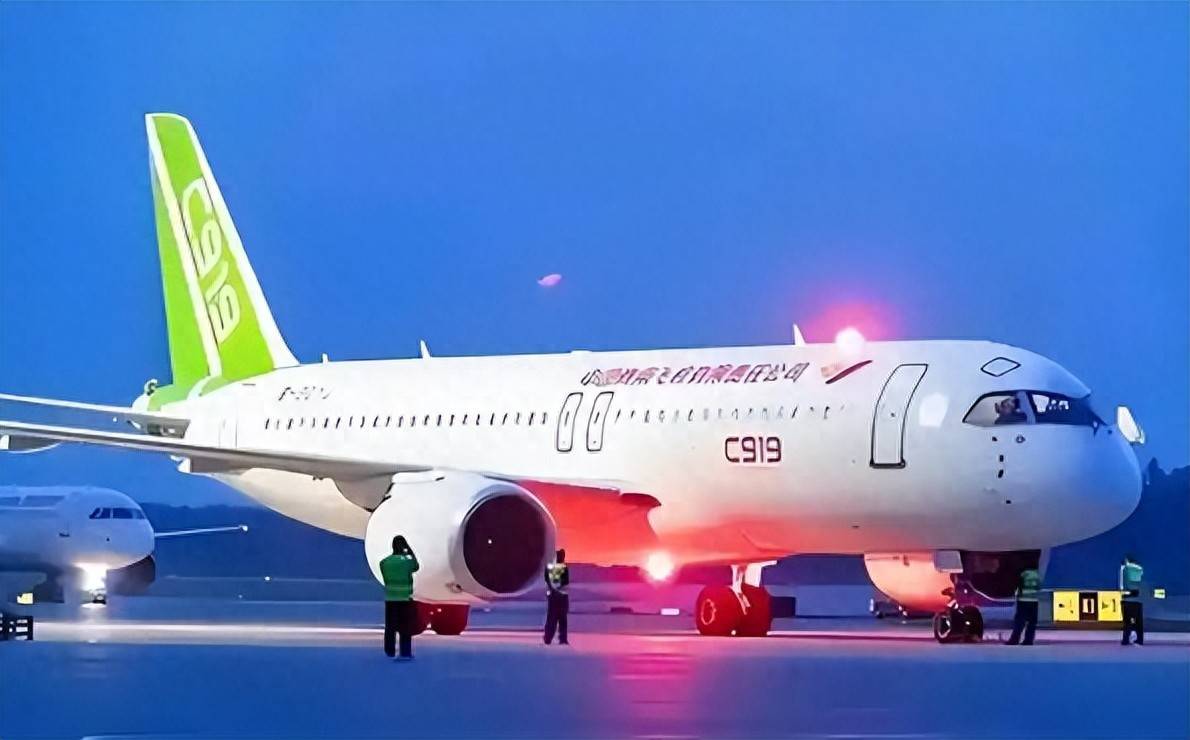
Core Viewpoint - The C919 aircraft, after a challenging development process, has received its airworthiness certificate from the Civil Aviation Administration of China (CAAC) and has begun commercial operations, indicating a significant advancement in China's aviation industry [1][10]. Group 1: Development and Certification - The C919 project started in 2008, with significant efforts leading to its airworthiness certification in September 2022 and commercial operation beginning in May 2023 [1]. - The majority of C919's components, approximately 80%, are sourced from European and American suppliers, highlighting international collaboration [1]. - The C919's engine, the LEAP-1C, provided by CFM, enhances the aircraft's performance with stable operation and low fuel consumption [1]. Group 2: Market Dynamics and Competition - The C919's entry into the market could disrupt the existing aviation landscape, especially as Boeing faces delays and Airbus has a backlog extending to 2030 [3]. - The European Union Aviation Safety Agency (EASA) has indicated that C919's certification could be delayed by three to six years due to the need for re-evaluation of design and component testing [4]. - There are allegations that the certification delays are a strategic move by Europe to protect Airbus's market share, reflecting a competitive tension in the aviation sector [5]. Group 3: Future Prospects and Challenges - C919's orders are primarily from domestic airlines, with major Chinese carriers expected to place over a thousand orders by 2025, primarily for domestic routes [1][10]. - The delay in European certification could hinder C919's international sales, as many countries rely on EASA's approval [6]. - Despite the challenges, C919 has shown strong performance in domestic operations, with high passenger load factors and positive feedback on comfort and noise levels [8][10]. Group 4: Technological Advancements - The CJ-1000A engine, a domestically developed alternative, is progressing well and is expected to complete certification by 2025, which could alleviate dependency on foreign suppliers [6][12]. - The successful operation of C919 and its acceptance in markets like Brunei and Indonesia demonstrate growing recognition of Chinese aviation standards [9][10]. - The C919 symbolizes China's rising aviation technology and its potential to secure a significant position in the global aviation market [14].
中国或许是全球最后一个进入民用航空工业俱乐部的国家
Sou Hu Cai Jing· 2025-11-21 02:49
Core Viewpoint - The Chinese commercial aviation industry, represented by COMAC, is making significant strides in the production of passenger jets, particularly with the C919 and ARJ21 models, despite being a late entrant in a market dominated by established players like Boeing and Airbus [2][4][22]. Group 1: Industry Overview - The global commercial jet market has high entry barriers, with only a few key players such as Boeing, Airbus, Embraer, and some Russian manufacturers [2]. - China has recently entered this market, with COMAC's C919 and ARJ21 models showing potential for growth and development [4][22]. Group 2: Product Development - The ARJ21 regional jet, which began development in 2002, has been crucial for COMAC, with over 100 units delivered and operational experience accumulated [6][10]. - The C919 project was initiated shortly after COMAC's establishment in 2008, with the first prototype flying in 2017 and commercial operations starting in 2023 [8][10]. Group 3: Market Demand and Orders - Major Chinese airlines have placed significant orders for C919 and ARJ21, with total orders exceeding 1,000 aircraft, indicating strong domestic demand [10][24]. - The domestic market is projected to require 9,323 aircraft, with 6,881 being single-aisle jets, providing a substantial opportunity for growth [22][24]. Group 4: Competitive Landscape - The article highlights the challenges faced by other countries in the aviation sector, such as Russia and Japan, which have struggled with production and certification issues [14][20]. - China's late entry into the market is contrasted with its rapid development and the establishment of a comprehensive supply chain involving thousands of domestic suppliers [10][22]. Group 5: Future Prospects - The Chinese aviation industry is expected to continue evolving, with potential advancements in supersonic and space travel, while also contributing significantly to the economy through various related sectors [24].