TCE

Search documents
医药生物行业跟踪周报:TCE或将下一个BD风口,建议关注泽璟制药-U、康诺亚、德琪医药等
Soochow Securities· 2026-03-29 14:24
TCE 或将下一个 BD 风口,建议关注泽璟制 药-U、康诺亚、德琪医药等 增持(维持) [Table_Tag] [Table_Summary] 投资要点 2026 年 03 月 29 日 证券研究报告·行业跟踪周报·医药生物 医药生物行业跟踪周报 证券分析师 朱国广 执业证书:S0600520070004 zhugg@dwzq.com.cn 行业走势 -8% -5% -2% 1% 4% 7% 10% 13% 16% 19% 22% 25% 2025/3/31 2025/7/29 2025/11/26 2026/3/26 医药生物 沪深300 相关研究 《BD 放量及再融资,创新药龙头现金 流充裕》 2026-03-22 《十五五"聚焦脑机接口、首款产品 获批,关注:微创脑科学、翔宇医疗、 爱朋医疗等》 2026-03-15 东吴证券研究所 1 / 30 请务必阅读正文之后的免责声明部分 ◼ 本周、年初至今 A 股医药指数涨跌幅分别为-1.26%、-1.38%,相对沪 深 300 的超额收益分别为 2.31%、1.37%;本周、年初至今恒生生物科 技指数涨跌幅分别为+4.03%、+2.52%,相对于恒生科技指 ...

医药生物行业跟踪周报:TCE或将下一个BD风口,建议关注泽璟制药-U、康诺亚、德琪医药等-20260329
Soochow Securities· 2026-03-29 13:04
证券研究报告·行业跟踪周报·医药生物 医药生物行业跟踪周报 TCE 或将下一个 BD 风口,建议关注泽璟制 药-U、康诺亚、德琪医药等 增持(维持) [Table_Tag] [Table_Summary] 投资要点 2026 年 03 月 29 日 证券分析师 朱国广 执业证书:S0600520070004 zhugg@dwzq.com.cn 行业走势 -8% -5% -2% 1% 4% 7% 10% 13% 16% 19% 22% 25% 2025/3/31 2025/7/29 2025/11/26 2026/3/26 医药生物 沪深300 相关研究 | 1. 本周及年初至今各医药股收益情况 | 4 | | --- | --- | | 2. TCE:冉冉升起的肿瘤及自免治疗新星 7 | | | 3. 研发进展与企业动态 | 13 | | 3.1. 创新药/改良药研发进展(获批上市/申报上市/获批临床) 13 | | | 3.2. 仿制药及生物类似物上市、临床申报情况 18 | | | 3.3. 重要研发管线一览 24 | | | 4. 行业洞察与监管洞察 | 25 | | 5. 行情回顾 | 25 | | ...
创新药下一个风口浮现
3 6 Ke· 2025-11-24 23:19
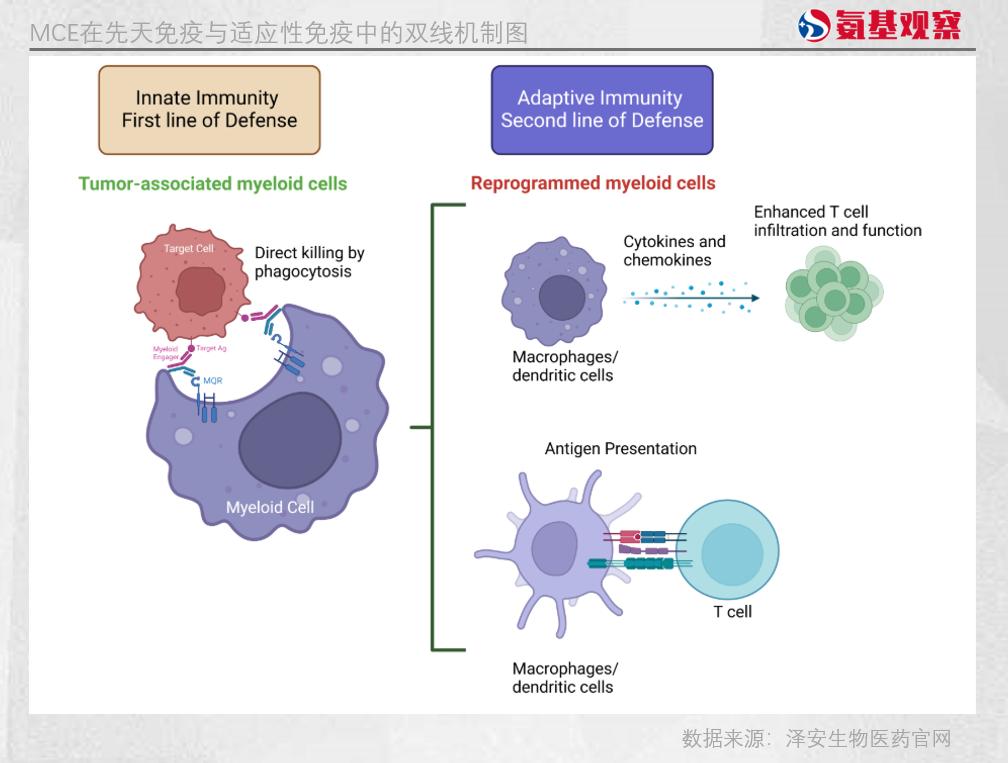
Core Insights - The MCE (myeloid cell engager) technology is rapidly gaining attention in the immunotherapy sector, with significant transactions indicating its strategic value among major pharmaceutical companies [1][4][6] - MCE's mechanism targets myeloid cells, potentially offering broader applications and reduced risks compared to TCE (T cell engager) therapies, which is a key factor in its appeal to large pharmaceutical firms [2][10] Group 1: Major Transactions and Collaborations - Novartis initiated interest in MCE by partnering with Dren Bio for $3 billion, aiming to develop a new class of bispecific antibodies using Dren's myeloid cell engager platform [4][5] - Sanofi followed by acquiring Dren Bio's promising CD20-targeting MCE, DR-0201, for an upfront payment of $600 million, with total milestone payments potentially reaching $1.9 billion [4][11] - GSK has also entered the MCE space by signing agreements for four MCE projects with Zealand Bio, integrating MCE into its broader ADC+IO Engager strategy [5][11] Group 2: Mechanism and Advantages of MCE - MCE operates through a "bind-activate-kill" mechanism, connecting myeloid cells with target cells, which enhances the immune response against tumors [7][10] - The targeting of tumor-associated myeloid cells (TAMCs) allows MCE to modulate the immune system more effectively, potentially overcoming limitations faced by TCE therapies in solid tumors [8][10] - MCE's ability to safely release pro-inflammatory factors reduces the risk of cytokine release syndrome (CRS), presenting a significant safety advantage over TCE [10][12] Group 3: Clinical Development and Future Potential - MCE is not merely a derivative of TCE but represents a new approach to harnessing innate immunity, with the potential to complement existing therapies like PD-1 and CAR-T [13][14] - The ongoing clinical trials and pipeline developments from companies like Dren Bio and Zeal Bio indicate a strong focus on both oncology and autoimmune diseases, showcasing MCE's versatility [11][14] - The growing interest from major pharmaceutical companies reflects the belief that MCE could fill critical gaps in the current immunotherapy landscape, leading to innovative treatment options [14]


医药生物行业专题报告:重点关注靶点选择及临床前优化
CAITONG SECURITIES· 2025-11-11 11:53
Investment Rating - The report maintains a "Positive" investment rating for the autoimmune dual-antibody sector [1]. Core Insights - The dual-antibody technology platform in the autoimmune disease field shows significant potential, with real-world clinical data validating its effectiveness. The focus should be on target selection and preclinical optimization, which are critical for determining clinical efficacy [3]. - The TCE (T-cell engagers) field is recommended to focus on combinations of CD3 with CD19/BCMA targets, while also being cautious of infection and low immunoglobulin levels as potential risks [3]. - There is a growing market for autoimmune diseases, with the global treatment market expected to exceed $220 billion by 2035, driven by increasing patient numbers in conditions like rheumatoid arthritis and psoriasis [19][21]. Summary by Sections 1. Autoimmune Disease Market Overview - There are over 150 types of autoimmune diseases, categorized into organ-specific and systemic types, with a significant patient population globally [13][15]. - The market for autoimmune disease treatments is projected to grow from $40 billion in 2023 to $263 billion by 2032 in China, reflecting a compound annual growth rate (CAGR) of 23.3% [21][19]. 2. Rise of Bispecific and Multispecific Antibodies - Bispecific antibodies (BsAbs) are emerging as a future direction for antibody drugs, with a market size expected to reach $484.8 billion by 2034, growing at a CAGR of 44.2% [31]. - The report highlights the rapid growth in sales of approved bispecific antibody drugs, with 19 products currently on the market [31]. 3. TCE Clinical Potential in Autoimmune Diseases - TCE therapies have shown significant clinical effects in various autoimmune diseases, with products like Teclistamab demonstrating strong B-cell clearance capabilities [3][19]. - The report emphasizes the need for careful clinical pre-screening for immunogenicity in dual-antibody products targeting multiple inflammatory pathways [3]. 4. Company Recommendations - For unlisted companies, the report recommends focusing on Huasheng Zhiyuan, Yikesite, and Huao Tai Biological, all of which have products with BD potential [3]. - For listed companies, it suggests paying attention to Weili Zhibo, Kangnuo Ya, and Quanxin Biological, particularly regarding their pipeline products and clinical data [3].
创新药发生了什么,后续怎么看?
雪球· 2025-11-07 08:05
Core Viewpoint - The article discusses the recent pullback in the innovative drug sector, emphasizing the fragility of market expectations driven by business development (BD) activities and the potential for valuation bubbles to form when these expectations are not met [2][5][6]. Group 1: Market Dynamics - The innovative drug sector has experienced significant volatility, with companies facing declines due to various BD-related factors, indicating weak market expectations [2][4]. - The phenomenon of "betting on BD" has evolved from a rational approach to a speculative one, leading to inflated valuations based on anticipated deals rather than actual performance [4][6]. - The market's focus on BD has overshadowed the fundamental improvements in the performance of innovative drug companies, which have shown significant growth in revenue and profit [7][11]. Group 2: Valuation Concerns - Prolonged periods without actual BD transactions can lead to valuation bubbles, with stock prices facing sharp corrections when BD progress falls short of expectations [5][6]. - The allure of BD transactions, often involving substantial upfront payments, can create a misleading perception of immediate value increase, diverting attention from the lengthy and complex drug development process [6][9]. - The article highlights that many high-value BD deals do not fully materialize, with only a fraction of the total deal value being realized, which can lead to disillusionment among investors [6][9]. Group 3: Long-term Outlook - The current "bubble clearing" phase is viewed positively, as it allows for the differentiation between fundamentally strong companies and those relying on speculative narratives, providing a better entry point for long-term investors [9][11]. - Historical trends suggest that the aftermath of a market correction often presents the best opportunities for identifying and investing in companies with solid fundamentals and long-term growth potential [9][11]. - The innovative drug sector has evolved significantly over the past four years, moving from a focus on high-end generics to a more diverse landscape of innovative therapies, indicating a maturation of the industry [11].

中信建投:三季度创新药产业链表现出色 各板块扣非增速排名有所变动
智通财经网· 2025-11-06 00:00
Core Viewpoint - The pharmaceutical industry has shown a decline in revenue and net profit for the first three quarters of 2025, with a year-on-year decrease of 1.98% in revenue and 11.60% in net profit, although the decline has narrowed compared to the first half of the year [1][2]. Summary by Relevant Sections Overall Industry Performance - The overall revenue and net profit of the pharmaceutical sector continue to decline year-on-year, but the rate of decline has decreased compared to the first half of the year [2]. Subsector Performance - The biopharmaceutical upstream, medical information technology, CRO/CMO, and research reagents sectors have shown strong growth in net profit [1][2]. - The biopharmaceutical upstream, CRO/CMO, medical devices, and home appliances sectors have experienced both revenue and net profit growth [1][2]. Key Sector Insights - **Pharmaceuticals and Innovative Drugs**: The chemical pharmaceutical sector has seen a narrowing of revenue decline, while profits remain under pressure. Innovative drug companies are advancing commercialization and internationalization, leading to significant revenue growth and reduced losses, with leading companies performing steadily [2]. - **CXO**: The industry returned to positive growth in the first half of 2025, with trends continuing into Q3. The CDMO sector shows stable demand, and the CRO sector has seen a notable improvement in order quantity and pricing expectations [2]. - **Upstream Pharmaceutical Chain**: Q3 of 2025 shows signs of recovery with significant profit improvement and gross margin enhancement, benefiting from domestic substitution and demand recovery [3]. - **Medical Devices**: Q3 revenue growth has turned positive, with a noticeable reduction in the year-on-year decline in profits. Several companies are expected to continue improving their performance, with accelerated growth anticipated in 2026 compared to 2025 [3]. - **Medical Services**: Q3 revenue has slightly declined year-on-year, but some consumer medical service companies have stabilized and increased their average transaction value [3]. - **Traditional Chinese Medicine**: Q3 performance has shown a narrowing decline compared to previous quarters, with optimism for demand recovery in the year-end peak season [3]. - **Vaccines**: The sector has experienced a significant year-on-year decline in both revenue and profit for the first three quarters, with future focus on sales improvement and innovation pipeline progress [3]. - **Blood Products**: Revenue has remained stable, but profits are under continued pressure. There is an expectation for a balanced supply-demand situation to recover, with attention on plasma station expansion and industry mergers [3]. - **Pharmaceutical Retail**: Q3 revenue growth has improved quarter-on-quarter, with profits maintaining rapid growth; prior stock price reactions have been sufficient, and attention is on diverse catalysts [3]. - **Pharmaceutical Distribution**: Q3 revenue growth has improved quarter-on-quarter, with impairment provisions affecting profits. Leading companies are stabilizing operations, with future focus on payment recovery and long-term growth expectations from the 14th Five-Year Plan [3]. Investment Outlook for H2 2025 - The company continues to seek new growth and industry consolidation opportunities, with a focus on innovation, global competitiveness, and the assessment of international competitiveness in innovative drugs and medical devices [4][5].

中国创新药一则风向标
投资界· 2025-09-15 07:38
Core Viewpoint - The article discusses the emergence of a new investment paradigm in China's innovative pharmaceutical sector, exemplified by the first "Fusion NewCo" model, which emphasizes the importance of small, efficient teams in driving innovation and the role of local capital in accelerating development [2][3]. Group 1: NewCo Model - The "NewCo" model is designed to facilitate rapid market entry for innovative drugs by involving investment institutions from the outset, focusing on value verification and global transactions [3][5]. - The recent establishment of the first domestic "Fusion NewCo" by Hongyi Investment and Aikou Lian Bio signifies a shift where local capital begins to dominate the value release pathway for Chinese innovative drugs [3][5]. Group 2: Market Dynamics - The Chinese innovative drug sector is transitioning from an "introduction" phase to a "leadership" phase in global markets, driven by unique advantages in research efficiency and cost [5][9]. - Data indicates that Phase I clinical trials in China can be completed 25% to 55% faster than in overseas companies, with costs only 30% to 50% of multinational corporations (MNCs) [5][9]. Group 3: Investment Strategy - Hongyi Investment's strategy focuses on leveraging local resources and optimizing asset allocation to capture investment opportunities in innovative drugs [9][10]. - The company aims to establish a "NewCo Plus platform + fund" model, which integrates top scientists, efficient clinical operations, and international business development channels to create a robust ecosystem for innovation [10][11]. Group 4: Future Outlook - The "NewCo Plus" model is expected to evolve into a Hub-and-Spoke structure, allowing for centralized resource management and enabling multiple NewCos to focus on technological breakthroughs [11][12]. - This approach is anticipated to significantly reduce the time required for innovative drugs to reach market readiness, enhancing capital turnover rates for investors [11][12].

招银国际:首次覆盖维立志博-B(09887)予“买入”评级 目标价63.5港元
智通财经网· 2025-09-04 06:33
Core Viewpoint - 招银国际 has initiated coverage on Valiant Bio-B (09887), expressing optimism about its focus on developing immune checkpoint therapies and other innovative treatments, assigning a "Buy" rating with a target price of HKD 63.5 [1] Company Summary - Valiant Bio-B specializes in developing immune therapies, including co-stimulatory agonists and checkpoint inhibitors, while also expanding into areas such as CD3 T cell engagers and antibody-drug conjugates (ADC) [1] - The company has developed proprietary platforms, namely the Leads Body platform and X-body platform, which serve as engines for continuous drug discovery [1] - The firm is particularly optimistic about Valiant Bio-B's development of PD-L1/4-1BB and TCE as next-generation immuno-oncology (IO) therapies [1]
下一个BD大药
投资界· 2025-08-18 07:57
Core Viewpoint - The article discusses the rising trend of business development (BD) in the Chinese innovative pharmaceutical sector, highlighting significant transactions and the evolving landscape of BD strategies among companies and investors [5][11]. BD Trends - Many fund teams are researching the next BD trends and adjusting their investments accordingly, with a notable increase in BD transaction amounts in China, exceeding $48.4 billion in the first half of 2025, including over $2 billion in upfront payments [5][6]. - The impact of BD news on companies' short-term strategies is significant, especially in a resource-constrained environment where pipeline prioritization is critical [5][6]. Major BD Events - Significant transactions this year include a $60.5 billion collaboration between 3SBio and Pfizer, setting a record for domestic dual antibodies, and a $53.3 billion deal between CSPC and AstraZeneca [8][9]. - The trend is shifting towards "packaged" BD deals, which help build trust between companies, as MNCs remain cautious about the long-term delivery capabilities of Chinese biotech firms [9][10]. Changes in Perception of Going Global - The perception of Chinese innovative drugs going global has evolved, with a shift from high barriers to entry to recognizing numerous opportunities as MNCs actively seek partnerships [12][13]. - The focus has shifted to products that can be standardized and have a proven track record in China, indicating that BD opportunities are increasingly competitive [12][13]. High-Value BD Opportunities - The PD-1/VEGF dual antibody market is highlighted as a high-value area, with multiple Chinese biotech firms entering clinical stages and generating significant BD events [13][14]. - The TCE (T-cell engagers) sector is also emerging as a promising area for BD, with substantial transaction amounts already recorded [15]. Future Considerations - The BD landscape is expected to evolve, with uncertainties about the long-term sustainability of current successes and the potential impact of future clinical data on the reputation of Chinese biotech [17][18]. - Concerns exist regarding the sustainability of companies focusing solely on BD, as excessive reliance on selling core pipelines may hinder future growth and exit strategies [18][19].

国金证券:从IL-2双抗 看TAA、细胞及趋化因子的PD-1升级新方向
Zhi Tong Cai Jing· 2025-08-13 09:14
Core Viewpoint - The report from Guojin Securities highlights the rise of innovative drugs in China, indicating that the industry is in the early stages of realizing innovation outcomes, with significant opportunities for independent development and large-scale licensing transactions in the future [1] Group 1: Industry Trends - The global oncology immunotherapy landscape is entering a new era characterized by the combination of PD-1 and TAA (tumor-associated antigens) with cytokines [2] - Multinational pharmaceutical companies are facing patent cliffs for their blockbuster drugs while new innovative drug assets are rapidly emerging globally, including in China, leading to a trend of licensing agreements to fill pipeline gaps [2] - The global innovative drug business development (BD) upfront payments have reached the billion-dollar level, with China accounting for 40% of the total upfront payments [2] Group 2: Drug Development Focus - The evolution from single antibodies to dual and multi-target molecules is ongoing, with a focus on enhancing efficacy and reducing toxicity [3] - The exploration of new molecular constructs has progressed from combinations of immune checkpoint inhibitors (ICIs) and TAAs to combinations with cytokines like IL-2, aiming for better therapeutic outcomes [3][4] - The next wave of innovation in the post-PD-1 era is just beginning, with numerous companies exploring combinations of PD-1 with IL-2 and other structural innovations [4] Group 3: Potential Investment Targets - The report suggests that promising new products may emerge from segments such as TCE (T-cell engagers), other dual/multi-antibodies, and innovative ADCs (antibody-drug conjugates), with a focus on leading clinical enterprises [5] - Recommended companies to watch include Innovent Biologics (01801), Kintor Pharmaceutical (09926), and Kelun-Biotech (06990) [5]