Hua Er Jie Jian Wen

Search documents
MiniMax发布M2.5模型:1美元运行1小时,价格仅为GPT-5的1/20,性能比肩Claude Opus
Hua Er Jie Jian Wen· 2026-02-13 02:15
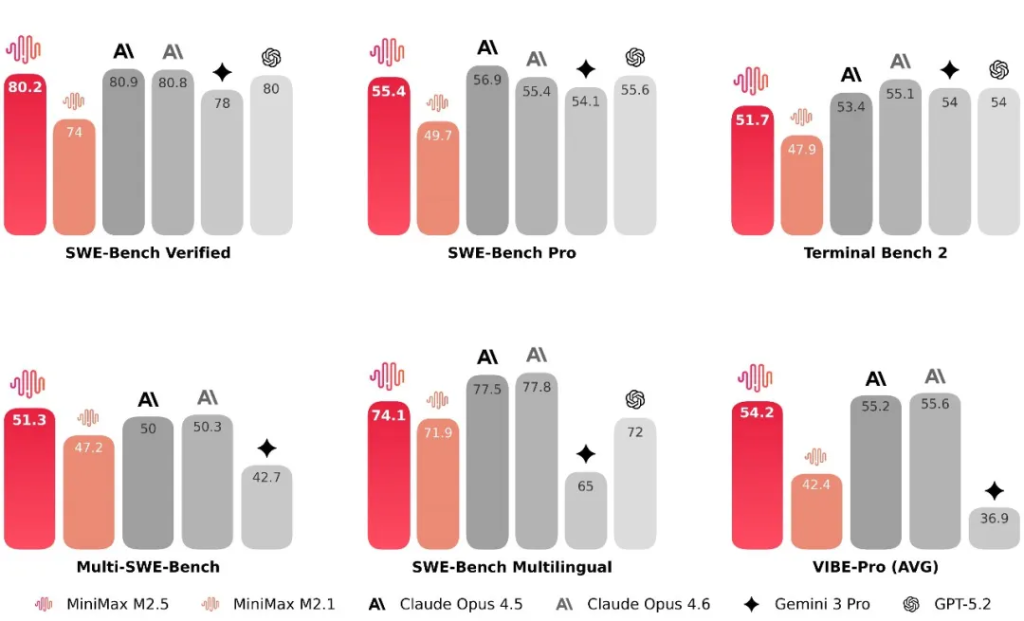
Core Insights - MiniMax has launched its latest M2.5 series model, significantly reducing inference costs while maintaining industry-leading performance, aiming to address the economic feasibility of complex agent applications [1] - The M2.5 model demonstrates a substantial price advantage, costing only 1/10 to 1/20 of mainstream models like Claude Opus and GPT-5 at a throughput of 50 tokens per second [1][2] - The model has shown strong performance in programming tasks and has achieved first place in the Multi-SWE-Bench multilingual task, with a 37% improvement in task completion speed compared to its predecessor M2.1 [2] Cost Efficiency - M2.5 is designed to eliminate cost constraints for running complex agents, achieving a processing speed of 100 TPS, which is approximately double that of current mainstream models [3] - The model reduces the total token consumption for tasks, averaging 3.52 million tokens per task in SWE-Bench Verified evaluations, down from 3.72 million tokens in M2.1 [3] Programming Capabilities - M2.5 emphasizes system design capabilities in addition to code generation, demonstrating a native specification behavior that allows it to decompose functions and structures from an architect's perspective [4] - The model has been trained in over 10 programming languages and has shown a pass rate of 79.7% on the Droid platform and 76.1% on OpenCode, outperforming previous models [5] Task Handling Efficiency - In search and tool invocation, M2.5 exhibits higher decision maturity, achieving approximately 20% fewer rounds of consumption compared to previous versions while maintaining token efficiency [8] Office Applications - MiniMax has integrated industry-specific knowledge into M2.5's training, resulting in an average win rate of 59.0% in the Cowork Agent evaluation framework against mainstream models, capable of producing industry-standard reports and financial models [10] Technical Foundation - The performance improvements of M2.5 are driven by a large-scale reinforcement learning framework named Forge, which decouples the underlying training engine from the agent [14] - The engineering team has optimized asynchronous scheduling and tree-structured sample merging strategies, achieving approximately 40 times training acceleration [14] Deployment - M2.5 is fully deployed in MiniMax Agent, API, and Coding Plan, with model weights set to be open-sourced on HuggingFace for local deployment [15]

深圳市地方金融管理局发布进一步规范黄金市场经营行为的公开提示
Hua Er Jie Jian Wen· 2026-02-13 02:06
Core Viewpoint - The articles highlight the prohibition of illegal gold trading activities, including pre-pricing, leveraged trading, and deferred trading, emphasizing the need for compliance in the gold market [1] Group 1: Prohibited Activities - Enterprises are not allowed to engage in illegal gold pre-pricing transactions, leveraged trading, or deferred trading through internet platforms under the guise of gold recycling and pre-pricing sales [1] - Companies must refrain from conducting illegal fundraising activities that promise fixed returns under the guise of gold custody, leasing, or repurchase [1] - Enterprises are prohibited from misleading consumers into purchasing physical gold while promoting illegal gold investment activities without actual delivery of the gold [1] Group 2: Individual Participation - Individuals are not permitted to organize or participate in illegal gold pre-pricing transactions, illegal fundraising under the name of gold, or any form of illegal gold investment activities [1]
AI“超级代理”大战打响!四大赛道全面铺开,OpenAI、Anthropic正挑战微软们的软件帝国
Hua Er Jie Jian Wen· 2026-02-13 02:01
Core Insights - Major AI companies like OpenAI and Anthropic are launching enterprise-level AI products that challenge existing enterprise software markets, prompting traditional software vendors like Microsoft and Salesforce to accelerate their own AI tools and management platforms [1][2] Group 1: Competitive Landscape - The competition involves four main product categories: browser-based agents, computer-operable agents, agent-building tools, and agent management consoles [1][2] - OpenAI and Google provide browser-based agents capable of executing multi-step tasks, while Anthropic's Cowork and Google's Gemini Computer Use are examples of computer-operable agents [2] - Agent-building tools such as Salesforce's Agentforce and Google's Gemini Enterprise allow clients to create agents that can access various enterprise applications [2] - The agent management console market features competitors like Microsoft's Agent 365 and OpenAI's Frontier, raising questions about the necessity of multiple consoles for clients [2] Group 2: Adoption Challenges - Despite the promising outlook, new agent technologies face significant challenges before widespread adoption, including security concerns and usability issues [3] - Companies like OpenAI and Anthropic indicate that their computer-operable agents are still in research preview, suggesting they are not yet ready for large-scale enterprise deployment [3] - Hilton's CTO Onkar Birk expressed caution in adopting new subscriptions, highlighting the complexity and investment required for developing customer support agents [4] Group 3: Traditional Software Companies' Response - OpenAI's strategy involves positioning its agent command technology above traditional enterprise "record systems," which are critical for storing business data [5] - Traditional enterprise application companies like Salesforce and Microsoft have not yet taken steps to block AI agents from accessing or modifying data within their systems [5] - There is a recognition that traditional companies are utilizing technologies from OpenAI and Anthropic to support their own agents, even as these AI firms promote their competitive tools [5] Group 4: Market Dynamics - Snowflake, a database company, has released a product supported by AI models from OpenAI and Anthropic, enabling clients to develop agents for searching and retrieving business metrics [6] - The competitive landscape is characterized by high stakes, with industry leaders feeling pressure to either achieve a $1 trillion valuation or face potential failure [6]




国家统计局:1月一二三线城市商品住宅销售价格环比降幅总体收窄
Hua Er Jie Jian Wen· 2026-02-13 01:35
Group 1 - The article emphasizes the importance of understanding market risks and the need for cautious investment strategies [1] Group 2 - No relevant content available for this section [1]
加剧AI恐慌!微软高管:大多数白领工作将在“未来12-18个月内”完全自动化
Hua Er Jie Jian Wen· 2026-02-13 01:09
这一警告并非孤例。大规模劳动力替代的问题正困扰着全球各国政府,尽管在更广泛的经济逆风中,真 实的失业人数仍不明朗。 微软人工智能业务负责人发出迄今最激进的自动化预警,称绝大多数白领专业工作可能在一年半内被 AI取代,这一时间表远早于商界和政策制定者的普遍预期,为全球劳动力市场敲响警钟。 微软AI首席执行官Mustafa Suleyman在接受英国《金融时报》采访时表示,律师、会计师、项目经理和 营销人员等从事电脑办公的专业人士,其"大多数任务"将在未来12至18个月内被AI完全自动化。 AI导致的失业已初现端倪。根据职业介绍公司Challenger的报告,今年1月有7624个工作岗位因AI被 裁,占当月裁员总数的7%;2025年全年,AI导致的裁员公告达54836人。自2023年开始追踪以来, 79449个计划裁员岗位归咎于AI。 与此同时,AI安全与滥用风险也在加速升温。Anthropic在最新破坏活动报告中警告,其Claude模型在特 定计算机使用场景下对"有害滥用"更敏感,甚至出现与化学武器开发相关的风险信号。 AI大规模取代白领还有12至18个月的时间窗口 Suleyman的预测标志着科技行业对AI取 ...
美股极其脆弱!从SaaS、PE到保险、物业甚至物流“轮流大跌”,高盛交易员“疲惫且震惊”
Hua Er Jie Jian Wen· 2026-02-13 00:48
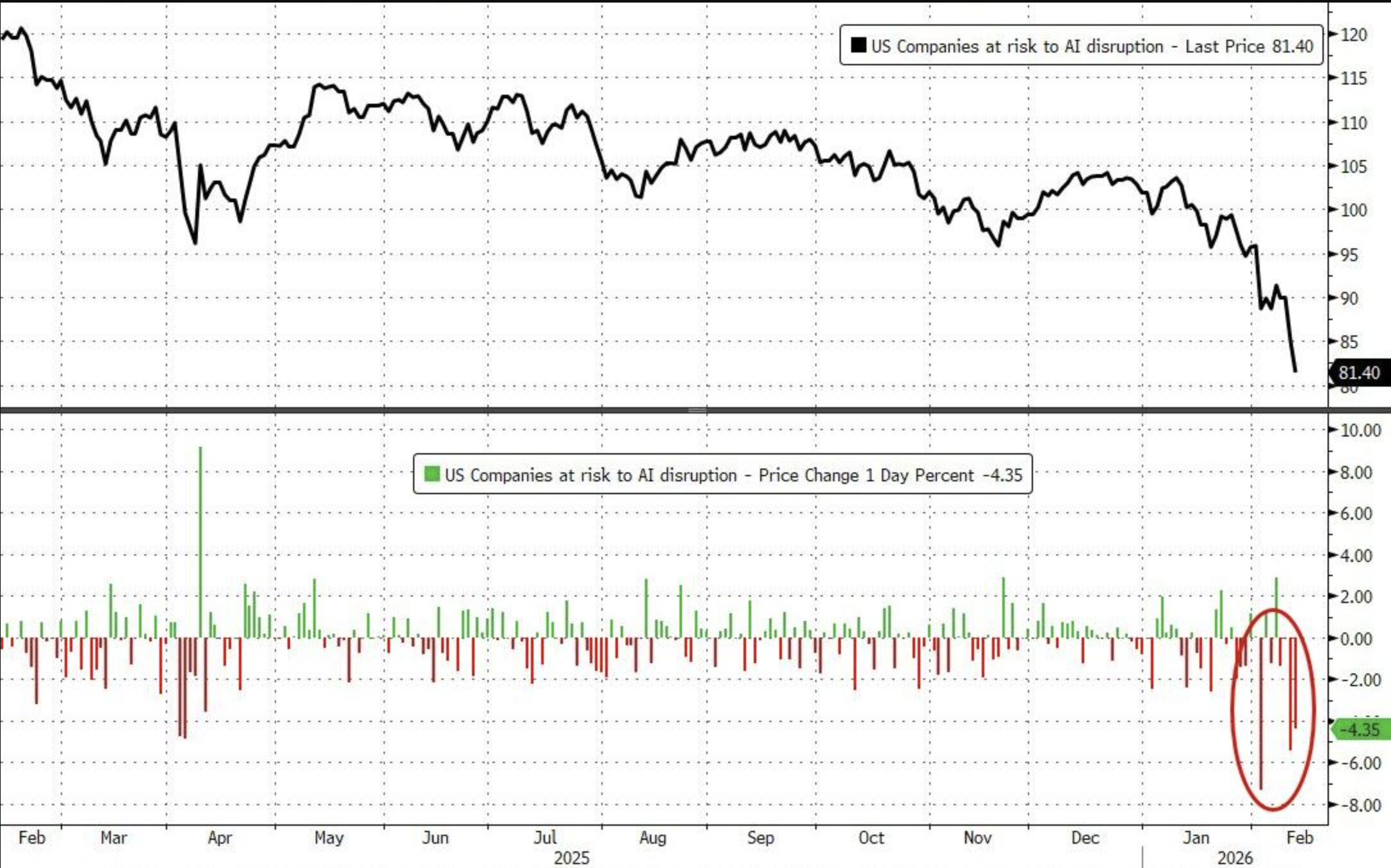
Core Viewpoint - The U.S. stock market is experiencing a rare and widespread panic sell-off, driven by concerns over AI's disruptive potential across various sectors [1][3] Market Behavior - Over 40 S&P 500 stocks exhibited abnormal volatility exceeding three standard deviations, marking the highest level observed by Goldman Sachs trader Ryan Shakey [1] - Defensive sectors such as utilities, consumer staples, REITs, and healthcare are leading the market, while technology, media, and telecommunications are facing significant declines [1] - The Goldman Sachs AI risk exposure basket (GSTMTAIR) saw a sharp drop of 510 basis points in a single day, indicating heightened market sensitivity to AI-related risks [1] Investor Sentiment - Investor sentiment has shifted dramatically, with a notable loss of appetite for bottom-fishing, as hedge funds and long institutions are selling off but at smaller scales, indicating a growing sense of fatigue [4] - The market breadth has deteriorated sharply, with 350 S&P 500 stocks declining, and major tech companies like Apple, Amazon, Microsoft, Meta, and Cisco dragging down the index [5] Sector-Specific Impacts - The logistics sector has become a recent focal point, with CH Robinson experiencing an eight-standard deviation drop, reflecting the spread of AI panic from tech to traditional industries [6] - Financial stocks, previously seen as safe havens, are also under pressure, with regional banks losing their appeal as attractive investments [6] - The healthcare sector has seen a 32% drop in contract research organizations (CROs) this month, following Pfizer's announcement to utilize AI for most clinical trials [6] Reassessment of AI Winners - The technology, media, and telecommunications sectors, excluding storage chips, are facing widespread declines, as previously regarded "winners" are being sold off amid risk-averse sentiment [7] - Investors are confused about the underlying issues in earnings reports, as fundamental analysis appears to be overlooked in the current panic environment [7]
引爆美股“黑色星期四”的导火索,是这家市值600万美元的“小公司”
Hua Er Jie Jian Wen· 2026-02-13 00:48
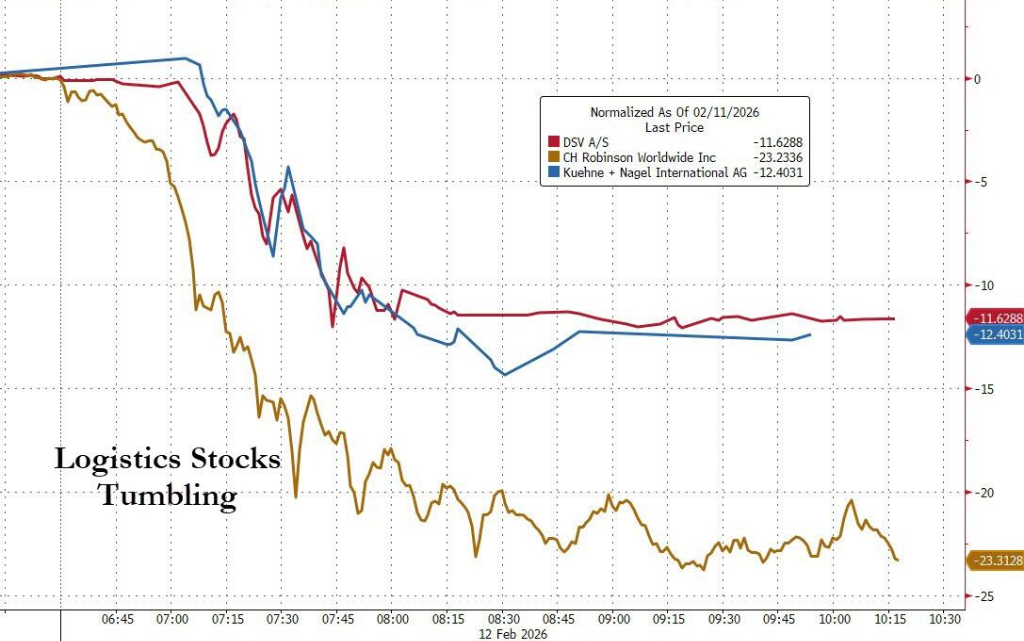
Core Viewpoint - The logistics sector in the U.S. experienced a significant sell-off due to fears surrounding AI's potential to disrupt traditional industries, triggered by a small company, Algorhythm Holdings Inc., claiming its AI logistics platform could increase freight volume by 300% to 400% without adding operational staff [1][4][5]. Group 1: Market Reaction - The Russell 3000 trucking index fell by 6.6%, with major players like CH Robinson Worldwide Inc. dropping 15% and Landstar System Inc. declining by 16% [1][3]. - The sell-off marked the worst single-day performance for the logistics sector since April of the previous year, spreading to pharmaceutical distributors and European markets, with McKesson Corp. and Cardinal Health Inc. both down around 4% [3]. - The Nasdaq 100 index also fell by 2%, indicating a broader market retreat from AI enthusiasm to fear of its disruptive potential [3]. Group 2: Company Background - Algorhythm Holdings, previously known as The Singing Machine Company Inc., announced its transition to an AI logistics company, driven by losses in its original business due to tariffs on imports [4]. - Despite reporting quarterly sales of less than $2 million and a net loss of nearly $3 million, Algorhythm's stock surged by 82% following the announcement, ultimately closing up 30% at $1.08 [4]. Group 3: Industry Sentiment - The logistics sector is the latest to be impacted by AI panic, following similar trends in real estate, software, and private credit sectors [5]. - Analysts noted a fundamental shift in market sentiment, with traditional industries previously seen as "AI-resistant" now facing significant declines [7]. - Concerns center around AI potentially eliminating the intermediary role of truck brokers, leading to substantial losses in the sector [6]. Group 4: Analyst Perspectives - Some analysts argue that the market's reaction is disproportionate to the actual risks, suggesting that the sell-off reflects an emotional response rather than a rational assessment of the situation [8]. - Barclays analysts defended companies like CH Robinson, indicating that the market's reaction does not align with the underlying risks [8]. - There is a consensus that while AI's long-term impact is significant, the immediate stock market reactions are often exaggerated and emotional [8].
特朗普希望美伊“一个月左右”达成协议 内塔尼亚胡表示怀疑
Hua Er Jie Jian Wen· 2026-02-13 00:17
美国总统特朗普为美伊谈判给出"一个月左右"的时间表,并将其与"非常严重"的后果绑定,但以色列总 理内塔尼亚胡对任何协议的"成色"公开表达怀疑,使中东局势在谈判与军事施压并行的节奏中继续维持 高不确定性。 据新华社,特朗普2月12日表示,希望美国与伊朗在接下来"一个月左右"达成协议,并警告若无法达成 协议,后果将"非常严重",对伊朗来说会"非常痛苦"。他同时强调,同伊朗达成协议将是美方"首选"。 同日,内塔尼亚胡结束访美行程前对媒体称,特朗普认为具备达成一项"好的协议"的条件,但他本人对 同伊朗达成任何协议的"成色"持怀疑态度,并表示若达成协议,必须包含"对以色列而言至关重要的内 容"。 在谈判信号释放的同时,美国对伊朗的军事威慑仍在加码。新华社称,美国近期在中东地区部署包 括"亚伯拉罕·林肯"号航空母舰在内多艘军舰。 这意味着,即便美方强调"达成协议为首选",以方对协议条款的要求仍可能成为谈判路径上的关键变 量。 军事部署与谈判窗口:航母在位,警报未解除 《华尔街日报》11日报道称,五角大楼已指示美军第二个航母打击群做好部署到中东的准备。对投资者 而言,谈判窗口与军事部署同步推进,意味着地缘风险溢价短期难以消 ...
8连跌!“资本开支最高”的亚马逊跌入熊市,投资者对Mag 7“用脚投票”
Hua Er Jie Jian Wen· 2026-02-13 00:07
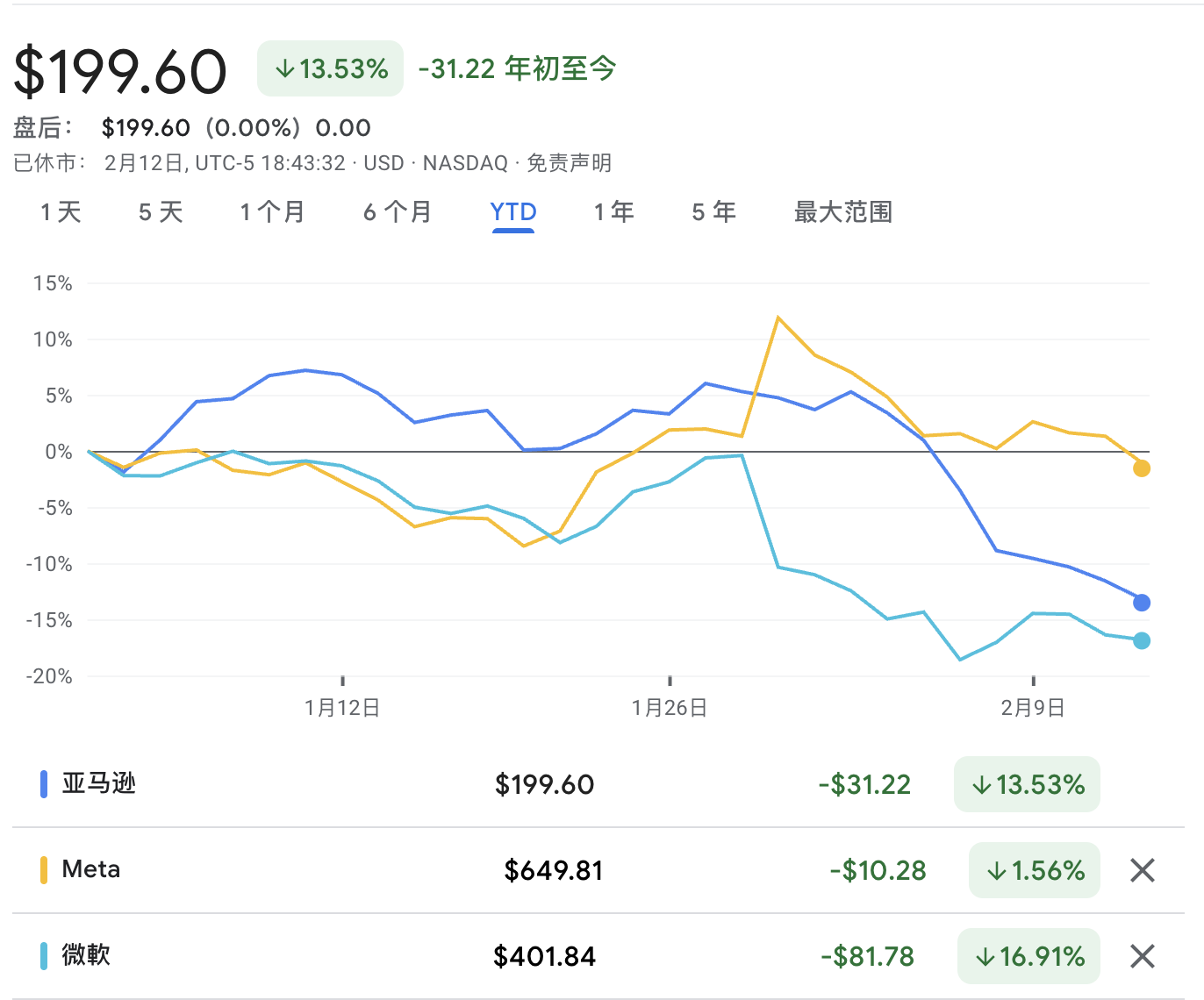
Group 1 - Amazon's stock has entered a technical bear market after falling for eight consecutive trading days, marking it as the second company in the Mag7 to do so, with a closing price of $199.60, down 21.4% from recent highs [1] - Amazon is projected to have the highest capital expenditure among major cloud service providers, with plans to spend $200 billion by 2026, contributing to concerns over AI spending and investor confidence [1] - Meta is at risk of becoming the next Mag7 member to enter a bear market, with its stock only 2.3% away from the bear market threshold, despite exceeding revenue and earnings expectations in Q4 [1] Group 2 - Investors are rotating within the Mag7, highlighting a growing divergence among its members, with a shift away from Microsoft, Nvidia, and Oracle towards Alphabet and Broadcom [3] - Alphabet's vertically integrated technology stack has helped mitigate concerns over excessive spending, resulting in a smaller decline of 9.2% from recent highs [3] - Increased AI spending by Amazon, Microsoft, and Meta has raised doubts about their ability to generate sufficient returns, with Amazon potentially facing negative free cash flow this year [4] Group 3 - The next significant catalyst for AI investments is expected to be Nvidia's earnings report on February 25, which will indicate whether the AI boom is cooling or if Nvidia has successfully captured substantial investments from its largest clients [4]


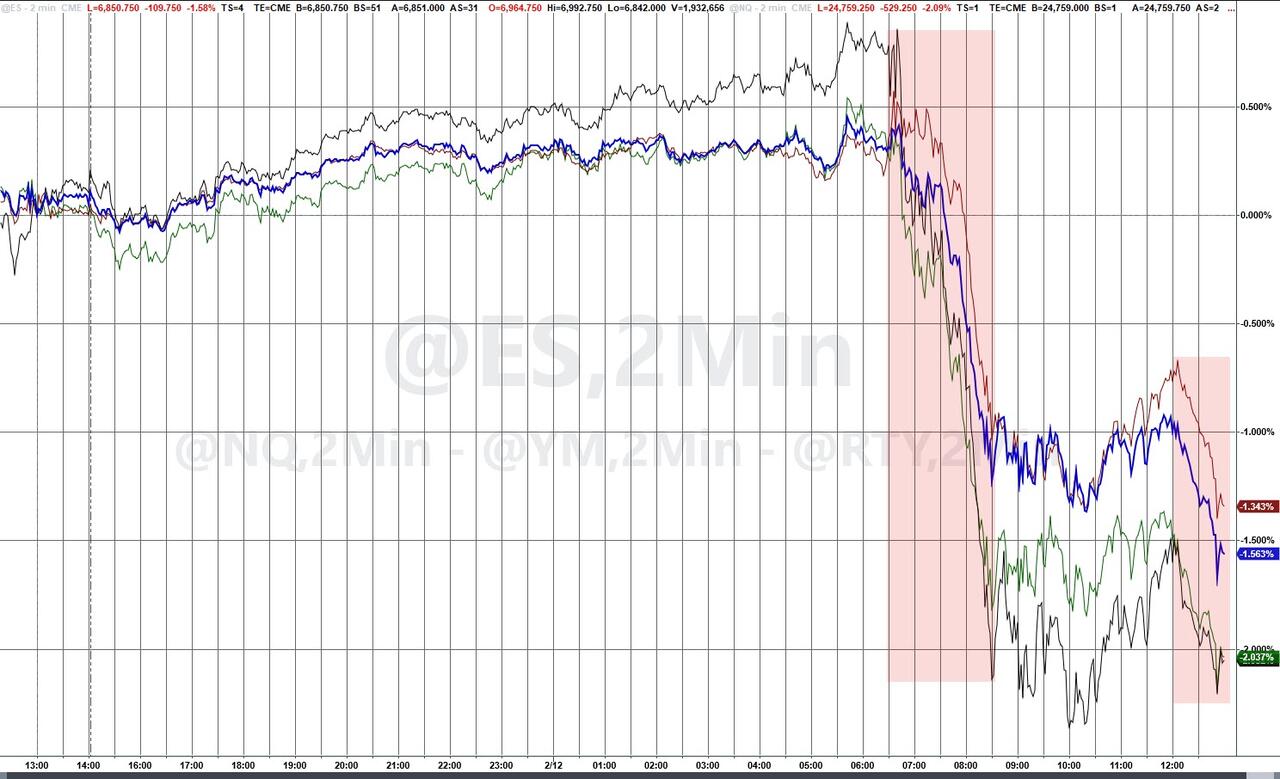
AI恐慌扩散,科技股再度拖垮美股,地产股连日重挫,苹果一日蒸发2000亿
Hua Er Jie Jian Wen· 2026-02-12 23:25
Group 1 - The core viewpoint of the articles highlights a significant market downturn driven by fears surrounding the disruptive impact of artificial intelligence (AI) on traditional industries, leading to panic selling among investors [1][4][12] - Major U.S. stock indices fell over 1%, with the Nasdaq dropping approximately 2%, marking a three-day decline, while the Dow Jones Industrial Average closed below the 50,000 mark for the first time in a week [1][2] - The technology sector was identified as the primary culprit for the market decline, with Cisco's stock plummeting 12% due to disappointing gross margin guidance, and the "big seven" tech companies all experiencing losses [2][8] Group 2 - Concerns about the return on AI investments have intensified, with major tech firms like Amazon, Google, Meta, and Microsoft expected to spend around $650 billion on AI this year, raising doubts about whether such capital expenditures will yield tangible returns [4][6] - The narrative in the market has shifted from identifying beneficiaries of AI to recognizing potential victims, with sectors such as software, insurance brokerage, asset management, and commercial real estate facing significant pressure [6][11] - The commercial real estate sector has been particularly hard hit, with companies like CBRE and Jones Lang LaSalle seeing stock declines exceeding 25% over two days, as fears grow that AI could automate key functions and reduce demand for human brokers [5][12] Group 3 - The market sentiment has transitioned from "AI euphoria" to "AI phobia," with investors reassessing whether AI capital expenditures are overheated and if the commercialization of AI is lagging behind expectations [6][10] - Analysts have noted that the recent sell-off appears disproportionate to the actual risks, suggesting that the market may be overreacting to AI-related concerns [12] - Despite the overall downturn, some segments within the semiconductor industry, such as storage chip stocks, have managed to maintain gains, indicating a divergence within the tech sector [8][10]